

During the 2025 holiday season, Shopify sales peaked at $5.1 million per minute. While the core platform is resilient, your specific stack of third-party APIs and custom themes is far more fragile. You likely trust Shopify to keep the lights on. However, you also know that a "green" status page doesn't help when a silent API failure breaks your checkout. Relying on an independent Shopify store monitoring service is the only way to catch localized outages, such as GraphQL rate-limiting or SSL errors, that go undetected by official channels for hours.
In this technical guide, you will learn how to detect these silent failures and maintain 99.99% availability. Independent infrastructure verification. We will examine how to monitor third-party API performance, automate incident communication, and bridge the gap between platform status and real-world performance. We focus on technical precision and data sovereignty to help you build a more reliable commerce stack. Proactive site reliability over reactive troubleshooting.
Key Takeaways
- Understand why official platform status pages often lag behind store-specific outages and how independent verification bridges this gap.
- Implement a Shopify store monitoring service to track the health of third-party APIs, custom checkout logic, and external ERP integrations.
- Optimize monitoring for peak traffic by increasing check frequencies and utilizing multi-region verification for global storefront accessibility.
- Leverage AI incident management tools to draft transparent, technically accurate communications for customers during service disruptions.
- Maintain security integrity by establishing automated alerts for SSL certificate expirations on custom domains.
What is a Shopify Store Monitoring Service?
A Shopify store monitoring service is an external infrastructure layer designed to audit the availability, performance, and security of your storefront. It acts as a neutral observer, viewing your site from the perspective of a customer rather than from within the Shopify admin. This distinction is vital for maintaining high availability. While Shopify manages the core platform, you are responsible for the integrity of your specific domain configurations and third-party integrations.
The core function of this service is verifying reachability across global regions. It ensures that your primary domain resolves correctly and that your checkout path remains functional for users in different geographic locations. By monitoring the primary domain, third-party API endpoints, and SSL certificate health, you can prevent "silent failures." These are scenarios where the Shopify status page shows green, but your specific store is failing due to a broken ERP sync or a conflicting script.
The Difference Between App-Based and Independent Monitoring
Many merchants rely on apps installed directly from the Shopify App Store. These tools are helpful for tracking theme-level SEO or internal speed metrics. However, they have a fundamental limitation. Because they run within the Shopify ecosystem, they often fail to detect external issues like DNS propagation errors or global routing failures. If the Shopify platform experiences a localized admin outage, an internal app may lose its ability to report the problem accurately.
Independent services like StatusPulse operate on external infrastructure. This provides a critical advantage for detecting infrastructure-level disruptions. While internal apps are easy to install, they lack the "outside-in" perspective needed to verify that your site is accessible from the open web. Independent monitoring ensures that your uptime data remains untainted by the platform's internal state.
Technical Metrics That Matter for Commerce
Basic website monitoring often stops at checking for an HTTP 200 status code. For a high-volume commerce site, you must track deeper technical metrics to ensure a functional user experience. Time to First Byte (TTFB) is a primary indicator of storefront health. A spike in TTFB often points to inefficient Liquid code or overloaded third-party apps that delay the initial server response, which can lead to immediate bounce rate increases.
- Global Latency: Monitoring performance from nodes in both the EU and the US is essential for regional speed consistency.
- API Health: Verifying that custom checkout logic and external CRM integrations respond within acceptable timeframes.
- SSL Integrity: Automated lookups for certificate validity on custom domains to prevent browser security warnings.
These metrics provide a granular view of your store's technical performance. High-availability monitoring requires more than just knowing the site is "up." It requires knowing that every critical component of the transaction path is responding at the speed your customers expect.
The Three Pillars of Shopify Infrastructure Monitoring
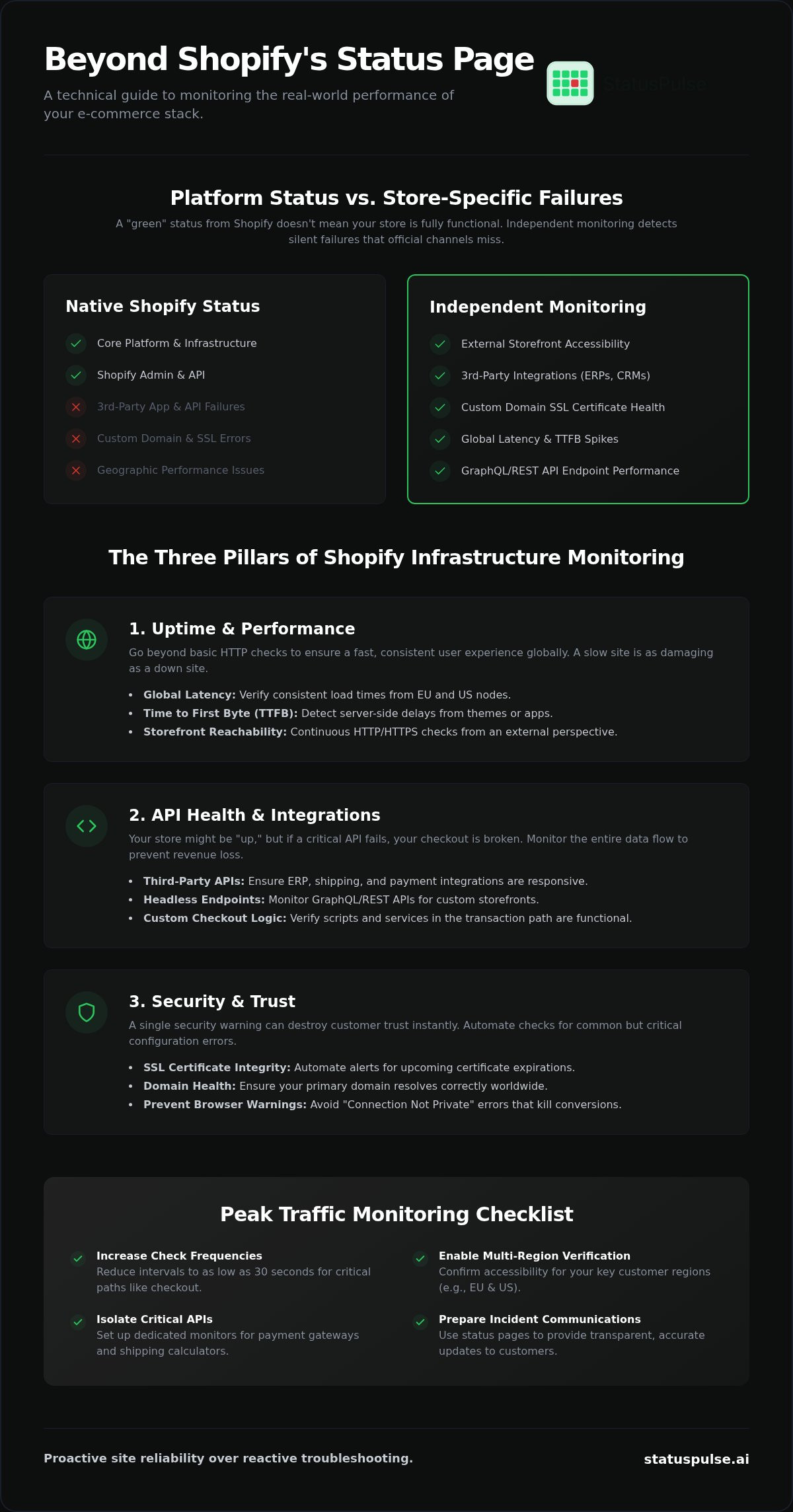
Maintaining high availability for a scalable e-commerce platform requires a strategy that goes beyond simple ping tests. A robust Shopify store monitoring service focuses on three technical pillars: uptime, API health, and security integrity. Uptime monitoring provides continuous HTTP/HTTPS checks to ensure the storefront is reachable. However, visibility into the underlying integration layer is what prevents revenue loss during high-traffic events.
API monitoring tracks the health of third-party apps, such as ERP systems and custom checkout logic. If a middleware service fails, your store might remain "up" while the ability to process orders vanishes. SSL monitoring complements this by tracking certificate expiration. A "Connection Not Private" error is often a fatal blow to customer trust, yet it remains a common result of automated renewal failures. Finally, incident communication via public status pages ensures that technical teams can manage customer expectations during unavoidable disruptions.
API Availability for Custom Storefronts
For teams running Headless Shopify setups via Hydrogen or custom middleware, monitoring GraphQL and REST endpoints is critical. These architectures rely on multiple microservices that must communicate without friction. A failure in a single endpoint can break product filtering or cart functionality without triggering a platform-wide alert. Using dedicated API monitoring allows you to track endpoint latency and catch performance degradation before it impacts the user experience. Identifying these bottlenecks in your middleware ensures that your custom storefront remains as resilient as the Shopify core itself.
SSL and Domain Health Verification
Domain management is a frequent point of failure for growing brands. Automating domain expiry lookups is a simple but essential step to prevent accidental domain loss. Beyond expiration, you must verify the entire SSL chain. Automated renewals can sometimes fail to install intermediate certificates correctly, leading to trust errors on specific mobile browsers or older operating systems. Monitoring for DNS record changes is also a vital security measure. It helps detect unauthorized modifications that might point your traffic to malicious IPs. These checks provide a layer of security that standard platform alerts often ignore.
Implementing these pillars doesn't require complex enterprise software. By using a tool like StatusPulse, you can centralize your uptime and API checks into a single dashboard. This approach provides the independent verification needed to audit your store's health honestly. You don't need to guess if your integrations are working; you can see the data in real time.
Independent Monitoring vs. Native Shopify Status Alerts
Shopify's official status page is an authoritative source for the platform's global health. However, it's not a substitute for a dedicated Shopify store monitoring service. Platform-level alerts focus on the aggregate health of millions of stores. They rarely reflect the specific performance of your custom domain or local integration stack. If your specific store instance experiences a database locking issue or a theme-level script conflict, the official status will likely remain green.
Independent monitoring provides the granularity needed to manage a high-growth brand. You can set specific thresholds for latency or error rates that align with e-commerce performance best practices. This allows for proactive intervention before a slow-loading page becomes a full outage. Redundancy is equally important. Hosting your public status page outside the Shopify network ensures you can communicate with customers even if the entire platform is unreachable.
Why Platform Status Pages Can Be Misleading
Platform status pages often suffer from a lag effect. Internal teams typically verify widespread impact before flagging an incident as "investigating" or "degraded." This verification period can take 15 to 30 minutes, during which your checkout could be losing thousands in revenue. Regional outages are another blind spot. A routing issue affecting only EU customers might not trigger a global alert, leaving your support team in the dark.
Data sovereignty is another factor for European businesses. Relying on an EU-based monitoring provider ensures that your uptime data and incident logs are stored in compliance with local standards. Independent services allow you to choose between EU or US hosting, providing a level of ethical and legal alignment that centralized platform providers don't always prioritize.
Comparison of Monitoring Capabilities
The table below outlines the functional differences between relying on native alerts and implementing an independent Shopify store monitoring service.
| Feature | Native Shopify Alerts | Independent Service (StatusPulse) |
|---|---|---|
| Check Frequency | [VERIFY: Shopify native alert frequency] | 1-minute intervals |
| Alert Routing | Email and Admin Notification | Slack, Discord, Webhooks, and SMS |
| Custom Thresholds | Limited/None | Fully configurable latency/error alerts |
| Monitoring Nodes | Internal platform health | Global nodes (EU and US hosting) |
By moving your monitoring to an external provider, you gain an unbiased auditor for your site's performance. You don't have to wait for a platform-wide acknowledgment to know your store is struggling. This independent layer provides the quiet confidence that your technical stack is functioning as intended, regardless of what the main platform status page claims.
Preparing for Peak Traffic: A Monitoring Checklist
Peak traffic events like Black Friday 2026 (November 27) leave no room for delayed responses. During these high-stakes windows, a standard five-minute check interval is too slow. If your store fails at the start of a check cycle, you could lose five minutes of sales before receiving a notification. For a store processing thousands of dollars per minute, this delay is unacceptable. High-availability setups require a 1-minute check frequency to minimize the mean time to detect (MTTD) outages.
Your Shopify store monitoring service must also account for global routing issues. Configure multi-region monitoring nodes in both the EU and US to ensure your storefront is accessible to all customer segments. Specific focus should be placed on critical third-party API endpoints, such as payment gateways and inventory syncs. If these fail, your site might look functional while the checkout is effectively dead. Pre-drafting incident templates using AI ensures you can communicate with customers in seconds, not minutes.
- Check Frequency: Set to 1 minute to catch spikes and intermittent failures.
- Multi-Region: Verify availability from diverse geographic nodes to catch localized routing errors.
- API Endpoints: Monitor the health of external apps and custom middleware that power your cart.
- AI Templates: Prepare incident communications in advance to reduce response time during a live outage.
Configuring Alerts for Technical Teams
Alert fatigue is a common failure point for DevOps teams. Sending a notification for every minor network blip leads to engineers ignoring their phones. Set appropriate error thresholds, such as requiring three consecutive failures from different regions before triggering a high-priority alert. This filters out transient issues while ensuring genuine outages are caught. Integrate these alerts into your existing developer workflows using webhooks or dedicated Slack channels. Clear escalation policies should define when an issue moves from a standard notification to an emergency SMS for the on-call engineer.
Incident Communication Strategy
Transparent communication is the best way to prevent customer churn during a disruption. When technical failures occur, your support team will be overwhelmed by repetitive inquiries. Using automated status alerts helps divert this traffic by providing a single source of truth for your users. AI incident management tools can now summarize complex technical logs into plain-spoken updates for your customers. This allows your engineers to focus on the fix while the system handles the explanation. You can configure your automated status page today to ensure your brand remains trusted even when technical challenges arise.
StatusPulse: Purpose-Built Monitoring for Modern Commerce
StatusPulse is built for technical teams that prioritize infrastructure integrity over marketing flair. It functions as an independent Shopify store monitoring service that audits your entire stack, from the primary domain to deep API integrations. By verifying uptime from external infrastructure, it eliminates the reporting lag often found in native platform alerts. The platform includes AI-powered incident management to assist in drafting technical updates. This ensures your customers receive honest, direct information during service disruptions without the manual overhead of drafting messages during a crisis.
We provide transparent, flat pricing. You won't find per-subscriber fees or per-seat bloat here. We believe reliability should be accessible, not a tax on your brand's growth. You also have the choice of EU or US hosting for your data. This supports data sovereignty requirements and ensures your monitoring nodes are geographically relevant to your specific user base. It's a grounded approach to high availability that respects both your budget and your regional compliance needs.
Simplifying the DevOps Stack
Reliability often becomes expensive and difficult to manage when you use multiple fragmented tools. StatusPulse consolidates uptime, API, and SSL monitoring into a single, high-precision dashboard. This reduces the complexity of your DevOps stack and ensures that your on-call engineers have one clear source of truth. Compared to enterprise incumbents like [VERIFY: PagerDuty entry price for 2026], we provide a focused alternative for specialists. Our team prioritizes technical depth without the corporate pretension or complex pricing models that define the current market.
Getting Started with Store Monitoring
Setting up your first HTTP check for a Shopify domain takes less than five minutes. You can immediately configure a public status page to build brand trust through transparency. This page serves as a neutral auditor, showing your customers that you value their time and their data. We recognize that every tool has its limits. If your team requires deep UI-only testing or visual regression, tools like TestingBot may be a better fit for those specific needs. However, for infrastructure health and integration reliability, StatusPulse provides the necessary technical rigor for modern commerce.
You can start monitoring your critical endpoints today. No complex configuration is required to gain a clear view of your store’s availability. We provide the data you need to maintain 99.99% uptime during your busiest sales cycles. By choosing an independent monitoring layer, you take full ownership of your store’s reliability stack. This proactive stance is what separates resilient brands from those that simply hope the platform stays up.
Securing Storefront Reliability for 2026
High availability isn't a default setting; it's an engineering choice. Relying solely on platform-level status pages leaves your business vulnerable to localized failures and silent integration outages. True resilience requires an independent Shopify store monitoring service to audit your custom domain, third-party APIs, and SSL health. By catching technical disruptions before they impact your conversion rate, you maintain customer trust during high-stakes sales events.
StatusPulse provides the infrastructure verification needed for modern commerce. You get the choice between EU and US hosting for data sovereignty and a transparent, flat pricing model that avoids corporate bloat. Our AI-assisted incident management helps you draft honest customer updates in seconds. This allows your technical team to stay focused on the fix rather than the fallout. Don't wait for the next peak traffic event to test your limits. Start monitoring your Shopify store with StatusPulse to ensure your brand stays online and your customers stay informed. Building a reliable store starts with better data.
Frequently Asked Questions
Does Shopify have built-in uptime monitoring?
Shopify provides a global status page for platform-wide health, but it doesn't offer granular, store-specific uptime monitoring for your custom domain or unique integration stack. If your specific theme or DNS record fails, the official status page will likely remain green. This reporting gap makes an independent Shopify store monitoring service necessary for individual storefront verification. You need a tool that alerts you to localized failures that platform-level status pages often miss.
What is the difference between a website monitor and a Shopify app?
Shopify apps run within the Shopify ecosystem and rely on the platform's infrastructure to function. If Shopify's admin or internal API fails, the app may stop reporting or fail entirely. An external website monitor operates on independent infrastructure outside the Shopify network. This "outside-in" perspective is essential for detecting DNS errors, global routing issues, and platform-wide outages that internal apps simply cannot see or report accurately.
How does independent monitoring help with Shopify Plus SLAs?
Shopify Plus offers specific uptime guarantees, but you need your own data to hold them accountable. Independent monitoring provides a neutral audit log of every disruption, including precise start and end times. This documentation is vital when discussing service credits or verifying if the platform met its [VERIFY: Shopify Plus current SLA in 2026] commitment. Without an external record, you rely entirely on the provider's own reporting during an outage.
Can I monitor third-party Shopify apps for downtime?
You can monitor the health of third-party integrations by tracking their specific API endpoints. If a critical app like a search provider or a reviews widget fails, it can break your storefront's functionality even if the core platform is up. A Shopify store monitoring service allows you to set up HTTP checks for these external dependencies. This ensures you know exactly which part of your stack is failing before your customers do.
Is SSL monitoring included in Shopify store monitoring services?
Professional monitoring services include SSL certificate tracking as a core feature. While Shopify manages many certificates automatically, custom domain renewals can still fail due to DNS misconfigurations or CAA record conflicts. Automated SSL monitoring alerts you before a certificate expires or if the chain of trust breaks. This prevents customers from seeing "Connection Not Private" warnings that immediately destroy brand trust and halt your sales in their tracks.
How do status pages reduce support tickets during a Shopify outage?
Public status pages act as a single source of truth for your customers during a disruption. When users see a clear, technical explanation of the issue on your status page, they're less likely to send a support email. AI-powered incident management can help draft these updates by summarizing technical logs into direct, plain language. This transparency manages expectations and significantly reduces the volume of repetitive inquiries hitting your support desk during a crisis.
Why should I choose an EU-based monitoring service for my Shopify store?
Choosing an EU-based service like StatusPulse ensures your uptime data and incident logs are handled according to European privacy standards. It provides clear data sovereignty options, allowing you to host your monitoring infrastructure in the EU or the US. This alignment is particularly important for brands operating in regulated markets. It also ensures that your monitoring nodes are geographically relevant to your European customer base for accurate latency tracking and performance audits.


