

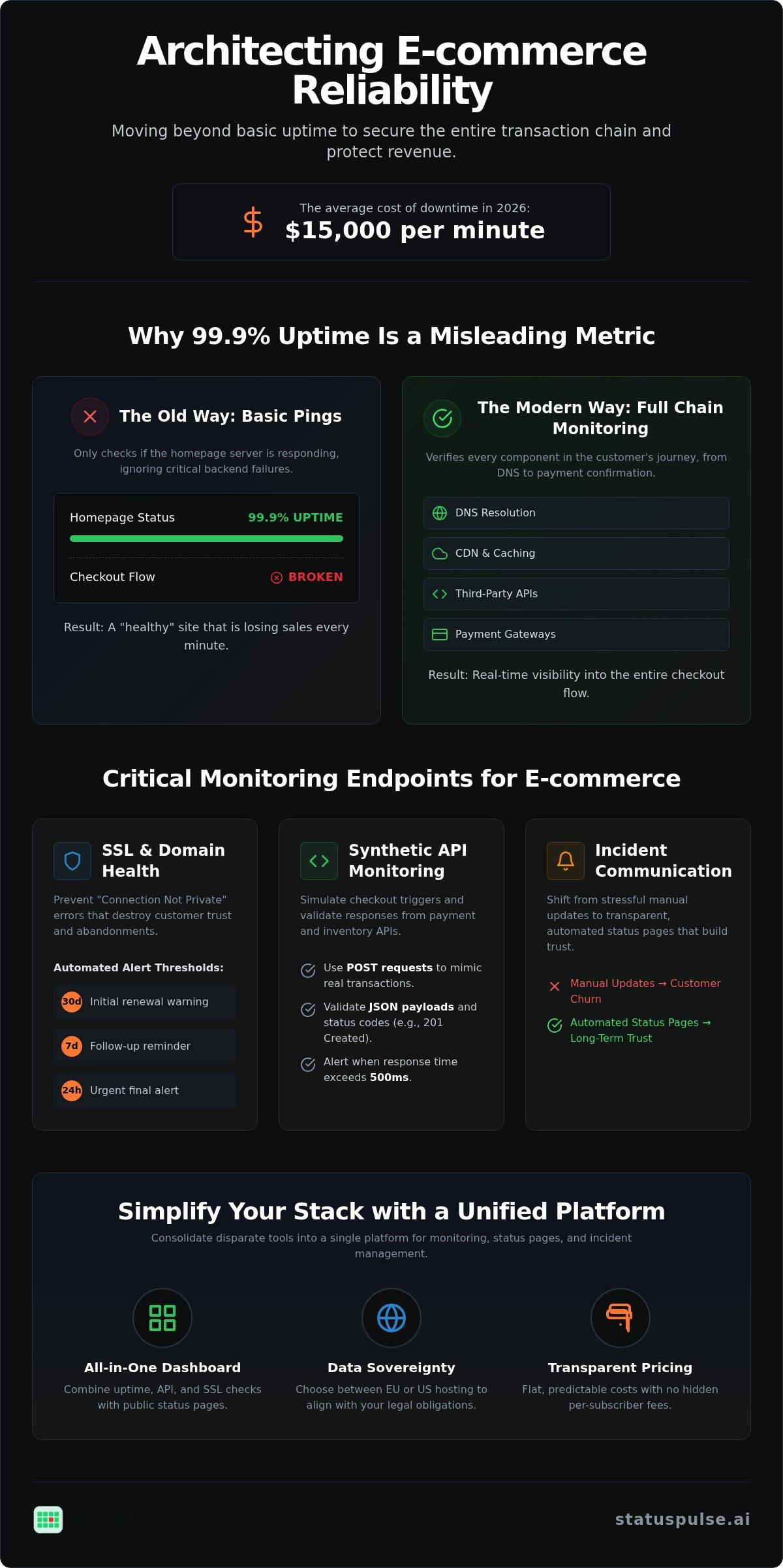
In 2026, the average cost of downtime has climbed to $15,000 per minute. For an online retailer, a silent checkout failure isn't just a technical bug. It's a direct hit to your bottom line and customer trust. You've likely felt the stress of manually updating customers during an outage while your team scrambles to find the root cause. Effective e-commerce website monitoring requires more than a simple ping. It demands a strategy that covers the entire transaction chain across multiple regions.
E-commerce website monitoring is the continuous tracking of site availability, API endpoints, and checkout flows to ensure a reliable shopping experience. A modern stack uses automated testing and transparent status pages to reduce Mean Time To Recovery (MTTR) and protect revenue.
This guide shows you how to architect a monitoring stack that secures your checkout flow and automates incident communication. We'll examine multi-region setups, SSL certificate tracking, and how to maintain data sovereignty under the latest EU regulations. You'll learn to build a resilient system that stays quiet when things work and speaks clearly when they don't.
Key Takeaways
- Move beyond basic uptime checks by architecting a stack that verifies the entire checkout chain rather than just the homepage status.
- Automate your SSL certificate and API monitoring to catch configuration errors and payload failures before they impact your conversion rate.
- Reduce churn during outages by shifting from manual updates to transparent, public status pages that build long-term customer trust.
- Align your e-commerce website monitoring with data sovereignty requirements by selecting regional hosting that matches your primary customer base and legal obligations.
- Simplify your technical workflow by consolidating disparate tools into a single platform that offers transparent, flat pricing without per-subscriber fees.
What is E-commerce Website Monitoring?
E-commerce website monitoring is the continuous, automated verification of a storefront’s availability, performance, and security. It sits within the broader discipline of Application Performance Management (APM), focusing specifically on the transactional integrity of the retail flow. Unlike standard uptime checks, it doesn't just confirm if a server is reachable. It ensures that a customer can actually complete a purchase without friction.
A standard HTTP 200 status on your homepage is a low bar for success. Modern storefronts rely on a "Checkout Chain" that includes DNS resolution, CDN caching, third-party JavaScript, and payment gateways. If your inventory API returns a 500 error while the homepage loads perfectly, you're losing money. This is where e-commerce website monitoring becomes critical. It uses synthetic probes to simulate user journeys, catching failures before a real customer encounters them.
Technical teams typically balance two types of data: synthetic monitoring and Real User Monitoring (RUM). Synthetic monitoring uses scripts to test specific paths at regular intervals from various global locations. RUM collects performance data from actual visitors in real time. While RUM provides deep insights into browser-side performance, synthetic monitoring acts as your early warning system. It detects outages at 3:00 AM when traffic is low but your systems must remain ready for the morning rush.
The E-commerce Reliability Stack
Uptime monitoring tracks server availability and load balancer health. If your Nginx or HAProxy instance fails, you need an alert immediately. API monitoring focuses on third-party integrations like Stripe for payments or Shippo for logistics. These are often the weakest links in your chain. Finally, SSL certificate tracking prevents the "Connection Not Private" warnings that kill consumer trust instantly. Platforms like StatusPulse consolidate these checks into a single dashboard to simplify your technical workflow.
Why 99.9% Uptime is a Misleading Metric
A site can boast 99.9% uptime while its checkout button is completely broken. These silent failures occur when the frontend remains accessible but the backend services fail to process requests. Regional latency also distorts these metrics. Research from Idea Fueled shows a 1-second delay in page load time can reduce e-commerce conversions by 7%. A fast response in Frankfurt means nothing to a customer in New York if your CDN isn't configured correctly. In the context of e-commerce revenue loss, Mean Time To Recovery (MTTR) is the average time required to troubleshoot and fix a system failure from the moment it's first detected until the checkout flow is fully operational.
Critical Monitoring Endpoints for E-commerce
Effective e-commerce website monitoring requires a granular focus on the specific services that drive revenue. While server pings confirm hardware status, they ignore the logic layer where transactions actually happen. IBM provides an authoritative explanation of website monitoring that highlights how security and data integrity are just as vital as speed. For a modern storefront, monitoring must extend to SSL certificates, third-party APIs, domain registry status, and background cron jobs.
Automating SSL and Domain Health
SSL certificate failures are entirely preventable, yet they remain a common cause of checkout abandonment. The technical mechanism involves automated lookups that query the certificate's metadata. These checks compare the "Not After" date against the current timestamp. To maintain high availability, set alert thresholds at 30 days, 7 days, and 24 hours. This tiered approach gives your team enough lead time to handle manual renewals or troubleshooting automated ACME clients. Combining this with domain expiry tracking is essential for preventing SSL surprises and brand hijacking.
Synthetic API Monitoring for Payments
Your checkout flow depends on multiple internal and external APIs. Monitoring these requires more than a simple GET request. You should configure synthetic POST requests that simulate checkout triggers. These tests must validate specific JSON payloads and status codes, such as 201 Created for new orders or 200 OK for inventory lookups. If a payment gateway's response time exceeds 500ms, it can block page rendering and lead to cart abandonment. It's often better to use focused API monitoring tools rather than bulky enterprise suites that require complex agent installations.
Beyond the frontend, background tasks keep the business running. Cron jobs handle critical operations like database backups, order syncing with ERP systems, and automated email triggers. If a sync job fails silently, your inventory counts will drift, leading to overselling. Monitoring these tasks ensures that your "behind the scenes" infrastructure is as reliable as your public storefront. A robust e-commerce website monitoring strategy treats these silent background processes with the same priority as your homepage uptime.
Incident Communication: The Ethical Edge
Technical monitoring tells you when a system fails. Communication tells your customers why they should still trust you. In 2026, e-commerce website monitoring is incomplete if it lacks a strategy for technical transparency. When a checkout flow breaks, the immediate reflex is often to hide the failure until it's fixed. This approach backfires. It increases support ticket volume and fuels customer frustration on social media. Silent failures are bad, but silent recoveries are worse because they leave your users in a state of uncertainty.
Honest communication creates what we call the "Transparency Dividend." By providing a single source of truth, you reduce the stress of manual incident reporting. While internal dashboards show the raw telemetry needed for debugging, public status pages translate that data into human-readable health markers. This distinction is vital. Your internal team needs to see P99 latency; your customers only need to know if they can complete their purchase. A public page acts as a shield for your support team, deflecting repetitive queries before they become tickets.
Drafting Honest Incident Updates
Vague updates like "We are experiencing issues" frustrate users because they lack utility. Effective updates use concrete language to describe the specific service affected, such as "Credit card processing is currently delayed." Following the architecture of incident communication transparency ensures your team stays disciplined during a crisis. A professional update follows a four-stage lifecycle: Investigation, Identification, Monitoring, and Resolved. This structure sets clear expectations for stakeholders and reduces the pressure on your engineering team to provide constant manual status checks.
AI Incident Management Workflows
During a high-stress outage, drafting clear prose is often the last thing on an engineer's mind. This is where AI serves as a technical assistant rather than a replacement for human judgment. AI can ingest error logs and draft a summary of the technical impact for non-technical users. It helps bridge the gap between the server room and the customer service desk. At StatusPulse, we use AI to draft these updates, but we keep human agency at the center. An engineer must always verify and publish the draft. This workflow ensures that your communication is fast, accurate, and ethical without removing the necessary human oversight.
Regional Hosting and Data Sovereignty
For EU-based retailers, where your monitoring data lives is a strategic decision. The 2026 regulatory environment, shaped by the June 3, 2026, Tech Sovereignty package, makes data residency a core architectural requirement. If your storefront serves European customers, hosting your monitoring stack exclusively in the US can introduce jurisdictional conflicts with the US CLOUD Act. Choosing regional hosting that aligns with your customer base isn't just about speed. It's about mitigating legal risk and ensuring compliance with Article 10 of the EU AI Act, which became enforceable on August 2, 2026.
EU vs US Monitoring Nodes
Check location directly impacts the accuracy of your e-commerce website monitoring. If your servers are in Frankfurt but your monitoring nodes are in Virginia, network congestion across the Atlantic can trigger "false positive" alerts. This unnecessary noise creates alert fatigue for SRE teams and wastes engineering hours on non-existent issues. Truly global brands should configure multi-region checks to match their primary demographics. This ensures that reported latency reflects the actual experience of your users. By selecting specific check locations, you verify that your CDN is performing correctly in every market you serve.
Privacy-First Monitoring
Technical visibility shouldn't come at the cost of user privacy. High-quality monitoring verifies application performance without collecting Personally Identifiable Information (PII). This approach simplifies GDPR compliance and reduces your attack surface. You can maintain deep visibility into your checkout flow's health without processing sensitive customer data or relying on "dark patterns" in cookie banners. StatusPulse prioritizes a privacy-focused architecture because we believe technical precision should never require compromising on ethical standards or data sovereignty. It allows you to focus on performance metrics while remaining compliant with the NIS2 Directive's cybersecurity audit requirements.
If you need a monitoring partner that respects regional legal requirements and offers a choice of hosting locations, you can configure your data residency with StatusPulse. This ensures your monitoring data remains within the jurisdiction that best fits your business model and legal obligations.
StatusPulse: Straightforward Monitoring for E-commerce
Fragmented monitoring stacks create friction when minutes matter most. StatusPulse combines uptime, SSL, and API monitoring into a single, logical workflow. This consolidation removes the need for multiple subscriptions and disparate dashboards. It ensures that when a failure occurs in the checkout chain, your team has all the telemetry in one place. By linking these alerts to automated public status pages, you maintain transparency with your customers without adding to your workload during a crisis.
The StatusPulse Value Proposition
We position StatusPulse as a principled alternative to bloated enterprise suites. Many industry incumbents rely on corporate bloat and opaque pricing structures. For example, charging per-subscriber for status page updates penalizes you for communicating with your audience. We use a flat pricing model that respects your budget. While enterprise competitors might start at [VERIFY: competitor X entry price], we prioritize a straightforward approach. Our platform is built by specialists for specialists. We don't include marketing fluff. You also get a genuine choice between EU or US hosting. This supports your specific data sovereignty needs without requiring complex enterprise contracts.
Getting Started with E-commerce Monitoring
You can deploy a robust e-commerce website monitoring stack in under five minutes. Start with these three essential monitors:
- Homepage: Verify basic server availability and load balancer health.
- Checkout API: Test the specific JSON payloads required for successful transactions.
- SSL Certificate: Track expiry dates to prevent trust-killing browser warnings.
Once these are active, connect your alerts to Slack or Discord. This ensures your engineering team is the first to know when a threshold is breached. This simple configuration protects your revenue and maintains the trust you've built with your customers. If you're ready to move away from complex, overpriced suites, you can protect your e-commerce uptime with StatusPulse and secure your storefront's future.
Securing Your Storefront's Future
High availability in 2026 requires a shift from basic ping checks to a comprehensive verification of the entire checkout chain. By automating SSL, API, and uptime tracking, you protect your revenue and build long-term customer trust through transparent communication. Data sovereignty is no longer optional. Selecting regional hosting that aligns with your specific legal obligations is now a core technical requirement for any modern online retailer. You need a system that remains quiet during normal operations but provides clear, actionable alerts when things go wrong.
StatusPulse provides a focused alternative to bloated enterprise suites that rely on complex pricing and corporate bloat. Our platform offers a genuine choice between EU or US hosting, transparent flat pricing, and AI-assisted incident communication to reduce the stress of technical disruptions. Professional e-commerce website monitoring should be straightforward and accessible to teams of all sizes. It's about having the right tools to act quickly when minutes cost thousands in lost sales.
Start Monitoring Your E-commerce Stack with StatusPulse. Building a resilient storefront is a continuous process. With a principled monitoring partner, you can focus on scaling your business while our software maintains the watch over your most critical endpoints.
Frequently Asked Questions
How often should I check my e-commerce site uptime?
One-minute intervals are the industry standard for high-traffic stores. Checking every 5 or 10 minutes leaves windows where you could lose significant revenue before an alert triggers. High-frequency checks help you catch transient issues and flapping services. For critical checkout APIs, 30-second intervals may be appropriate to ensure the lowest possible Mean Time To Recovery (MTTR) during peak shopping events. This frequency ensures your team can act before customers notice the disruption.
Can I monitor my e-commerce checkout flow without processing real orders?
Yes, you can use synthetic API monitoring to simulate checkout triggers. By configuring POST requests to hit your staging environment or using "test mode" keys in your production payment gateway, you verify the logic without moving real funds. This process checks headers, status codes, and JSON payloads. It ensures the integration between your frontend and third-party processors like Stripe remains intact without skewing your actual sales data or creating fraudulent transaction logs.
What is the difference between a status page and a monitoring dashboard?
A monitoring dashboard is an internal tool for engineers to track raw telemetry and P99 latency. A status page is a public-facing "single source of truth" for your customers and stakeholders. While your dashboard might show complex server metrics, your status page translates that data into human-readable service health markers. This separation reduces support ticket volume by providing clear updates during an incident without exposing sensitive infrastructure details or internal debugging notes.
How does SSL monitoring prevent e-commerce outages?
SSL monitoring tracks the "Not After" metadata of your certificates to alert you well before they expire. If a certificate lapses, browsers block access with a "Connection Not Private" warning, which immediately halts all transaction traffic. By setting tiered alerts at 30, 7, and 1-day intervals, your team has sufficient lead time to troubleshoot renewal failures. This automated lookup is a core component of effective e-commerce website monitoring and prevents preventable downtime.
Do I need a status page if I only have a small e-commerce site?
Yes, because transparency builds trust regardless of your business size. Even a small storefront faces the risk of technical disruptions. Providing a public status page shows your customers that you are proactive and honest about your uptime. It prevents the frustration of a "silent failure" where a user doesn't know if the problem is on their end or yours. This professional approach helps you compete with larger incumbents who often hide their technical failures.
How does AI help in incident management for developers?
AI acts as a technical assistant by ingesting complex error logs and drafting clear incident updates for non-technical users. During high-stress outages, engineers often struggle to communicate impact while they are busy debugging. AI-powered tools can summarize the situation and suggest status page copy. Human agency remains central; an engineer must verify the draft before publishing. This workflow speeds up communication without sacrificing technical accuracy or oversight, allowing the team to focus on the root cause.
Is EU-based monitoring better for GDPR compliance?
It significantly simplifies your compliance roadmap by ensuring monitoring data remains within the European jurisdiction. Under the 2026 Tech Sovereignty package, data residency is a strategic requirement to avoid conflicts with foreign surveillance laws like the US CLOUD Act. Choosing a provider that offers EU-hosted nodes ensures that your metadata and incident logs are handled according to strict GDPR standards. This reduces legal risk for retailers who must protect the privacy of European citizens.
What happens if my API monitoring detects a silent failure?
The system triggers an immediate alert to your team via Slack or Discord, even if your homepage appears healthy. A silent failure occurs when the frontend loads but the backend services, like inventory lookups or shipping calculators, fail to respond. Effective e-commerce website monitoring catches these 500-series errors or timeout issues before they result in abandoned carts. This early detection allows you to resolve the bottleneck before it impacts your global conversion rates or brand reputation.


