
Sugarcoating a technical failure is a debt that compounds every time your status page stays green while your API is down. You've likely felt the pressure to keep incident details vague, even as support tickets flood your queue from users who already know your system is failing. Adopting a strategy of incident communication transparency is the only way to stop this manual struggle from draining your engineering focus and eroding user trust.
True reliability isn't just about high uptime; it's about how you handle the inevitable moments of downtime. This guide explains why technical honesty is the only scalable way to maintain trust and meet the strict 24-hour reporting windows required by the EU Cyber Resilience Act. We'll provide a repeatable framework for incident updates that reduces support volume and removes the manual effort of updating status pages. You'll learn how to move from reactive damage control to a principled architecture of transparency that protects your reputation during every incident.
Key Takeaways
- Eliminate the "Silence Tax" by replacing filtered marketing updates with real-time, unfiltered system health data.
- Establish a technical framework that maps P1 to P4 severity levels to specific update frequencies and audience needs.
- Balance technical depth with high-level summaries to provide the right information to both API developers and CTOs.
- Use uptime monitoring triggers to automate the "Investigating" state. This ensures incident communication transparency is maintained during high-pressure events.
- Prioritize ethical infrastructure by selecting hosting that supports data sovereignty. Avoid pricing models that penalize growth with per-subscriber fees.
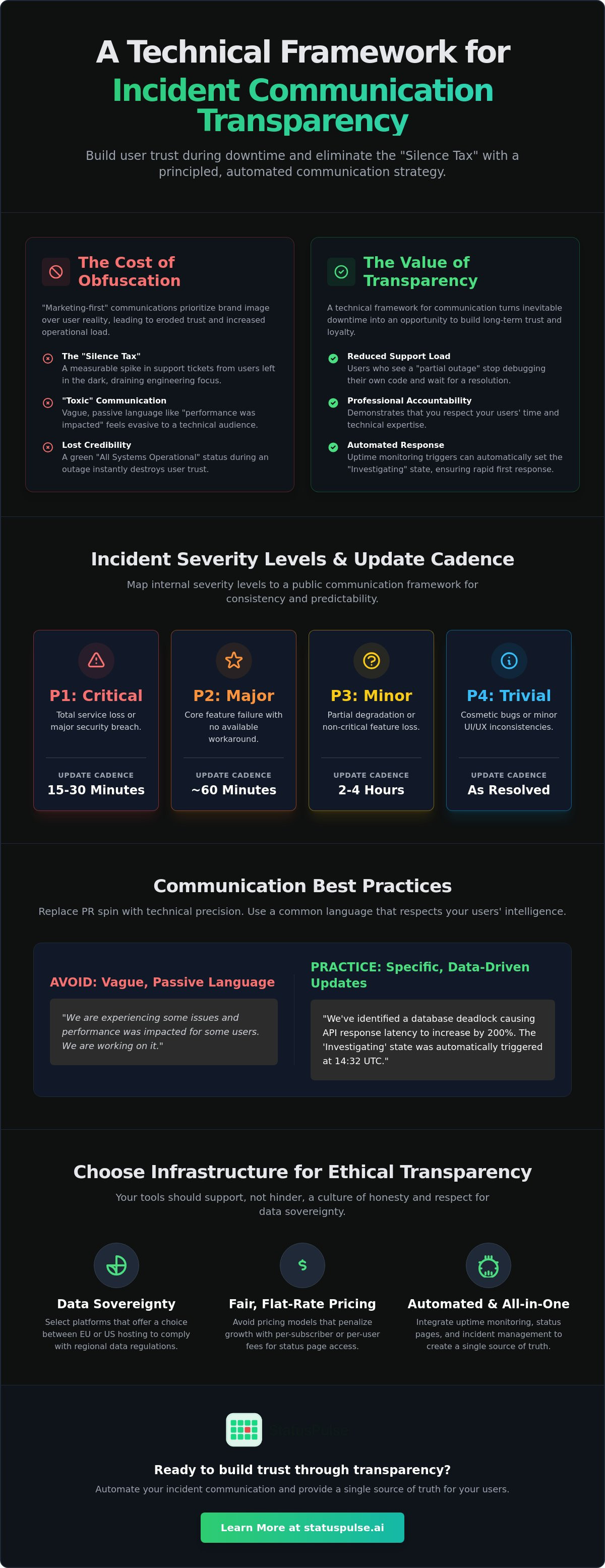
The Cost of Obfuscation: Why Marketing-First Comms Fail Developers
Developers have a built-in sensor for PR spin. When an API returns a 500 error or a database query hangs, they check your status page. If it shows a bright green "all systems operational" checkmark, you've lost their trust. This is the failure of marketing-first communications. It prioritizes the brand's image over the user's ability to debug their own stack. We define incident communication transparency as the real-time sharing of unfiltered system health data. It's a technical requirement for any team that values its users' time and sanity.
Staying quiet during a minor outage creates a "Silence Tax". This is the measurable spike in support tickets that occurs when users are left in the dark. A technical user would rather see a "partial outage" notification than a lie. It allows them to stop debugging their own code and wait for yours to recover. Adopting incident communication transparency ensures your support team isn't buried under repetitive queries. By shifting the focus from defending the brand to assisting the user, you reduce friction for everyone involved.
The Transparency Paradox in Modern SaaS
Hiding failures feels safe in the short term, but it drives long-term churn. Technical users don't expect 100% uptime; they expect a partner who takes accountability. Adhering to standard crisis communication principles means prioritizing facts over feelings. Incident transparency is a technical trust-building mechanism that replaces corporate exposure with professional accountability. It's about being a fair and ethical alternative in a market full of faceless corporations that hide behind vague updates.
Identifying "Toxic" Communication Patterns
Marketing teams often default to the passive voice. Phrases like "errors were experienced" or "performance was impacted" shift blame away from the source. This language feels evasive to specialists who value technical precision. Avoid the "everything is fine" dashboard at all costs. Honesty differentiates a principled team from corporate bloat. Using tools like automated public status pages ensures your users see the same reality your engineers do. This removes the temptation to sugarcoat failures and builds a foundation of trust that survives technical disruptions. It's a logical path from problem to solution that respects your user's intelligence.
Defining a Technical Framework for Incident Communication Transparency
Effective incident communication transparency requires more than a public URL. It demands a structured architecture that mirrors your internal incident response hierarchy. Without predefined severity levels and standardized language, updates become inconsistent. Consistency is the foundation of reliability. A technical framework ensures that your team doesn't have to decide what to say while they're busy fixing a database deadlock.
Establishing a single source of truth (SSOT) is the first step. Your public status page must be the definitive record for system health. If your internal Slack channels and your public updates provide conflicting data, trust vanishes. Use a "common language" for status descriptions to avoid internal jargon. Instead of saying "The flurbis node is flapping," tell your users that "API response latency has increased by 200%." This clarity helps users make informed decisions about their own infrastructure.
- P1 (Critical): Total service loss. Update every 15 to 30 minutes until resolved.
- P2 (Major): Core feature failure with no workaround. Update every 60 minutes.
- P3 (Minor): Partial degradation or non-critical feature loss. Update every 2 to 4 hours.
- P4 (Trivial): Cosmetic bugs or UI inconsistencies. Update once per day or upon resolution.
Categorising Incidents for Clarity
Incidents generally fall into three buckets: operational, security, or performance. Hard outages are easy to communicate. However, "degraded performance" is often more frustrating for developers than a "hard down" state. It creates intermittent failures that are difficult to debug. Implementing robust uptime monitoring provides the telemetry needed to identify these nuances. It moves your communication from a "hunch" to a data-driven notification.
Stakeholder Mapping for SREs
Different groups require different levels of detail. Your internal Customer Success and Sales teams need talk tracks to manage client expectations. External stakeholders, such as enterprise partners, require formal root cause analysis (RCA) and specific impact data. Free users usually just need to know that you're aware of the problem. Creating specific channels for each group prevents noise and ensures the right people get the right data. If your team is still manually drafting these updates during a crisis, using automated incident management tools can help maintain this framework without adding to your engineering cognitive load.
Managing the Transparency Paradox: What to Share and When
Sharing too much technical detail can be just as damaging as sharing too little. This is the transparency paradox. If you dump raw database logs into a public update, you risk confusing your users or exposing security vulnerabilities. True incident communication transparency involves a deliberate filter. You must translate internal technical failures into external user impact. Your users need to know if their data is safe and when they can get back to work. They don't need the specific stack trace of your failing microservice.
Deciding between a public status page update and a direct email depends on the scope of the incident. Status pages are ideal for general system health and minor regressions. However, when an incident affects specific account data or requires user action, direct email is non-negotiable. This is especially true for security incidents. Under the EU Cyber Resilience Act, significant incidents must be reported to authorities within 24 hours. Honesty here is a legal requirement, but you must balance this with the need to prevent further exploitation while a patch is in progress.
Internal vs. External Detail Levels
Your SREs require deep technical context to resolve an issue. Your users require clarity. Internal updates should include logs, server IDs, and specific commit hashes. External updates should focus on affected features and workarounds. For example, comparing sentry status with your own monitoring can help you identify if an issue is upstream or internal. Closing the loop with a public post-mortem using the "Five Whys" method proves you've addressed the root cause rather than just the symptoms.
Honesty in Time-to-Recovery (TTR) Estimates
Promising a "fix in five minutes" is a dangerous trap. If the estimate is wrong, you've broken trust twice. "Investigating" is a perfectly valid status when the root cause is unknown. It's better to provide no estimate than a false one. When a quick fix isn't available, acknowledge the trade-offs. If a database migration will take three hours to complete safely, tell your users. They'd rather plan around a three-hour delay than be disappointed every fifteen minutes by a missed deadline. Technical honesty is the only way to maintain a reputation for reliability.
Building a Resilient Pipeline for Honest Incident Updates
Manual updates are the enemy of speed. When a primary database fails, your engineers shouldn't have to leave their terminal to update a status page. A resilient pipeline connects your monitoring directly to your communication channels. Automating the "Investigating" state through uptime monitoring triggers ensures that your users are notified the moment a check fails. This immediate response is the first step in maintaining incident communication transparency without slowing down your recovery efforts.
Templates should be short, punchy, and declarative. Avoid long paragraphs that bury the lead. A simple structure works best: identify the component, state the current status, and describe the user impact. This minimalist approach mirrors the efficiency of your technical stack. It respects the user's time by providing facts without the fluff of traditional enterprise comms.
The "Human-in-the-loop" rule is a vital safeguard. While automation handles the initial alert, a human must verify and refine the final resolution details. Tools should act as assistants that prepare the data, but the final action remains with your team. This balance ensures that your updates remain accurate and prevents the accidental disclosure of sensitive internal architecture details.
Leveraging AI for Incident Summaries
AI can parse complex logs and stack traces to draft user-friendly summaries. This helps maintain a consistent voice across different team members, regardless of who is on call. These drafts should prioritize honesty over marketing spin. By using AI to distill technical data into plain language, you provide clarity during high-stress events. It's a logical way to scale your comms without hiring a dedicated PR team for every minor outage.
The shift toward AI-assisted drafting isn't limited to technical summaries; it extends to broader business strategy as well. To see how AI can help you structure your organization’s documentation, you can visit GrowthGrid to access their simple guide and template for an operational plan.
The Status Page as a Trust Anchor
Setting up automated public status pages reduces the manual overhead that often leads to communication delays. Integrating monitoring data directly into this flow creates a trust anchor for your users. Native monitoring is superior to third-party "bolted-on" solutions because it eliminates the lag between the actual event and the notification. This direct connection proves your commitment to integrity. If you want to reduce support tickets and build a reputation for reliability, you can launch a transparent status page that updates in real-time based on your actual system performance.
Choosing Infrastructure for Ethical Incident Management
Infrastructure is the silent partner in your communication strategy. If your status page is hosted on the same infrastructure as your primary application, it will fail exactly when you need it most. True incident communication transparency requires isolation and ethical data handling. This means considering where your monitoring data is stored and how that storage aligns with global regulations. Trust is built through these technical choices before you ever write your first incident update.
Data sovereignty is a vital trust signal. For teams operating in the European Union, GDPR-compliant monitoring is a necessity [VERIFY: GDPR compliance source]. Providing a choice between EU and US hosting ensures you meet regional compliance without sacrificing performance. Hosting location also affects latency. High-frequency checks require proximity to your services to avoid false positives. Integrating api monitoring within your preferred jurisdiction simplifies your regulatory burden and improves alert accuracy.
The "Meticulous Underdog" approach to software prioritizes precision over feature bloat. We avoid the corporate trend of "bolting on" unnecessary sub-services that complicate the user experience. Instead, we focus on a core set of tools that work together logically. This includes uptime monitoring, public status pages, and AI-assisted incident management. It's a straightforward alternative for teams tired of navigating enterprise complexity and opaque sales cycles. We build for specialists who value technical depth over marketing flash.
Hosting and Privacy as Trust Signals
Isolation is a technical trade-off you must manage. While all-in-one platforms are efficient, they must maintain independent infrastructure for status pages. This prevents a "single point of failure" where your communication tool goes down with your API. We acknowledge that some teams prefer highly specialized, separate vendors for every layer of their stack. However, for those seeking a streamlined workflow without the "corporate tax," a principled all-in-one solution is more effective. It reduces the cognitive load of managing multiple logins and billing cycles.
The StatusPulse Value Proposition
Pricing should be as transparent as your incident updates. Many incumbents use per-subscriber or per-seat models that act as a growth tax. We believe in flat pricing. You shouldn't be penalized for having more users or a larger team. This ethical approach to cost ensures that your monitoring budget remains predictable as you scale. StatusPulse is built by specialists who value integrity and regulatory compliance as core virtues. We don't use flashy marketing to hide technical gaps. We provide a reliable, straightforward platform that respects your time and your data. Start building trust with StatusPulse today.
Choosing ethical infrastructure is a long-term investment in your brand's integrity. It moves the conversation from "how do we hide this" to "how do we solve this." By prioritizing data sovereignty and transparent pricing, you align your technical operations with your public promises. This consistency is what builds lasting trust with a technical audience. It's not just about the code; it's about the principles behind the platform. This philosophy of integrity is why many businesses also turn to WhoRatesMe to manage their online reputation ethically and effectively.
Scaling Reliability Through Technical Honesty
Building a culture of incident communication transparency removes the friction between your engineering team and your users. By implementing a structured severity framework and automating the investigating state, you eliminate the "Silence Tax" that drains your resources during downtime. This approach moves your brand away from the corporate bloat of industry incumbents and toward a principled, specialist-led model of accountability.
The right tools should act as assistants, not complications. You need a platform that prioritizes integrity through EU-based GDPR compliant hosting and AI-powered incident drafting. Our flat, transparent pricing ensures you can scale your user base without facing a per-subscriber tax. This allows you to focus on resolving technical disruptions rather than managing complex billing cycles or manual status updates.
Reliability is more than just a high uptime percentage; it's the trust you maintain when things go wrong. Deploy your public status page in minutes with StatusPulse. Take control of your technical narrative and start building lasting trust with your users today.
Frequently Asked Questions
What is incident communication transparency and why does it matter?
Incident communication transparency is the practice of sharing real-time, unfiltered system health data with your users. It matters because it replaces marketing spin with technical accountability. It helps you comply with the EU Cyber Resilience Act, which requires reporting significant incidents within 24 hours. By being honest about failures, you reduce the support ticket flood that occurs when users are left in the dark. This builds a foundation of trust that survives technical disruptions.
How often should I update my status page during an outage?
Update frequency should match your severity mapping. P1 critical outages require updates every 15 to 30 minutes. Major P2 issues need hourly updates. For minor P3 degradations, every 2 to 4 hours is sufficient. The key is maintaining a predictable rhythm. This prevents users from feeling abandoned during a service disruption. If you have no news, state that you are still investigating. Consistency is more important than the specific interval.
Should I admit to human error in a public post-mortem?
Admitting human error is a powerful trust signal. It proves you prioritize technical honesty over brand defense. However, don't just blame an individual. Use your post-mortem to explain the systemic gaps that allowed the error to happen. Focus on the architectural changes you've implemented to prevent a recurrence. This shift from defending the brand to assisting the user is what differentiates principled teams from corporate bloat. It shows you value precision over PR.
How can AI help with incident management without losing accuracy?
AI acts as an assistant by parsing complex logs to draft user-friendly summaries. This maintains a consistent voice during high-stress events. To ensure accuracy, you must follow the human-in-the-loop rule. An engineer should always verify the AI's draft before it goes public. This prevents technical hallucinations while scaling your efforts. Communication becomes more manageable when AI distilled data is verified by a specialist before being shared with your users. It respects human agency while increasing efficiency.
What is the difference between internal and external incident updates?
Internal updates are for engineers; external updates are for users. Internal comms include specific commit hashes, stack traces, and server logs. External updates focus on the "what" and "when" for the user. They describe which features are impacted and provide clear workarounds. Translating technical failures into user impact is the core of effective transparency. It respects the user's intelligence without exposing your internal infrastructure vulnerabilities. This distinction ensures clarity for all stakeholders involved.
Does transparency during incidents actually reduce customer churn?
Honesty reduces churn by proving your reliability as a partner. Technical users expect failures but they won't tolerate being lied to. When you provide clear, honest updates, you reduce the frustration that leads to long-term churn. It's a logical way to build a reputation for integrity. Teams that hide behind a green status page during an outage often face a "Silence Tax" of lost customers and increased support costs. Transparency turns a technical failure into a trust-building opportunity.
Can I automate my status page updates directly from my monitoring tools?
Automation is essential for speed and accuracy. You can link your uptime monitoring directly to your status page to trigger alerts the moment a check fails. This ensures incident communication transparency happens in real-time. StatusPulse provides this integration natively. It allows you to focus on the fix while the system handles the initial notification. This removes the manual burden of updating status pages while you are handling a crisis. It ensures your users see the same reality your engineers do.


