

What if your "independent" status page is actually a single point of failure hidden in your own deployment scripts? Many SRE teams choose to self-host to maintain control over data and costs. It's a logical starting point for hobby projects or air-gapped environments. However, the circular dependency of hosting a status page on the same infrastructure it monitors often leads to silence during the most critical outages.
Knowing when to move from self-hosted to a managed status page requires a cold look at your engineering toil and reliability metrics. This guide provides a rigorous evaluation of the total cost, reliability paradoxes, and compliance triggers that signal it's time to deprecate your DIY tool. We'll examine how to decouple your communication layer, automate incident drafting with AI, and maintain data sovereignty through regional hosting. You'll learn how to scale notifications without facing a success tax on your subscriber count, ensuring your status page remains a trusted source of truth even when your primary stack is dark.
Key Takeaways
- Identify the circular dependency risks where your status page fails alongside your primary infrastructure during a major incident.
- Calculate the true engineering toil of maintaining DIY stacks, including security patches and database backups that divert focus from core product work.
- Determine exactly when to move from self-hosted to a managed status page by evaluating compliance triggers such as SOC 2 audit requirements for independent logging.
- Execute a low-risk migration strategy using DNS TTL adjustments to ensure a transition that protects your custom domains and subscriber lists.
- Establish an independent communication layer that provides data sovereignty through specific EU or US hosting options.
The Circular Dependency: Why Self-Hosting Often Fails During Outages
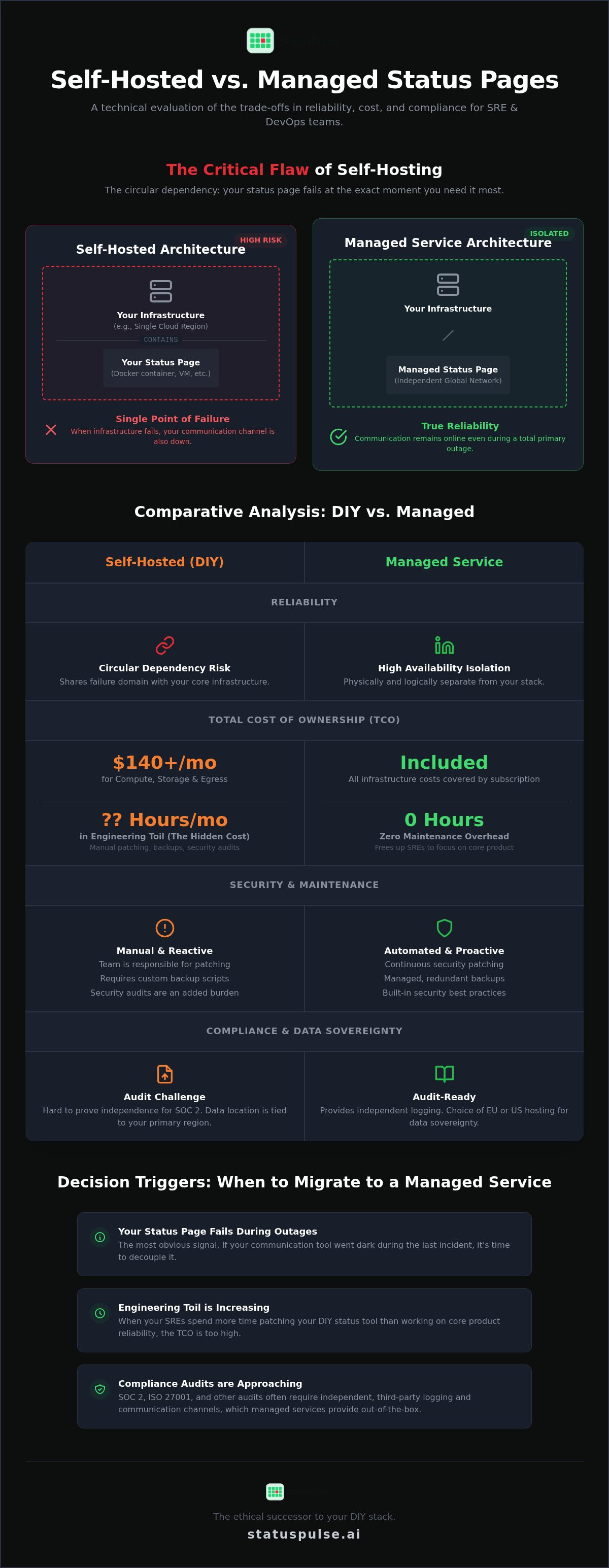
A status page is your most critical tool during a crisis. If your application is down because a cloud provider region is failing, but your status page is a Docker container running in that same region, your communication channel is also dead. This is the circular dependency. It's the primary technical signal for teams deciding when to move from self-hosted to a managed status page. When the monitor relies on the infrastructure it's supposed to watch, you've created a single point of failure.
| Factor | Self-Hosted (DIY) | Managed Service |
|---|---|---|
| Infrastructure | Shared or manual isolation | Physically independent |
| Maintenance | Manual patching and backups | Zero maintenance |
| Reliability | Circular dependency risk | High availability isolation |
DIY stacks often suffer from the "Who Monitors the Monitor" problem. To make a self-hosted page reliable, you need a second, independent monitoring system just for the status page. Maintaining this recursive loop is expensive. Building multi-region redundancy yourself requires managing multiple VPCs, separate IAM roles, and often a different DNS provider. By the time you've achieved true isolation, the infrastructure costs and engineering hours often exceed the price of a professional service.
Centralized failure points are common in DIY deployments. Shared secrets, such as a single set of CI/CD credentials or a shared Terraform state, can inadvertently wipe out both your production environment and your status page. True reliability requires an independent communication layer that exists outside your primary failure domain.
The Architecture of Independent Communication
To be effective, a status page must live on a separate network and use a different DNS provider than your main site. Managing a separate AWS or GCP account specifically for a status page adds significant administrative overhead. You're forced to manage patches, backups, and security updates for a tool that should be simplifying your life, not adding to your task list. Infrastructure decoupling is the practice of ensuring your communication channels share zero infrastructure dependencies with the services they report on.
When DIY Still Makes Sense
Managed services aren't a universal fix. Air-gapped environments or high-security setups where SaaS is strictly prohibited require local hosting. Similarly, hobbyist projects with no Service-level agreement (SLA) and zero budget are better served by simple open-source tools. If your project is internal-only and downtime has no impact on external trust or revenue, the maintenance burden of a DIY tool might be acceptable. For everyone else, the risk of a "dark" status page is too high.
Evaluating the Total Cost of Ownership (TCO)
Self-hosting isn't free; it's a debt. When teams ask when to move from self-hosted to a managed status page, they often overlook the "engineering tax." A DIY stack requires a Total Cost of Ownership (TCO) framework that accounts for more than just monthly compute credits. Compute costs for a standard general-purpose VM average $0.19 per hour across major providers. That's roughly $136 per month before adding storage, data egress, or backup costs.
The real cost is the human maintenance of the platform. Every hour an SRE spends patching an old open-source tool like Cachet is an hour not spent on core product reliability. Cachet has not had an official release since 2023, meaning your team is responsible for manual security audits and dependency updates. This is the opportunity cost of DIY.
Engineering Hours vs. Subscription Fees
The financial math rarely favors self-hosting once you reach a certain scale. A managed service eliminates the need for manual database backups and security patching. This allows your team to focus on the actual incident rather than the tool used to report it.
| Cost Driver | Self-Hosted (DIY) | Managed Service |
|---|---|---|
| Compute & Storage | ~$140+/mo | Included |
| Maintenance (Patching) | [VERIFY: typical engineering hours] @ [VERIFY: average SRE hourly rate] | 0 Hours |
| Security & Backups | Manual/Custom | Automated |
The Scalability Wall
Outages create massive traffic spikes. If 10,000 users hit your self-hosted status page simultaneously, you need an auto-scaling strategy and a robust CDN. Building this for a tool that remains idle 99% of the time is inefficient. A managed service handles this burst capacity as a standard feature, ensuring your website availability monitoring remains visible when it matters most.
Many managed providers charge a "success tax" through per-subscriber fees. As your user base grows, your bill increases regardless of actual incident volume. We prefer transparent, flat-rate pricing that doesn't penalize you for communicating with your customers. This approach eliminates the "Feature Lag" tax where DIY tools fail to keep up with modern notification channels like Discord or Slack.
Compliance, Data Sovereignty, and the Trust Threshold
Auditors for SOC 2 and ISO 27001 require objective proof of operational resilience. A self-hosted status page often lacks the immutable audit trail needed to satisfy these requirements. When your team asks when to move from self-hosted to a managed status page, the answer is often the moment you enter a serious enterprise procurement cycle. Enterprise clients demand timestamped logs of past incidents to verify your uptime claims before signing high-value contracts.
DIY tools allow developers to modify or delete database entries with a simple SQL command. While this is helpful for fixing a typo, it creates a transparency gap that auditors find problematic. Managed platforms act as a neutral third party, recording the exact start and end times of every disruption. This prevents the "cleanup" of downtime records that can occur in internal DIY systems where the same team manages both the service and its reporting tool.
Audit-Ready Transparency
A managed platform provides the "Single Source of Truth" auditors require by decoupling the incident record from your internal production databases. If an incident is recorded, it remains in the history as a permanent record of your response. This level of Incident Communication Transparency builds trust with stakeholders who rely on your service for their own operations.
In DIY setups, the risk of circular dependencies isn't just about uptime; it's about the integrity of the audit log itself. If the monitoring system and the status page share a database, a corruption in one can compromise the evidence of the other. Managed services provide the physical and logical isolation required for true compliance and disaster recovery documentation.
Regional Hosting and GDPR
Data residency is a technical requirement, not just a legal checkbox. Many status page providers use a global CDN to mask the fact that their primary database is located in a single US region. For European companies, this creates a complex Data Processing Agreement (DPA) landscape. The technical difference between a "Global CDN" and "Regional Data Residency" is where the actual customer data, such as subscriber emails and IP addresses, is stored at rest.
We provide a choice between EU or US hosting for the entire stack, not just the edge cache. Choosing an EU-based SaaS provides a simpler DPA for European companies because the data never leaves the jurisdiction. Maintaining a professional presence also requires vigilance over your own infrastructure. Automated SSL certificate monitoring ensures your status page never presents a security warning to users during a crisis. A managed service handles these certificates automatically, removing one more manual task from your SRE's plate.
Migration Strategy: Moving from DIY to Managed
Migration is a technical project, not a marketing switch. Once you've decided when to move from self-hosted to a managed status page, you need a plan that preserves your historical data and minimizes DNS propagation delays. A successful transition ensures that your users never experience a "dark" period where status information is unavailable.
- Step 1: Audit endpoints. Map every monitoring probe, API endpoint, and subscriber list currently in your DIY tool.
- Step 2: DNS preparation. Lower your custom domain TTL to 300 seconds at least 24 hours before the cutover to ensure rapid global updates.
- Step 3: Export history. Reliability is built on history. Export your incident logs to maintain your track record of transparency.
- Step 4: Automate updates. Replace manual dashboard entries with API-driven updates to eliminate human error during high-stress incidents.
Automating the Transition
Modern infrastructure requires version control. Use Terraform or direct API integrations to manage your status page configuration alongside your primary stack. This approach allows you to programmatically define components and maintenance windows. Setting up 1-minute uptime checks provides the granular data needed for accurate reporting. For a deeper look at managing these endpoints, see our guide on API Monitoring: The Developer’s Guide to High Availability in 2026.
Communication Cutover
Your users expect consistency. Before going live, verify your integrations with Slack, Discord, or PagerDuty to ensure notifications reach the right channels. A successful go-live day includes a final verification of your subscriber import and a test incident post to confirm the mail server is firing correctly. Follow this checklist for a stable transition:
- Verify CNAME propagation via global DNS checkers.
- Confirm SSL certificate validity for the custom domain.
- Test subscriber notification delivery in a staging environment.
- Verify data sovereignty settings (EU or US hosting).
Moving away from a manual DIY stack shouldn't be complex. You can start your migration to StatusPulse in under five minutes using our straightforward import tools.
StatusPulse: The Ethical Successor to Your DIY Stack
StatusPulse serves as the principled alternative for teams that have outgrown the maintenance burden of a DIY stack. It integrates uptime monitoring, API monitoring, and public status pages into a single dashboard. Native SSL certificate monitoring is included by default, preventing the common DIY oversight of expired certificates on the status domain itself. This consolidation removes the need to juggle multiple subscriptions or manage separate infrastructure for communication.
Unlike industry incumbents that impose a "success tax" through per-subscriber fees, we use a flat-rate pricing model. Your costs don't increase just because your user base grows. This transparency is a core differentiator for teams deciding when to move from self-hosted to a managed status page. It ensures that honest communication with your audience remains affordable regardless of your scale. We avoid corporate bloat and complex tiers, focusing instead on technical precision and reliability.
AI-Powered Incident Management
AI Incident Management simplifies the drafting process during high-pressure outages. The system analyzes technical logs and monitoring data to generate a concise summary of the event. This helps SREs communicate clearly with users when stress levels are high. However, we prioritize human agency; SREs maintain final control and must approve or edit every update before it goes live. This ensures accuracy and maintains the "human" element of Uptime Monitoring: A Developer’s Guide to Reliability and Honest Communication.
The AI acts as an assistant, not a replacement for engineering judgment. By automating the initial draft, you reduce the time between detection and communication. This speed is critical for maintaining user trust during a service disruption. It removes the friction of staring at a blank text box while trying to debug a production environment.
European Data Sovereignty
Data sovereignty is treated as a core virtue rather than a marketing afterthought. You can choose to host your entire stack in either the EU or the US to meet specific regulatory requirements. This grounded approach to privacy ensures compliance with GDPR without the complexity of managing your own regional infrastructure. It's a technical framework built by specialists, for specialists, valuing integrity over flashiness. You can move your status page to StatusPulse and replace your DIY stack with a reliable, independent communication layer in minutes.
Decoupling Your Incident Communication Layer
Transitioning from a DIY tool is a strategic move to eliminate circular dependencies. Shared infrastructure often silences a status page exactly when users need it most. By evaluating engineering hours and the requirements of SOC 2 auditors, you can pinpoint exactly when to move from self-hosted to a managed status page.
A managed solution provides the physical isolation and immutable logs necessary for true reliability. It removes the "success tax" found in other tools, allowing you to scale without per-subscriber fees. With options for EU and US hosting, you maintain data sovereignty while using AI assistants to draft incident updates.
Ready to simplify your stack? Switch to StatusPulse: No per-subscriber fees, just reliable monitoring.
Building a resilient communication channel is the best way to maintain trust during disruptions. Focus on solving incidents, not managing the tools that report them.
Frequently Asked Questions
Is a managed status page more reliable than a self-hosted one?
Managed pages are generally more reliable because they reside in a separate failure domain. A self-hosted page often shares infrastructure with the services it monitors. If your primary cloud region fails, your status page likely fails with it. Managed services provide the physical isolation required to keep communication channels open during a total site outage. This decoupling is a major factor in when to move from self-hosted to a managed status page.
How long does it take to migrate from Cachet or other DIY tools to StatusPulse?
Transitioning from tools like Cachet or custom Docker stacks takes less than five minutes for the initial configuration. The total time depends on your DNS TTL settings and the volume of historical data you choose to import. Most teams can complete the full cutover within a single afternoon. Our import tools are designed to pull existing subscriber lists and monitoring endpoints to ensure continuity for your users.
Does StatusPulse charge per subscriber like other managed services?
We don't charge per subscriber. Many enterprise incumbents use a pricing model that penalizes growth, often referred to as a "success tax." StatusPulse uses a flat-rate pricing structure regardless of your subscriber count. This allows you to scale your communication without worrying about a ballooning monthly bill. It's a more ethical approach for teams that value predictable costs and transparent budgeting without hidden fees.
Can I host my status page in the EU for GDPR compliance?
Yes, you can choose to host your entire stack in the EU. We provide a choice between EU and US data centers to support regional data sovereignty. This ensures that subscriber emails and IP addresses stay within your preferred jurisdiction at rest. For European companies, this simplifies GDPR compliance and Data Processing Agreements (DPAs) by avoiding the complexities and legal risks of international data transfers.
What is the "Who Monitors the Monitor" problem?
This refers to the recursive maintenance loop of self-hosting. If you host your own status page, you need a separate system to monitor that page's availability. This creates a chain of dependencies that increases engineering toil and infrastructure costs. Decoupling your status page into a managed environment solves this by moving the monitoring responsibility to a physically independent network, ensuring your status page remains a reliable source of truth.
Does StatusPulse include uptime monitoring or just the status page?
StatusPulse is an all-in-one platform for monitoring and communication. It includes uptime monitoring, API monitoring, and SSL certificate monitoring as native features. You don't need to bolt on third-party tools to feed data into your status page. This integration ensures that your status updates are based on the same granular data used for internal alerting, reducing the time required to update stakeholders during an incident.
How does the AI incident management feature work?
The AI incident management tool drafts status updates based on your technical logs and monitoring data. It identifies the scope of the disruption and suggests a clear, honest summary for your users. However, SREs maintain final control over every post. A human must review and approve the draft before it goes live. This keeps the communication accurate while saving critical minutes during high-stress outages when every second counts.
Can I use my own domain for a managed status page?
You can use your own custom domain for any public status page. We handle the SSL certificate issuance and renewals automatically through our platform. This prevents the common DIY failure where a status page presents security warnings because an SRE forgot to renew a certificate. Using a custom domain ensures your users stay within a trusted brand environment even during a service disruption, which is vital for maintaining trust.


