

In 2026, the average cost of IT downtime has reached approximately $15,000 per minute for most organizations. This reality makes basic website availability monitoring feel increasingly insufficient, leading many to seek comprehensive support from spacecentersystems.com. You've likely dealt with the stress of a "green" dashboard while customers report broken checkouts or silent failures. These gaps, along with notification fatigue and the hidden costs of status page subscribers, prove that traditional tools often prioritize their own margins over your site's actual reliability.
We agree that a simple ping is not a strategy. It's a baseline that misses the nuance of global reachability and application health. This guide provides a technical roadmap to building a monitoring stack that ensures true service uptime. You'll learn how to eliminate blind spots with global probes, automate incident communication, and maintain data sovereignty through EU-based hosting options. We're moving beyond simple pings to help you achieve genuine service reliability without the enterprise bloat.
Key Takeaways
- Move beyond basic pings to full HTTP/S request validation. This ensures your site isn't just reachable but actually functional for your users.
- Master the technical lifecycle of a check. Learn how DNS resolution, TCP handshakes, and TLS negotiations reveal the root cause of latent failures.
- Strengthen your website availability monitoring by tracking SSL certificates and domain expiry. These silent failures often bypass traditional uptime checks and cause preventable outages.
- Build a resilient strategy with multi-region probes. This helps you distinguish between local network issues and global service outages to reduce false positives.
- Simplify incident communication with automated status pages. Focus on transparency and data sovereignty without the burden of complex per-subscriber pricing models.
What is Website Availability Monitoring?
At its core, website availability monitoring is the continuous process of verifying that a web resource is both reachable and fully functional for your end users. It isn't a single check. It's a distributed sequence of automated tests performed from multiple global locations. While many legacy tools treat "up" as a binary state, modern reliability engineering views availability as a spectrum of performance and correctness.
There's a fundamental difference between a simple ICMP ping and a full HTTP/S request validation. A ping only tells you the server's network stack is responsive. It doesn't tell you if the Nginx process crashed or if your database connection timed out. By 2026, relying on a basic "200 OK" status code is no longer enough. Sophisticated monitoring must assert that specific content exists on the page to avoid silent failures where a site is technically up but functionally broken. This level of precision is what maintains Service Level Agreements (SLAs) and preserves customer trust when every minute of downtime can cost thousands of dollars.
The Core Components of Modern Monitoring
Effective monitoring relies on three pillars. First, synthetic monitoring uses automated probes to simulate real user behavior. This catches broken workflows before a human ever sees them. Second, check intervals are critical for your Mean Time to Recovery (MTTR). A 1-minute interval catches issues five times faster than a 5-minute interval. This speed can be the difference between a minor blip and a major outage. Finally, global probe distribution ensures you're testing from the same regions as your users, accounting for regional ISP issues or BGP routing errors.
Why a "Homegrown" Script Usually Fails
It's tempting to use a cron job and a curl script. However, this approach creates a "monitoring the monitor" paradox. If your internal monitoring server goes down, you're flying blind. Homegrown scripts also suffer from high false-positive rates because they lack multi-region consensus. A local network hiccup on your script's host can trigger an unnecessary 2 AM page. Without historical reporting or trend analysis, you lose the ability to identify chronic performance degradation. Using a dedicated platform like StatusPulse provides the infrastructure needed for reliable, unbiased data without the maintenance overhead of a custom-built solution.
How Website Availability Monitoring Works Under the Hood
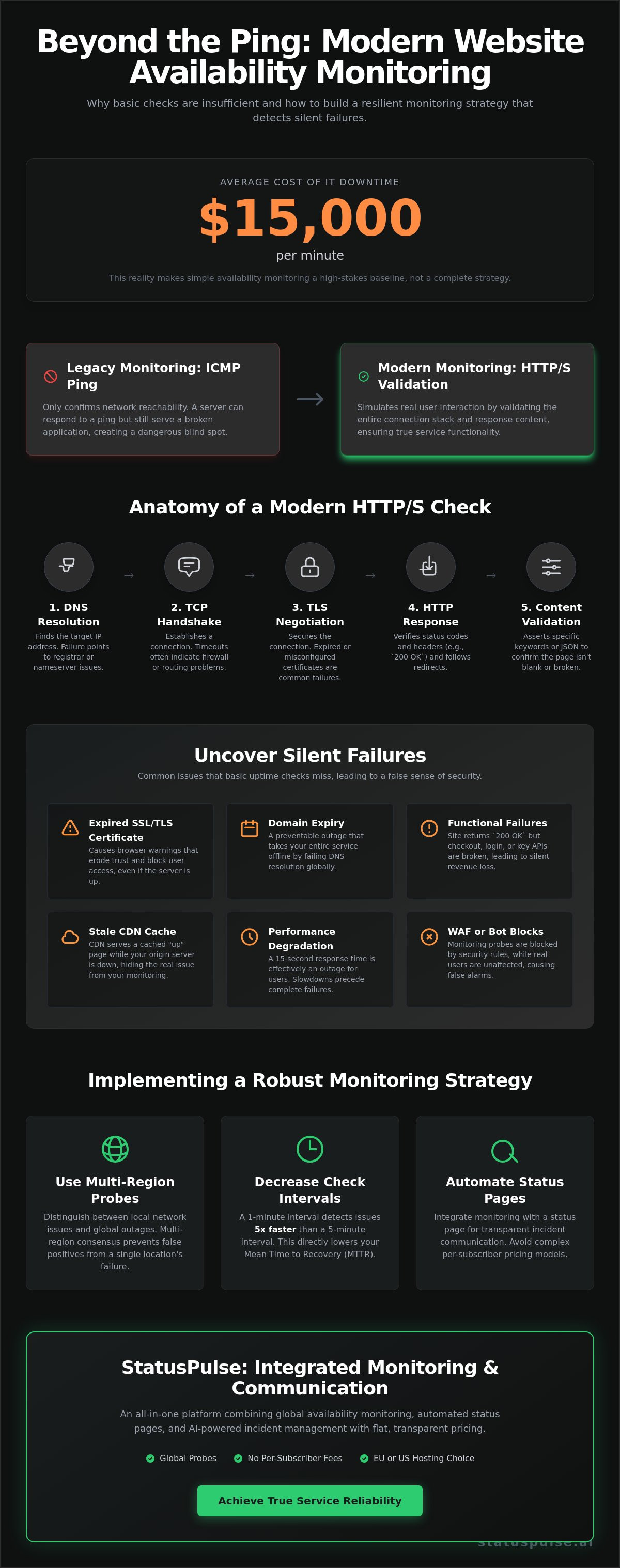
Reliable website availability monitoring relies on a precise execution of network protocols. It doesn't just ask if a server is there. It follows a strict lifecycle. First, the monitoring probe performs a DNS resolution to find the target IP. Then, it initiates a TCP handshake to establish a connection. Finally, it performs a TLS negotiation to secure the data transfer. Any failure in this chain provides immediate diagnostic data. For instance, a DNS failure suggests a registrar or nameserver issue, while a TCP timeout often points to a firewall or routing problem.
A robust website availability monitoring strategy also requires validating the entire response body and its metadata. HTTP response headers are your first line of defense. They reveal more than just status codes. Headers like `X-Cache` help you determine if a success response came from a CDN edge while your origin was actually down. We recommend using specific bypass-cache headers to ensure your probes reach the application server. Without `Cache-Control: no-cache`, you might receive a false positive from a stale cache. Consistent user-agent strings are also vital for bypassing WAF rules that might block generic bot traffic. This ensures your monitoring traffic reflects actual user experience rather than being treated as a malicious crawler.
Anatomy of an HTTP/S Check
The TLS handshake is the most common point of silent failure in 2026. Probes must also manage redirects. Following a 301 or 302 redirect is often necessary, but you should configure your checks to fail if the redirect chain exceeds a specific limit or leads to a known-bad domain. Timeout thresholds are equally critical. If a response takes 15 seconds, your site is effectively unavailable to a human user. Setting aggressive timeouts helps you identify latency before it becomes a total outage. This level of granularity is essential for maintaining a high-performance production environment.
Advanced Check Logic: Keywords and Content
Checking for a status code isn't enough for complex stacks. Keyword monitoring asserts that specific strings, like "Welcome" or "Logout," appear on the page. This prevents scenarios where your server returns a 200 OK but displays a blank screen. For API-first architectures, JSON validation allows you to verify specific data structures. You can use regex to match dynamic content that changes based on user sessions or geographic regions. If you're managing complex endpoints or headless apps, StatusPulse provides the technical depth to validate these workflows without adding complexity to your stack. This approach catches functional errors that simple uptime checks would miss, ensuring your services are truly reliable.
Beyond Up/Down: Identifying Silent Failures
A site can return a 200 OK status while still being effectively dead to your users. These silent failures are often missed by standard website availability monitoring tools that only look for basic reachability. If your SSL certificate expires or your domain registration lapses, your server might be running perfectly, but no one can reach it. Similarly, if a critical third-party API fails, your frontend might load while your checkout button does nothing. True reliability requires monitoring every layer of the stack, from the registrar to the backend integration.
Latency is another form of silent failure. In 2026, 98% of organizations report that an hour of downtime costs over $100,000. High latency often signals an impending crash or a saturated resource. If your Time to First Byte (TTFB) spikes from 200ms to 5s, your users will leave before the page ever loads. Your website availability monitoring strategy should treat these latency spikes with the same urgency as a total blackout. Slow is the new down, and your monitoring logic must reflect that reality.
The High Cost of SSL Surprises
Expired certificates are a leading cause of preventable downtime. A "Connection Not Private" warning kills conversion rates and erodes user trust instantly. You need to automate lookups that check the entire certificate chain and alert your team weeks before the expiration date. This proactive approach ensures you aren't caught off guard by a failed auto-renewal. For a deeper look at the business impact, see our guide on SSL Certificate Monitoring: No More Unexpected Outages. It's about preventing the outage before the browser blocks your traffic.
Synthetic API Health Checks
Modern apps are often just shells for various microservices. Basic uptime checks won't tell you if your payment gateway or database is failing. You must implement synthetic checks that test POST or PUT requests to verify that backend services are truly operational. Differentiating between a 401 Unauthorized and a 500 Internal Server Error helps your team pinpoint whether the issue is a credential rotation failure or a code bug. Using dedicated API monitoring allows you to catch microservice failures before they cascade into a full site outage. This focused approach ensures your integrations aren't the weak link in your availability chain.
Implementing a Robust Monitoring Strategy
A successful framework for website availability monitoring moves beyond reactive firefighting. It starts with identifying your critical path. Don't waste resources monitoring every static asset. Instead, focus on the endpoints that drive your business logic, such as your authentication service or checkout API. Set your check intervals to one minute. This is the professional standard for SaaS because it provides enough data to identify trends without overwhelming your logs.
Your second step is establishing multi-region consensus. A single probe location is a single point of failure. If a probe in New York reports an outage while London and Frankfurt are green, the problem is likely regional network congestion. Configure your logic to require at least two or three failing regions before triggering a critical alert. Once confirmed, integrate these alerts directly into your workflow via Slack, PagerDuty, or custom Webhooks. Finally, connect your monitoring to a public status page to automate incident communication and maintain transparency with your users.
Escalation Policies and Alert Fatigue
Not every blip is an emergency. Use retries to confirm an outage before paging your on-call engineer. A common pattern is to wait for three consecutive failures across multiple regions. You should also differentiate between alert levels. A latency spike might trigger a "Warning" in Slack, while a total 5xx error response triggers a "Critical" incident. This hierarchy ensures that your team only receives high-priority interruptions when human intervention is strictly necessary. Professional uptime monitoring depends on this balance to prevent burnout.
EU vs. US Hosting: Data Sovereignty
Data residency is a core requirement for many organizations, particularly those operating in Europe. Many monitoring providers default to US-based hosting, which can complicate GDPR compliance for your logs and metadata. You should choose a provider that offers a choice between EU and US hosting regions. This ensures your monitoring data stays within your required jurisdiction while still utilizing a global probe network for testing. Balancing geographic reach with localized data sovereignty is essential for modern regulatory standards.
For teams that value both precision and privacy, StatusPulse provides a compliant website availability monitoring platform that integrates uptime checks with automated incident communication. You get the technical depth of multi-region probes and the peace of mind of EU-based data residency without the complexity of traditional enterprise bloat.
StatusPulse: Integrated Monitoring and Incident Communication
Technical reliability is a communication problem as much as an engineering one. Many legacy providers silo your website availability monitoring data away from your status page. This creates a manual bottleneck during an outage. When a service fails, you shouldn't have to toggle between dashboards to update your users. StatusPulse eliminates this friction by integrating uptime checks, SSL monitoring, and API validation with automated incident management in a single platform.
Our approach to pricing reflects our commitment to transparency. We don't charge per subscriber for your status pages. Industry incumbents often penalize your growth by scaling costs as your audience expands. We believe that communicating with your customers during a crisis is a fundamental requirement, not a premium add-on. By offering flat, predictable pricing, we ensure your costs remain stable regardless of how many users sign up for your updates.
The platform also includes native SSL and API checks. This means you can track the entire health of your stack without managing multiple subscriptions. As we discussed in previous sections, identifying silent failures like expired certificates or broken JSON responses is critical. Having this data in one dashboard allows for faster root-cause analysis and more accurate reporting for your stakeholders.
Automating Transparency with AI
During an active incident, every second counts. Our AI incident management assistant analyzes your monitoring logs to draft honest, technical updates. It summarizes complex failures into readable status changes, which helps reduce the volume of support tickets. You can maintain site uptime monitoring and keep your users informed without the manual overhead of drafting every update from scratch. The human remains in control, but the assistant handles the heavy lifting of data synthesis.
Choosing Your Hosting Region
We prioritize data sovereignty by letting you choose between EU and US hosting for your account. For European development teams, this ensures that your logs and metadata are stored in compliance with local privacy standards. We don't treat regulatory requirements as an afterthought. Whether you need to meet GDPR mandates or simply prefer localized data residency, you have full control over where your monitoring hub resides. Start monitoring with StatusPulse to see how a technical, principled approach to reliability can simplify your operations and build trust with your users.
Establishing Long-Term Service Reliability
Effective website availability monitoring requires moving past the binary "up or down" mindset. By validating the entire request lifecycle and tracking silent failures like SSL expiration, you protect your site from the outages that basic pings miss. A robust strategy depends on multi-region consensus and technical precision to ensure that alerts are both accurate and actionable for your team.
Reliability shouldn't be complicated by corporate bloat or unpredictable costs. StatusPulse offers a straightforward alternative with flat-rate pricing and a dedicated focus on data sovereignty through EU-based hosting options. Our AI-powered incident management assists you in drafting honest updates; this ensures you can focus on technical resolution while your users stay informed. Build a more reliable stack with StatusPulse. You're ready to turn technical challenges into a foundation of trust and consistent performance.
Frequently Asked Questions
What is the difference between uptime and availability?
Uptime measures if the server or process is running. Availability measures if a user can actually complete a request. A site might have 100% uptime but 0% availability if the network or a critical dependency is broken. Modern website availability monitoring focuses on the end-user request lifecycle rather than just process health. This ensures you catch functional failures that basic server pings miss.
How often should I monitor my website availability?
You should monitor your critical endpoints every minute. This 60-second interval is the professional standard for catching outages before they impact a significant portion of your traffic. Using longer intervals like 5 or 10 minutes increases your Mean Time to Recovery (MTTR) significantly. Frequent checks provide the granular data needed for accurate SLA reporting and rapid incident response without adding excessive load to your origin.
Can website monitoring detect slow page loads?
Yes, monitoring tools detect latency by measuring the time between the request and the response. You can set specific timeout thresholds to trigger alerts when performance degrades. If a page takes 10 seconds to load, it's effectively unavailable to most users. Tracking metrics like Time to First Byte (TTFB) helps you identify backend bottlenecks before they lead to a total service blackout.
Is multi-region monitoring necessary for a local business?
Multi-region monitoring is vital even for local businesses to ensure consensus. it prevents false positives caused by a single network hiccup between a specific probe and your server. If probes in two distinct regions both report a failure, you know the issue is with your infrastructure rather than a regional ISP. This approach reduces unnecessary 2 AM pages and builds confidence in your alerting logic.
How does SSL certificate monitoring prevent downtime?
SSL monitoring tracks the validity and expiration dates of your certificates. It alerts your team weeks in advance so you can renew before browsers start blocking your traffic. This prevents the "Connection Not Private" errors that kill conversion rates instantly. Automated lookups ensure you aren't caught off guard by a failed auto-renewal or a broken certificate chain that appeared valid during initial deployment.
What are the most common causes of website downtime in 2026?
In 2026, common causes include expired SSL certificates, DNS misconfigurations, and silent failures in third-party APIs. Infrastructure outages remain a threat; 80% of data centers experienced at least one outage in the past three years. With the average cost of IT downtime reaching $15,000 per minute, these failures represent a massive financial risk. Robust website availability monitoring is your primary defense against these recurring industry patterns, though following security best practices from HJS Technology Ltd is equally vital for overall resilience.
How do I reduce false positive alerts in my monitoring tool?
Use a retry policy and multi-region checks to filter out transient network noise. Don't trigger a high-priority alert until at least two distinct geographic probes confirm the failure across multiple consecutive checks. This hierarchy ensures that your team only receives interruptions when human intervention is strictly necessary. Differentiating between "Warning" for latency and "Critical" for downtime also helps manage your team's attention effectively.
Why should I use a public status page for incident communication?
A public status page serves as a single source of truth during an incident. It reduces the burden on your support team by proactively communicating the state of your services to your users. Automated updates based on your monitoring data build trust through transparency. By providing a clear record of your uptime and incident history, you demonstrate professional accountability and commitment to service reliability.


