

In October 2025, a DNS failure at AWS impacted over 3,500 companies across 60 countries. It wasn't a hardware crash. It was a silent conflict between two management components. You've likely felt this same frustration. Your servers are healthy, but your users see a timeout because a CNAME looped or an SPF record drifted into a spam filter. DNS is the single point of failure that teams often ignore until the status page turns red.
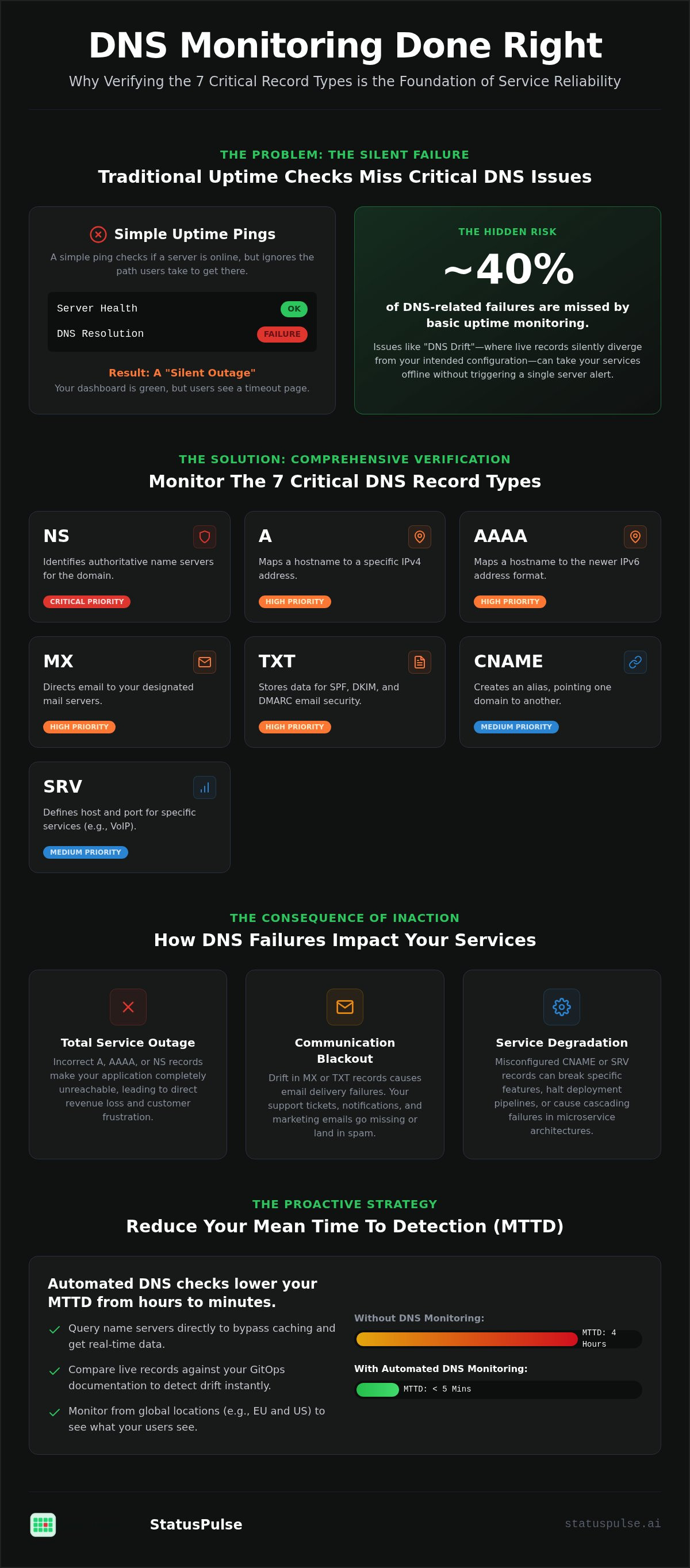
Effective infrastructure management requires DNS Monitoring Done Right: 7 Record Types that go beyond simple resolution checks. Following the 2026 NIST SP 800-81r3 guidance, DNS is now a critical security control. You must verify that your global pointer records haven't drifted from their intended state. This article explains how to monitor the seven critical records to prevent silent outages and mail delivery failures. We'll look at specific configurations for A, MX, and TXT records. This approach helps you lower your Mean Time to Detection (MTTD) and maintain a transparent status page for your users.
Key Takeaways
- Understand why simple uptime pings miss nearly 40% of DNS-related failures and how to build a foundation for true service reliability.
- Master DNS Monitoring Done Right: 7 Record Types including A, CNAME, and MX to prevent silent outages and email delivery issues.
- Identify "DNS Drift" by comparing live records against GitOps documentation to detect unauthorized changes before they impact your users.
- Reduce your Mean Time to Detection (MTTD) by automating synthetic DNS checks that query specific name servers directly.
- Learn to translate technical DNS failures into plain language on your status page to maintain transparency and trust during disruptions.
Why DNS Monitoring is the Foundation of Service Reliability
DNS acts as the map of your infrastructure. If the map points to the wrong destination, your service is effectively down. Standard uptime tests often miss a significant portion of DNS-related failures. A server might respond to a ping. New users still cannot find you if records are misconfigured. This is why DNS Monitoring Done Right: 7 Record Types focuses on the integrity of the records themselves, not just the availability of the endpoint.
DNS monitoring is the automated, continuous verification of record values and resolution speed across global networks. It ensures that what you've documented in your GitOps workflow matches what the public internet sees. Without this verification, you risk "DNS drift." This occurs when records change due to human error, provider migrations, or malicious interference. A stable strategy for DNS Monitoring Done Right: 7 Record Types requires understanding how these records interact with modern resolvers. The cost of drift is high. It leads to security vulnerabilities and lost revenue during critical infrastructure shifts.
The Silent Failure: Why DNS Issues Go Unnoticed
DNS issues are difficult to debug because of caching. Your internal team might see a functioning site while users in a different region face timeouts. This happens because local recursive resolvers store old data based on the Time to Live (TTL) settings. These resolvers mask configuration errors until the cache expires. By then, the outage is already widespread. Unauthorized changes, such as DNS hijacking, can also redirect traffic without ever triggering a server-side alert. You need a monitoring strategy that queries name servers directly to bypass these blind spots.
The Impact on Modern Distributed Stacks
Modern infrastructure is rarely static. Multi-cloud environments and global traffic management add layers of complexity to how names are resolved. Microservices rely on both internal and external DNS health to communicate. A single broken CNAME can halt an entire deployment pipeline. Holistic uptime monitoring must include DNS health to provide a complete picture of reliability. StatusPulse addresses this by offering global monitoring nodes in both the EU and US. This allows you to verify resolution from the same regions where your customers reside, ensuring data sovereignty and technical precision.
The 7 Critical DNS Record Types for Modern Stacks
To implement DNS Monitoring Done Right: 7 Record Types, you must first categorize your records by their impact on your service availability. Not every record carries the same weight. A misconfigured A record causes an immediate total outage. A drifted TXT record might only be noticed when your outbound emails start hitting spam folders three days later.
| Record Type | Purpose | Monitoring Priority |
|---|---|---|
| A | Maps hostname to IPv4 address | High |
| AAAA | Maps hostname to IPv6 address | High |
| CNAME | Creates an alias for a canonical name | Medium |
| MX | Directs mail to a mail server | High |
| TXT | Metadata for SPF, DKIM, and DMARC | High |
| NS | Identifies authoritative name servers | Critical |
| SRV | Service discovery for specific protocols | Medium |
Core Routing: A, AAAA, and CNAME
A and AAAA records are the foundation of uptime. While A records handle IPv4 traffic, AAAA records are no longer optional. As IPv6 adoption grows globally, failing to monitor AAAA records can lead to "partial outages" where mobile users or specific ISPs cannot reach your API. CNAME records simplify management by creating aliases. They also introduce risks like CNAME loops or "flattening" issues where the root domain behaves unexpectedly. Monitoring these for unauthorized IP changes is the first step in preventing hijacking.
Communication and Security: MX and TXT
MX records define your mail routing. A single incorrect priority number or a typo in the mail server hostname will kill your inbound communication. TXT records serve as the catch-all for domain-level metadata and verification. They're the home of SPF, DKIM, and DMARC. If these records drift, your domain's reputation suffers. DNS Monitoring Done Right: 7 Record Types ensures that these security strings remain exactly as your IT team intended, preventing "security drift" that attackers exploit for phishing.
Authority and Discovery: NS and SRV
NS records define which servers are authoritative for your zone. If these are swapped without your knowledge, an attacker gains full control of your traffic. You also face the risk of "lame delegation," where NS records point to non-responsive servers, causing resolution timeouts. SRV records are the unsung heroes of service discovery. They're essential for VoIP, SIP, and specialized API discovery. If you use automated scaling, verifying that SRV records point to healthy, active nodes is vital for internal service communication. You can track these critical changes across global regions using uptime monitoring nodes to ensure your authority remains intact.
Beyond 'It Resolves': Detecting DNS Drift and Misconfigurations
Technical teams often fall into the trap of checking only if a domain resolves. This is a binary view of a complex system. True reliability requires detecting "DNS Drift." This occurs when the live state of your records deviates from your source of truth, such as a GitOps repository or internal documentation. If your infrastructure as code (IaC) expects one IP but the public resolver returns another, your environment is in an inconsistent state.
Time to Live (TTL) values play a decisive role in how quickly you can recover from these inconsistencies. A high TTL reduces query load but extends the duration of an outage during a failover. Conversely, a low TTL allows for rapid updates but can increase latency for users. DNS Monitoring Done Right: 7 Record Types involves verifying that your TTLs are optimized for your specific recovery time objectives (RTO). Monitoring from a single location is a technical blind spot. It fails to account for regional cache poisoning or localized routing issues that only affect a subset of your global user base.
Monitoring for Global Propagation
Detecting regional failures requires monitoring nodes distributed across different geographic zones. StatusPulse provides the option to monitor from both EU and US regions. This supports data sovereignty and allows you to see exactly what users in different jurisdictions experience. You should distinguish between authoritative lookups and recursive resolution. Authoritative checks verify the source records on your name servers. Recursive checks simulate the path a typical user's query takes through ISPs. Both are necessary to identify where the chain of trust is breaking.
The Danger of Stale Records
Orphaned records are a primary security risk. An orphaned CNAME occurs when a record points to a resource that has been decommissioned, such as a deleted S3 bucket or a closed GitHub Pages account. Attackers can claim these external resources and effectively hijack your subdomain. Automated monitoring flags these discrepancies by verifying that the destination of every alias is still active and valid. Regular audits are essential to maintain a clean zone file.
Use this checklist for your monthly DNS health audit:
- Verify that all CNAME targets are active and owned by your organization.
- Check for trailing dots in zone files to prevent unintended relative path resolutions.
- Audit MX priorities to ensure secondary servers are still operational.
- Remove TXT records used for one-time domain verifications (e.g., old SSL or SaaS tokens).
- Confirm that NS records point only to your current authoritative providers.
By treating DNS as a dynamic state rather than a static configuration, you reduce the risk of "silent" outages. This proactive approach is the core of DNS Monitoring Done Right: 7 Record Types. It ensures your infrastructure remains resilient against both human error and targeted attacks.
Implementation: Setting Up Automated DNS Record Checks
Moving from manual audits to automated verification is the core of DNS Monitoring Done Right: 7 Record Types. You cannot rely on ad-hoc dig commands to catch drift. A structured implementation ensures that every critical record is validated every minute, regardless of whether you're actively making changes. Start by creating an inventory of your critical endpoints and their expected values, including A, AAAA, MX, and TXT records.
Effective automation follows a clear five-step process:
- Inventory: Document every public-facing hostname and its expected IP or alias.
- Synthetic Checks: Configure checks that query your authoritative name servers directly to bypass caching.
- Thresholds: Set alerts for value changes or resolution latency exceeding 500ms.
- Integration: Connect these alerts to StatusPulse or your preferred incident management tool.
- Status Page Automation: Configure your status page to update automatically when a DNS failure is confirmed.
Defining Your Alerting Logic
To avoid alert fatigue, your monitoring system shouldn't trigger a page on a single failure. A robust logic requires at least two consecutive failures from three distinct geographic locations before escalating. Monitoring resolution latency is a leading indicator of DNS provider issues. If latency spikes consistently, it often precedes a total resolution failure. One-minute check intervals are the industry standard for high-availability apps to ensure your Mean Time to Detection (MTTD) remains as low as possible.
Synthetic vs. Real User Monitoring (RUM)
Synthetic monitoring is superior for DNS because it doesn't rely on existing user traffic to detect a problem. If your DNS is down, RUM data stops flowing entirely, leaving you blind. Synthetic checks allow you to verify record changes before they hit 100% of your users. This is particularly useful during migrations where you can point a check at a new IP to confirm it resolves correctly before updating the live record. Integrating these checks into your API monitoring strategy creates a holistic view of your service health. You can start building these automated checks today by setting up uptime monitoring with StatusPulse to secure your infrastructure.
Integrating DNS Health into Your Incident Response Workflow
DNS failures are notoriously opaque for end-users. When a resolver fails, your customers don't see a branded error page. They see a generic browser timeout. This lack of clarity often leads to a surge in support tickets that your team isn't equipped to handle during an active incident. By implementing DNS Monitoring Done Right: 7 Record Types, you gain the granular data needed to fuel a transparent communication strategy.
The goal of incident response is to bridge the gap between technical reality and user perception. Telling users "the site is down" is too broad and often inaccurate. If your servers are healthy but your DNS provider is experiencing a DDoS attack, your status page should reflect that specific reality. StatusPulse uses AI to summarize the impact of these failures for your customers. It translates raw resolution errors into plain English, explaining that the issue is external to your application. This level of honesty builds long-term trust with your user base.
Automating Status Page Updates
Your DNS monitor should connect directly to your public status page. This automation removes the manual overhead of updating users during the critical first minutes of an outage. When a DNS monitor detects a confirmed failure, it can trigger a specific incident state like "DNS Resolution Issues." This precision helps users understand that the problem might be localized to their ISP or region. Given that IT downtime costs averaged $14,056 per minute in 2024, every second saved in communication reduces the overall business impact.
Regional status updates are particularly important for DNS-specific outages. Because DNS relies on a global network of resolvers, a failure in one geographic zone might not affect another. StatusPulse allows you to report on regional health individually. This prevents unnecessary alarm for users in the EU if the issue is strictly localized to a US-West resolver. It's a more logical way to manage high-availability infrastructure without over-communicating to unaffected segments.
Choosing a Principled Monitoring Partner
Selecting a monitoring tool is as much about ethics as it is about features. Many industry incumbents use complex pricing models that include per-subscriber fees. We view these fees as a "corporate tax" on your growth. StatusPulse offers a flat pricing model that doesn't penalize you for having a large audience. This straightforward approach mirrors the simplicity we build into our software.
For teams focused on data sovereignty, we provide the choice between EU and US-based hosting. This ensures your monitoring data remains within your preferred jurisdiction, supporting GDPR compliance without sacrificing performance. If you're tired of corporate bloat and want a tool built by specialists for specialists, it's time to change your approach. You can start monitoring your DNS records with StatusPulse today to ensure your infrastructure remains reliable and your communication stays transparent.
Secure Your Infrastructure with Proactive DNS Verification
DNS is no longer just a resolution tool. It's a frontline security control. Implementing DNS Monitoring Done Right: 7 Record Types ensures that your global traffic management remains consistent with your documentation. You've learned how to identify drift in TXT records and prevent the silent failures caused by orphaned CNAMEs. These steps reduce your Mean Time to Detection (MTTD) and keep your status page accurate during regional disruptions.
Reliable monitoring doesn't have to be complex or expensive. StatusPulse provides a principled alternative to bloated enterprise tools. We offer AI-powered incident management and the choice between EU or US hosting for full data sovereignty. Our flat-rate pricing model means you won't face per-subscriber taxes as your audience grows. This straightforward approach allows your DevOps team to focus on resolution rather than billing cycles.
Integrity in infrastructure starts with verifying every record. Build trust with a StatusPulse public status page and start monitoring your critical records today. Your users deserve transparency, and your team deserves a tool that works as hard as they do. Stay proactive and keep your services reachable.
Frequently Asked Questions
What is the most important DNS record to monitor for uptime?
The A record (and AAAA for IPv6) is the most critical because it maps your hostname to a physical IP address. If this record is missing or incorrect, your service is unreachable. You should also prioritize NS records. These define your authoritative servers; if they fail, no other records will resolve. Monitoring both ensures your foundation remains stable.
How often should I check my DNS records for changes?
You should check your DNS records every 60 seconds for high-availability services. This 1-minute interval is the industry standard for production environments. Frequent checks allow you to detect unauthorized changes or "DNS drift" almost instantly. This minimizes the impact of misconfigurations before they propagate to global resolvers and affect your users.
Can DNS monitoring detect if my domain has been hijacked?
Yes, monitoring detects hijacking by flagging unexpected changes in your NS or A records. If an attacker gains access to your registrar and points your domain to their own name servers, a synthetic check will alert you immediately. This is a core part of DNS Monitoring Done Right: 7 Record Types. It verifies that your live state matches your documented intent.
What is DNS propagation and how does monitoring help?
DNS propagation is the time it takes for changes to spread across global recursive resolvers. Monitoring helps by querying multiple geographic nodes to see which regions have updated and which are still serving stale data. This transparency is vital during migrations. It lets you know exactly when your new configuration is live for your entire global user base.
Should I monitor DNS resolution time or just the record value?
You must monitor both. While the record value ensures users reach the correct server, resolution time is a leading indicator of provider health. A spike in latency often precedes a total outage. If resolution takes longer than 500ms, your users will experience perceived slowness, even if the record itself is technically correct. Proactive latency tracking prevents performance degradation.
What happens if my MX records are configured incorrectly?
Incorrect MX records result in immediate email delivery failures. Senders will receive bounce-back messages, and your organization will stop receiving all inbound mail. Monitoring these records ensures that priority levels and mail server hostnames remain valid. This prevents "security drift" where misconfigured records might lead to mail being routed through unauthorized or insecure servers, risking your data integrity.
How do I monitor DNS records across multiple geographical regions?
Use a monitoring service with distributed global nodes. StatusPulse allows you to choose between EU and US-based hosting to query records from different jurisdictions. This identifies localized issues, such as regional cache poisoning or routing failures. It's the only way to ensure your service is reachable for a global audience, rather than just from your specific office network.
What is the difference between an A record and a CNAME record for monitoring?
An A record maps a hostname to an IP address, while a CNAME maps a hostname to another hostname. For monitoring, an A record failure is usually a direct pointer issue. A CNAME failure is often more complex because it depends on the health of the target domain. Monitoring CNAMEs requires verifying the entire resolution chain to prevent outages or subdomain takeovers.


