

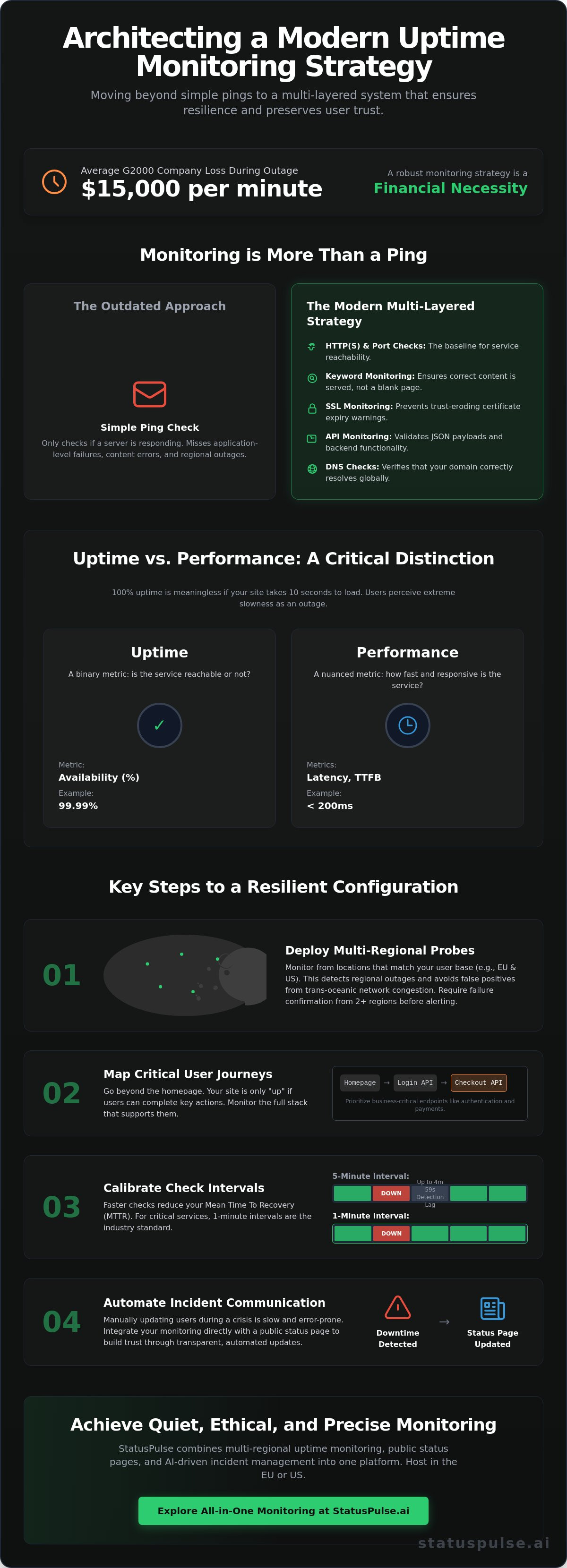
The average Global 2000 company now loses $15,000 every minute during an unplanned outage. This reality makes a robust site uptime monitoring strategy a financial necessity rather than a technical luxury. You've likely felt the drain of alert fatigue from false positives or the panic of an unexpected SSL certificate expiry. It's frustrating when complex monitoring tools claim to help but only add to the noise and corporate bloat.
We believe monitoring should be quiet, ethical, and precise. This guide explains how to architect a multi-layered strategy that catches failures before your users notice them. You'll learn to automate incident communication and maintain 99.99% visibility while respecting EU data sovereignty. We'll move beyond simple pings to a system that handles everything from API health to AI-driven incident response, ensuring your stack remains resilient in 2026.
Key Takeaways
- Modern site uptime monitoring requires multi-regional HTTP(S) and DNS checks to verify global accessibility beyond simple homepage pings.
- Map critical endpoints like authentication services and checkout APIs to ensure your monitoring strategy mirrors actual user traffic patterns.
- Detect regional outages and latency spikes by deploying monitors across diverse geographic locations to prevent localized failures.
- Automate the transition from downtime detection to public status updates to reduce manual overhead and maintain user trust during incidents.
- Select tools that provide a choice between EU and US hosting to align your infrastructure with regional data sovereignty requirements.
What is site uptime monitoring in a modern stack?
Site uptime monitoring is the automated process of verifying web availability from multiple global locations. It isn't just a simple ping to see if a server is breathing. Modern stacks require periodic HTTP(S), Port, and DNS checks to ensure every layer of the service remains accessible to the end user. Website monitoring serves as the first line of defense against silent failures that internal logs might miss. Technically, uptime is defined as the ratio of available time to total time within a specific measurement window. For most production environments, this is expressed through "nines" of availability.
The difference between uptime and performance
Uptime is a binary metric. Your service is either reachable or it isn't. Performance monitoring tracks the nuance between those states, specifically measuring latency and Time to First Byte (TTFB). You might achieve 100% uptime on paper, but if your page takes 10 seconds to load, it's an outage in the eyes of your customers. Users don't distinguish between a 503 error and a non-responsive UI. High availability requires both reachability and acceptable response times. If your monitoring tool only checks for a heartbeat, you're missing the slow degradation that leads to customer churn.
Layered monitoring: Beyond the HTTP 200 OK
A standard HTTP 200 OK status code can be deceptive. A web server might return a successful header while serving a blank white page or a broken database connection string. To build a resilient strategy, you need to look deeper into the response body. Keyword monitoring ensures the expected content actually rendered on the client side. If your "Add to Cart" button is missing, the site isn't functional. The server is up, but the service is down.
SSL monitoring is another critical layer. Expired certificates trigger aggressive "Connection Not Private" browser warnings that kill user trust instantly. Tracking expiration dates and certificate chain validity allows your team to rotate secrets before they become an emergency. Validating JSON payloads is the core of API monitoring. It checks that your backend isn't just responding, but is returning the specific data structures required for your application to function. Comprehensive site uptime monitoring must account for these technical dependencies to provide a true picture of health.
5 Steps to configuring robust site uptime monitoring
High availability isn't an accident. It's the result of a deliberate configuration that mirrors your actual system architecture. Effective site uptime monitoring starts with identifying your most critical endpoints. While your homepage is the most visible, your authentication services and checkout APIs are often more vital for business continuity. If these fail, your users are effectively locked out, regardless of whether the front-end is still serving static assets.
A resilient setup requires a logical sequence of deployment. You must select probe locations that match your traffic, set intervals that respect your SLA, and ensure alerts reach the right people through multiple channels. Finally, integrating these checks with a public status page removes the manual burden of incident communication. For teams looking to streamline this process, an all-in-one monitoring and status page platform can bridge the gap between detection and transparency.
Step 1: Selecting your monitoring locations
If your users are primarily in Berlin and New York, monitoring only from a data center in Tokyo will provide misleading latency data. Worse, it might trigger false positives due to transpacific network congestion that doesn't affect your core audience. The Annual Outage Analysis indicates that localized infrastructure failures are becoming more frequent. To avoid alert fatigue, configure your system to require failure confirmation from at least two distinct regions before escalating.
Content Delivery Networks (CDNs) like Cloudflare add another layer of complexity. A "green" status from a global probe might only mean the edge cache is reachable, while your origin server is actually down. You need a status page for multi-region services to accurately reflect the health of your origin versus your edge. This ensures technical teams see the truth while users get a clear picture of regional availability.
Step 2: Calibrating check intervals
Check intervals are a direct lever for your Mean Time to Recovery (MTTR). For high-traffic SaaS applications, 1-minute checks are the industry standard. If you rely on 5-minute intervals, a service could be down for nearly 300 seconds before your team even receives the first notification. This delay is unacceptable for production environments where every second of downtime carries a specific financial cost.
While 5-minute or 10-minute checks might be sufficient for internal documentation or low-priority marketing sites, they are a dangerous choice for revenue-critical paths. Don't fall for the myth of free monitoring that offers slow intervals. These "free" tiers often hide the true cost of delayed detection. Investing in high-frequency monitoring ensures you catch micro-outages and flapping services before they escalate into total system failures.
Monitoring global latency and regional availability
Regional outages are often silent. Monitoring from a single data center creates a massive blind spot. If your primary probe is in Frankfurt, you won't see the routing failure affecting your users in Paris. High-fidelity site uptime monitoring requires a distributed approach. Synthetic monitoring simulates real user journeys across global nodes. This reveals localized issues that internal health checks might miss. Multi-region probes identify localized ISP issues by isolating connectivity failures to specific geographic paths rather than the origin server.
Latency is a leading indicator. A sudden spike in response time often signals database exhaustion or a misconfigured load balancer. Tracking these metrics allows you to intervene before a slow site becomes a hard outage. When Time to First Byte (TTFB) increases significantly, it's usually a sign that your infrastructure is reaching a breaking point. Monitoring these trends globally ensures you provide a consistent experience for every user, regardless of their location.
The role of DNS and SSL in global uptime
DNS is a common point of failure. Unauthorized record changes or TTL-related propagation delays can drop your traffic to zero instantly. Monitoring your DNS records ensures your infrastructure remains correctly mapped. SSL certificate health is equally vital. Don't rely on manual calendars. Automate expiry checks to trigger alerts 30, 15, and 7 days before the deadline. This gives your team ample time for rotation without emergency pressure. For deeper visibility into backend health, implement robust API monitoring to validate the data structures powering your global services.
Reducing alert fatigue with confirmation logic
Alert fatigue destroys DevOps productivity. If your phone buzzes for every transient network blip, you'll eventually ignore a real disaster. Use "Consecutive Failures" settings to filter out noise. Requiring two or three failed checks before sending a notification ensures the issue is persistent. This simple filter prevents unnecessary context switching for your engineering team.
Another effective strategy is "X of Y" location logic. You might only trigger a high-priority alert if at least 3 out of 5 global nodes report a failure. This prevents localized ISP congestion from waking up an on-call engineer for a problem they can't fix. There is a clear trade-off here. High sensitivity catches every micro-outage but increases noise. Low sensitivity provides high-fidelity alerts but might delay your response by a few minutes. Finding the right balance depends on your specific SLA and user expectations.
Bridging the gap: From detection to incident communication
Detection is only half the battle. While site uptime monitoring alerts your on-call engineer, it does nothing to reassure your users. An outage without an explanation leads to a flood of identical support tickets; this wastes your team's time when they should be focused on the root cause. Effective incident management bridges the gap between raw technical data and human transparency.
Automating the workflow from a "Down" alert to an "Investigating" status update is critical. It removes the friction of manual reporting during the initial panic of a system failure. When your monitoring probe confirms a persistent issue, your status page should update instantly to acknowledge the problem. This immediate transparency filters out support requests and proves that your team is already on the case.
Building trust with public status pages
Move away from vague "Maintenance" banners or generic "Service is down" messages. Honesty is a competitive advantage. Showing historical availability data, even when it isn't perfect, builds long-term credibility with your customers. A public record of your reliability proves you prioritize integrity over marketing gloss. You can find more on this in our uptime monitoring developer’s guide.
Transparency also means being granular. If only your checkout API is failing, don't mark the entire system as down. Use your status page to show that your homepage and search functions are still operational. This precision helps users understand exactly which parts of your service they can still rely on, further reducing the load on your support team.
AI-powered incident management
AI can now summarize technical root causes for non-technical stakeholders by analyzing error logs and stack traces. This reduces the time spent translating "504 Gateway Timeout" into "We are experiencing high traffic volume." However, we believe in human agency. AI drafts the update, but an engineer must approve it before it goes live. This ensures accuracy while maintaining the speed required for modern DevOps.
StatusPulse’s native AI incident management tools are built specifically for this workflow. By centralizing site uptime monitoring and status updates, you eliminate the need to jump between multiple complex tools. This streamlined approach allows a small team to manage large-scale incidents with precision. If you want to reduce support overhead during outages, you can configure your automated status page to sync directly with your monitors.
Choosing a site uptime monitoring tool for 2026
Selecting a site uptime monitoring provider involves more than counting global probe locations. In a technical landscape defined by regional regulations and complex stacks, your choice of tool directly impacts your operational overhead. You should evaluate platforms based on three core pillars: check frequency, probe density, and integration depth. High-traffic services require 1-minute intervals as a baseline, but the tool must also offer the technical flexibility to monitor SSL chains and API payloads within the same dashboard.
Avoid providers that utilize "corporate bloat" pricing models. Many industry incumbents punish your success by charging per subscriber or per alert. A transparent, flat pricing model is more than just a cost-saving measure; it represents an ethical approach to software. By choosing an all-in-one platform that centralizes monitoring, SSL tracking, and status pages, you eliminate the friction of managing multiple vendor contracts and disparate data streams.
Data sovereignty and compliance
For SaaS teams operating in Europe, data sovereignty is a technical requirement, not a marketing checkbox. Using a monitoring provider that defaults to US-based hosting can complicate GDPR alignment and introduce unnecessary legal risk. You need the ability to choose where your monitoring data resides. StatusPulse provides a dedicated choice between EU and US hosting to ensure your infrastructure remains compliant with regional data privacy standards [VERIFY: StatusPulse GDPR citation].
There is also a technical benefit to regional hosting. Monitoring from the same geographic region as your users provides a more accurate representation of their experience. It reduces the noise caused by trans-oceanic network jitter. This precision allows your team to distinguish between a genuine service degradation and a transient global routing issue.
Implementation: Starting with StatusPulse
Setting up a resilient monitoring strategy shouldn't require a week of configuration. You can start by deploying a standard HTTP monitor for your primary endpoint and linking it to a public status page. This creates an immediate feedback loop between your infrastructure and your users. Once the basics are in place, you should expand your visibility by enabling specific checks for your critical dependencies:
- API Monitoring: Validate JSON responses to ensure backend logic is functioning correctly.
- SSL Certificate Monitoring: Track the entire certificate chain to prevent browser trust errors.
- AI Incident Management: Use drafted summaries to communicate technical issues to stakeholders quickly.
A 360-degree view of your stack ensures that no failure goes undetected. If you are ready to move away from complex, overpriced enterprise tools, you can start monitoring your site with StatusPulse today. This approach prioritizes technical depth and honest communication over hyperbolic marketing claims.
Architecting for Resilience in 2026
Effective site uptime monitoring is no longer just about checking for a 200 OK status. It requires a layered approach that integrates deep API validation, SSL health, and multi-regional probe density. By automating the path from failure detection to public status updates, you protect your team's time and maintain user trust during technical disruptions. Precision in detection paired with honesty in communication is the only way to achieve true high availability.
Modern DevOps teams need tools that prioritize technical depth over corporate bloat. You shouldn't be punished with complex pricing models or per-subscriber fees as your service grows. Choosing a platform that offers EU or US hosting ensures your monitoring data respects regional sovereignty while providing the low-latency visibility you need to manage incidents effectively. AI-powered incident summaries can then bridge the final gap by translating technical logs into clear updates for your stakeholders.
Reliability is a continuous practice. You can build your first status page and start monitoring with StatusPulse to unify your stack under a transparent, flat-rate model. It's time to move beyond noisy, legacy systems and build a monitoring strategy that works as hard as your code does. Your users deserve the transparency, and your team deserves the quiet confidence of a tool that just works.
Frequently Asked Questions
What is the difference between uptime monitoring and synthetic monitoring?
Uptime monitoring is a binary check that verifies if a server or endpoint is reachable and returning a successful status code. Synthetic monitoring goes deeper by simulating specific user journeys, such as logging into an account or completing a checkout process. While uptime tells you the lights are on, synthetic monitoring ensures the machinery inside the building is actually functioning.
How often should my uptime monitor check my website?
Production SaaS applications and revenue-critical sites require 1-minute check intervals to ensure a low Mean Time to Recovery (MTTR). For internal documentation or low-traffic marketing sites, 5-minute intervals are usually sufficient. Choosing a slower interval for a high-traffic site risks allowing a micro-outage to persist for several minutes before your team is even notified.
Can uptime monitoring prevent SSL certificate expiration?
Monitoring cannot physically renew a certificate, but it provides the technical visibility needed to prevent a surprise expiry. By configuring alerts to trigger 30, 15, and 7 days before a certificate expires, your team has ample time to rotate secrets or verify that your automated renewal scripts have executed correctly. This prevents the browser "Connection Not Private" errors that kill user trust.
Do I need a public status page if I have internal monitoring?
Yes, because internal monitoring is a technical tool for engineers while a status page is a communication tool for customers. A public status page reduces support ticket volume during an outage by acknowledging the issue early. It shifts your team's focus from answering repetitive emails to actually fixing the root cause of the downtime.
How do I avoid false positive alerts in my monitoring tool?
The most effective way to eliminate noise is to require failure confirmation from multiple geographic regions. Configure your site uptime monitoring tool to only alert you if a failure is persistent across at least two or three distinct nodes. This filters out transient network jitter or localized ISP issues that don't represent a total service outage.
Is there a difference between EU and US monitoring locations for my site?
The primary difference involves data sovereignty and latency accuracy. EU-based companies often require EU-hosted monitoring to align with GDPR requirements and regional privacy standards. Technically, monitoring from the same region as your core user base provides a more truthful representation of the latency and connectivity they experience daily.
Can I monitor private APIs behind a firewall?
You can monitor private endpoints by whitelisting the specific IP addresses of your monitoring provider's probe locations. This allows external checks to pass through your firewall safely. If your security policy prevents all external access, you may need to consider an on-premise monitoring solution, though this adds significant maintenance overhead compared to a SaaS platform.
How does AI incident management help during a server outage?
AI helps by analyzing technical error logs and drafting concise incident summaries for your stakeholders. This allows your engineers to stay focused on technical recovery while the AI handles the initial draft of the communication. It translates complex failures into plain-spoken updates, ensuring that both technical and non-technical team members remain informed during a crisis.


