

Imagine your main API endpoint goes down at 2:00 AM. Within minutes, your support queue is a wall of identical tickets while your Slack pings with "is it down?" from every department. This chaos happens because your status page is likely a static relic rather than a functional part of your incident response. Mastering The Anatomy of a Status Page That Actually Builds Trust (MTTR reduction being the ultimate goal) means moving beyond a simple "All Systems Operational" badge.
You already know that transparency is the only way to stop customer churn during a crisis. But manually updating a page while you're deep in a debugger is an inefficient use of your time. This guide will show you how to build a technical communication strategy that offloads the support burden and keeps your engineering team focused on the fix.
We will examine the essential technical requirements, from native API monitoring to AI-assisted incident drafting. You will learn how to structure your status page to provide verifiable uptime transparency and streamlined communication. This transition turns a passive site into a high-trust tool that actively lowers your mean time to recovery.
Key Takeaways
- Avoid "Status Page Theater" by decoupling your status page from your primary cloud provider to prevent simultaneous failures during an outage.
- Distinguish between mean time to respond and mean time to resolve to set realistic expectations for your users during technical disruptions.
- Master The Anatomy of a Status Page That Actually Builds Trust (MTTR is reduced when you replace "Global Green" status bars with granular, service-level updates.
- Ensure data sovereignty by selecting hosting regions in the EU or US that align with your specific regulatory and privacy requirements.
- Streamline incident communication using AI-assisted drafting tools that speed up public updates without removing necessary human oversight.
Beyond Uptime: Why Traditional Status Pages Fail During Incidents
A status page is not a marketing asset. It is a critical component of your technical stack. Most companies treat it like a static badge to prove uptime to prospects. This is a mistake. A technical status page serves your existing users when things break. It provides the context they need to stop debugging their own code and wait for yours to recover.
Marketing-focused pages prioritize the "All Systems Operational" look to close deals. Technical pages prioritize the "Service Degraded" reality to save users. When you prioritize optics over information, you engage in "Status Page Theater." This happens when your page remains green while your users are staring at 500 errors. It's a performance that fools no one and destroys long-term credibility.
Delayed manual updates are the primary cause of this friction. If your status page lags 20 minutes behind an outage, your support queue is already flooded. Communication lag correlates directly with customer frustration. Relying on social media as a substitute is equally risky. Algorithms gatekeep your message, and your incident history disappears into a noisy feed. You need a dedicated, sovereign infrastructure for incident logs.
The Problem with Manual Intervention
Engineers are your most expensive resource. They should be focused on the fix, not writing manual HTML updates or copy-pasting messages into a CMS. Manual intervention creates a bottleneck that inflates your Mean Time To Repair (MTTR) by distracting the very people who can solve the issue. It also leads to inconsistent messaging across Slack, email, and support tickets. Users demand a single source of truth. They want to see historical logs to verify your reliability over time, not just a snapshot of the current minute.
Defining Trust in the Context of Downtime
Trust isn't the absence of bugs. It's the presence of proactive communication. You build trust when your status page acknowledges an issue before a user has the chance to report it. This transparency is the most effective tool for preventing churn in SaaS environments. Understanding The Anatomy of a Status Page That Actually Builds Trust (MTTR being the metric that matters most) starts with radical honesty. For a deeper look at the logic behind these systems, read about The Architecture of Incident Communication Transparency. Acknowledging a failure early proves you are in control of your stack.
The Technical Components of a High-Trust Status Page
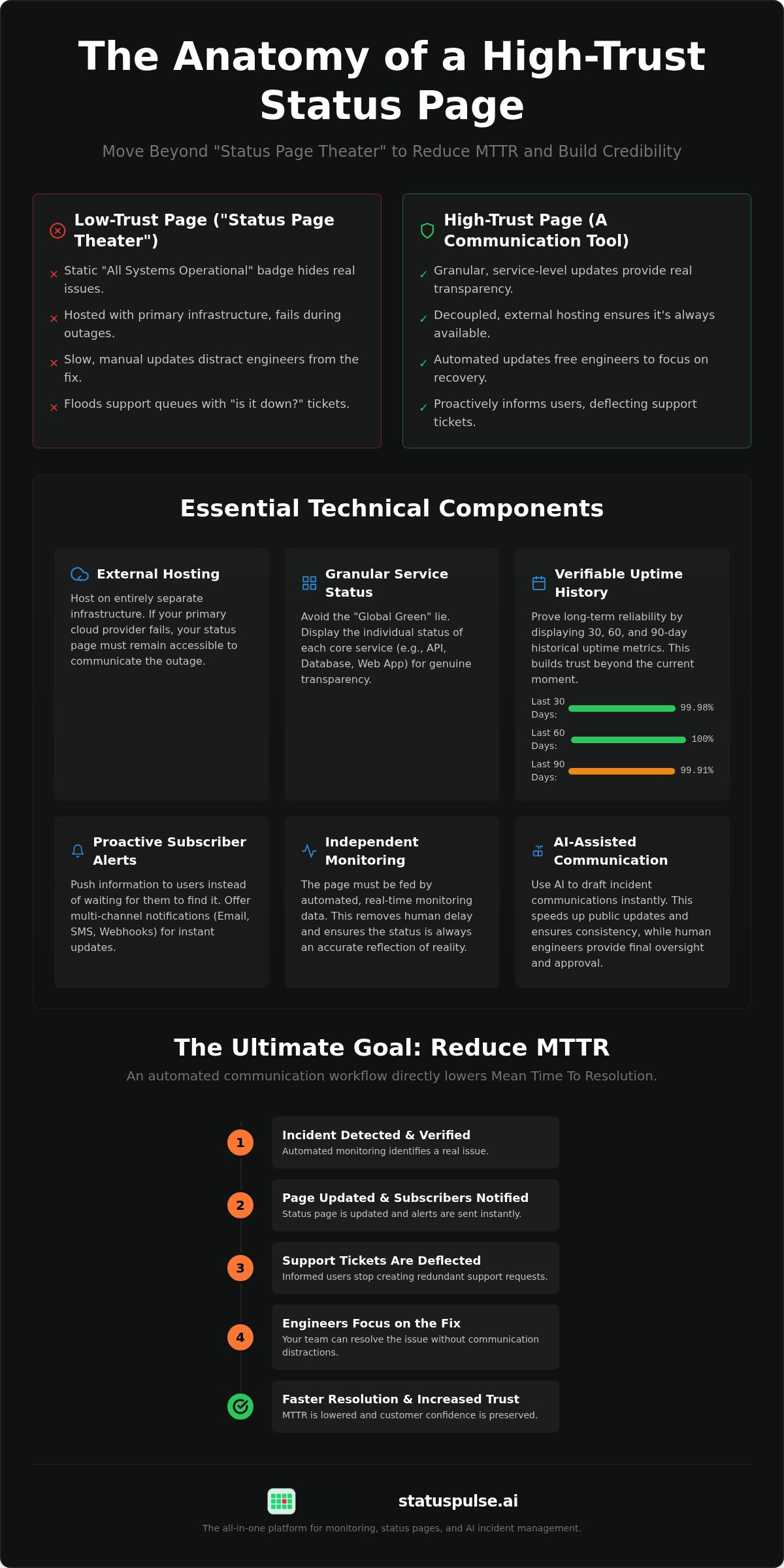
External hosting is a non-negotiable technical requirement. You must host your status page on infrastructure entirely separate from your primary application. If your main cloud provider or region fails, your status page must remain accessible to explain the situation. Hosting them together creates a circular dependency that leaves users in the dark during the exact moments they need information most.
Avoid the "Global Green" lie that plagues many enterprise status sites. Users know when a specific service is failing because they are experiencing the error. If your checkout API is down but your landing page is up, your status page should reflect that granularity. Grouping services by function allows users to see exactly which parts of the stack are affected without guessing which specific microservice is at fault.
Transparency requires looking backward as well as at the present. Displaying 30, 60, and 90-day historical uptime metrics proves that your reliability claims are verifiable. It moves the customer conversation from "is it working right now?" to "is this a reliable partner for the long term?" When analyzing The Anatomy of a Status Page That Actually Builds Trust (MTTR and communication speed being the core focus), these infrastructure choices become the foundation of your credibility.
High-trust pages push information to the user rather than waiting for them to check a URL. Reliable subscriber management includes multi-channel alerts via Email, SMS, and Webhooks. This ensures that SREs and customers receive updates in their preferred environment. If you need a solution that balances this technical depth with straightforward management, you can launch a public status page that integrates these components natively.
Independent Monitoring and Verification
A status page is only as good as the data feeding it. Integrating uptime monitoring directly into the page ensures that status changes are triggered by technical reality rather than manual PR approvals. Public-facing SSL and API health checks add another layer of verification. A High-Trust Status Page is one that is decoupled from the monitored system.
Audience-Specific Views
Not every incident update is meant for every pair of eyes. Internal status pages often require deep technical logs for SREs, while public pages need high-level summaries for end-users. Role-based access control allows enterprise teams to manage these distinctions securely. Subscription filters further refine this by letting users opt-in only to the services they actually use. This prevents notification fatigue and ensures that alerts remain relevant to the user's specific workflow.
Optimizing MTTR Through Automated Incident Communication
Many teams confuse Mean Time to Resolve with Mean Time to Respond. While both use the MTTR acronym, they represent different stages of the incident lifecycle. Resolving a complex database deadlock takes time. Responding to the users affected by that deadlock should be nearly instantaneous. A status page that reduces the gap between detection and notification is the most effective way to manage user expectations.
Automated detection acts as the trigger for your entire communication strategy. When your monitoring stack identifies a failure, it should immediately initiate a draft update. This proactive approach ensures that your Mean Time to Respond stays low, even if the resolution takes hours. Understanding The Anatomy of a Status Page That Actually Builds Trust (MTTR being the core performance indicator) requires looking at how quickly information moves from your servers to your users.
AI plays a specific role here as a drafting assistant. It can ingest error logs and monitoring data to generate a concise "Investigating" update for your review. This removes the "blank page" problem for engineers who are under pressure. By using AI to handle the initial prose, you ensure that technical updates are clear, professional, and published within seconds of an incident's start.
The Incident Response Workflow
Effective communication follows a three-step technical path. First, your system needs automated detection via API monitoring to identify service degradation. This is a foundational element of The Anatomy of a Status Page That Actually Builds Trust (MTTR and response speed are inextricably linked here). Second, use AI-assisted drafting to create the initial public update, allowing a human to verify the details before hitting publish. Third, provide real-time progress updates followed by a technical post-mortem once the service is restored.
Measuring the Impact on Engineering Velocity
SREs often carry a heavy "Communication Debt" when they have to manually update stakeholders. Offloading this burden to an automated platform returns valuable time to your engineering team. Transparent updates also prevent "angry-typing" from developers who rely on your API. When they see a technical acknowledgment of the issue, they stop trying to fix their own code and wait for yours to recover, preserving the relationship between your technical teams.
Architectural Trade-offs: External Hosting and Data Sovereignty
The infrastructure supporting your status page is just as important as the code running your application. Many teams fall into the "Circular Dependency" trap by hosting their status page on the same cloud provider as their primary production environment. If your cloud provider experiences a regional outage, your status page will fail at the exact moment your customers need it. True resilience requires physical and logical separation between your app and your status infrastructure.
Data sovereignty is the second major architectural consideration. For teams operating in the EU, storing subscriber emails and incident logs on US-based servers can create significant GDPR compliance hurdles. You must evaluate whether your status page provider allows you to choose your data residency. Managing PII (Personally Identifiable Information) for thousands of subscribers requires a principled approach to privacy that many US-centric incumbents overlook. Understanding The Anatomy of a Status Page That Actually Builds Trust (MTTR being the metric at risk if your architecture is brittle) helps you avoid these common pitfalls.
Implementation Checklist for SREs
- Verify DNS isolation. Use a separate TLD or a dedicated subdomain that does not rely on your primary application's name servers.
- Check for SSL certificate monitoring. Expired certificates on a status page are a major trust killer and prevent users from accessing critical updates.
- Ensure the provider offers a documented 99.99% uptime SLA. Your status page should be the most reliable part of your technical stack.
The Case for Regional Hosting
European companies often require EU-based hosting to satisfy internal compliance and regulatory standards. While global CDN delivery improves latency for users in different regions, the underlying data must often reside within a specific jurisdiction. This creates a trade-off between speed and sovereignty. StatusPulse addresses this by providing a choice between EU and US data centers, ensuring your data residency aligns with your legal requirements.
Latency considerations remain important for global delivery. Your status page should load quickly regardless of where the user is located. However, for a technical audience, the integrity of the data and its legal standing often outweigh a few milliseconds of load time. When you select your infrastructure, you are defining The Anatomy of a Status Page That Actually Builds Trust (MTTR and regional compliance included). If you need an infrastructure that respects your data residency needs while maintaining high availability, you can get started with StatusPulse today.
Implementing a Principled Communication Stack with StatusPulse
Implementing a principled stack means choosing tools that prioritize your time over their own growth metrics. StatusPulse combines uptime monitoring, API health checks, and SSL certificate tracking into a single dashboard. This integration eliminates the need to stitch together multiple third-party providers. It ensures that your data flows directly into your public status page without manual intervention. Understanding The Anatomy of a Status Page That Actually Builds Trust (MTTR and communication speed included) requires this level of technical consolidation.
Per-subscriber fees are a tax on your growth. Many legacy providers charge more as your audience expands, which punishes you for being successful. We use a flat pricing model instead. You pay for the infrastructure and the monitoring precision, not the number of people reading your updates. This tool is built for technical teams who value utility over marketing fluff. It provides the quiet confidence you need when your system is under pressure.
AI incident management functions as a technical assistant rather than a replacement for human judgment. It ingests your monitoring data to draft clear, concise updates during an incident. You maintain the final human action, ensuring that every public message is accurate and professional. This "human-in-the-loop" automation speeds up your response time without sacrificing the integrity of your communication.
Getting Started Without the Bloat
You can sync your existing monitors to a public page in under 10 minutes. The setup process is designed to be straightforward, avoiding the complex configuration labyrinths found in enterprise software. You can configure custom domains and apply functional CSS to ensure your status page matches your brand identity. Once your monitors are live, you can immediately draft your first AI-assisted incident update to see how the workflow handles service degradation in real time.
The Ethical Alternative
StatusPulse offers a focused path to reliability compared to legacy incumbents like [VERIFY: competitor X entry price]. A simple, logical UI is a hard requirement during high-stress outages. When your primary systems are failing, you don't have the mental bandwidth to navigate bloated menus or complex permission trees. We prioritize a streamlined experience that respects your time and your data sovereignty. If you're ready to move beyond status page theater, you can build your first high-trust status page with StatusPulse and start providing verifiable transparency to your users.
Building a Resilient Communication Strategy
A status page is only effective if it remains online when your primary stack fails. By decoupling your infrastructure and choosing sovereign hosting in the EU or US, you ensure your users always have a source of truth. Moving away from manual updates toward AI-powered incident drafting allows your engineers to stay focused on the fix. This proactive approach reduces the support burden and prevents the chaos of a ticket storm during minor disruptions.
Mastering The Anatomy of a Status Page That Actually Builds Trust (MTTR included) means choosing a platform that values integrity over complex pricing models. You don't need per-subscriber taxes or bloated enterprise features to communicate effectively. You need a straightforward tool that works when it's supposed to. With flat pricing and integrated monitoring, you can provide the transparency your customers expect without the operational overhead.
Ready to improve your incident response? Start building trust with a StatusPulse status page and take control of your technical communication today. Clear communication is the fastest path to recovery.
Frequently Asked Questions
What is MTTR and why does it matter for status pages?
MTTR is the key metric for measuring how quickly your team responds to and resolves technical disruptions. In the context of status pages, it tracks the time between an incident's start and the first public acknowledgment. Faster communication directly lowers customer anxiety and reduces the volume of duplicate support requests hitting your team.
Should a status page be hosted on the same server as my website?
You should never host your status page on the same server or even the same cloud provider as your primary application. This prevents a single point of failure from taking down both your service and your communication channel. True redundancy requires the status page to live on a completely independent infrastructure stack.
How often should I update my status page during an active incident?
Aim for updates every 20 to 30 minutes during an active incident. Even if you don't have a final resolution, letting users know that you are still investigating or implementing a fix is vital. Regular intervals of communication prevent users from assuming your team has abandoned the problem.
What is the difference between a public and a private status page?
Public status pages provide high-level uptime data for your entire customer base. Private status pages are restricted to internal teams or specific enterprise clients. They often display more granular technical details, such as internal API endpoints or staging environment health, that aren't relevant to the general public.
Can I automate status page updates using my existing monitoring tools?
Automation is the most reliable way to ensure your page reflects the current state of your system. By linking your monitoring tools to your status page, you build The Anatomy of a Status Page That Actually Builds Trust (MTTR reduction being the result). This removes the bottleneck of manual intervention during high-stress outages.
Is a status page required for GDPR compliance?
GDPR requires businesses to maintain the availability of their systems and notify users of significant issues. A status page serves as a documented record of your uptime and a compliant way to communicate disruptions. Using EU-based hosting for these logs further strengthens your data sovereignty and regulatory alignment.
What should be included in a technical post-mortem on a status page?
Focus on the root cause, the impact duration, and the remediation steps. Technical users appreciate honesty about what went wrong, whether it was a botched deployment or a third-party provider failure. Providing a clear timeline proves that your team has a deep understanding of your own architecture.
How do I prevent my status page from becoming a target for DDoS during an outage?
Choose a provider that uses a robust Content Delivery Network (CDN) to serve your status page. This offloads the traffic from a single origin and provides a layer of protection against malicious surges. Your status infrastructure must be resilient enough to stay online when your main site is under attack.


