
That free monitoring script you're running might be the most expensive tool in your stack. It feels like a budget win. The reality is hidden in wasted engineering hours and eroded customer trust. For mid-sized enterprises in 2026, a single hour of downtime costs over $300,000. If a "free" tool misses a critical incident or buries your team in alert fatigue, the perceived savings vanish instantly.
We know the frustration of high support ticket volumes during an outage. It's difficult to explain the value of professional tools to a finance team that only sees the bottom line. Technical precision shouldn't be a luxury, but it also shouldn't be a guessing game. This guide shows you how to calculate your true uptime monitoring ROI by uncovering the invisible costs of downtime. You'll learn to translate system performance into financial value that stakeholders actually respect.
We'll provide a clear formula to prove your department's worth. You'll see how to reduce engineering toil and use transparency to protect your brand reputation. It's time to move past the myth of free and start building a more resilient, ethical technical operation.
Key Takeaways
- Expose the true cost of "free" monitoring tools by accounting for engineering toil and the distraction of noisy false positives.
- Calculate a comprehensive uptime monitoring ROI by factoring in contractual SLA penalties and direct revenue loss from service credits.
- Reduce support ticket volume and preserve team focus through transparent communication with public status pages.
- Audit your critical path services to identify vulnerabilities in API endpoints and SSL certificates before they impact your users.
- Leverage AI incident management to accelerate your response, reducing the time spent drafting updates from minutes to seconds.
The Myth of the 'Free' Uptime Check
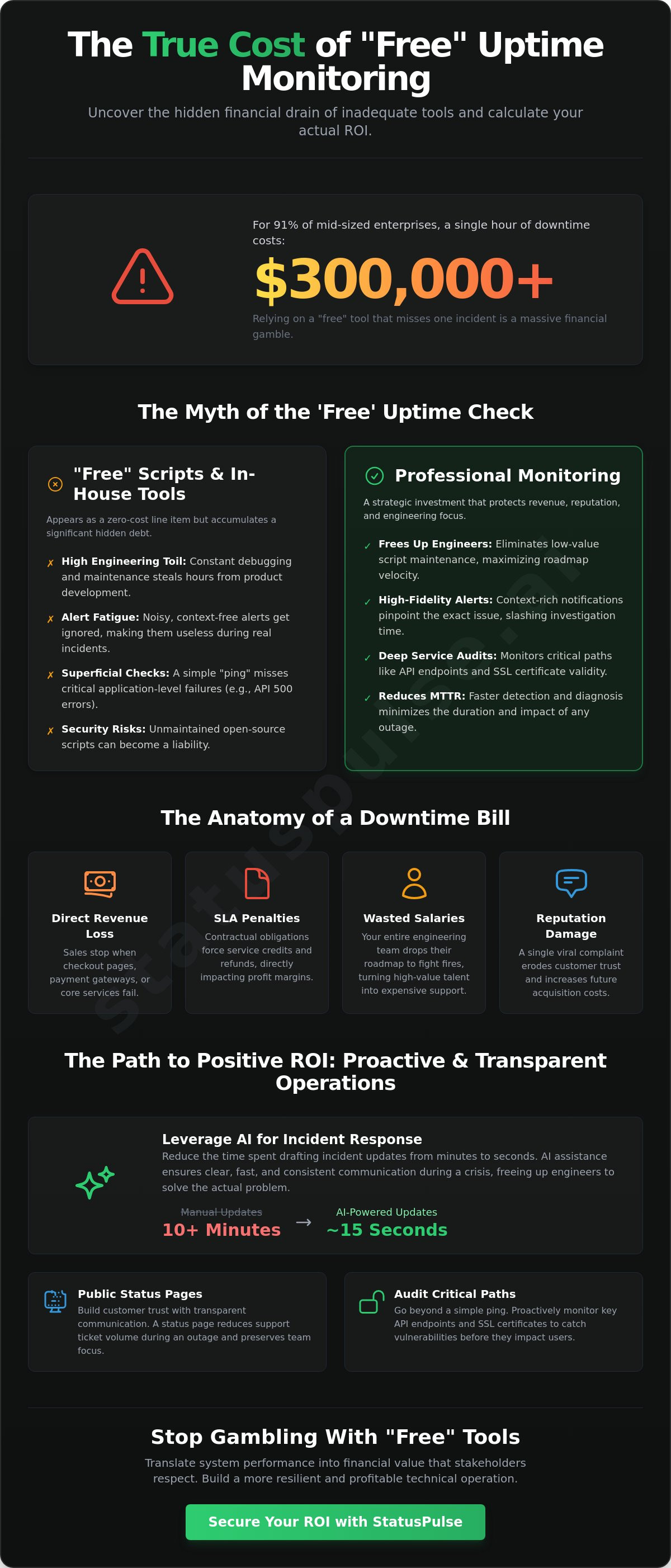
Free monitoring is a budget illusion. It looks like a zero on a spreadsheet. In reality, it's a growing debt. Most teams realize this too late. They start with a basic ping test or a custom script. Then they spend weeks fixing the script. This is where your uptime monitoring ROI begins to hemorrhage. For 91% of mid-sized enterprises, a single hour of downtime costs over $300,000. Relying on a "free" tool that misses even one incident is a massive financial gamble.
Professional tools provide depth that scripts can't match. A basic ping tells you if the server is "on." It doesn't tell you if your checkout API is returning a 500 error. It won't warn you about a pending SSL expiration. When you research what is website monitoring, you see it's about more than just a pulse. It's about functional integrity and protecting the user experience.
The Hidden Labor Cost of In-House Tools
Engineering time is your most expensive resource. Every hour spent debugging a custom monitoring script is an hour stolen from your product roadmap. Custom scripts require maintenance. They need updates for new protocols. They need secure hosting and constant patching. If your senior engineer spends just a few hours a month tweaking a cron job, you've already paid for a professional service several times over.
The "set it and forget it" promise of in-house tools is a dangerous myth. Infrastructure changes. APIs evolve. Without a dedicated team like StatusPulse managing the monitoring layer, your developers become part-time tool maintainers. The opportunity cost is massive. You're trading high-value feature development for low-value script maintenance.
Alert Fatigue: The ROI Killer
Low-quality monitors are noisy. They trigger for a momentary network blip. They send an email at 3 AM for a non-critical issue. This creates alert fatigue. When your engineers start ignoring notifications, your uptime monitoring ROI drops to zero. A monitor that everyone ignores is the same as having no monitor at all.
- Noisy alerts lead to missed critical outages during peak traffic.
- False positives erode trust in the monitoring system across the entire team.
- Context-free alerts force engineers to waste time hunting for the root cause instead of fixing the problem.
Context-rich alerts are worth the premium. Knowing exactly which API endpoint failed and why saves minutes during an incident. High-fidelity monitoring reduces the time spent on discovery. It keeps your team focused on the solution, not the noise. Finally, consider the security risk. Open-source scripts that lack regular updates are a liability. Professional monitoring is a principled choice that prioritizes precision over a false sense of security.
Calculating the Real Cost of Invisible Downtime
Downtime is rarely a clean break. It's usually a slow, expensive leak. While enterprise giants might lose millions, the impact on a growing business is often more personal. The average cost of downtime for small to medium-sized businesses sits around $8,000 per hour. This isn't just lost sales. It's a combination of contractual failures, wasted engineering talent, and a slow decay of customer trust. If you aren't measuring these variables, your uptime monitoring ROI will always look smaller than it actually is.
Revenue loss is the obvious starting point. If the checkout page is down, the money stops. But for B2B companies, the real pain lies in Service Level Agreements (SLAs). Contractual penalties often require issuing service credits for even minor breaches. These credits come directly out of your profit margin. They're the literal price of failing to maintain professional visibility over your stack.
A Tiered Formula for Downtime Costs
To prove value to finance teams, you need a repeatable model. Use this formula: (Lost Revenue/Hr + Salary Cost/Hr) x Duration. For a SaaS startup, the "Salary Cost" represents the entire engineering team dropping their roadmap to fight a fire. For an established enterprise, you must also factor in the "halo effect." This is the long-tail damage of negative social media sentiment. A single viral post about an outage can increase your customer acquisition costs for months. By investing in API monitoring, you catch these failures before they become public relations nightmares.
MTTR: The Metric That Defines Your ROI
The difference between a five-minute blip and a three-hour catastrophe is visibility. Proactive monitoring reduces detection time from hours to seconds. Without it, you're waiting for a customer to complain. That's a reactive, expensive way to run a business. Mean Time To Recovery is the primary lever for monitoring ROI.
When your team has context-rich alerts, they don't waste time wondering what broke. They see the specific API endpoint or the expired SSL certificate immediately. Faster resolution means less "toil," which is the repetitive, manual work that burns out engineers. Reducing toil is a massive win for retention. It keeps your best minds focused on building new features rather than repeating the same recovery steps. High-quality monitoring isn't just an insurance policy; it's a productivity multiplier for your entire technical organization.
Beyond the Dashboard: The ROI of Transparent Communication
Monitoring isn't just for your dev team. It's for your customers. Most companies look at a dashboard and see green or red lights. They miss the human element. When a service fails, a clock starts ticking in the mind of every user. This is the "Anxiety Gap." If you don't fill that gap with information, they fill it with frustration. This frustration leads to support tickets. Every ticket has a price tag.
The average cost of downtime often focuses on lost sales. It ignores the operational surge in support. Managing a crisis is expensive. Managing a silent crisis is even worse. A public status page is your first line of defense. It acts as a pressure release valve for your help desk. This is a massive, often unmeasured part of your uptime monitoring ROI. By being proactive, you stop the flood of "Is it down?" messages before it starts.
Reducing Support Load via Automation
Think about the cost of a single support ticket. You pay for the agent's time, the software license, and the overhead. Now compare that to a single status update. One proactive message can deflect hundreds of identical queries. This isn't just efficient; it's ethical. You're respecting your user's time.
Modern tools like StatusPulse use AI incident management to draft these updates in seconds. You aren't staring at a blank screen during a high-stress outage. The tool acts as an assistant. It suggests the language. You provide the final human approval. This speed is the difference between a controlled response and a support queue that takes days to clear. Automation ensures your communication is as fast as your detection.
Brand Equity and the 'Trust Premium'
Transparency is a competitive advantage. In a market full of faceless corporations, being an honest underdog matters. Customers don't expect perfection. They expect honesty. Brands that communicate openly during an outage actually see higher loyalty. They prove they're reliable partners who don't hide behind "scheduled maintenance" excuses.
Uptime stats are also a powerful sales tool. When an enterprise prospect asks about reliability, showing them a history of transparent incident logs is more convincing than a vague marketing claim. For deeper insights on this, check out the StatusPulse guide on honest communication. It's about building a "Trust Premium." This trust makes your uptime monitoring ROI tangible during every sales call and renewal conversation. You aren't just selling software; you're selling peace of mind.
Building Your ROI Business Case for 2026
Proving the value of a professional monitoring stack requires a shift in perspective. You aren't just buying software. You're protecting revenue. To build a compelling case for uptime monitoring ROI, you must move beyond technical metrics and speak the language of risk management. Start by auditing your current hidden costs. Review the engineering hours lost to manual checks and the support volume generated during your last three incidents. These numbers are the foundation of your argument.
The next step involves mapping your critical path. Not every service requires the same level of scrutiny. Focus on the endpoints that directly impact your bottom line, such as checkout APIs or customer-facing dashboards. For small to medium-sized businesses, the average cost of downtime is approximately $8,000 per hour. When you compare this to the modest cost of a professional tool, the financial decision becomes a matter of basic logic. You're trading a predictable, low-cost subscription for protection against a high-impact, unpredictable loss.
Identifying High-Value Monitoring Targets
SSL certificate monitoring is the ultimate quick win for ROI. It's a binary failure point. If a certificate expires, your site stops working for everyone. It's a predictable disaster that is 100% preventable. Catching an expiration notice 30 days in advance is worth far more than the price of the monitor itself. It prevents a total brand blackout.
API monitoring is equally vital, especially for products that rely on third-party integrations. If a payment gateway or a data provider fails, your product is effectively down. You need to know before your customers do. For a deeper look at protecting these connections, see our API Monitoring Guide for 2026. These targets provide the most immediate evidence of value to your stakeholders.
The 'Insurance' vs. 'Investment' Framing
When you speak to finance teams, frame monitoring as a revenue protection tool. It isn't just an expense; it's an insurance policy for your digital storefront. Use historical data to show how long it took to detect past outages without proactive tools. If a professional monitor reduces that detection time from sixty minutes to sixty seconds, you've just saved the company thousands of dollars in a single incident.
Pitching monitoring as a force multiplier for small teams means framing it as an automated sentry that frees up your best engineers for high-impact work. You don't need a massive DevOps department when you have precise, automated alerts. It allows a lean team to maintain the reliability of a much larger organization. You can start protecting your revenue today by choosing a tool that prioritizes precision over enterprise bloat.
StatusPulse: Maximizing ROI through AI and Simplicity
StatusPulse isn't another faceless enterprise tool. It's a principled choice for teams tired of corporate bloat. We built a platform that values your time and your budget. By unifying uptime, API, and SSL certificate monitoring into one streamlined interface, we eliminate the need for a fragmented stack. This consolidation is a direct boost to your uptime monitoring ROI. You stop paying for features you don't use. You start focusing on the precision that matters. Our approach is straightforward. No complex pricing models. No hidden fees. Just a fair, ethical alternative for specialists who value reliability.
Our AI incident management isn't about replacing human agency. It's about assisting it. During a high-stress outage, the last thing you want is a blank cursor. Our tool drafts incident summaries in seconds. You provide the human judgment and the final click. This reduces the cognitive load on your engineers. It allows them to fix the root cause while the communication remains transparent and professional. It's a logical way to manage a crisis without the usual panic.
Efficiency Through AI Integration
Incident drafting is a major bottleneck during downtime. AI removes the friction. By summarizing technical impacts quickly, you keep your status page updated without diverting focus from the repair. We also prioritize security as a core virtue. With EU-based hosting and strict privacy standards, your monitoring data stays protected and compliant. This regional signature isn't just about ethics. It's a security ROI factor that reduces long-term regulatory risk. You gain a tool that respects privacy as much as it respects performance.
Quick Setup, Immediate Value
You can get your first status page live in under five minutes. There are no complex onboarding sessions. No "managed IT" contracts to sign. We believe software should be easy to understand and even easier to deploy. This speed ensures your uptime monitoring ROI begins to manifest immediately. You aren't just buying a monitor. You're gaining a dedicated assistant for your technical operations. It's about moving from a reactive state to a controlled, proactive posture. Start protecting your uptime with StatusPulse and experience a fairer, more efficient way to manage your digital reputation.
Protecting Your Revenue with Precision
The myth of free monitoring is a costly distraction. We've seen how hidden labor costs and alert fatigue erode your margins. True uptime monitoring ROI comes from reclaiming engineering focus and reducing support volume through radical transparency. It's about moving away from reactive fire-fighting and toward a logical, automated sentry. You don't need enterprise bloat to achieve professional results. You need a tool built by specialists who respect your time and your privacy. Precision is the ultimate budget win.
StatusPulse offers exactly that. No complex pricing. No unnecessary layers. Just precision monitoring with AI-powered incident drafting and secure EU-based hosting. Our platform acts as an assistant, ensuring you maintain control during high-stress outages without the manual toil. We help you turn downtime into a clear demonstration of reliability. It's time to stop gambling with your brand reputation and start investing in a platform that prioritizes integrity over flashiness. Your users deserve honesty, and your team deserves better tools.
Start your 14-day free trial with StatusPulse today. Build a more resilient, ethical future for your technical operations.
Frequently Asked Questions
How do I calculate the cost of downtime for my specific business?
Use the formula (Lost Revenue per Hour + Salary Cost per Hour) multiplied by the Duration of the outage. For small to medium businesses, the average cost of downtime is approximately $8,000 per hour. Don't forget to include the "toil" cost of engineers who must drop their current projects to handle the incident. This calculation provides the baseline for your uptime monitoring ROI. It translates technical failures into the financial language your stakeholders understand.
Is paid uptime monitoring really better than a free tool?
Paid monitoring is superior because it offers faster check intervals and deeper technical precision. Most free tiers limit you to five-minute checks, which is too slow for production environments where every second costs money. Professional tools also provide API monitoring and SSL alerts that basic scripts often miss. You're paying for reliability and the peace of mind that a dedicated team is maintaining the monitoring layer for you.
What is the typical payback period for an uptime monitoring investment?
Most businesses see a positive uptime monitoring ROI within 60 to 90 days of implementation. This rapid payback occurs because a professional tool usually catches at least one critical incident or expiring certificate that a free tool would have missed. The cost of a single prevented hour of downtime often covers the subscription for several years. It's an investment that pays for itself by protecting your existing revenue streams.
Can uptime monitoring help reduce my customer churn rate?
Yes, because uptime is the foundation of customer trust. Users are more likely to stay with a brand that demonstrates high availability and communicates transparently when issues occur. By catching performance degradation before it becomes a total outage, you preserve the user experience. Reliability is a core virtue that keeps customers from looking at your competitors during a service disruption. Consistent uptime is a powerful retention tool.
How does a public status page actually save the company money?
A public status page saves money by deflecting support tickets during an incident. When users can see a clear update, they don't need to email your help desk. This reduces the operational surge that typically overwhelms support teams during an outage. One proactive update can stop hundreds of duplicate queries. It keeps your support costs predictable and allows your team to focus on high-value customer interactions instead of crisis management.
Does monitoring SSL certificates provide a measurable ROI?
Monitoring SSL certificates provides an immediate return by preventing total site blackouts. An expired certificate is a binary failure that blocks all user traffic and damages your brand reputation instantly. It's a 100% preventable disaster. Automated alerts ensure you have weeks of lead time to renew. The ROI is measured by the total revenue protected during those potential hours of downtime that a simple expiration would have caused.
How much engineering time should be spent on monitoring tasks?
Engineering time spent on monitoring should be minimal. Your best minds should be building features, not maintaining custom monitoring scripts or tweaking cron jobs. A professional platform acts as an automated assistant that requires only final human approval for incident updates. If your team spends more than an hour a month on monitoring infrastructure, you're likely losing money on labor costs. Automation is the key to reducing engineering toil.
What is the difference between uptime monitoring and full observability?
Uptime monitoring is external and user-centric, answering the question "Is my service available and working?" It focuses on the pulse of your web pages, APIs, and certificates. Full observability is internal and complex, looking at logs, traces, and metrics to explain why a system is behaving a certain way. StatusPulse focuses on the external pulse. We provide the straightforward, logical visibility you need to protect your reputation without the complexity of enterprise observability bloat.


