

A status page is only useful if it remains online when your primary infrastructure fails. If your communication tool shares a fate with your database or load balancer, it's a liability, not an asset. You've likely struggled with the "who monitors the monitor" problem. It's a common friction point. You want to keep customers informed without adding hours of maintenance to your sprint or overpaying for bloated enterprise contracts.
This guide evaluates the technical trade-offs of a self-hosted vs cloud status page to help you choose the right architecture for your DevOps stack. We'll look at the hidden costs of managing your own instance versus the data sovereignty benefits of specialized cloud providers. You'll learn how to balance operational overhead with strict compliance standards like GDPR and the NIS2 Directive. We'll compare the manual effort required for open-source tools against the reliability of independent, external monitoring layers. By the end, you'll have a clear framework for selecting a solution that protects your reputation during an outage.
Key Takeaways
- Status pages require complete architectural independence to ensure communication remains online even when your primary stack fails.
- Maintenance debt from security patches and database migrations often makes the total cost of self-hosting higher than a flat-rate cloud subscription.
- Data sovereignty is a technical requirement; choosing between EU or US hosting ensures compliance with regional standards like GDPR and the NIS2 Directive.
- When evaluating a self-hosted vs cloud status page, prioritize your team's capacity to manage non-core infrastructure during high-stress outages.
- Integrated monitoring and AI-assisted drafting can significantly reduce your Mean Time to Communicate (MTTC) by removing manual update steps.
The Status Page Paradox: Reliability vs. Control
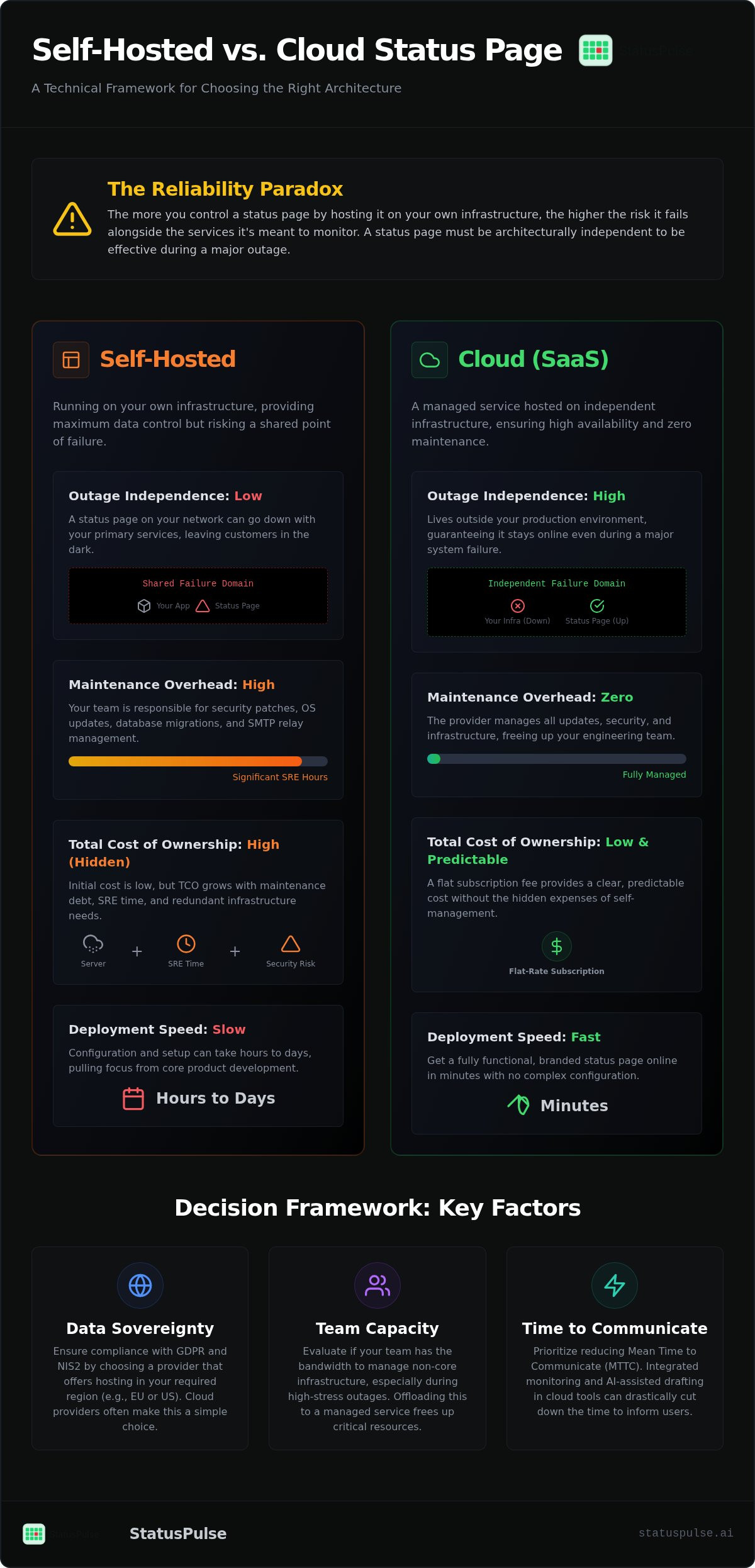
The primary function of a status page is to serve as an independent communication channel. If your monitoring tool shares the same underlying infrastructure as your application, it stops being a source of truth during a total site outage. This creates a technical tension between the desire for total control and the need for high availability. The Reliability Paradox is defined by the fact that the more control you exert by self-hosting a status page on your own infrastructure, the higher the risk that it will fail alongside the services it is meant to monitor.
Choosing between a self-hosted vs cloud status page is a decision about where your failure domain ends. Self-hosting often feels like the most secure path for teams with strict internal network requirements. However, this control usually comes at the expense of automated failover. If your status page lives in your own K8s cluster and your cluster goes down, your customers are left in the dark. Cloud-based solutions provide an out-of-band communication layer that stays operational even when your primary provider faces a regional blackout.
Core Differences in Architectural Design
On-premise or self-hosted architectures give you absolute data control and deep internal network access. This is ideal for air-gapped environments but requires manual maintenance for OS updates and security patches. SaaS-based cloud status pages offer automated scaling and external verification. They live outside your production environment, ensuring that the status update process remains unblocked. Some teams opt for hybrid approaches, using local probes to gather metrics while pushing that data to a public status page hosted on a separate cloud provider.
Status Page Architecture Comparison Table
| Metric | Self-Hosted | Cloud (SaaS) |
|---|---|---|
| Deployment Speed | Hours to Days | Minutes |
| Maintenance Overhead | High (Manual Patches) | Zero (Managed) |
| Outage Independence | Low (Shared Failure Domain) | High (External CDN/DNS) |
| Initial Cost | Low (Hardware Only) | Low to Moderate |
Cloud providers typically use geographically distributed CDNs and independent DNS providers to ensure their frontend remains reachable. This separation is critical for reducing your Mean Time to Communicate (MTTC). While engineering teams focus on Mean Time to Repair (MTTR), stakeholders care more about how quickly they are informed. A cloud architecture ensures that communication doesn't depend on the same database or network route currently being repaired.
The Hidden Costs of Self-Hosting a Status Page
Self-hosting an open-source tool might look like a cost-saving measure on a spreadsheet. However, the true total cost of ownership (TCO) for a self-hosted vs cloud status page is rarely just the price of a VPS. It includes the steady accumulation of maintenance debt. Your team becomes responsible for OS hardening, kernel updates, and database migrations. These tasks often fall on SREs during their most productive hours, pulling them away from core infrastructure projects to manage a tool that should just work.
A critical technical failure point is the "Circular Monitoring" trap. If you deploy your status page within your existing Kubernetes cluster or VPC, you've created a shared failure domain. When the cluster's control plane hangs or the network fabric fails, your status page disappears exactly when your users need it most. Solving this requires redundant infrastructure across different cloud providers, which adds significant monthly costs for load balancers, storage, and multi-region compute resources that often exceed a SaaS subscription.
Notification reliability adds another layer of manual complexity. Managing your own SMTP relays or SMS gateways for incident alerts is notoriously difficult. Deliverability issues or rate limits on third-party APIs can lead to delayed updates, which directly damages customer trust. By using a managed uptime monitoring platform, you offload the burden of webhook reliability and gateway maintenance to a dedicated system designed for high-pressure scenarios.
Operational Overhead: SRE Hours vs. Licensing
Internal tools often lag behind in feature parity. While cloud providers introduce AI-assisted incident drafting to reduce MTTC, self-hosted instances require manual updates that your team might delay for months. The risk of running unpatched software increases over time, potentially turning your transparency tool into a security vulnerability. Quantifying the hours spent "keeping the lights on" usually reveals that a flat-rate license is a more efficient use of engineering talent than maintaining a DIY stack.
The Problem of Global Probe Distribution
Self-hosting typically limits your monitoring to the regions where you already have a network presence. Setting up and maintaining 20 or more global monitoring nodes to verify latency and availability from Tokyo to London is a massive infrastructure project on its own. For a deeper look at why geographic diversity is essential for accurate reporting, see our Uptime Monitoring: A Developer’s Guide. Most teams find that the logistical effort of global probe management far outweighs the perceived control of a self-hosted instance.
Cloud-Based Status Pages: Sovereignty and Scalability
Cloud solutions shift the burden of availability to specialists. When weighing a self-hosted vs cloud status page, the most immediate technical benefit is external scalability. Managed providers use globally distributed edge caching to serve static status assets, ensuring that a massive spike in traffic doesn't crash the communication layer. This infrastructure allows you to handle 100,000 or more concurrent visitors during a major outage without manual intervention. It provides a level of resilience that is difficult to replicate with a single-instance self-hosted setup.
Beyond traffic handling, cloud architectures simplify the incident response workflow. Native API monitoring can be linked directly to your status page to trigger automated updates. This integration removes the human delay between a service failure and a public notification. It ensures that your Mean Time to Communicate (MTTC) stays as low as possible. For a deep dive into setting up these automated checks, see our guide on API monitoring for high availability.
Compliance and Data Residency
Data residency is no longer just a legal checkbox. It's a technical requirement for engineering teams handling subscriber PII in incident logs. GDPR mandates strict control over where this data resides, especially when it includes email addresses and phone numbers for notifications. Many US-based providers offer rapid feature development but often fall short of EU privacy standards. StatusPulse solves this by offering a choice between EU or US hosting, allowing you to host your status page in the same region as your primary infrastructure to satisfy data sovereignty requirements.
The Per-Subscriber Pricing Trap
Many industry incumbents rely on per-subscriber pricing models. These plans often look affordable during your initial growth phase but become a financial liability as your user base expands. The technical cost of managing 10,000 or more simultaneous email and SMS alerts is significant. It requires robust message queuing, multiple delivery providers, and sophisticated rate-limiting logic to avoid being flagged as spam. We prioritize a flat-fee model that supports unlimited subscribers. This approach removes the financial penalty for keeping your customers informed and ensures your operational costs remain predictable even during your busiest months.
Decision Framework: Which Architecture Fits Your Stack?
Deciding on a self-hosted vs cloud status page requires an honest assessment of your operational capacity. It's easy to overlook the hidden costs of maintenance. A single SRE spending four hours a month on internal tool patches costs significantly more than most SaaS subscriptions. You must calculate your total cost of ownership (TCO) by combining server expenses with the opportunity cost of your engineering team's time. If your developers are fixing status page database migrations instead of shipping features, the "free" open-source option is actually a drain on your budget.
Your required Service Level Objective (SLO) for communication should also drive this choice. If your primary product promises 99.9% uptime, your status page must exceed that to remain credible during an incident. Achieving 99.99% availability on a self-hosted instance requires multi-region redundancy and automated failover. When comparing a self-hosted vs cloud status page, consider the impact of a total provider outage. If your entire stack lives on a single cloud provider and your self-hosted status page is in the same region, you lose your ability to communicate when that provider fails.
Security requirements often dictate the final architecture. In high-security environments where data cannot leave the internal network, self-hosting is the only viable path. However, for public-facing services, you must decide if you want to manage the security lifecycle of the status page software itself. This includes rapid patching when vulnerabilities are discovered in open-source dependencies. Cloud providers handle this hardening as part of their managed service, reducing your team's surface area for attack.
When to Choose Self-Hosted
- Your organization has strict regulatory bans on third-party SaaS for internal infrastructure.
- You operate in high-security environments with no external internet egress (air-gapped).
- Your team has surplus SRE capacity and a strong preference for deep open-source customization.
- The status page is for internal-only use and doesn't need to be reachable by the public internet.
When to Choose Cloud/SaaS
- You are a SaaS company requiring 99.99% communication availability during primary stack failures.
- You have a lean engineering team that needs to focus on product development rather than infrastructure maintenance.
- You need advanced features like SSL certificate monitoring and AI incident management out of the box.
- You want to avoid the per-subscriber pricing trap and keep operational costs predictable.
If you want to offload the reliability burden and ensure your status page stays up when your infrastructure goes down, launch your status page on StatusPulse in minutes. We provide the technical depth you need without the maintenance overhead of a DIY stack.
StatusPulse: Managed Reliability with Technical Transparency
StatusPulse bridges the gap between SaaS convenience and the technical control typically associated with open-source tools. We built our platform for engineers who value data sovereignty and architectural independence but want to eliminate maintenance debt. By choosing a managed service over a DIY stack, you gain a reliability layer that remains operational even when your primary infrastructure fails. This approach resolves the self-hosted vs cloud status page debate by providing technical depth without the operational burden of patching servers or managing global probe networks.
Transparency is a core value of our platform. We offer native EU and US hosting options to ensure your incident data resides where you need it for compliance. Unlike industry incumbents that use complex per-subscriber pricing, we use a flat-fee model. This ethical approach ensures that your costs remain predictable as your audience grows. You won't be penalized for communicating with your customers during an outage.
Integrated Monitoring and Communication
Our platform creates a logical loop between uptime checks, API monitoring, and your public status page. When a check fails, the AI Incident Management tool analyzes technical logs to draft a clear, honest update for your users. This assistant reduces your Mean Time to Communicate (MTTC) by handling the initial drafting; you simply review and publish the final message. This workflow maintains human agency while removing the friction of manual reporting. For best practices on maintaining trust, refer to our guide on The Architecture of Incident Communication Transparency.
Getting Started Without the Bloat
Migrating from a self-hosted instance to a managed cloud environment is straightforward. You can point your custom domain to our globally distributed edge network and set up your first public status page in under 10 minutes. This transition removes the "Circular Monitoring" risk discussed earlier by placing your communication tool on an entirely separate network fabric. You get the benefits of a distributed CDN and multi-region redundancy without writing a single line of infrastructure-as-code for your status page.
If you are ready to move beyond the hidden costs of maintenance and the risks of shared failure domains, it is time to switch to a platform designed for precision. Focus on your core product while we manage the reliability of your communication layer. Explore StatusPulse for transparent incident communication and secure your reputation with an independent status page today.
Securing Your Reliability Layer
Choosing between a self-hosted vs cloud status page is a strategic decision about where your failure domain ends. While self-hosting offers deep control for air-gapped environments, it often introduces significant maintenance debt and the risk of circular monitoring. A managed cloud solution provides the out-of-band independence required for true high availability. This ensures your customers stay informed even if your primary provider faces a regional blackout.
StatusPulse offers a technical middle ground with EU-based hosting for data sovereignty and AI-powered incident management to reduce communication lag. We intentionally avoid the complex per-subscriber fees that turn your success into a financial penalty. By offloading the reliability burden to a dedicated platform, you allow your engineering team to focus on resolving the root cause rather than patching internal tools.
Build a reliable status page on StatusPulse today. You can maintain complete transparency with your users without the operational overhead of a DIY stack. Your reputation depends on how you communicate during a crisis; make sure your communication tools are as resilient as your code.
Frequently Asked Questions
Is a self-hosted status page more secure than a cloud one?
Security isn't guaranteed by hosting location alone. While self-hosting offers network isolation, it places the full burden of security patches and hardening on your team. Vulnerabilities in unpatched open-source dependencies can lead to breaches. Cloud providers manage the security lifecycle; they ensure the platform remains hardened against common exploits without manual intervention from your SREs, which often results in a more robust security posture.
How does circular monitoring affect self-hosted status pages?
Circular monitoring occurs when your status page depends on the same infrastructure it monitors. If you host your page on the same Kubernetes cluster or within the same VPC as your application, a total infrastructure failure will take both offline. This shared failure domain prevents you from communicating with customers during the exact moment they need updates most. True independence requires hosting your communication tools on a completely separate network.
What is the cost of managing a self-hosted status page in 2026?
The total cost includes server hosting, storage, and the high opportunity cost of engineering time. While an open-source tool might seem free, maintaining OS updates and database migrations consumes SRE hours that could be spent on core product development. When comparing a self-hosted vs cloud status page, teams often find that managed licensing is more efficient than the accumulated maintenance debt of a DIY stack.
Can cloud status pages meet GDPR requirements for EU companies?
Yes, provided the cloud provider offers data residency options within the European Union. GDPR compliance requires strict control over subscriber PII, such as email addresses and phone numbers used for incident alerts. Selecting a provider that guarantees EU-based hosting ensures that your incident logs and subscriber data remain within the correct legal jurisdiction. This is a critical technical requirement for satisfy regional regulatory audits in 2026.
Does StatusPulse offer a choice between EU and US hosting?
Yes, StatusPulse provides native hosting options in both the EU and the US to support global data sovereignty requirements. This allows you to select the region that aligns with your internal compliance standards or the location of your primary audience. Having this choice ensures that your status page remains an independent and compliant layer of your DevOps stack. It removes the need to compromise between performance and privacy standards.
What happens to my status page if my cloud provider goes down?
If you use an independent status page provider, your page remains online even if your primary infrastructure provider fails. Specialized cloud status pages reside on separate network fabrics, CDNs, and DNS providers. This architectural isolation ensures that your communication channel stays reachable. It allows you to provide real-time updates while your engineering team works on a recovery plan, protecting your reputation during a total site outage.
Why should I avoid per-subscriber pricing for status pages?
Per-subscriber pricing models create unpredictable costs that scale as your audience grows. You shouldn't be penalized for keeping more customers informed during a crisis. Flat-fee models allow for unlimited subscribers, ensuring your operational budget remains stable regardless of how many users sign up for updates. This ethical pricing approach removes the financial friction from transparent incident communication. It ensures that your costs don't spike during high-traffic incidents.
Can I automate status updates from my monitoring tools?
Automation is possible through integrated uptime and API monitoring tools that trigger status page updates via webhooks or native APIs. This reduces your Mean Time to Communicate (MTTC) by removing manual steps. StatusPulse uses AI incident management to analyze technical logs and draft updates. This allows your team to review and publish honest information to customers in seconds, maintaining human agency while utilizing the speed of automated assistants.


