

Why are you still paying a "subscriber tax" just to tell your customers that your API is down? It's a common trap. Proprietary platforms often charge more as your audience grows, effectively punishing you for your success. Many engineers turn to open source to regain control, but self-hosting brings its own set of burdens. If you're evaluating a hosted status page service, you likely want the reliability of the cloud without the corporate bloat or the high price tag of enterprise incumbents.
You deserve a communication tool that's as stable as the systems it tracks. We agree that maintenance shouldn't feel like a second job. Data residency should be a standard, not a premium add-on. This technical review provides a deep dive into the seven best open-source status page alternatives for 2026. We compare everything from the lightweight simplicity of Uptime Kuma to the configuration-as-code approach of Gatus. You'll learn how these tools stack up against modern, AI-assisted SaaS alternatives. Our goal is to help you find a path to lower total cost of ownership and truly transparent incident response.
Key Takeaways
- Compare the technical capabilities of leading 2026 projects like Upptime and Statping-ng to find the right architectural fit for your team.
- Account for the "monitoring paradox" and engineering maintenance hours when calculating the true total cost of ownership for self-hosted tools.
- Ensure regulatory compliance by selecting a hosted status page service that provides verified EU data residency and flat pricing models.
- Audit your specific data sovereignty and observer requirements using our two-step evaluation framework.
- Learn why flat-fee SaaS models offer a principled alternative to both complex self-hosting and the "subscriber tax" of legacy providers.
Why Teams Move to Open Source Status Page Alternatives
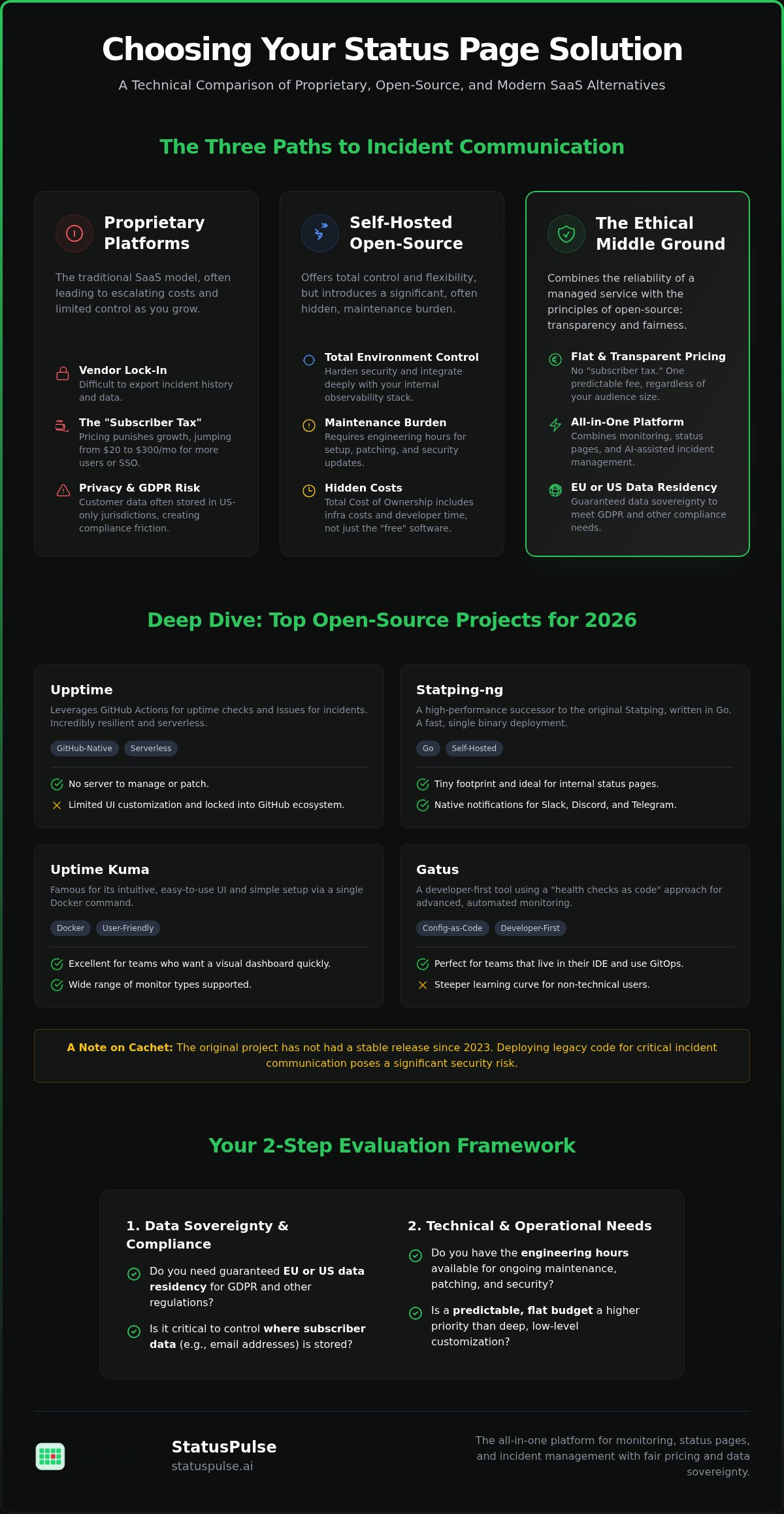
Status pages are the cornerstone of incident communication. They exist to maintain trust when systems fail. However, many technical teams find that industry leaders prioritize corporate bloat over utility. Moving to an open-source alternative isn't just about saving money. It's about reclaiming control over your data and your relationship with your users. Whether you choose a self-hosted Docker container or a GitHub-native tool, the goal is the same: transparency without the overhead.
Open-source solutions typically fall into two categories. Self-hosted projects like Uptime Kuma or Statping-ng run on your own infrastructure. GitHub-native tools like Upptime leverage GitHub Actions and Pages to host the site. Both options allow you to bypass the restrictive nature of a traditional hosted status page service. They offer a path toward better high availability strategies that don't rely on a single proprietary vendor.
The Problem with Proprietary Status Pages
Vendor lock-in is a silent killer. Exporting years of incident history from a closed platform is often difficult. Then there's the cost. Many SaaS providers use a per-subscriber pricing model. This "Subscriber Tax" turns your growth into a budget liability. For example, some platforms jump from $20 a month to $300 a month just to unlock SSO or handle more users. It's a pricing model that punishes success.
Privacy is another major concern. When you use a US-centric provider, your customers' email addresses are often stored in jurisdictions with different privacy standards. For teams managing GDPR compliance, this creates unnecessary legal friction. You shouldn't have to compromise on data residency just to keep your users informed.
The Open Source Value Proposition
Open source offers total environmental control. You can harden the security of the server yourself. You can integrate the page deeply with your internal observability stack. If you need a specific feature, you don't wait for a corporate product roadmap. You build it or find a community fork. This flexibility is vital for specialists who value precision over flashy marketing.
For teams that want the ethics of open source without the maintenance burden, a fair hosted status page service like StatusPulse offers a middle ground. We provide flat pricing and guaranteed EU data residency. It's built for those who value integrity and simplicity. You get the reliability of a managed service without the complex scaling fees of the incumbents.
The Best Open Source Status Page Projects in 2026
Choosing an open-source tool requires looking past the stars on GitHub. Many popular repositories are effectively abandoned. We've vetted the current landscape to find projects that are actually ready for production. These tools offer a way to avoid the bloat of traditional vendors while maintaining professional incident communication.
Upptime: Minimalist and Serverless
Upptime is a clever use of existing infrastructure. It uses GitHub Actions to run uptime checks and GitHub Issues to track incidents. As of July 2026, the monitor reached v1.43.7, proving it's still actively maintained. Because it runs on GitHub's infrastructure, it's incredibly resilient. You don't have to manage a separate server. However, you're locked into the GitHub ecosystem. Customizing the UI beyond basic themes is difficult, which might not fit brands looking for a specific aesthetic.
Statping-ng: High Performance via Go
Statping-ng is the modern successor to the original Statping project. It's written in Go, which means it's a single binary with a tiny footprint. It's fast and easy to deploy. It handles notifications for Slack, Discord, and Telegram natively. This project is a strong candidate for teams that need an internal status page tucked behind a VPN. It gives you a clean dashboard without the overhead of a full observability suite.
Other notable projects in 2026 include:
- Uptime Kuma: Reached v2.5.3 in August 2026. It's famous for its intuitive UI and ease of setup via Docker.
- Gatus: A developer-first tool that uses health checks as code. It reached v5.11.0 in April 2026.
- OneUptime: An enterprise-grade platform that covers logs, traces, and on-call scheduling. It's powerful but requires significant resources to self-host.
The State of Cachet
We must address the "Cachet problem." Many lists still recommend it, but the original project hasn't seen a stable release since v2.4.1 in late 2023. While a v3.x is in development, the gap in maintenance is a risk. Don't deploy legacy code for critical incident communication. Security debt is a real liability for your infrastructure. If you're tired of managing these updates yourself, a principled hosted status page service like StatusPulse offers a reliable middle ground. We provide the features you need without the "subscriber tax" or the constant server maintenance of self-hosted forks.
Modern incident response moves fast. Your tools should too. Whether you choose the serverless path of Upptime or the robust features of Uptime Kuma, ensure your choice aligns with your team's maintenance capacity. A status page that goes down when your API does is worse than no status page at all.
The Hidden Cost of Self-Hosting Your Incident Stack
Self-hosting looks like a bargain on paper. A basic VPS costs a few dollars a month. The software is free. However, this calculation ignores the Monitoring Paradox: who monitors the monitor? If your status page lives on the same infrastructure as your application, a regional outage takes both down. To achieve true independence, you need a redundant, multi-region setup. This immediately triples your infrastructure costs and complicates your deployment pipeline.
The real Total Cost of Ownership (TCO) is measured in engineering hours. A senior developer's time is expensive. If they spend just three hours a month patching OS vulnerabilities or fixing broken database migrations, the cost exceeds most premium SaaS plans. You're not just running a website. You're maintaining a mission-critical communication tool that must work precisely when everything else fails.
Infrastructure Reliability and Redundancy
High availability requires more than a single Docker container. You need geographically distributed nodes to ensure your status page remains reachable during a backbone provider failure. Managing database backups and incident history integrity across these nodes adds significant overhead. If your self-hosted tool loses its history during an upgrade, you lose the "single source of truth" your customers rely on. This level of reliability is standard in a professional hosted status page service, but it's a heavy lift for a small DevOps team.
Maintenance and Security Overhead
Security debt accumulates quickly. Open-source projects often rely on hundreds of upstream dependencies. When a critical CVE is announced, like the Log4j crisis or recent memory safety issues in Go-based binaries, you must drop everything to patch. There's also the burden of mail server reputation. Ensuring that status alerts actually reach customer inboxes requires constant monitoring of SPF, DKIM, and DMARC records. If your alerts end up in spam, your status page is useless.
Finally, consider the feature lag. Most open-source projects lack modern integrations like AI-powered incident drafting or automated SSL monitoring. While these tools are excellent for basic pings, they often require manual updates for every incident. At StatusPulse, we believe your engineers should focus on fixing your product, not maintaining the tool that reports it's broken. We offer a fair, flat-priced alternative that handles the security, redundancy, and EU data residency requirements for you.
Evaluation Framework: How to Choose Your Alternative
Choosing a status tool shouldn't be a gamble. It's a strategic decision that impacts your brand's reputation during its most vulnerable moments. You need a framework that moves past feature lists and looks at the long-term impact on your team's focus. A principled approach ensures you don't trade one headache for another.
Follow these four steps to audit your options:
- Step 1: Audit compliance needs. GDPR and data sovereignty are non-negotiable for EU-based businesses. Verify if the tool allows you to choose your hosting region.
- Step 2: Define your Observer count. Project your growth over the next 24 months. If a hosted status page service charges per subscriber, your communication costs will scale faster than your infrastructure.
- Step 3: Assess DevOps capacity. Be honest about your team's bandwidth. If you don't have the hours to manage database migrations and security patches, a managed service is more ethical than a neglected self-hosted one.
- Step 4: Determine the need for automated AI incident drafting. Speed is the only metric that matters during an outage. Look for tools that use AI to draft incident updates based on monitoring data.
Security and Compliance Checklist
Security isn't a marketing afterthought. It's a core virtue. If you're managing an internal team, SSO support via OIDC or SAML is essential for secure access control. You must also verify where subscriber data, like customer emails, is stored. Ensure all data is encrypted at rest. A tool that provides clear audit logs allows your security team to verify integrity without digging through raw database entries. This transparency builds the foundation of trust your customers expect.
Integration and Automation Needs
Your status page shouldn't be an island. It must integrate with your existing observability stack. Check for native support for PagerDuty, Slack, or generic webhooks. Depth matters more than breadth here when choosing a hosted status page service. Look for a robust API and official Terraform or Pulumi providers. API-first design is critical because it allows SREs to automate the entire incident lifecycle without ever leaving their terminal. This level of automation reduces the human error that often plagues manual updates.
If you're looking for a platform that respects your budget and your data residency requirements, explore StatusPulse for your incident communication. We offer flat pricing and AI-assisted drafting to help you maintain transparency without the technical debt of self-hosting.
StatusPulse: The Ethical Middle Ground
Self-hosting provides control, but it often sacrifices speed. Traditional SaaS provides speed but adds a "subscriber tax." StatusPulse represents a principled third path. We built a hosted status page service that respects your budget and your autonomy. We don't charge you more just because your customer base grows. Our flat pricing model eliminates the anxiety of scaling. It's a straightforward approach for teams who value integrity over corporate bloat.
Built for Technical Teams
Precision is a requirement, not a feature. Our platform provides native monitoring for SSL certificates, APIs, and general uptime within a single dashboard. We perform 1-minute checks from global locations to ensure your data is accurate. This eliminates the need for fragmented tools. For a deeper look at these mechanics, read our guide on Uptime Monitoring: A Developer’s Guide to Reliability and Honest Communication. We focus on technical accuracy so you can focus on code.
Incident Communication with AI
The most stressful part of an outage is the silence. While your engineers fix the root cause, customers need updates. StatusPulse uses AI-powered incident management to assist your team. Our system can analyze technical logs and draft human-readable summaries for your status page. This keeps your users informed without adding to the cognitive load of the on-call engineer. It's about The Architecture of Incident Communication Transparency. You maintain final human agency; the AI simply removes the friction of drafting.
Privacy isn't a marketing slogan. It's a core virtue of our architecture. We offer hosting options in Frankfurt and Dublin to guarantee EU data residency. This makes GDPR compliance straightforward for regulated industries. You shouldn't have to choose between a reliable hosted status page service and your users' privacy. We provide the stability of the cloud with the ethical standards of the open-source community. It's a calm, reassuring way to handle technical disruptions.
Choosing a Path for Reliable Incident Communication
Managing incident communication shouldn't feel like a second job. Open-source tools like Uptime Kuma and Upptime provide excellent sovereignty, but they require constant maintenance and security patching. The "subscriber tax" in traditional SaaS models often punishes your growth by charging more as you reach more users. You need a solution that balances technical control with operational efficiency. A reliable hosted status page service should offer transparency without the hidden costs of infrastructure or complex scaling fees. You shouldn't have to choose between a manageable budget and a professional presence.
StatusPulse offers this ethical middle ground. We provide flat pricing, AI-assisted incident drafting, and guaranteed EU or US hosting options to meet your data residency needs. You get the benefits of a managed platform without sacrificing your principles or your budget. It's time to move past the bloat of legacy providers and the burden of self-hosting. Start your transparent status page with StatusPulse today. Build a foundation of trust with your users that stays stable even when your systems don't.
Frequently Asked Questions
Is there a completely free open source status page?
Yes, several projects like Uptime Kuma, Gatus, and Upptime are open-source and free to use. However, the software license is only one part of the cost. You still need to pay for the infrastructure to host these tools. A basic VPS or the compute time for automated checks represents the actual operational cost. While the code is free, the maintenance and hosting are not.
Can I host a status page on GitHub for free?
You can use Upptime to host a status page on GitHub for free. It leverages GitHub Actions for monitoring and GitHub Pages for the interface. This is a resilient approach because it uses GitHub's global infrastructure. The main trade-off is limited customization. You are also locked into the GitHub ecosystem, which might not fit every team's specific risk profile or branding needs.
What is the best self-hosted alternative to Statuspage.io?
Uptime Kuma is currently the most popular self-hosted alternative due to its intuitive UI and ease of setup. It reached version 2.5.3 in August 2026 and remains actively developed. For teams that prefer a configuration-as-code approach, Gatus is a strong contender. These tools help you avoid the high fees often found in a proprietary hosted status page service while keeping full control over your data.
Does StatusPulse offer a self-hosted version?
No, StatusPulse is a cloud-based SaaS platform. We do not offer on-premise software licensing or managed IT support. Our focus is on providing a maintenance-free environment with a flat pricing model. We handle the technical debt of patching vulnerabilities and managing backups for you. This allows your engineering team to focus on fixing your product rather than maintaining the tools that report its status.
How do I ensure my status page stays up when my servers are down?
You must host your status page on infrastructure that is logically and physically separate from your main application. If you self-host, use a different cloud provider or a separate geographic region. A professional hosted status page service like StatusPulse handles this by default. We use independent hosting and distributed nodes to ensure your communication channel remains reachable even during a total collapse of your primary stack.
Is Upptime good for enterprise production environments?
Upptime is a solid choice for small teams, but enterprises often find it limiting. The UI is difficult to brand, and incident management relies on GitHub Issues, which may lack granular access controls. Enterprises usually require features like SSO, AI-powered drafting, and 1-minute global checks. These are more effectively managed by a dedicated platform rather than a serverless hybrid tool that lacks deep administrative features.
How does StatusPulse handle GDPR and data residency?
We prioritize data sovereignty by offering specific hosting locations in Frankfurt and Dublin. This ensures that your subscriber data, such as customer email addresses, stays within the EU jurisdiction. Unlike many US-centric competitors, we view privacy as a core virtue rather than an optional add-on. We are a principled alternative for teams that need to meet strict regulatory requirements without navigating complex international data transfer laws.
Can I migrate my incident history from Cachet to StatusPulse?
Yes, we support data migration from legacy tools like Cachet. Since the original Cachet project has seen stalled development, many teams are moving to modern platforms to avoid accumulating security debt. We help you transition your historical incident logs and subscriber lists to our platform. This ensures you maintain your "single source of truth" while gaining access to modern AI-powered incident management and automated monitoring tools.


