

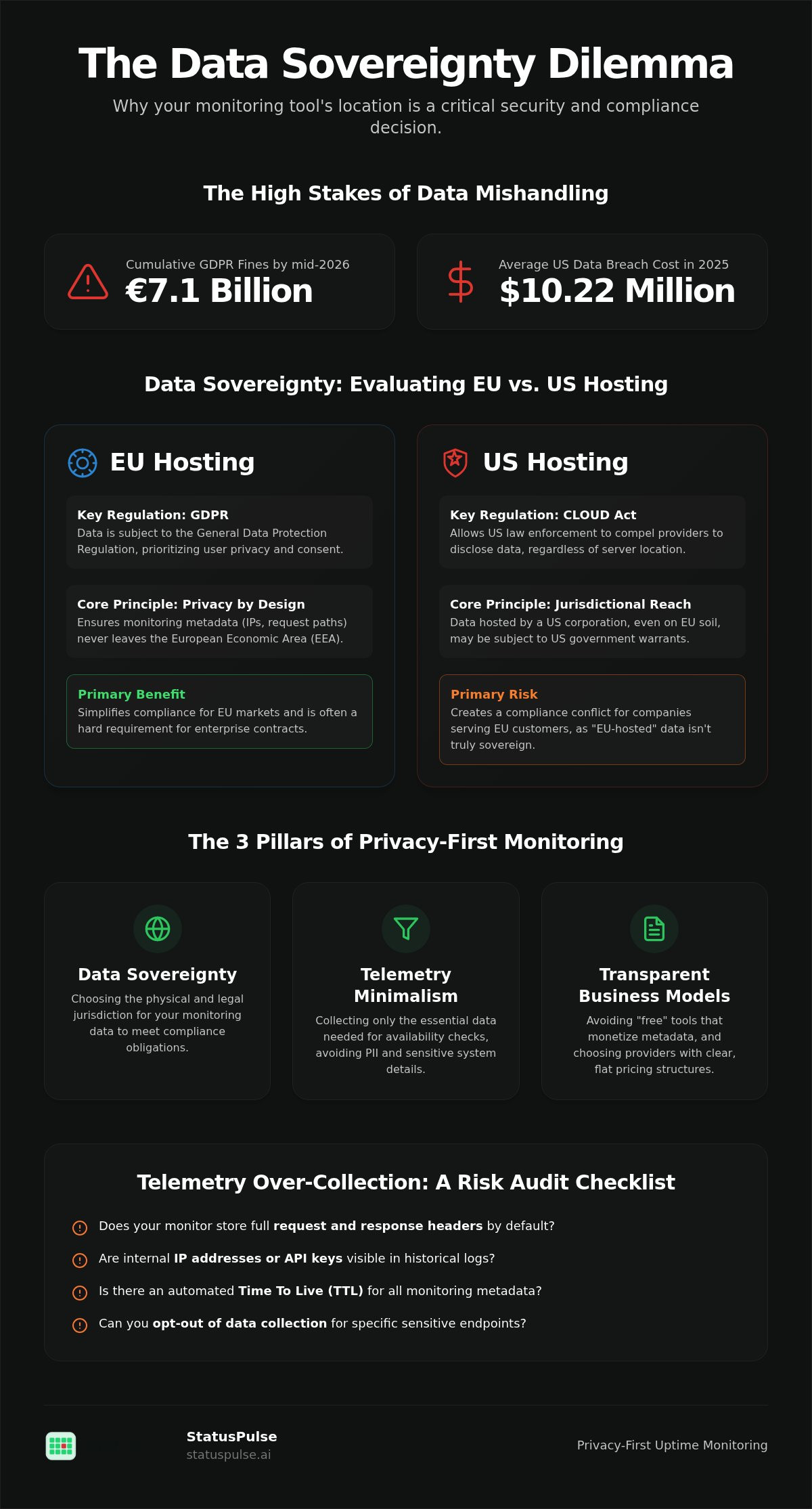
Your monitoring stack is a silent backdoor for data leakage. Traditional tools often trade user privacy for a green status icon. Privacy-focused uptime monitoring treats telemetry as a potential liability. It prioritizes data sovereignty. This ensures your logs stay out of jurisdictions with weak privacy protections. Cumulative GDPR fines reached €7.1 billion by mid-2026, and the average US data breach cost hit $10.22 million in 2025. The risk is real.
Privacy-focused uptime monitoring is an observability strategy that uses regional hosting and minimalist data collection to satisfy legal and security requirements. It prevents monitoring metadata from compromising your regulatory standing. You're likely familiar with the stress of balancing high availability with strict data laws. This guide shows you how to secure your stack using data sovereignty and privacy-first architecture. We'll cover regional hosting trade-offs, the ISO/IEC 27701:2025 update, and log sanitization techniques. Choosing where your data lives is a technical decision with massive legal consequences. We will look at why regional hosting is now a baseline requirement for engineering teams who value integrity over convenience.
Key Takeaways
- Implement privacy-focused uptime monitoring by reducing telemetry to the bare essentials required for availability checks.
- Understand how the US CLOUD Act affects your observability data and why regional hosting is a critical security control.
- Identify hidden privacy trade-offs in tools that monetize metadata or use complex per-subscriber pricing models.
- Secure your incident response by scrubbing sensitive system details from public status pages and automated updates.
- Weigh the trade-offs between self-hosting and specialized privacy-first providers to meet your specific data sovereignty requirements.
Why Privacy is the Missing Link in Modern Observability
Most uptime monitors focus exclusively on availability. They check if a service is up but ignore the trail of data left behind. Privacy-focused uptime monitoring changes this priority. It defines monitoring as the practice of measuring availability with minimal data retention. You shouldn't have to sacrifice user privacy for a status badge. Reliability and privacy can exist in the same stack.
Traditional tools often suffer from "monitoring bloat." They collect request headers, full response bodies, and detailed trace data. While useful for debugging, this metadata is often unnecessary for a simple health check. If a third-party monitor is breached, this data becomes a map for attackers. It turns your observability stack into a secondary point of failure for data leaks. Your monitoring provider should not know more about your internal API structures than necessary.
Effective monitoring relies on three pillars: data sovereignty, telemetry minimalism, and transparent business models. These pillars ensure that your monitoring activities don't create new compliance or security risks.
The Problem with Telemetry Over-Collection
Verbose logging creates hidden risks. If your monitor logs the full HTTP response, it might capture PII, session tokens, or internal system details. Simple "ping-only" checks are safer than deep-packet inspection, which analyzes the content of your traffic. Many "free" tools monetize this metadata or use it to build fingerprinting profiles of your infrastructure. Use this checklist to audit your current setup:
- Does the monitor store full request and response headers by default?
- Are internal IP addresses or API keys visible in historical logs?
- Is there an automated TTL (Time to Live) for all monitoring metadata?
- Can you opt-out of data collection for specific sensitive endpoints?
Regulatory Pressure: Beyond GDPR
Compliance is getting harder. The EU Data Act and the fallout from Schrems II have changed the legal landscape. Cumulative GDPR fines reached €7.1 billion by mid-2026. Regulators now scrutinize how technical metadata moves across borders. Even US-based companies must consider EU hosting for their European user segments to avoid legal friction. Data sovereignty is the principle that data is subject to the laws of the country where it is physically located.
Managing these requirements shouldn't require a massive legal team. At StatusPulse, we help developers solve this by offering a choice between EU and US hosting regions. This ensures your monitoring data lives where your legal obligations reside. It's a straightforward approach to a complex problem that avoids the bloat of traditional enterprise platforms.
Data Sovereignty: Evaluating EU vs. US Hosting for Monitoring Data
Selecting a monitoring region involves more than a latency check. It is a decision about legal jurisdiction. For developers, the choice between EU and US hosting determines which government can subpoena your telemetry. Privacy-focused uptime monitoring requires a clear understanding of these boundaries. While the EU-U.S. Data Privacy Framework currently facilitates data transfers, its stability is under threat. The June 2026 US Supreme Court decision in Trump v. Slaughter has raised new concerns about the independence of US regulatory oversight. This legal volatility makes data sovereignty a technical priority.
The US CLOUD Act presents a specific challenge for data stored with US-based providers. It allows US law enforcement to compel providers to disclose data, even if it's physically located on European soil. If your monitoring provider is a US corporation, your "EU-hosted" data may still be subject to US warrants. You can mitigate this by choosing providers with distinct legal entities in your preferred jurisdiction. Multi-region monitoring can still coexist with centralized sovereignty. You can run check agents globally to measure latency while ensuring the results are only stored and processed in a sovereign EU or US data center.
The Case for EU-Native Hosting
For SaaS companies targeting European markets, EU-native infrastructure is often a hard requirement. Enterprise contracts frequently include clauses that forbid data processing outside the EEA. Using a monitor that defaults to US-only storage can disqualify you from these deals. A "Privacy by Design" approach ensures that monitoring metadata, such as IP addresses and request paths, never leaves the EU. This simplifies your compliance audits and reduces the risk of Tier 2 GDPR fines, which can reach 4% of worldwide revenue.
Technical Implementation of Data Residency
Configuring your stack for residency requires precision. You should ensure your monitoring agents use TLS 1.3 and Encrypted Client Hello (ECH) to protect metadata in transit. This prevents middleboxes from sniffing SNI data during uptime checks. For those running high-traffic services, our API Monitoring: The Developer’s Guide provides more detail on securing these connections. At StatusPulse, we allow you to select your hosting region during setup. This ensures your uptime data lives where your legal obligations reside, without the complexity of enterprise-bloated platforms.
The Hidden Privacy Costs of "Free" Monitoring Tools
Free tools aren't free to operate. Servers and bandwidth cost money. If a provider doesn't charge you, they often subsidize costs by harvesting metadata or selling aggregated performance data. Privacy-focused uptime monitoring requires a business model where the user is the customer, not the data source. When you don't pay for the service, your infrastructure's telemetry becomes the product.
The "per-subscriber" pricing model is another subtle privacy risk. To charge per subscriber, a tool must track every individual who signs up for your status updates. This creates a centralized database of your users' contact information held by a third party. A flat pricing model avoids this entirely. It treats subscribers as a technical metric rather than a revenue stream to be exploited.
For hobbyists, self-hosted tools like Uptime Kuma are excellent alternatives. They offer total control over your data. However, they often lack the enterprise-grade data sovereignty provided by managed platforms with geographically distributed check nodes. You trade the convenience of a managed service for the manual overhead of maintenance and security patching. If you need global uptime checks without the management debt, a principled SaaS is usually a better fit.
Business Models and Data Integrity
Venture-backed companies are often under pressure to achieve "growth at all costs." This can lead to acquisitions where your monitoring data is transferred to a larger corporate entity with a different privacy stance. Look for sustainable SaaS providers that prioritize integrity over flashiness. Beware of "dark patterns" in dashboards that encourage you to enable verbose logging or share infrastructure maps for a "better experience." These are often just data-gathering exercises.
Auditing Third-Party Privacy Policies
Don't accept "Industry Standard Encryption" at face value. It's a vague term that often hides a lack of end-to-end protection for your monitoring logs. When you evaluate a tool, use this 4-point checklist:
- Data retention: Can you set custom TTLs for your check history?
- Sub-processors: Does the tool share data with third-party analytics or marketing firms?
- Encryption: Is data encrypted at rest and in transit using modern protocols?
- Sovereignty: Can you pin your data to a specific region like the EU?
Understanding these layers helps build a more resilient incident response strategy. For a deeper look at how to communicate during outages without leaking data, see The Architecture of Incident Communication Transparency. At StatusPulse, we use a flat pricing model to keep our incentives aligned with your privacy. We don't charge per subscriber because we don't believe in monetizing your user list.
Best Practices for Secure, Privacy-First Incident Communication
Transparency is a security risk if handled poorly. Public status pages often leak internal hostnames, staging URLs, or specific API paths during an outage. Privacy-focused uptime monitoring requires a filtered approach to communication. You need to inform users without giving attackers a map of your infrastructure. Managing this balance is a technical challenge, not just a PR task.
Incident reports should focus on impact rather than internal topology. Masking sensitive endpoints is a baseline requirement. Never include internal hostnames like prod-db-01.vlan.internal in public updates. Use generic terms like "Primary Database" or "Authentication Service." This follows the "Need to Know" principle, ensuring that only necessary information reaches the public domain.
Private status pages are the solution for internal stakeholders. They allow you to share technical specifics, such as specific cluster IDs or provider ticket numbers, without exposing them to the world. This keeps your developers informed and your security posture intact. It prevents your monitoring stack from becoming an unintentional reconnaissance tool for malicious actors.
AI and Privacy in Incident Management
Many tools now use Large Language Models (LLMs) to automate incident summaries. This is efficient but creates a data leakage vector. If you feed raw system logs or stack traces into an external AI, you're exporting sensitive data to a third party. It's better to use AI as a drafting assistant for tone and clarity rather than a replacement for human judgment. You should always be the final filter for what gets published.
StatusPulse prioritizes human agency in this process. Our AI drafts updates based on your specific input, but it doesn't ingest your raw telemetry. This ensures that PII or internal architecture details are scrubbed before they go live. It is a principled approach to automation that respects data integrity. You can maintain high-speed communication without compromising your privacy standards.
Public vs. Private Transparency
A public post-mortem shouldn't be a vulnerability report. It should explain what happened, why it happened, and how you're preventing it from recurring. Avoid mentioning specific security patches or configuration files that were changed. Keep the technical depth focused on reliability rather than exploitability. This protects your system while fulfilling your promise of honesty to your users.
Internal alerts require more depth. Your SREs need the raw data to fix the root cause. For a deeper look at balancing these two worlds, read Uptime Monitoring: A Developer’s Guide to Reliability. You can build a secure communication workflow with privacy-first status pages that separate public updates from internal technical logs, ensuring your data sovereignty remains intact throughout the incident lifecycle.
StatusPulse: Privacy-First Monitoring Built for Developers
Monitoring shouldn't be a complex corporate burden. Many teams find that enterprise suites like Datadog [VERIFY: competitor X entry price] introduce unnecessary friction and opaque pricing. StatusPulse is a principled alternative focused on technical precision and honesty. We built a platform for developers who value data sovereignty as much as high availability. Our goal is to provide a reliable observability stack without the bloat of traditional incumbents.
Privacy-focused uptime monitoring is the core of our architecture. We don't believe in per-subscriber fees or hidden tracking. You pay a flat rate for the tools you need, and your users' data stays private. By combining uptime, SSL, and API monitoring with AI-assisted status pages, we offer a consolidated workflow that respects your regulatory boundaries. It is a straightforward solution for teams that want to own their telemetry.
Architecture Built for Data Sovereignty
We provide dedicated infrastructure in both the EU and the US. This allows you to pin your monitoring data to the jurisdiction that matches your legal requirements. We minimize data retention by default, storing only the metadata necessary to verify service health. Setting up a privacy-focused check takes less than five minutes. You can configure your monitors to respect regional boundaries through a simple JSON definition:
{
  "check_name": "Secure API Gateway",
  "target_url": "https://api.yourdomain.com/v1/health",
  "hosting_region": "eu-west-1",
  "scrub_headers": ["Authorization", "Cookie", "X-Api-Key"],
  "retention_days": 30
}
This configuration ensures that sensitive headers are never written to our persistent storage. It provides a technical safeguard against accidental data exposure. You maintain full control over what is logged and where it lives.
Transparent Incident Management
Incident response is stressful enough without worrying about data leaks. Our AI incident assistant helps your team draft clear, honest updates. It functions as a technical assistant that requires human agency for the final action. This ensures that internal secrets or system vulnerabilities are scrubbed before they reach your public status page. Our status pages are also built without invasive third-party tracking, protecting your visitors' privacy during every visit.
Choosing a monitoring partner is a vote for the type of web you want to build. We prioritize integrity over flashy marketing and technical depth over corporate growth. If you are ready to move away from bloated enterprise tools, you can experience privacy-focused monitoring with StatusPulse. We offer the precision you need with the data sovereignty you deserve.
Securing Your Observability Future
Monitoring is no longer just about uptime. It's about where your data lives and who can see it. You've seen how regional hosting and telemetry minimalism turn observability from a liability into a security asset. By choosing a provider that respects data sovereignty, you protect your users and your regulatory standing. The shift toward privacy-focused uptime monitoring is a move away from corporate bloat and toward technical integrity.
Choosing between EU and US hosting should be a standard feature, not an enterprise upsell. Transparent business models ensure your interests stay aligned with your provider's incentives. You can maintain high availability without sacrificing privacy or dealing with complex pricing traps. It is a technical decision that defines your brand's commitment to its users.
It's time to reclaim control of your monitoring stack. You can build a more transparent, privacy-first infrastructure with StatusPulse. Our platform offers EU-based hosting for guaranteed data sovereignty and AI-assisted incident management with human-in-the-loop control. We don't use per-subscriber fees or hidden tracking. Start building a stack that prioritizes precision and ethics today.
Frequently Asked Questions
What makes uptime monitoring "privacy-focused" compared to standard tools?
Privacy-focused uptime monitoring prioritizes telemetry minimalism and data sovereignty. Standard tools often capture extensive request headers and response bodies, creating a risk of PII leakage. A privacy-first approach limits collection to essential status codes and latency metrics. It also ensures that monitoring logs are stored in jurisdictions with strong legal protections, such as the EU. This prevents data from being subject to broader surveillance laws found in centralized US-based storage models.
Does choosing an EU-based monitoring provider guarantee GDPR compliance?
Choosing an EU-based provider simplifies GDPR compliance but doesn't guarantee it. You must still ensure your specific monitoring configurations and internal processes meet regulatory standards. However, EU hosting ensures that telemetry data resides within the EEA, which helps satisfy data residency requirements. It mitigates risks associated with third-country transfers following the invalidation of previous adequacy decisions. You should verify the provider's specific sub-processors and data processing agreements before signing.
Can I monitor US-based infrastructure from an EU-based privacy monitor?
Yes, you can monitor infrastructure globally while maintaining centralized data sovereignty. Privacy-focused tools use distributed check nodes to measure availability from various geographic locations. While the check originates from different regions, the resulting telemetry and logs are sent back to your chosen sovereign data center. This allows you to track US-based server performance while ensuring all monitoring metadata is processed and stored exclusively within the EU or your preferred jurisdiction.
How does data sovereignty affect my monitoring latency?
Data sovereignty typically has a negligible impact on monitoring accuracy but can affect dashboard responsiveness. The latency of an uptime check depends on the distance between the probe and your server, not where the data is stored. However, if your team is in the US and accesses an EU-hosted dashboard, you may experience slightly higher loading times for log data. This is a minor trade-off for the legal security provided by sovereign data residency.
Is AI incident management safe for sensitive technical data?
AI incident management is safe when implemented with strict privacy guardrails. Problems arise when raw system logs or stack traces are sent directly to external LLMs. A secure approach uses AI as a drafting assistant for human-provided summaries. This keeps the technical team in control of what is shared. It ensures that sensitive internal architecture details or PII are scrubbed before any status updates are generated or published to users.
Why should I avoid free uptime monitoring tools for my business?
Free tools often lack transparent business models and enterprise-grade privacy controls. They may subsidize operational costs by harvesting metadata or selling aggregated performance data. For a business, this creates an unmanaged security risk and potential compliance violations. Opting for privacy-focused uptime monitoring through a paid service provides contractual guarantees and dedicated regional hosting. While self-hosted tools are excellent for hobbyists, they require manual maintenance that most production environments can't justify.
What is the risk of "per-subscriber" pricing for status pages?
Per-subscriber pricing forces your monitoring provider to track every individual who signs up for updates. This creates a third-party database of your customers' contact information, increasing your attack surface. If the provider is breached, your entire subscriber list is exposed. Flat pricing models avoid this by treating subscribers as a technical metric rather than a revenue source. It allows you to communicate with your audience without creating a new PII management burden.
How often should I audit my monitoring tool’s privacy policy?
You should audit your provider's privacy policy at least once a year or whenever major regulatory shifts occur. The legal landscape for data transfers is volatile. Cumulative GDPR fines reached €7.1 billion by mid-2026. Frequent audits ensure that your provider hasn't introduced new sub-processors or changed their data retention terms. It's also wise to review these policies after any corporate acquisitions. Ownership changes often impact data handling practices and your long-term sovereignty.


