

Relying on the EU-US Data Privacy Framework is currently a high-stakes gamble for your infrastructure. Following the June 2026 ruling in Trump v. Slaughter, the legal foundation for Schrems II compliant SaaS monitoring is once again unstable. You're likely tired of the constant cycle of invalidated agreements and the threat of heavy GDPR fines. It's difficult to balance the need for low-latency performance with the strict requirement to keep data out of reach from foreign surveillance laws.
Building a sovereign monitoring stack doesn't mean you have to sacrifice uptime granularity or settle for bloated enterprise pricing. You can maintain high availability while ensuring your logs never leave the EU. This technical guide explains how to audit your sub-processors, implement robust Transfer Impact Assessments, and configure a monitoring architecture that passes legal scrutiny. We'll examine the trade-offs of localized hosting and show you how to maintain a reliable status page and incident response workflow without relying on high-risk US-based incumbents.
Key Takeaways
- Understand why physical server location is insufficient for compliance if the provider's parent company is subject to US surveillance laws like FISA 702.
- Learn the specific architectural requirements for Schrems II compliant SaaS monitoring, including the necessity of an EU-based legal entity and sovereign infrastructure.
- Map your monitoring data flows from agent to dashboard to identify hidden sub-processor risks and jurisdictional vulnerabilities in your stack.
- Compare the impact of the US CLOUD Act on EU-native versus US-owned data centers to ensure your uptime monitoring passes a strict legal audit.
- Configure a monitoring strategy that balances high-availability API checks with your specific data sovereignty needs through regional hosting choices.
Why Schrems II Ended Business as Usual for SaaS Monitoring
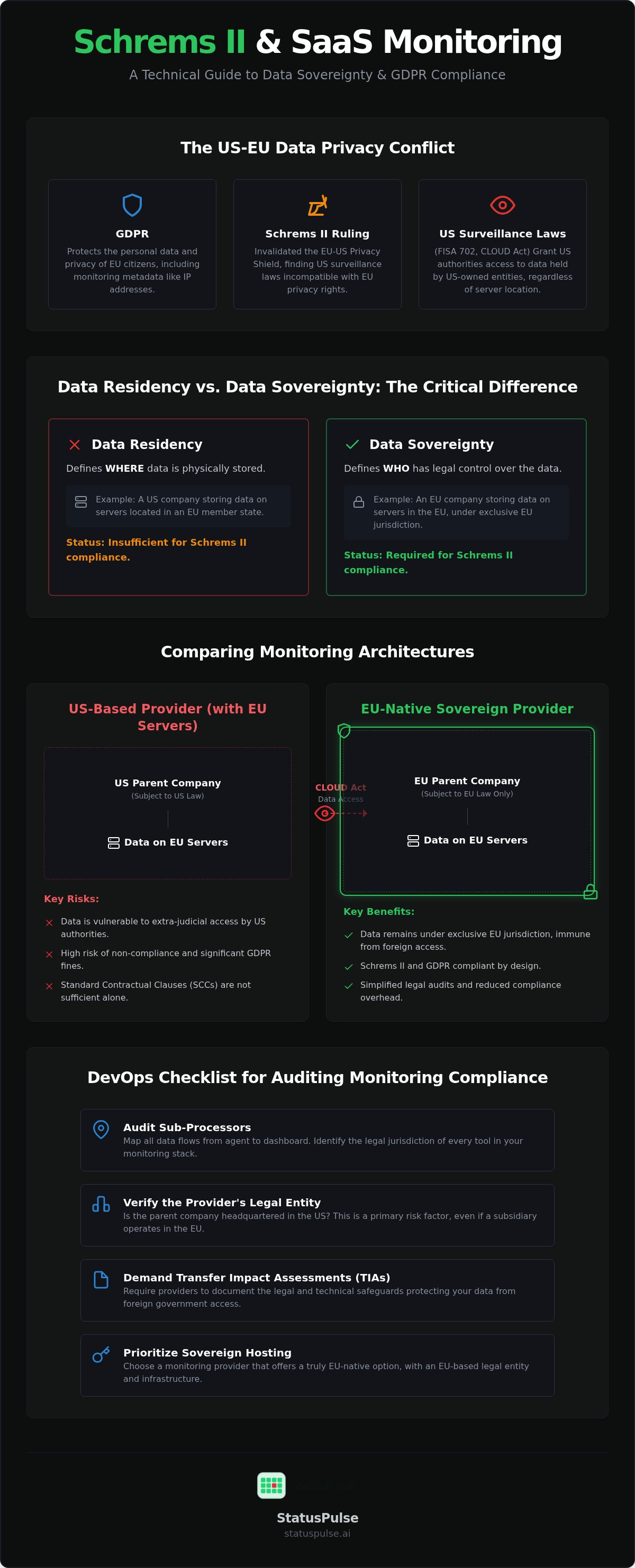
If your monitoring dashboard relies on a US-based provider, your compliance audit is likely to fail. The 2020 Schrems II ruling ended the era of easy data transfers by striking down the EU-US Privacy Shield. This framework previously allowed US companies to self-certify that they protected European data. The Court of Justice of the European Union (CJEU) found that US surveillance programs prioritize national security over individual privacy rights. Specifically, Section 702 of the Foreign Intelligence Surveillance Act (FISA 702) allows broad access to data held by US providers, creating a direct conflict with GDPR.
The Invalidation of the Privacy Shield
The court's primary concern was the lack of judicial redress for EU citizens. Under US law, non-US persons have no effective way to challenge government surveillance. This created an adequacy gap that self-certification could not bridge. Continuing to use US-only monitoring providers became a legal liability overnight. If your monitoring data is processed by a US-based entity, it is technically accessible to US intelligence. This accessibility violates the GDPR requirement for a level of protection essentially equivalent to that guaranteed within the EU. Recent legal shifts in 2026 have only increased this instability, making sovereign infrastructure a necessity rather than a preference.
Why Monitoring Metadata is Personal Data
Many engineers believe that uptime monitoring involves only anonymous system data. This is a technical misconception. Every uptime check, API request, and SSL handshake involves processing IP addresses. The GDPR classifies IP addresses as personal data. When you monitor an API endpoint, you capture metadata that can reveal user behavior or sensitive system architecture. SaaS providers using non-compliant sub-processors face significant legal exposure if this data is transferred without proper safeguards. If the provider is a US-owned subsidiary, the US CLOUD Act may still grant US authorities access to that data, even if the servers are physically located in the EU.
Achieving Schrems II compliant SaaS monitoring requires more than just signing a contract. Standard Contractual Clauses (SCCs) are no longer sufficient on their own. You must now implement supplementary technical measures to prevent unauthorized access. This often requires shifting to providers like StatusPulse that prioritize data sovereignty and offer specific EU-native hosting options. Without these technical barriers, your monitoring stack remains a weak point in your GDPR compliance strategy. Relying on a provider with a sovereign legal entity ensures that your data remains under EU jurisdiction, protecting you from the reach of foreign surveillance laws.
The Technical Requirements for Data Sovereignty in 2026
Data residency is a physical metric; data sovereignty is a legal one. Simply picking an "EU-Central-1" region on a US cloud provider doesn't guarantee Schrems II compliant SaaS monitoring. The Impact of Schrems II has forced a shift from where data is stored to who controls the infrastructure. If a US-headquartered company owns the legal entity, the US CLOUD Act can compel them to provide access to data stored on European soil.
Defining Data Sovereignty for SREs
For an SRE, sovereignty means immunity from foreign extra-judicial access. US-headquartered cloud giants operate under a legal jurisdiction that often conflicts with GDPR privacy mandates. When you use a US-owned subsidiary, you're still tethered to the parent company's legal obligations. Sovereign hosting is data immune to foreign extra-judicial access. This distinction is critical for maintaining a defensible compliance posture during a legal audit. It ensures that your monitoring metadata remains under the exclusive control of EU law.
Supplementary Measures: Beyond the Contract
Compliance requires technical safeguards that go beyond signing a Data Processing Agreement (DPA). You should implement pseudonymization for public status pages to ensure that viewer IP addresses aren't stored in a way that identifies individuals. Bring Your Own Key (BYOK) or client-side encryption for incident logs adds a layer of protection that even the service provider can't bypass. These measures are no longer optional for high-risk data transfers.
Transparency in how these systems are built is essential for modern technical teams. We recommend reviewing The Architecture of Incident Communication Transparency to understand how to build trust with your users. Incident logs and communication records often contain sensitive diagnostic data. This information must be encrypted end-to-end to prevent unauthorized access by third parties or foreign governments.
Achieving a fully compliant stack involves evaluating the ultimate parent company of your sub-processors. It's not enough to rely on marketing claims; you need a monitoring solution that offers a choice between EU or US hosting regions while maintaining a sovereign legal status. If you're looking for a platform that prioritizes these ethical standards, you can explore sovereign uptime monitoring options that align with your specific regional requirements.
Comparing Monitoring Architectures: EU-Native vs. US-Based
The choice between monitoring architectures is a trade-off between feature depth and regulatory safety. While US incumbents offer extensive legacy integrations, they operate under a legal framework that creates a direct conflict with European privacy standards. Understanding the Schrems II ruling and its impact is the first step in deciding which model fits your risk profile and technical needs.
The CLOUD Act vs. GDPR Conflict
The US CLOUD Act requires US companies to provide data to authorities regardless of where that data is stored physically. This creates a legal deadlock for European firms. A provider might host your monitoring data in Frankfurt, but if their parent company is US-based, they cannot legally refuse a valid US warrant. For European SaaS companies, achieving Schrems II compliant SaaS monitoring is nearly impossible when using US-owned sub-processors because the legal entity itself is the vulnerability.
| Architecture Model | Legal Entity Origin | US CLOUD Act Exposure | Compliance Status |
|---|---|---|---|
| EU-Sovereign | European Union | None | High (Schrems II Compliant) |
| US-Based (EU Region) | United States | Full | Low (Subject to FISA 702) |
| Hybrid / Multi-Cloud | Global | Partial | Requires complex TIA |
Managing Latency in Sovereign Monitoring
SREs often worry that keeping data in the EU will increase latency for global uptime checks. If you monitor a US West endpoint from a Dublin data center, you will see higher Round Trip Times (RTT). However, you don't need to host your entire stack in the US to get accurate data. StatusPulse manages this by separating the monitoring agents from the data storage. We provide the choice to deploy monitoring in EU or US regions, ensuring you get the granularity you need without compromising your legal entity's sovereignty. For more on optimizing these checks, see API Monitoring: The Developer’s Guide to High Availability in 2026.
Verifying the sub-processor chain requires a deep dive into your tool's infrastructure. You must identify every third-party service used for log storage, alerting, and dashboarding. If any of these links in the chain are US-owned, the sovereign status of the primary provider is undermined. A truly sovereign architecture ensures that the entire path of your monitoring data remains under EU jurisdiction, protecting you from the reach of foreign surveillance laws while maintaining 1-minute check intervals globally.
A DevOps Checklist for Auditing Monitoring Compliance
Audits often fail because of hidden dependencies. You might have an EU-based dashboard, but the underlying log storage or alerting engine could be running on US infrastructure. To achieve Schrems II compliant SaaS monitoring, you must look past the marketing site and verify the entire sub-processor chain. This requires a systematic review of how metadata moves from your agents to the final dashboard view.
Mapping Your Data Flow Architecture
Start by identifying every touchpoint for your uptime metadata. When a monitoring agent pings your API, it captures IP addresses, response headers, and latency data. You need to know where this data is ingested and where it is stored. Many monitoring tools use US-based cloud services for their backend databases or log processing pipelines. Verifying the "data at rest" location for SSL logs is mandatory to prevent certificate metadata from leaking into non-compliant jurisdictions. Use a traceroute approach to map these flows and flag any hops that cross into US-owned infrastructure.
Reviewing Sub-processor Risk
A Data Processing Agreement (DPA) is only as strong as its sub-processor list. When reviewing a DPA, look specifically for language regarding FISA 702 exposure and the provider's ultimate parent company. If the provider is a subsidiary of a US corporation, they are subject to the CLOUD Act regardless of where the servers sit. Check for the option to choose between EU or US hosting as a primary safeguard. For deeper insights on performing these technical reviews, see Uptime Monitoring: A Developer’s Guide to Reliability and Honest Communication.
Your audit should also include a reliability check for your status pages. In the event of a regional outage, an EU-based status page must remain reachable and independent of your primary US-based infrastructure. This "Z-Score" of reliability ensures that your incident communication remains sovereign and functional when you need it most. Follow this checklist to verify your current stack:
- Trace Metadata: Identify the physical storage location of all IP logs and API response bodies.
- Verify Ownership: Confirm that the monitoring provider is an EU-legal entity without a US parent company.
- Audit DPAs: Ensure SCCs are supported by documented supplementary technical measures.
- Check Sovereignty: Confirm that alerting and incident management data stays within your chosen region.
If your current provider cannot give you a transparent list of their sub-processors, it's time to evaluate alternative tools. You can audit your monitoring compliance with StatusPulse to see how a sovereign legal entity simplifies your GDPR requirements while maintaining high-granularity API checks.
Implementing StatusPulse: Sovereignty by Design
Once you've mapped your data flows and audited your sub-processors, the final step is selecting a platform that honors those boundaries. StatusPulse provides a technical foundation specifically for teams that require Schrems II compliant SaaS monitoring. We don't bolt on compliance as an afterthought; we build it into the architecture from the first line of code.
Regional Hosting Choice
At the moment of signup, you choose your primary data residency. This decision sets a strict perimeter for where your monitoring metadata and incident logs are stored. Selecting the EU region keeps your data under the protection of European law, while the US region serves teams with different jurisdictional needs. This flexibility allows you to align your monitoring stack with your specific Transfer Impact Assessment (TIA) results. We're a focused team of specialists. This means we prioritize technical precision over the corporate bloat typical of faceless incumbents.
AI-Powered Incident Communication
Communicating during a high-stress outage is difficult. Our AI incident management system assists technical teams by drafting clear, honest updates based on real-time monitoring data. The AI functions as an assistant that requires a final human approval before any update goes public. This ensures that your status page remains a source of truth rather than a collection of corporate jargon. You can explore the AI incident management tool to see how it simplifies your response workflow without sacrificing human agency.
Ethics extend to how we charge for our software. Many platforms use per-subscriber fees that become unpredictable as your audience grows. We offer flat, transparent pricing. This model ensures that you aren't penalized for effectively communicating with your users. By combining uptime, API, and SSL monitoring with a sovereign legal entity, we provide a reliable alternative for SREs who value data sovereignty as much as system performance. Our approach is straightforward: we provide the tools you need to maintain high availability without the legal uncertainty of US-based sub-processors.
Securing Your Infrastructure for a Sovereign Future
Navigating the legal instability of 2026 requires a shift from passive hosting to active data sovereignty. You've learned that server location is only the first step. True Schrems II compliant SaaS monitoring depends on the legal entity's jurisdiction and the transparency of its sub-processor chain. By mapping your data flows and prioritizing sovereign architectures, you protect your organization from the reach of foreign surveillance laws while maintaining the high availability your users expect.
Reliable monitoring shouldn't come with the stress of legal uncertainty or the frustration of per-subscriber pricing bloat. You can maintain a precise uptime and API monitoring stack that respects regional privacy standards without sacrificing performance. Whether you need EU or US hosting regions, you can deploy a solution that combines technical depth with ethical clarity. Use AI-assisted incident summaries to communicate with integrity during outages, ensuring your team stays focused on resolution rather than drafting updates.
Ready to build a defensible compliance posture? Start your sovereign monitoring journey with StatusPulse today. It's time to choose a platform that values your data sovereignty as much as you do.
Frequently Asked Questions
Is a monitoring tool compliant if it uses AWS servers in Frankfurt?
Physical server location is only one part of the equation. If your monitoring provider is a US-owned company, they are subject to the US CLOUD Act regardless of the data center's geography. This allows US authorities to request data stored on European soil. To achieve Schrems II compliant SaaS monitoring, you need a provider with an EU-based legal entity and no US parent company to fully eliminate this jurisdictional risk.
Does Schrems II apply to non-personal technical data like server uptime?
Yes, it applies. While "uptime" sounds like a purely technical metric, the monitoring process captures IP addresses and response headers. The GDPR classifies IP addresses as personal data. Monitoring an API or website involves processing these identifiers, making the tool a data processor. If this metadata is transferred to a country without an adequacy decision, you must implement the safeguards required by the Schrems II ruling.
How does StatusPulse handle data transfers for global monitoring checks?
StatusPulse allows you to select your primary hosting region, EU or US, during the signup process. This ensures that your monitoring metadata and incident logs remain within your chosen jurisdiction. For global uptime checks, our agents ping endpoints worldwide, but the resulting data is stored and processed only in the region you specify. This architecture supports data sovereignty while providing the low-latency granularity required for high-availability API monitoring.
Can I use a US-based status page if my monitoring is in the EU?
Using a US-based status page for EU-monitored services introduces unnecessary compliance risk. Even if your monitoring data stays in the EU, the status page sub-processors may transfer viewer IP data to the US. This creates a split legal profile that complicates your Transfer Impact Assessment (TIA). For a streamlined audit, it is best to keep your entire monitoring and incident communication stack within a single sovereign jurisdiction.
What are supplementary measures for SaaS monitoring compliance?
Supplementary measures are technical, organizational, or contractual safeguards used alongside Standard Contractual Clauses (SCCs). In SaaS monitoring, these include end-to-end encryption for incident logs, pseudonymization of viewer IP addresses on status pages, and documented TIAs. These measures must prevent foreign intelligence agencies from accessing the data in a way that bypasses EU privacy protections. They are essential for any transfer to a third country like the US.
Does StatusPulse offer a Data Processing Agreement (DPA) including SCCs?
StatusPulse provides a comprehensive Data Processing Agreement (DPA) that incorporates the latest modular Standard Contractual Clauses (SCCs). This agreement outlines our responsibilities as a data processor and your rights as a data controller. Since we offer specific EU-based hosting, our DPA is designed to support your GDPR compliance requirements by providing a clear legal framework for data storage and processing within your chosen geographic region.
How does flat pricing benefit my compliance and audit process?
Flat pricing simplifies the audit process by removing the need to track per-subscriber or per-seat usage for compliance reporting. In a technical audit, you can focus on data flow mapping and sub-processor verification without the distraction of complex, variable cost models. This transparency aligns with the ethical standards of sovereign monitoring, ensuring that your compliance efforts aren't hindered by the administrative bloat of traditional enterprise pricing structures.
Can I switch my hosting region from US to EU after setup?
Switching hosting regions after setup is generally treated as a migration rather than a toggle. Because StatusPulse maintains strict logical and physical separation between the EU and US regions to ensure data sovereignty, data cannot be moved between them. You should choose the region that matches your compliance profile at signup. If your requirements change, our team can guide you through the process of setting up a new sovereign environment.


