

Selecting a European region in a dropdown menu doesn't guarantee legal safety. Many technical teams assume that choosing a Frankfurt data center satisfies EU data residency for monitoring tools, but geography is just a technical detail. The June 2026 Supreme Court ruling in Trump v. Slaughter and the reach of the U.S. CLOUD Act mean that jurisdiction often overrides physical server location. If your provider is U.S.-owned, your monitoring data remains subject to foreign warrants regardless of the data center's coordinates.
You likely feel the pressure of conflicting laws while trying to maintain high-availability uptime checks and incident response. It's frustrating to balance technical performance with the risk of PII leaks and regulatory fines that have now surpassed €7.1 billion across the EU. This article explains why server location is only half the battle and shows you how to audit your monitoring stack for true sovereignty. We'll cover the specific legal conflicts of 2026, the technical reality of data transfers, and how to build a defensible compliance position.
Key Takeaways
- Understand why U.S. owned monitoring vendors remain subject to the CLOUD Act regardless of which physical data center region you select.
- Identify how IP addresses in uptime checks and user IDs in API traces constitute personal data under the Breyer C-582/14 ruling.
- Learn to evaluate EU data residency for monitoring tools by auditing the legal jurisdiction of parent companies and their sub-processor chains.
- Discover the technical requirements for achieving true data sovereignty in 2026, moving beyond simple data localization.
- Establish a defensible compliance position by utilizing monitoring platforms that offer dedicated EU hosting and legal incorporation within the Union.
Why Monitoring Data is Personal Data under GDPR
Monitoring is often viewed as a purely technical exercise. This is a mistake. Every ping, traceroute, and API request involves data that legal frameworks now treat with extreme caution. Under the General Data Protection Regulation (GDPR), your monitoring stack is a processing engine for personal data. In 2026, EU data residency for monitoring tools is defined as the storage and processing of monitoring data within the EU/EEA, managed by an entity that is not subject to foreign extraterritorial surveillance laws.
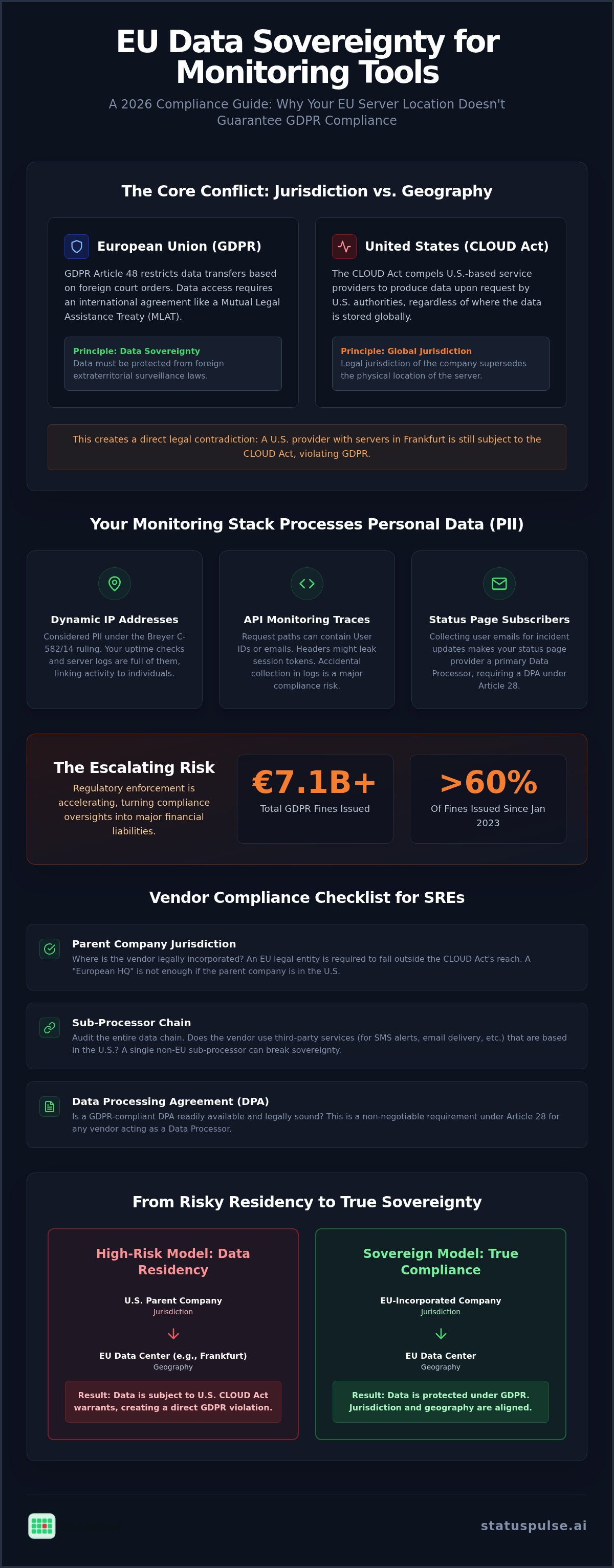
The legal reality is that your monitoring vendor acts as a Data Processor under Article 28. You are the Data Controller. This means you are responsible for ensuring the vendor handles PII according to strict standards. With total GDPR fines now exceeding €7.1 billion across 2,500 enforcement actions, the cost of an overlooked log file is higher than ever. Over 60% of these fines were issued after January 2023, showing that regulators are moving past the learning phase into robust enforcement.
The PII Leak in Your Monitoring Traces
Dynamic IP addresses are the most common form of PII in monitoring. The Court of Justice of the European Union confirmed in the Breyer C-582/14 ruling that these are personal data. They allow for the identification of a user when combined with additional data held by an ISP. Your uptime checks and logs are full of them.
API monitoring adds more complexity. Request paths often contain User IDs or email addresses. Headers might leak session tokens or authorization data. If your monitoring tool captures these in traces, you are processing PII. Accidental collection is a major risk. Developers often paste raw logs into incident summaries or AI incident management tools. If those logs contain customer data, you've created a compliance breach. You need a tool that understands these boundaries and keeps the data where it belongs.
Status Pages and Subscriber Privacy
Public status pages are a visible compliance surface. When users subscribe to updates, you collect their email addresses. This makes your status page provider a primary Data Processor. You must have a signed Data Processing Agreement (DPA) in place to satisfy Article 28 requirements. Many teams forget that subscriber management is a significant PII repository.
Third-party subscriber management adds to your compliance surface. If your vendor uses a long chain of sub-processors outside the EU, your risk increases. StatusPulse helps mitigate this by offering an all-in-one platform for monitoring and status pages. You choose the hosting region for both your monitoring data and your subscriber lists, ensuring your stack remains sovereign and defensible.
Jurisdiction vs. Geography: The CLOUD Act Conflict
Technical teams often view "EU-West-1" as a compliance checkbox. It isn't. Selecting a European data center in a dropdown menu provides data residency in a geographic sense, but it does not provide data sovereignty. In 2026, the legal landscape is increasingly volatile. The June 29, 2026, Supreme Court ruling in Trump v. Slaughter has already triggered new challenges to the EU-US Data Privacy Framework. This instability makes EU data residency for monitoring tools a complex legal target rather than a simple configuration choice.
The core issue is the conflict between EU data privacy laws and U.S. surveillance powers. While GDPR mandates strict control over who can access personal data, U.S. laws prioritize access for national security. This creates a direct legal contradiction for any team using U.S.-based monitoring vendors, even those with servers in Dublin or Frankfurt.
Understanding the US CLOUD Act Reach
The U.S. CLOUD Act (18 U.S.C. § 2713) is the primary source of this conflict. It grants U.S. authorities the power to compel service providers to produce data regardless of where that data is stored. If the provider is a U.S. company, they must comply with U.S. warrants for data sitting on European soil. This directly violates GDPR Article 48, which states that foreign court orders are only recognized if based on an international agreement like a Mutual Legal Assistance Treaty (MLAT).
Data Protection Officers (DPOs) are increasingly rejecting U.S. vendors for this exact reason. The conflict with FISA 702 further complicates the matter, as it allows for bulk collection that lacks the "proportionality" required by European courts. For an SRE, this means your monitoring traces and uptime logs could be legally accessed by a foreign government without your knowledge or consent.
The Sovereignty Advantage of EU-Incorporated Tools
True sovereignty requires an EU-incorporated entity. These companies operate under European law as their primary jurisdiction. They are not subject to the CLOUD Act because they lack the necessary "nexus" to the United States. This provides a clean legal break from U.S. surveillance orders. By choosing a provider like StatusPulse, which is an EU-based entity, you remove the extraterritorial reach of foreign warrants from your compliance equation.
Building a defensible position for EU data residency for monitoring tools involves more than just server location. It requires a vendor that is legally immune to foreign data requests. This creates a foundation of trust that U.S. incumbents cannot match, despite their regional hosting options. When your monitoring tool is governed by the same laws as your business, the regulatory risk drops significantly.
Technical Requirements for EU Data Residency in 2026
Technical teams often confuse data localization with data transfer restrictions. Localization is the physical act of keeping bits on servers within a specific border. Transfer restrictions are the legal rules governing who can access those bits from outside. To achieve true EU data residency for monitoring tools, you must satisfy both. It's not enough to host data in Paris if a support engineer in a third country can pull raw PII from your database without a Transfer Impact Assessment (TIA).
Compliance documentation should be accessible, not hidden behind a "Contact Sales" button. A sovereign vendor provides instant, downloadable Data Processing Agreements (DPAs) that clearly outline sub-processor locations. If a vendor can't provide a transparent list of where your monitoring data travels, they aren't ready for a 2026 audit. Transparency is a technical requirement, not a marketing preference.
Auditing Your Monitoring Sub-processors
Your monitoring tool has its own telemetry. You need to know where that data goes. If your status page provider uses a U.S.-based logging service or a CDN with aggressive data collection, your compliance chain is broken. The chain of compliance must extend from your application to the monitoring tool and down to every cloud provider they use. A single non-compliant sub-processor in the stack can invalidate your entire data sovereignty position.
Technical depth is required to map these flows. When setting up API Monitoring: The Developer’s Guide to High Availability in 2026, you should verify that the probe locations and the central data store share the same legal jurisdiction. If your API traces contain sensitive User IDs, those traces must never leave the EU/EEA boundaries during processing or storage.
Retention and Deletion Controls
GDPR mandates data minimization. You should only keep monitoring data as long as it's technically necessary. Long-term observability is useful for trend analysis, but it increases your privacy risk. Configure your retention periods to match your actual operational needs. For most teams, keeping detailed uptime logs for 30 to 90 days is sufficient for SLA reporting while reducing the volume of stored PII.
Automated deletion is a core feature of a compliant stack. Incident logs and status updates should have clear expiration dates. When an incident is resolved and the post-mortem is complete, the raw traces should be purged. This trade-off between long-term data history and privacy risk is a decision SREs must make intentionally. Choose a tool that gives you granular control over these deletion cycles rather than one that defaults to "keep everything forever."
Auditing Your Vendors: A Compliance Checklist for SREs
SREs often inherit legacy monitoring stacks. These stacks frequently fail modern compliance checks. To maintain EU data residency for monitoring tools, you must move beyond the "EU Region" dropdown and audit the entity behind the software. Compliance isn't just a legal task; it's a technical requirement for any stack operating in 2026.
Start with the parent company jurisdiction. If the vendor is U.S.-incorporated, they are subject to the CLOUD Act, making server location a secondary detail. You also need a transparent list of sub-processors. If a vendor hides their infrastructure partners behind a sales call, they're likely hiding a compliance risk. A Data Processing Agreement (DPA) should be standard and ready to sign without a three-week legal review.
Technical redaction is your final line of defense. Does the tool allow you to mask IP addresses or scrub User IDs from API traces before they are stored? If not, you're importing a compliance headache. Effective tools provide granular control over what data is captured and how long it's kept.
The Procurement Audit Framework
Follow these steps during your next vendor review. First, perform a jurisdiction check. Confirm if the entity is EU-based or U.S.-based. Second, verify hosting choice. Some vendors claim EU hosting but replicate metadata to the U.S. for "global visibility." Ensure you can pin all data, including telemetry and logs, to the EU.
Third, assess access controls. Verify encryption at rest and in transit. Ask if support staff in countries without an adequacy decision can access your raw logs. If the vendor can't provide a clear technical answer, their security model is likely insufficient for GDPR-sensitive environments.
Consolidating the Monitoring Stack
Every niche tool adds a new DPA to manage. Using five different vendors for uptime, SSL, and API traces creates compliance sprawl. This increases your audit surface and the likelihood of a PII leak. Consolidating into an all-in-one platform reduces this risk significantly. You manage one vendor, one sub-processor list, and one jurisdiction.
Check out our Website Uptime Monitoring Tools: A Developer’s Guide to 2026 Reliability for a deeper look at how consolidation improves uptime. By reducing the number of third-party integrations, you simplify your legal and technical stack. StatusPulse provides this consolidation with an EU-based entity and transparent hosting choices, helping you avoid the pitfalls of compliance sprawl.
StatusPulse: Sovereign Monitoring for European Teams
Technical compliance is a design choice. At StatusPulse, we built our platform to solve the exact jurisdictional conflicts that make U.S. incumbents a liability for European firms. We are an EU-incorporated entity. This status ensures that your telemetry and subscriber data are governed exclusively by European privacy standards, removing the risk of extraterritorial data requests from foreign authorities. For SRE teams, this provides a clean legal foundation for EU data residency for monitoring tools.
Managing compliance is easier when your tools are consolidated. Instead of signing separate DPAs for uptime monitoring, SSL checks, and status pages, you manage one relationship. We provide a single, transparent list of sub-processors. You can audit our entire stack without booking a sales call or navigating corporate bloat. This lean approach mirrors our product philosophy: high-precision monitoring without the unnecessary complexity of enterprise software giants.
Data Residency by Choice
We don't force a specific region on your data. During setup, you can choose between EU or US hosting for your entire account. This toggle pins your uptime data, API traces, and status page subscriber lists to your preferred jurisdiction. If you select the EU, your data stays on European soil, managed by a European company. This is the only way to achieve true data sovereignty in 2026.
Our AI incident management follows the same strict rules. We treat AI as an assistant that requires final human action, ensuring that incident summaries and post-mortems are processed according to your residency choice. You get the efficiency of modern incident response without the PII leakage risks common in tools that ship data to third-party models in unauthorized regions. It's a straightforward technical implementation of the privacy-by-design principle.
A Fair Alternative to Industry Incumbents
Integrity is part of our pricing model. We avoid the complex, per-subscriber fees that make competitors expensive as your audience grows. Our pricing is flat and transparent. We believe you shouldn't be penalized for keeping your users informed during a disruption. This ethical approach to cost is a core signature of how we operate as a principled underdog in the monitoring space.
Transparency extends to how we communicate. Our guide on The Architecture of Incident Communication Transparency explains how we balance technical precision with clear user updates. We focus on solving problems effectively rather than sounding like a traditional enterprise provider. If you are tired of corporate bloat and want a reliable, sovereign stack, StatusPulse is built for you. We provide the tools you need to maintain a defensible compliance position while ensuring your services stay online.
Future-Proofing Your Monitoring Compliance
Geography is a technical setting; jurisdiction is a legal reality. Relying on a region dropdown in a U.S. owned tool leaves your organization exposed to the CLOUD Act and shifting data transfer frameworks. True EU data residency for monitoring tools requires a vendor that is legally and physically rooted in the European Union. This distinction is the difference between a checkbox and a defensible compliance position.
Auditing your parent company's jurisdiction and consolidating your stack reduces your compliance surface. It eliminates the risk of foreign government surveillance while ensuring your SRE team has the high-availability tools they need. Moving away from corporate bloat allows you to focus on precision and privacy without compromising on performance.
StatusPulse offers an ethical alternative for teams that value sovereignty. We are an EU-incorporated entity with ISO 27001 compliant infrastructure and transparent, flat-rate pricing. You can start monitoring with true EU data residency on StatusPulse today. Build a monitoring stack that respects your users and your legal obligations.
Frequently Asked Questions
Does GDPR require my monitoring data to stay in the EU?
GDPR doesn't strictly forbid data leaving the EU, but it places a heavy burden on the controller. Transfers to the US currently face intense scrutiny due to the 2026 legal challenges to the Data Privacy Framework. Maintaining EU data residency for monitoring tools simplifies your compliance. It removes the need for complex Transfer Impact Assessments (TIAs). By keeping data within the Union, you avoid the legal volatility of international data agreements.
Is an EU region in a US-based tool enough for compliance?
No, an EU region in a US tool is often insufficient for strict compliance. The US CLOUD Act allows authorities to access data stored by US companies, even if the physical servers are in Frankfurt or Dublin. This creates a conflict with GDPR protections. True sovereignty requires both geographic localization and an EU-based legal jurisdiction. Without both, your monitoring data remains subject to foreign surveillance laws.
What is the conflict between the CLOUD Act and GDPR?
The conflict centers on extraterritorial reach. The US CLOUD Act mandates that US-owned providers comply with warrants regardless of server location. GDPR Article 48 states that foreign court orders are only recognized if they are based on international agreements. This puts US vendors in a position where they must either violate US law or breach GDPR. This legal deadlock is why many European DPOs now prioritize EU-incorporated monitoring partners.
What monitoring data is considered PII under GDPR?
Personal data in monitoring includes IP addresses, User IDs, and email addresses. The Breyer C-582/14 ruling established that dynamic IP addresses are PII. API monitoring traces often leak sensitive identifiers in request paths or headers. Additionally, subscriber lists for public status pages are direct collections of personal data. Every part of your monitoring telemetry must be audited for these identifiers to ensure full regulatory compliance.
Can I use StatusPulse if my team is based in the US?
Yes, StatusPulse is built for global teams. We offer a choice between EU or US hosting for all data. If your team is in the US, you can select US residency to keep your telemetry and status pages local. Our platform provides the same flat-rate pricing and incident management tools to all users. We believe in giving you the agency to decide where your data lives based on your specific requirements.
How does StatusPulse handle data residency for AI incident management?
AI processing is pinned to your selected hosting region. If you choose EU residency, your AI-assisted incident summaries and drafts are processed and stored within the EU. We treat AI as a technical assistant that supports human action rather than a black box that exports data. This ensures your EU data residency for monitoring tools is not compromised when you use our incident management features to draft updates during an outage.
Do I need a separate DPA for my public status page?
No, StatusPulse consolidates your entire stack into a single Data Processing Agreement. We include uptime monitoring, API checks, and public status pages under one legal framework. This approach reduces compliance sprawl by limiting the number of third-party vendors you need to audit. You manage a single sub-processor list and one jurisdiction. This significantly simplifies your annual compliance reviews and procurement processes for your technical team.


