

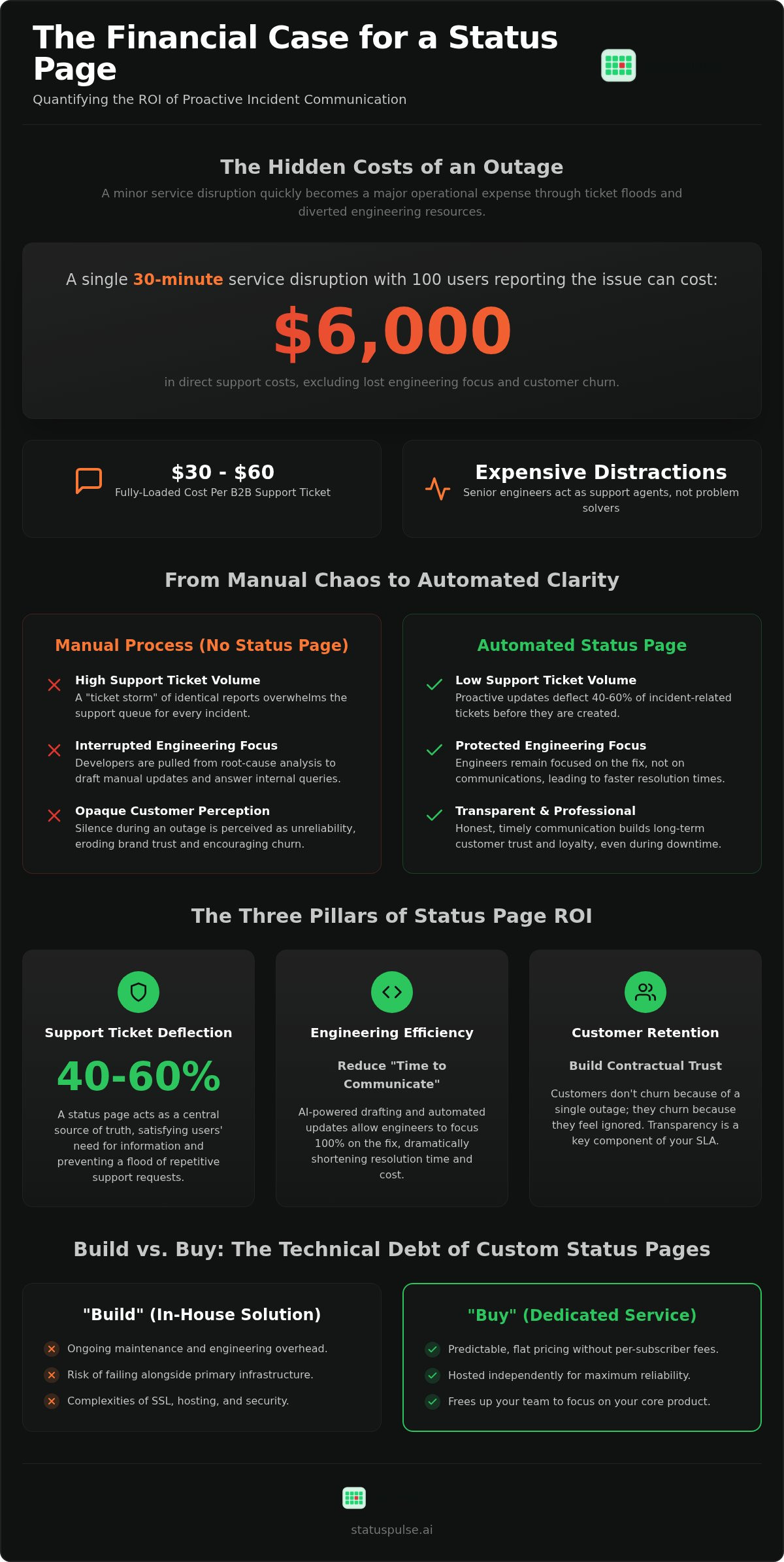
A single B2B support ticket costs between $30 and $60 to resolve. During a 30 minute service disruption, a flood of 100 tickets can quietly erase $6,000 from your margin. This doesn't account for the engineering time lost to manual updates or the long term cost of customer churn. Justifying the ROI of a status page requires looking past the subscription fee and focusing on these hidden operational drains. It's about protecting your most expensive resources from repetitive, low value work.
You likely already feel the friction of manual incident management. It's frustrating to watch your senior developers act as temporary support agents instead of fixing the root cause. This article provides a framework to quantify the financial impact of incident communication and build a data-driven case for a dedicated status page. We'll examine a clear ROI formula, explore support volume reduction, and analyze how transparency protects your brand trust when things go wrong. By the end, you'll have the metrics needed to prove that technical transparency is a financial asset rather than just an overhead cost.
Key Takeaways
- Quantify the financial drain of outages by calculating the fully-loaded cost of support tickets, which typically range from $18 to $60 per issue.
- Use a data-driven framework for justifying the ROI of a status page by auditing ticket volume and engineering hours spent on manual updates during past incidents.
- Evaluate the technical debt of custom-built solutions, including the ongoing maintenance of SSL certificates and the risk of the status page failing alongside your primary infrastructure.
- Reduce the "Time to Communicate" metric by using AI-powered drafting tools that allow engineers to focus on root-cause fixes instead of manual copy-writing.
- Protect your margins with flat pricing models that eliminate per-subscriber fees, ensuring your incident communication costs remain predictable as your user base grows.
What is the ROI of a Status Page?
ROI in incident communication isn't a vague sentiment. It's a measurable ratio of support and churn savings relative to tool costs. Status page ROI is the net gain from reduced support load and engineering focus. When you're justifying the ROI of a status page to stakeholders, you're arguing for a technical shock absorber. It prevents a minor service blip from becoming a major operational expense.
A dedicated status page moves your team from a reactive defensive crouch to a proactive communication stance. This shift preserves your most expensive resources: engineering time and customer trust. Without a central source of truth, every outage triggers a series of expensive, redundant manual actions.
The Information Vacuum: Why Silence is Expensive
Silence during a technical disruption is never neutral. It's a liability. When a SaaS platform stops responding, users immediately enter an information vacuum. This lack of data triggers anxiety. Anxiety drives users to the support portal. If you don't acknowledge the issue within minutes, you'll face a "ticket storm." This is a phenomenon where a single 15-minute outage generates hundreds of identical support requests.
Reactive support is inherently inefficient. Your team spends hours answering "is it down?" instead of helping users with complex problems. Proactive transparency breaks this cycle. By providing a public acknowledgment, you satisfy the user's need for information before they feel the need to open a ticket. This simple act of honesty reduces the financial weight of every incident.
The Three Pillars of Incident Value
To build a data-driven case for transparency, focus on three core areas of impact:
- Support ticket deflection: This is the most immediate and measurable metric. If a single B2B ticket costs between $30 and $60, deflecting just 50 tickets covers the cost of most professional tools like StatusPulse for months.
- Customer Retention: Reliability is a fundamental component of your service-level agreement (SLA). Users don't churn because of a single outage; they churn because they feel ignored during that outage. Transparency builds the long-term contractual trust required for renewals.
- Engineering Efficiency: This is often the largest hidden cost. Every minute a senior developer spends drafting a manual email or updating a social media account is a minute they aren't fixing the root cause. A status page keeps your specialists focused on restoration.
By quantifying these pillars, justifying the ROI of a status page becomes a matter of basic arithmetic. You're trading a small, predictable subscription fee for the elimination of large, unpredictable support and engineering costs.
Quantifying the ROI: Support, Churn, and Engineering Focus
Justifying the ROI of a status page requires shifting from qualitative feelings to quantitative metrics. You must account for the direct costs of support and the indirect costs of engineering disruption. The following table compares the operational reality of manual incident management against automated transparency.
| Metric | Manual Process (No Status Page) | Automated Status Page |
|---|---|---|
| Support Ticket Volume | High (1:1 per affected user) | Low (Deflected by 40-60%) |
| Engineering Focus | Interrupted by manual comms | Focused on root-cause fix |
| Customer Perception | Unreliable and opaque | Transparent and professional |
| Cost per Incident | High and variable | Low and predictable |
The Support Ticket Deflection Formula
A single SaaS support ticket costs between $18 and $35. In technical B2B environments, this often reaches $60 per issue. During a service disruption, ticket volume scales linearly with your user base. Use this formula to calculate your savings: (Total Tickets per Outage x Fully Loaded Cost per Ticket) = Gross Savings.
Industry benchmarks suggest that public status pages deflect between 40% and 60% of incoming inquiries. This deflection occurs because the status page serves as the authoritative source of truth. Integrating AI incident management improves this further by drafting updates in seconds. This ensures information is public before the first user can open a ticket. Transparency also correlates with Net Promoter Score (NPS); customers often reward honesty with higher loyalty, even after a failure.
Protecting the Engineering Workflow
The opportunity cost of pulling a Senior SRE away from a fix is significant. If an SRE earns $150,000 annually, their base hourly rate is approximately $72. However, the true cost includes the delay in system restoration. Research into the ROI of Mass Notification shows that centralized communication reduces the information gap that slows down technical recovery. By centralizing the message, you stop the internal "what's the status?" pings that distract the fix team.
Every manual update requires context switching. It takes an average of 23 minutes for a developer to return to a state of deep focus after an interruption. If your team manually updates a page four times during a two-hour outage, you lose nearly 90 minutes of productive fix time per engineer. You can read more about optimizing these workflows in our guide on The Architecture of Incident Communication Transparency. Protecting this focus is a core reason to consider transparent monitoring tools that handle the communication heavy lifting for you.
Build vs. Buy: The Technical Debt of Custom Status Pages
Many engineering teams view a status page as a "weekend project." It looks like a simple CRUD application with a public frontend. However, this perspective often ignores the long-term technical debt and operational risks involved. When justifying the ROI of a status page, you must account for the total cost of ownership (TCO) over a 24-month horizon rather than just the initial build time.
Building in-house creates a false sense of economy. While the initial code might come together quickly, the hidden costs of maintenance and reliability begin to accumulate the moment the project goes live. You aren't just building a website; you're building a mission-critical communication bridge that must work when everything else fails.
Infrastructure Independence
While professional developers at Peak Digital can build high-performance custom websites and AI agents, the specific requirements of an independent status page often make a dedicated SaaS solution more economical for most teams.
The most common mistake is hosting a status page on the same infrastructure as the primary application. If your app lives in a specific AWS region and that region experiences a blackout, your status page will likely go dark too. This creates a single point of failure that defeats the entire purpose of incident communication. A reliable status page requires complete infrastructure isolation, ideally with multi-region redundancy to ensure availability during global cloud provider disruptions.
Effective communication relies on robust uptime monitoring that operates externally to your own stack. Building this yourself means managing a fleet of global probes and handling the logic for false positives. For a 1-person hobby project, a static HTML file on a different provider might suffice. For a production environment, the complexity of maintaining an independent monitoring stack quickly outweighs the cost of a specialized tool.
Feature Creep and Maintenance
Maintenance debt is the silent killer of custom builds. You don't just build the page; you must maintain the notification logic for Email, Slack, and SMS. API changes from third-party providers will eventually break your integrations. You also have to manage ongoing security patching and ensure GDPR compliance for any subscriber PII your system handles. These tasks pull your developers away from core product work and high-value features.
Let's look at the 24-month TCO. A basic custom build typically requires 40 engineering hours for a functional MVP. At an average hourly rate of $75, that's $3,000 in initial labor. You then face a recurring maintenance tax. Managing SSL certificates, patching the OS, and updating notification webhooks requires at least five hours of attention per month. Over two years, this maintenance labor adds $9,000 to the bill. When you include hosting costs and the risk of the system failing during an actual outage, the "build" route becomes an expensive distraction. Choosing a platform with transparent, flat pricing ensures your costs remain fixed while your reliability increases.
A Practical Framework for Calculating Your ROI
Justifying the ROI of a status page requires a cold look at your incident history. You can't rely on gut feelings when requesting a budget. Follow this four-step framework to build a data-driven case for technical transparency.
- Step 1: Audit your last three incidents for support ticket volume. Identify the peak ticket arrival rate during the first 30 minutes.
- Step 2: Estimate the engineering hours spent on manual communication. Include time spent drafting emails, updating social media, and answering internal pings.
- Step 3: Factor in the cost of customer credits or SLA breaches. Review how many "goodwill" discounts were issued to pacify frustrated users.
- Step 4: Compare these combined costs against a flat-rate subscription like StatusPulse.
This audit often reveals that the cost of a single major outage exceeds an entire year of status page hosting. By centralizing your response, you move from expensive, reactive firefighting to a controlled, predictable communication process.
Auditing the "Silent" Costs
Standard support metrics rarely capture the full scope of an outage. You must also account for "shadow support." These are the direct Slack pings, LinkedIn DMs, and emails sent directly to your developers or account managers. This shadow volume drains high-value focus but remains invisible in tools like Zendesk or Intercom.
There's also a "Trust Tax" to consider. This represents customers who churned without ever filing a ticket. They simply saw the service fail, experienced the silence, and decided your platform was unreliable. Use this 30-minute ROI audit checklist to find these hidden leaks:
- Check Slack/Teams history for "status update" pings during the last outage.
- Cross-reference churn dates with major downtime events.
- Review the "Time to First Response" for support tickets during incidents.
- Calculate the total engineering "fix time" lost to status reporting.
The Scalability Factor
Many legacy status page providers use per-subscriber pricing models. This creates a "success tax" on your growth. As your user base expands, your incident communication costs balloon, even if your infrastructure becomes more stable. [VERIFY: competitor X] follows this per-subscriber model, which can make long-term budget predictability difficult for growing DevOps teams.
Transparent, flat pricing is essential for a healthy ROI. It ensures that your costs stay fixed regardless of how many users subscribe to your updates. This predictability allows you to scale your transparency without scaling your overhead. You can calculate your potential savings by switching to a model that doesn't penalize you for having a large audience.
Scaling Transparency with StatusPulse: ROI Beyond the Spreadsheet
Calculating ticket deflection and engineering hours provides the baseline for justifying the ROI of a status page. However, the operational efficiency of your chosen platform determines whether those savings actually materialize. A fragmented stack of monitoring tools often creates a secondary layer of "management overhead" that eats into your projected gains. Scaling transparency effectively requires a move toward consolidation and automation.
StatusPulse is designed to eliminate the friction between detecting an issue and informing your users. By integrating monitoring and communication into a single workflow, you reduce the "Time to Communicate" metric. This is where the theoretical ROI becomes a tangible business asset. It's about moving from manual data entry to a system where incident response is a byproduct of your existing technical monitoring.
All-in-One vs. Tool Sprawl
Managing three separate subscriptions for uptime, SSL, and status pages is an inefficient use of budget and attention. Consolidating website availability monitoring with your status page creates a single source of truth for your infrastructure. It simplifies your billing cycle and streamlines security audits by reducing the number of third-party vendors with access to your system data.
Technical teams benefit when API monitoring feeds directly into your public status dashboard. Instead of an engineer manually checking a Grafana board and then typing a status update, the system identifies the failure and drafts the communication. StatusPulse uses AI to assist in this drafting process. An engineer reviews the technical details and clicks "publish," maintaining human agency while stripping away the time-consuming task of copy-writing during a crisis.
Data Sovereignty as a Competitive Edge
For European SaaS providers, ROI isn't just about support tickets. It's about compliance. Choosing a platform that offers EU-based hosting allows you to support data sovereignty requirements for your enterprise clients. This reduces the legal overhead associated with complex data processing agreements and ensures your status infrastructure is GDPR-native from day one.
We provide a choice between EU and US hosting to ensure your status page aligns with your regional privacy standards. This transparency is a competitive advantage when closing deals with security-conscious organizations. It's a standard feature, not an enterprise add-on. ROI is fully realized when your communication tool also serves as a proof-point for your commitment to privacy and reliability.
Justifying the ROI of a status page is a matter of comparing predictable tool costs against the high, variable expenses of silence. Technical transparency isn't just a cultural choice; it's a financial strategy. By auditing your ticket volume and engineering focus, you can see how much margin is lost to manual updates and redundant support inquiries. Consolidating your monitoring and communication reduces the information gap that drives customer churn.
StatusPulse provides a straightforward path to this operational maturity. We offer flat pricing with no per-subscriber fees, ensuring your costs remain predictable as your user base grows. You can maintain data sovereignty with a choice of EU or US hosting while using integrated AI incident management tools to accelerate your response times. It's time to stop reactive firefighting and treat communication as a core part of your technical stack. Start building technical trust with StatusPulse today.
Frequently Asked Questions
How does a status page reduce support tickets?
A status page serves as an authoritative source of truth that deflects inquiries before they reach your help desk. By acknowledging an incident publicly, you prevent the "ticket storm" where every affected user submits an identical report. Industry benchmarks suggest a public page can deflect 40% to 60% of incoming inquiries. This allows your support team to focus on resolving complex user issues rather than answering repetitive downtime confirmations.
Is it cheaper to build a status page or buy one?
Buying is almost always more cost-effective when you factor in long-term maintenance and reliability. A custom build requires initial engineering labor and ongoing attention for security patches, API updates, and notification logic. Over a 24-month period, the labor costs for maintaining a "free" in-house tool often exceed the subscription price of a dedicated platform. Specialized tools also offer infrastructure isolation that is difficult to replicate in-house.
What metrics should I use to measure status page ROI?
Start by tracking ticket deflection rates and the reduction in "Time to First Response" during incidents. You should also measure engineering "Opportunity Cost" by calculating the hours developers spend on manual updates instead of technical fixes. Comparing these operational expenses against your tool's subscription cost is the most direct way of justifying the ROI of a status page. Long-term metrics like Net Promoter Score (NPS) and churn rates also provide valuable data.
Does a status page help with SEO or brand trust?
It primarily builds trust by demonstrating technical maturity and honesty during failures. While a status page isn't a primary SEO driver, it protects your brand's reputation in search results by providing an official narrative during outages. This prevents third-party "is it down" sites from dominating the conversation. Transparency reassures enterprise clients that you have a disciplined incident response process, which is often a requirement for high-value contract renewals.
How does per-subscriber pricing affect the ROI of a status page?
Per-subscriber models create a "success tax" that diminishes ROI as your company grows. When you pay for every user who signs up for updates, your incident communication costs balloon alongside your user base. Flat pricing models ensure that your expenses remain predictable regardless of your audience size. This predictability is essential for maintaining a stable budget while scaling your transparency to thousands of stakeholders without increasing your monthly overhead.
Can AI incident management actually improve ROI?
AI improves ROI by significantly reducing the "Time to Communicate" metric. Drafting clear, technical updates during a crisis is time-consuming for stressed engineers. AI tools can analyze incident data to generate initial drafts in seconds, allowing developers to focus on the root-cause fix. This speed ensures that a public acknowledgment is live before the first wave of support tickets arrives, maximizing your deflection potential and preserving expensive engineering focus.
Why is hosting a status page separately from my app important for ROI?
Infrastructure isolation ensures your communication channel remains available when your primary application fails. If your status page shares the same cloud region or load balancer as your app, a single outage could take both offline. This creates a total communication blackout that forces users to flood your support team with tickets. Separate hosting protects your ROI by ensuring the tool you pay for is actually reachable during the moments you need it most.


