

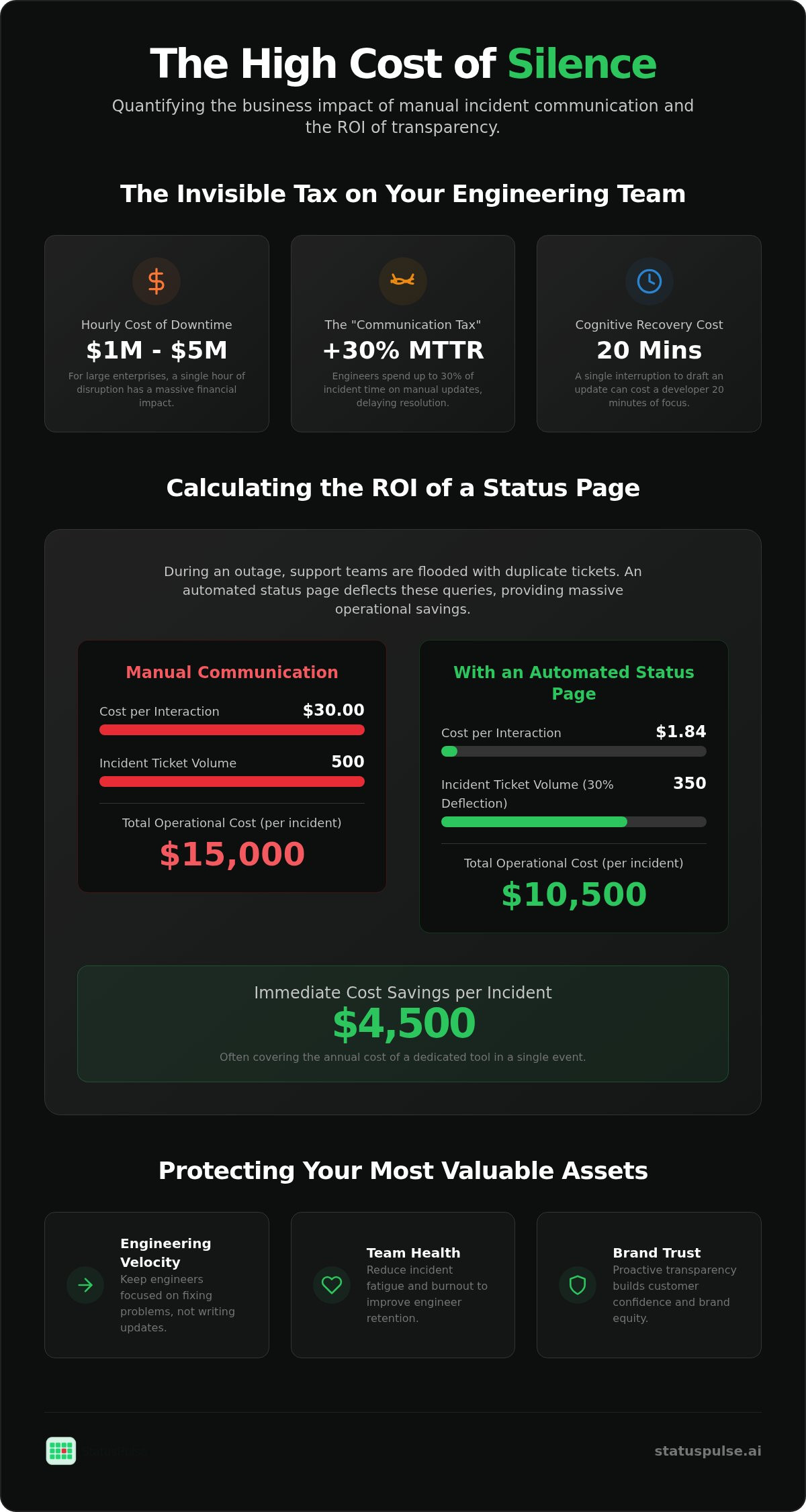
41% of large enterprises report that a single hour of downtime costs between $1 million and $5 million. While the infrastructure team scrambles to restore service, your senior SREs often become the most expensive customer support agents in the company. They're pulled away from critical fixes to answer repetitive "is it down" queries from stakeholders and frustrated users. Learning how to convince management to invest in a status page isn't about requesting a luxury. It's about protecting engineering velocity and reducing the $25 to $35 cost of every support ticket generated during an outage.
It's frustrating to see technical talent wasted on manual communication. You know that transparency is the right path, but you need a way to prove it pays for itself through ticket deflection and faster recovery. This guide provides a data-driven framework to build a business case that aligns with executive priorities. We'll examine the real-world math of incident communication, compare the overhead of internal builds, and show you how to standardize transparency to reduce Mean Time to Acknowledge (MTTA) without adding to the team's cognitive load.
Key Takeaways
- Learn how to convince management to invest in a status page by framing it as a tool for engineering velocity rather than just a public relations asset.
- Calculate the "Communication Tax" on your team by quantifying the cost of manual updates and the volume of support tickets during service disruptions.
- Evaluate the "Build vs. Buy" trade-off by accounting for the high cost of senior SRE time and the risk of recursive failure when hosting status pages on internal infrastructure.
- Tailor your pitch to different stakeholders, focusing on developer focus for the CTO and brand equity protection for the CFO.
- Use AI-assisted drafting to maintain transparency without adding cognitive load to the engineers who are busy fixing the actual problem.
The Invisible Cost of Manual Incident Communication
A status page is a decoupled communication layer for your technical stack. It separates the act of fixing a system from the act of reporting on it. Most teams treat incident updates as a manual chore. This approach is a hidden drain on resources that impacts both the bottom line and team health. Understanding how to convince management to invest in a status page requires looking at these hidden hours and the "Communication Tax" they impose.
When an incident occurs, the technical team enters the Incident Management lifecycle. Without automation, they pay a high price. We define the Communication Tax as the delta between resolution time with and without automated status updates. If your engineers spend 30% of their time during an outage explaining what they're doing, your Mean Time to Resolution (MTTR) increases by that same 30%. This tax is paid in lost uptime and frustrated customers.
This creates a persistent friction point. Support teams need constant updates to manage customer expectations. DevOps teams need silence to focus on the root cause. This tension is a primary driver of "Incident Fatigue." It's exhausting to fix a database while typing Slack updates every ten minutes. Over time, this fatigue leads to burnout and directly impacts long-term engineering retention. If you are building a case for how to convince management to invest in a status page, start with the cost of replacing a senior engineer who is tired of being a part-time PR agent.
Context Switching and Engineering Velocity
Context switching is the primary enemy of engineering velocity. For a developer in a state of "Deep Work" during a P0 incident, a single interruption can cost 20 minutes of cognitive recovery. Drafting manual updates isn't just a five-minute task. It's a complete break in the logic flow required to solve complex infrastructure problems. When you automate these updates, you preserve the mental state needed for a fast resolution.
The Support Ticket Avalanche
Outages trigger an exponential growth of duplicate support tickets. The average cost per support ticket for a B2B SaaS company is between $25 and $35, according to data from Helply and SaaS Capital. In the first 15 minutes of a service disruption, a single failure can generate hundreds of identical queries. This noise slows down the entire organization. Support agents become overwhelmed, and critical, unique bugs get lost in the shuffle. A public status page acts as a shield, providing a self-service answer before the user clicks "Submit Ticket." For a deeper look at how to build these structures, read about The Architecture of Incident Communication Transparency.
Quantifying Value: Ticket Deflection and Brand Equity
To move beyond technical theory, you must present management with hard numbers. Executive teams respond to cost reduction and risk mitigation. When you calculate the ROI of incident transparency, start with ticket deflection. While the industry average cost per support ticket for B2B SaaS companies is between $25 and $35, these costs assume a unique technical query. During an outage, you're paying that premium for repetitive "is it down" messages. A public status page acts as a self-service shield, allowing users to verify service health without opening a ticket. This shift from assisted support ($13.50 median cost) to self-service ($1.84 median cost) provides a clear path for how to convince management to invest in a status page.
The Support Deflection Formula
To build your case, use the fully-loaded cost of your support operations. Use the formula: Total Cost = (Tickets per Incident) x (Cost per Ticket). If a typical incident generates 500 duplicate tickets, the manual handling cost is approximately $15,000. Reducing that volume by just 30% saves $4,500 per event. This often covers the annual cost of a dedicated tool in a single afternoon. The following table illustrates the delta between manual handling and an automated approach.
| Metric | Manual Support Only | With StatusPulse Automation |
|---|---|---|
| Cost per Interaction | $30.00 (Average) | $1.84 (Self-service) |
| Incident Ticket Volume | 500 | 350 (30% deflection) |
| Operational Cost | $15,000 | $10,500 |
Brand Reliability and SLA Transparency
Beyond immediate ticket costs, there's a "Trust Dividend" associated with transparency. A silent outage breeds suspicion and suggests a lack of control. In contrast, a documented incident shows a team that's disciplined and accountable. This is essential to maintain customer trust when things go wrong. Splunk's 2026 research found that 81% of technology leaders named customer loss as a direct consequence of downtime. Transparency mitigates this risk by providing a clear record of resolution.
Sales teams also benefit from this data. During enterprise SLA negotiations, having a public history of uptime proves reliability better than any marketing slide. It moves the conversation from "Do you have outages?" to "How well do you handle them?" If you want to standardize this level of transparency, exploring integrated status pages can help you provide the historical metrics that enterprise buyers demand. This long-term data is often the final piece of evidence needed when deciding how to convince management to invest in a status page.
Build vs. Buy: The Hidden Costs of Internal Status Tools
Engineers often feel the pull to build internal solutions. It's a natural instinct to spin up a simple frontend or deploy an open-source project on a spare instance. However, this path often leads to a technical debt trap. When you're determining how to convince management to invest in a status page, you must highlight that "free" open-source software isn't actually free. It carries a heavy burden of maintenance and infrastructure risk.
The most critical technical risk is recursive failure. If your status page lives on the same infrastructure as your application, a major provider outage will likely take both down simultaneously. A status page that is inaccessible during a crisis is worse than having no page at all. It increases customer frustration and removes your only channel for damage control. Building a truly decoupled, high-availability system requires significant engineering time that could be spent on your core product.
The 'Who Monitors the Monitor' Problem
A reliable status page must exist on a completely separate network. If your primary stack is in AWS US-East-1, your status page should ideally reside in a different region or with a different provider. This redundancy is essential for surviving global CDN failures or cloud provider blackouts. For a deeper dive into these technical requirements, see Uptime Monitoring: A Developer’s Guide to Reliability and Honest Communication. Tools like StatusPulse allow you to choose between EU and US hosting to ensure data sovereignty and geographical separation from your primary stack.
Total Cost of Ownership (TCO)
The initial build is only a fraction of the cost. Internal tools require perpetual maintenance. You have to manage security patches, host the infrastructure, and update API integrations every time your monitoring stack evolves. DIY tools also lack essential features like automated subscriber notification management, SSL monitoring, and AI-assisted incident drafting. Based on median SRE salaries in 2026, which can reach $159,374 in the US or €160,000 in Western Europe, the opportunity cost of building "status plumbing" is immense. Every hour an engineer spends on an internal status tool is an hour lost on revenue-generating features. This is a powerful argument for how to convince management to invest in a status page: it buys back your team's focus.
Crafting the Pitch: Data-Driven Arguments for the CTO and CFO
Understanding how to convince management to invest in a status page requires speaking two distinct business languages. The CTO prioritizes engineering velocity and team health. The CFO focuses on cost predictability and risk mitigation. You can reframe a status page as a low-cost insurance policy. It protects against the high-cost brand damage and customer churn that follow uncommunicated downtime. To further strengthen this defense, openSquat offers threat intelligence to identify brand impersonation, ensuring your reputation is protected from external bad actors as well. If the executive team is hesitant about public transparency, suggest a pilot program. Start with a private status page for one product line to measure internal alignment and ticket deflection before going public.
- Protect Engineering Velocity: Automating updates saves approximately 30 minutes of context-switching per engineer during every major incident.
- Reduce MTTA: Standardizing communication workflows allows the team to acknowledge incidents faster without manual drafting.
- Consolidate Tooling: Using an all-in-one platform for monitoring and reporting reduces the overhead of managing multiple disparate vendors.
The Argument for the CFO: Risk and Compliance
The CFO needs to see cost predictability. Many industry incumbents use complex pricing models with "per-subscriber taxes" that punish you for growing your audience. We advocate for flat pricing models that ensure your costs don't spike during a crisis. Additionally, data sovereignty is a significant compliance factor. Choosing a provider that offers a choice between EU and US hosting ensures you meet regional GDPR requirements for incident logs and subscriber data. Here is a checklist of what the CFO needs to hear:
- Predictable OpEx: Flat monthly pricing with no hidden fees for subscriber volume or notification counts.
- Compliance and Privacy: Full GDPR alignment through dedicated EU-based hosting options.
- Sales Enablement: Public uptime history functions as a verified record to support enterprise SLA negotiations and reduce sales cycles.
A structured pitch moves the conversation from "why do we need this" to "how soon can we start." If you are ready to demonstrate the value of a unified incident workflow, you can set up a technical pilot with StatusPulse to gather the initial deflection data your management team needs to see.
Strategic Implementation with StatusPulse
StatusPulse is a platform built by specialists for specialists. It functions as a technical peer that respects engineering workflows. Instead of adding another layer of complexity, it consolidates uptime monitoring, SSL certificate tracking, and API monitoring into a single dashboard. This integration is a primary tool for how to convince management to invest in a status page. It removes the need for multiple vendors while providing the transparency your users expect. By grouping these functions, you move away from the "bolted-on" communication models of the past.
The platform is designed to be a quiet, reliable assistant. It avoids the corporate bloat common in the incident management industry. There are no complex pricing tiers based on how many people want to know your system is healthy. Instead, you get a straightforward tool that prioritizes integrity and technical precision. This approach makes it easier to align engineering needs with the broader business goals of transparency and trust.
AI-Assisted Incident Drafting
During a high-stress outage, drafting a clear customer update is often the last task an engineer wants to handle. Our AI incident management tools assist this process by summarizing technical logs into readable updates in seconds. We use a human-in-the-loop approach. The AI drafts the report, but the human maintains final agency over the final message. This significantly reduces cognitive load. It ensures that communication remains honest and precise without pulling the technical lead away from the root cause fix for more than a few seconds.
Flat Pricing and Data Sovereignty
Many industry incumbents impose a "subscriber tax" by charging more as your audience grows. This model punishes you for being transparent. StatusPulse uses a flat pricing model. Your costs remain predictable regardless of how many users sign up for notifications. This predictability is a key part of your business case when explaining the long-term ROI to a CFO. You won't face a surprise bill because a minor incident went viral.
We also prioritize data sovereignty. You can choose between EU or US hosting for your status page and monitoring data. This is a critical requirement for companies operating under strict GDPR or regional privacy standards. It ensures that your incident logs and subscriber lists are stored in a region that aligns with your specific regulatory needs. If you want to demonstrate this value to your stakeholders, you can start a trial on StatusPulse today. It is the most direct way to show how standardized transparency protects your engineering velocity while keeping costs under control.
Standardizing Your Incident Communication Strategy
Transparency isn't a luxury. It's a fundamental requirement for maintaining engineering velocity and protecting your company's brand equity. By decoupling communication from the resolution process, you remove the "Communication Tax" that slows down your most expensive technical talent. You've seen that the path forward involves quantifying the cost of support noise and avoiding the recursive failure risks of internal DIY tools.
When you're ready to act on how to convince management to invest in a status page, focus on the operational buy-back. Emphasize that a dedicated platform isn't just about public relations; it's a technical shield for your DevOps team. StatusPulse supports this mission with AI-powered incident drafting, EU-based data sovereignty, and integrated uptime and SSL monitoring. These features ensure your team stays focused on the fix while stakeholders stay informed through a reliable, independent channel.
Build your business case for transparency with a free StatusPulse trial. You have the data and the framework to move the needle. It's time to reclaim your team's focus and build a more resilient communication culture.
Frequently Asked Questions
Will a public status page make our brand look unreliable?
A public status page actually improves brand perception by demonstrating accountability. Users already know when a service is down; a status page proves that you know it too. This prevents customers from feeling ignored during disruptions. It also provides a historical record of reliability that helps sales teams during enterprise negotiations. Documenting incidents shows a level of technical maturity that silent companies lack.
How much time does it take to maintain a status page monthly?
Maintenance time is negligible when you use integrated monitoring. Most updates happen automatically based on your uptime checks and API monitoring. You only spend time during active incidents to provide context or estimated resolution times. This automation is a key part of how to convince management to invest in a status page. It ensures the tool remains a time-saver rather than a new administrative burden for the engineering team.
Can we use a status page for internal-only communication first?
Yes, starting with an internal-only status page is a strategic way to align your technical and support teams. It allows you to refine your incident response workflows without the pressure of a public audience. Once the internal feedback loop is tight, you can flip the switch to public transparency. This staged approach is often the easiest way to prove the tool's value to skeptical stakeholders before a full rollout.
What is the difference between uptime monitoring and a status page?
Uptime monitoring is the technical process of detecting a failure; a status page is the communication layer that explains it. Monitoring tools ping your endpoints to verify they are reachable. A status page takes that data and presents it in a human-readable format for customers and stakeholders. While monitoring tells your team that something is wrong, the status page tells your customers what you are doing to fix it.
Do we need a status page if we have a small customer base?
Even with a small customer base, a status page is essential for professionalizing your operations. It prevents a handful of users from overwhelming your inbox with the same question. Early adoption also builds a long-term record of uptime that becomes a valuable asset as you scale. Learning how to convince management to invest in a status page early ensures that your communication infrastructure grows alongside your technical stack.
How does AI incident management actually work in practice?
AI incident management functions as a technical assistant that drafts updates based on system logs and monitoring data. It scans the incident context to create a concise summary for your users. The human-in-the-loop model ensures that an engineer always reviews and approves the draft before it goes live. This significantly reduces the cognitive load on responders who are already busy debugging the root cause of the failure.
What happens if the status page provider itself goes down?
We mitigate this risk by hosting status pages on infrastructure that is completely independent of our monitoring nodes. You can choose between EU and US hosting to ensure geographical separation from your primary application stack. This prevents recursive failure, where a single cloud outage takes down both your app and your status page. Reliability is maintained through redundancy across different regions and provider networks to ensure constant availability.


