

Adding people won’t fix an incident process that depends on everyone already knowing what to do. Scaling incident management as your team grows takes five deliberate changes: clearer communication, defined roles, visible incident leadership, explicit escalation paths, and planned skills development.
When incidents become harder to coordinate, it’s natural to add tools or people. But without clear ownership and shared information, those changes can create confusion instead of capacity. The goal is a process that helps the right people act, keeps updates moving, and makes clear when an issue needs to escalate.
This guide explains how to adapt each part of incident response as your organization grows. You’ll learn how to structure communication, assign responsibilities, keep leaders informed without creating bottlenecks, clarify escalation decisions, and identify capability gaps before they slow response. The result is a practical foundation your team can review and adjust as its needs change.
Key Takeaways
- Set clear communication routines so incident updates, decisions, and handoffs stay visible as more people join the response.
- Define incident roles around team needs and individual expertise, then revisit responsibilities as the organization changes.
- Make escalation triggers and leadership responsibilities explicit to reduce delays and avoid bottlenecks during incidents.
- Assess workload, current capabilities, and upcoming demands before deciding whether to hire, train, or adjust the team structure.
- Use monitoring and public status updates to keep technical teams informed and give stakeholders a consistent view of service disruptions.
1. Communication tools, regular check-ins, and information-sharing processes
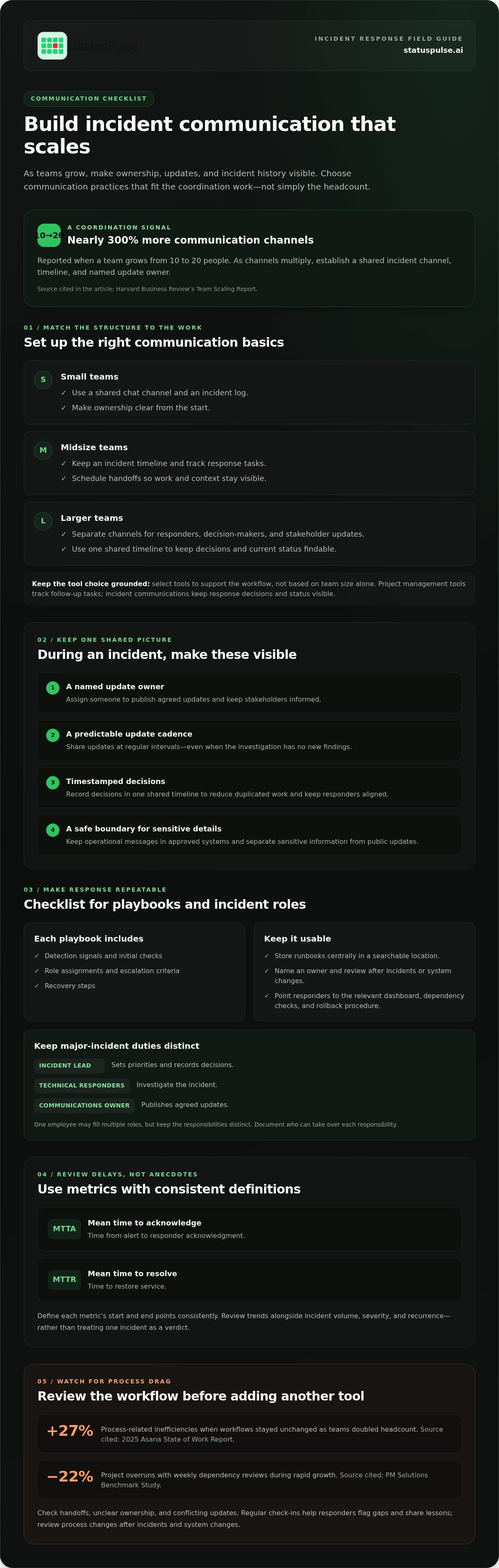
Small teams can coordinate through a shared chat channel, an incident log, and clear ownership. Midsize teams benefit from incident timelines, task tracking, and scheduled handoffs. Larger teams need distinct channels for responders, decision-makers, and stakeholder updates. Choose tools to support the workflow, not based on team size alone. A project management tool tracks follow-up tasks; incident communications keep response decisions and current status visible.
The information a team must capture and share also depends on its industry. A financial service may need documented decisions for internal review, while an online retailer may prioritize customer-facing updates. Regulatory requirements vary by jurisdiction and sector, so work with legal and compliance teams to build applicable obligations into the relevant playbook. Keep operational messages in approved systems, and separate sensitive details from public updates.
As engineering teams grow, informal coordination becomes harder to sustain. Communication channels increase by nearly 300% when a team grows from 10 to 20 people, according to Harvard Business Review’s Team Scaling Report. Establish one incident channel, a shared timeline, and a named update owner. That structure helps distributed teams collaborate without relying on private messages or memory.
Build playbooks around repeatable actions, not lengthy instructions. For each incident type, document detection signals, initial checks, role assignments, escalation criteria, and recovery steps. Store runbooks centrally in a searchable location, name an owner, and review them after incidents or system changes. For example, an API error playbook should point responders to the relevant dashboard, dependency checks, and rollback procedure.
Measure response with metrics that reveal delays. Mean time to acknowledge (MTTA) measures the time from alert to responder acknowledgment; mean time to resolve (MTTR) measures the time to restore service. Define each metric’s start and end points consistently. Pair them with incident volume, severity, and recurrence, then review trends instead of treating one incident as a verdict.
During a major incident, assign an incident lead, technical responders, and a communications owner. The lead sets priorities and records decisions; responders investigate; the communications owner publishes agreed updates. Use one shared timeline and timestamp decisions. Schedule updates at a predictable cadence, even when the investigation has produced no new findings. This keeps teams aligned and reduces duplicated work.
Growth also exposes process weaknesses. Teams that doubled headcount saw a 27% increase in process-related inefficiencies when workflows stayed unchanged, according to the 2025 Asana State of Work Report. Weekly dependency reviews during rapid growth reduced project overruns by 22%, according to the PM Solutions Benchmark Study. Review handoffs, unclear ownership, and conflicting updates before adding another tool.
Common mistakes include scattering incident discussions across channels, leaving playbooks outdated, and relying on assumptions to assign escalation. Regular check-ins give responders a place to flag gaps and share lessons. Make early escalation safe, document decisions without blame, and connect process changes to shared values. As you hire, include communication tools and incident procedures in onboarding.
2. Adapting team composition and roles as an organization grows
Assign incident responsibilities based on service ownership, technical expertise, and workload. For example, one person might investigate, an incident lead might coordinate, and a communications owner might handle updates. Keep the duties distinct, even when one employee fills multiple roles. As the organization expands, document who can take over each responsibility and how teams share decisions across service boundaries. Scaling incident management as your team grows means adding clarity where coordination starts to break down.
Structure should solve coordination problems, not add hierarchy for its own sake. A team with several service groups might appoint a lead for each group, while keeping one incident lead accountable for cross-team decisions. Define which decisions responders can make independently and which need leadership input. McKinsey’s Organizational Health Index links hiring payroll too quickly with a 32% reduction in project predictability. Add roles when a specific responsibility or capability needs ownership.
Before hiring, map the work employees already handle. Identify critical services without a clear owner, expertise concentrated in one person, and incident tasks that regularly stall. Then decide whether to recruit, train, or redistribute responsibilities. A new hire should complement existing skills, not simply duplicate them. For example, a team strong in application code but weak in database operations could build that capability through targeted training or recruitment.
Values matter in role design. If an organization values autonomy, give service teams authority to mitigate incidents within agreed boundaries. If it values shared accountability, define cross-team handoffs without making every decision require consensus. Explain how each role supports those values during onboarding. Microsoft’s Work Trend Index reports that 52% of employees in rapidly growing companies felt culturally disconnected within 60 days of being hired. Pair new employees with experienced responders and include them in incident reviews.
An on-call rotation scales when coverage matches service ownership, responder expertise, and actual alert demand. Assign a primary responder and a backup, define escalation conditions, and review alert quality before adding people. Share after-hours work fairly, protect recovery time after disruptive incidents, and avoid making one specialist the permanent fallback. If only one person can resolve a failure, treat that as a skills and resilience gap.
Review the structure when services, dependencies, or workloads change. Ask responders where ownership remains unclear, then adjust the role map and training plan. Scaling incident management as your team grows also means checking whether new team members can identify the incident lead, service owner, escalation route, and communications responsibility. Gaps in their answers show where ownership or skill-sharing needs attention.
Mitigate any single-point-of-failure and coverage risk, then build backup expertise through targeted training or recruitment. Roles should reflect each member’s skills and expertise, the team’s overall needs, and whether responsibilities can adapt as business needs change. Scaling objectives should align with the organization’s core values and mission, supported by management structures that enable autonomy and communication. Teams using StatusPulse have navigated rapid growth from 10 people to 50 employees and beyond by maintaining clear role definitions.
3. Leadership visibility and escalation paths
As an engineering organization expands, leaders need useful visibility without taking over incident response. Define what the incident lead handles, what service owners decide, and which conditions require executive involvement. For example, responders can mitigate a failing service while a director approves trade-offs that affect customers. Written decision boundaries prevent every action from waiting for senior approval.
Leadership amplification means translating organizational priorities into clear guidance through team leads. Harvard Business Review reports companies investing in leadership amplification during growth see 29% higher project stability over the following year. Leaders can put this into practice by sharing the reason for a priority, naming the person responsible for implementation, and asking team leads to surface conflicts before they affect incident work.
Build an escalation path around observable triggers, not titles or personal relationships. For a payment failure, a runbook might tell the service owner to escalate when transactions fail across multiple regions or recovery steps exceed their authority. Specify who receives the escalation, what evidence to include, and what decision is needed. This makes escalation actionable, whether the organization is a startup or a larger company.
Separate operational escalation from status reporting. A technical lead may need an infrastructure specialist to diagnose a dependency, while an executive needs a concise account of customer impact and business decisions. Assign an owner to each path. For example, the incident lead can request a specialist, while a designated leader receives a summary when service restoration requires a broader trade-off.
Make leadership visibility event-driven. Define triggers for updates, such as a change in impact, a failed mitigation, or a decision outside the incident lead’s authority. The incident lead records the trigger, decision owner, and outcome in the incident timeline. Leaders can then see what needs their attention without interrupting responders with repeated status checks.
Delegation works when team leaders have both authority and context. Give each lead a clear service boundary, access to relevant incident procedures, and a way to raise dependencies across teams. If two leads disagree about prioritizing shared infrastructure, the escalation rule should specify who resolves the conflict. Leaders still own the final decision, while members closest to the failure contribute evidence.
Use feedback to test whether escalation rules work under pressure. After an incident, ask responders where the path was unclear, which approval delayed mitigation, and whether leaders had the information they needed to decide. For example, if a startup’s engineering lead is repeatedly pulled into routine service issues, delegate those decisions and revise the trigger for escalation.
Review the escalation map whenever ownership changes or a new critical service enters production. Have a team lead walk through a realistic incident, from the first alert to a leadership decision. If they cannot identify the next owner or explain what information to share, update the path before the next incident. This keeps leadership involved where decisions matter without turning visibility into another response bottleneck.
4. Assessing current capabilities and forecasting future needs
Before expanding an incident team, define the operational gap you need to close. Review recent incidents, service ownership, workload, and the skills responders relied on. For example, repeated delays diagnosing database failures may point to a training need, unclear ownership, or a missing specialist. Each cause calls for a different response. Adding employees before identifying the cause can increase coordination work without improving incident handling.
Use a capability map to make gaps visible. List critical services, the skills needed to restore them, and the people currently able to perform each task. Mark single-person dependencies, missing backups, and work that regularly interrupts planned engineering. Then compare the map with expected changes, such as a service launch or a major architecture shift. This turns general concerns about productivity into specific decisions.
Forecast against several time horizons. Assess whether the same staffing and process choices would still fit in 3, 6, and 12 months under current or reasonably forecast conditions. A growing organization might need to train an existing service owner now, then recruit for a capability required by an upcoming platform change. Revisit assumptions as product scope, dependencies, and incident patterns change.
Separate scaling from simply adding headcount. For incident response, ask whether better automation, clearer ownership, or targeted training can meet demand before adding roles. Hiring can be appropriate, but it should address a defined capacity or expertise gap.
The Startup Genome Report survey summarized that 70% of surveyed startups tried to scale too early. Apply that warning by tying each proposed change to evidence: recurring incidents, unsupported services, excessive workload, or a planned technical shift. For each gap, define the intervention, its owner, and the signal that would show whether it helped. Avoid treating team growth itself as proof that the incident process needs expansion.
Software and dashboards can reveal operational patterns, but they need context. Pair incident records with service changes, on-call workload, and follow-up actions. A rising alert count might reflect noisy thresholds rather than greater service risk. Review the underlying incidents before changing staffing or targets, and ask responders which tasks consume time without improving diagnosis or recovery.
Turn the assessment into a concise capability plan. Record current strengths, critical gaps, an action for each gap, and a review point tied to a planned change or incident trend. Share the plan with engineering leads and responders, then gather feedback after implementation. This helps the organization adjust training, hiring, and processes as needs develop, rather than waiting for a high-impact incident to expose a dependency.
5. Assessing team structure, strengths, and skill gaps
A team map shows whether incident responsibilities match current skills. List each critical service, its primary and backup owners, and the expertise it requires. Then compare the map with recent incident reviews. For example, if responders repeatedly need help tracing database failures, the gap may involve database knowledge, service documentation, or unclear ownership.
Assess strengths, weaknesses, gaps, and redundancies before changing the structure. Ask team members which incident tasks they handle confidently and where they rely on someone else. Compare their feedback with incident timelines and follow-up actions. If one engineer resolves every deployment failure, that expertise is valuable, but the dependency creates a resilience risk.
Turn findings into a skills matrix that describes practical capabilities, not job titles. Record whether each responder can acknowledge an alert, diagnose a service, use a rollback procedure, or coordinate a handoff. The matrix might show that several people know application debugging, while only one understands a critical data pipeline. Use that distinction to prioritize cross-training.
Train new responders through guided practice and access to real procedures. Pair each new team member with an experienced responder, walk through a past incident, then run a scenario using current runbooks. Maintain readiness with regular exercises and post-incident reviews that identify skills to develop. A new responder should know when to act, when to escalate, and where to record decisions.
Structure affects how well those skills are used. Map service ownership to team boundaries, then look for handoffs that obscure accountability. For example, if application and infrastructure teams both assume the other owns a failed health check, assign one team to lead the diagnosis and define the other’s supporting role. Record that decision in the ownership map.
Use feedback to distinguish a knowledge gap from a process problem. If responders know the recovery steps but cannot find the right dashboard, improve the documentation or tooling. If they understand the procedure but lack permission to act, clarify their authority. These problems need different fixes, so don’t default to hiring whenever an incident exposes friction.
Review the skills matrix after significant service changes or shifts in incident patterns. Ask team members to identify skills that have become isolated, duplicated, or less relevant. Then assign an owner to each development action, such as pairing on a deployment rollback or updating a service guide. This keeps the team structure aligned with operational needs.
Use a clear incident response workflow to make roles and communication easier to apply during disruptions. Review whether responders can find the right owner, share service impact, and follow established procedures. That practical check can reveal where training or team structure still needs work.
StatusPulse: Public Status Pages
StatusPulse helps growing teams share service updates through Public Status Pages. When an incident affects customers or internal users, a public page gives the team one place to communicate confirmed impact and recovery progress. This is useful when service ownership is distributed and responders need to keep updates consistent without relying on separate messages.
StatusPulse also offers Uptime Monitoring, SSL Certificate Monitoring, and API Monitoring. These capabilities help teams track service availability and relevant technical signals alongside incident communications. A status page supports transparency, but it doesn’t replace incident roles, escalation decisions, or internal response procedures. Use it as the customer-facing part of a broader incident process.
Visit StatusPulse to explore Public Status Pages.
Make the next change deliberate
Choose an upcoming change that could affect incident response, such as a service launch, a new dependency, or a shift in ownership. Before it happens, walk through how the team would detect a failure, assign decision-making, and keep affected people informed. Record unclear handoffs, then give each gap an owner and a practical next step.
A useful approach to scaling incident management as your team grows is to treat readiness as ongoing engineering work. Review what changed after a release or incident, and update the process when evidence points to a real gap. Keep the process proportionate: add structure where it reduces confusion, not for its own sake.
If you’re considering how public status communication fits your incident workflow, contact StatusPulse to discuss incident management. Start with the operational problem your team wants to solve, then decide what support makes sense. A clear next step can help your team grow without losing sight of reliable response.
Frequently Asked Questions
How should incident roles and responsibilities scale with team size?
Scale by separating responsibilities only when coordination requires it. In a small team, one responder may investigate and coordinate; as more services and teams join, assign distinct incident lead, technical lead, and communications roles. Keep service ownership with the team that understands the system. Revisit assignments after reorganizations or service launches, and ensure every critical responsibility has a capable backup.
What incident severity levels and escalation rules should growing teams define?
Define severity levels by customer impact, affected service scope, and available workarounds. For example, a critical level might mean a core customer workflow is unavailable, while a lower level could describe limited degradation with a viable workaround. For each level, state who leads the response, what changes trigger escalation, and which decisions need leadership input. Test the rules against past incidents and adjust unclear thresholds.


