

Your status page isn't a marketing brochure. It's a critical piece of your technical stack. Most teams treat status page incident communication as a manual chore, something to be handled only after the fire is out. This delay creates a communication vacuum. That vacuum is quickly filled by frustrated users and a mountain of "is it down?" support tickets. You shouldn't be punished with higher per-subscriber fees just because your user base is growing during a crisis.
We agree that managing an outage is stressful enough without fighting your communication tools. You want a system that works as hard as your monitoring does. This guide promises to show you how to architect a communication strategy that prioritizes technical honesty and automated efficiency. We'll explore how to move from a monitoring alert to a verified status update in seconds. You'll learn to reduce support volume, build developer credibility, and maintain predictable infrastructure costs through a streamlined workflow.
Key Takeaways
- Understand the role of your status page as the single source of truth in a modern DevOps stack.
- Architect a communication strategy using severity levels and automated triggers to reduce manual effort.
- Evaluate tooling trade-offs to avoid hidden costs like per-subscriber pricing or missing SSL certificates.
- Leverage human-in-the-loop AI to draft precise technical summaries that move beyond vague "down" messages.
- Optimize your status page incident communication to lower support ticket volume and maintain predictable infrastructure costs.
What is Incident Communication in a Modern DevOps Stack?
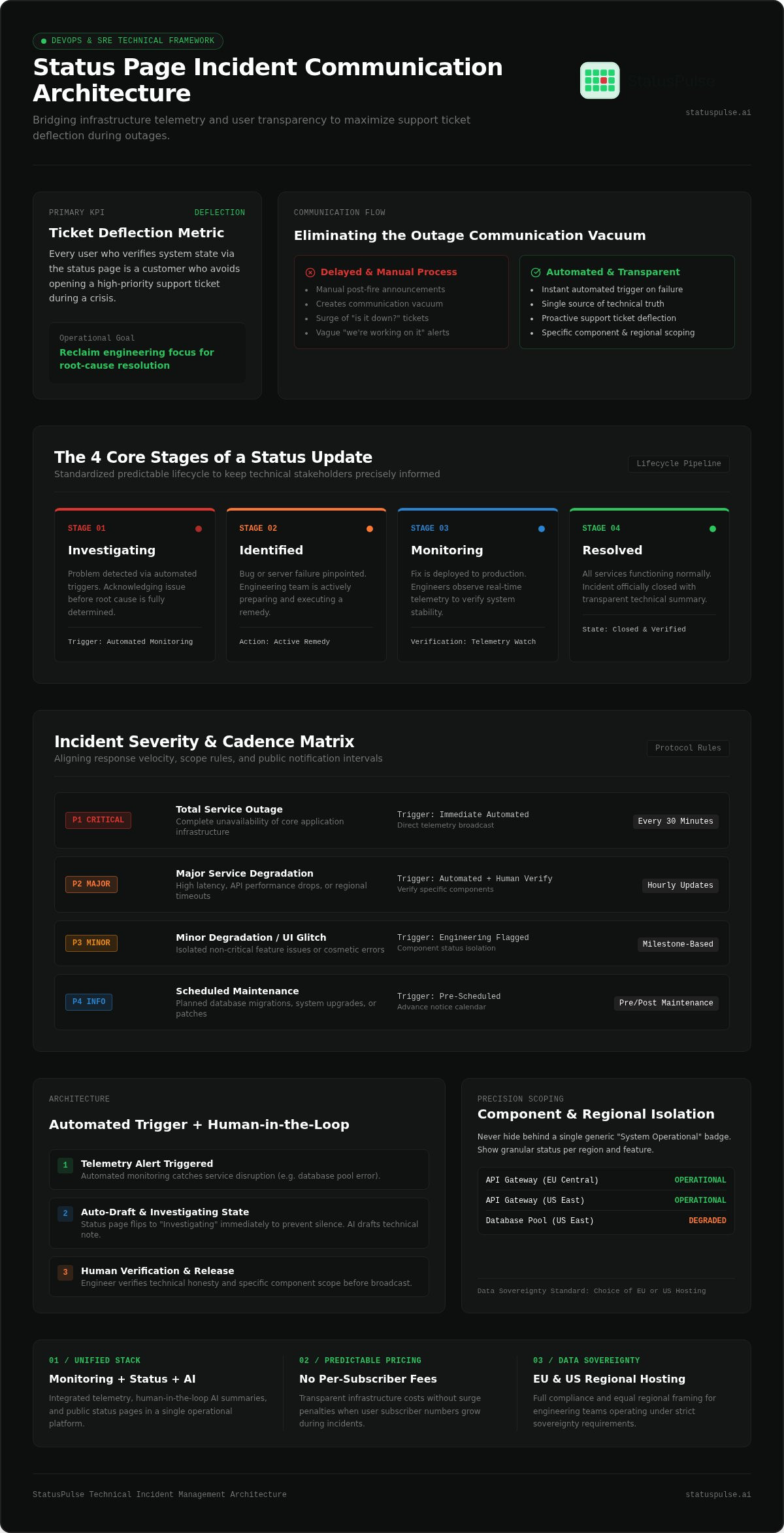
Incident communication is the structured process of telling people what is broken, why it happened, and when they can expect a fix. In a modern DevOps stack, it serves as the essential bridge between your infrastructure and your users. It isn't just about PR. It's about data. A public status page acts as your single source of truth during a crisis. When things break, users don't want a generic "we're working on it" message. They want technical honesty. This transparency prevents churn by showing your team is competent and values the user's time.
Successful status page incident communication is measured by support ticket deflection. Every user who checks your status page is a user who didn't email your support team. This metric directly impacts your operational efficiency. It reduces the heavy load on your staff during high-stress outages. By providing a clear destination for truth, you reclaim time for your engineers to focus on the actual fix rather than answering repetitive queries.
The Core Components of a Status Update
A technical status update should follow a predictable lifecycle. This clarity helps users understand the severity without needing to read between the lines. Most effective updates use four distinct states:
- Investigating: You know there's a problem but haven't found the root cause yet.
- Identified: You've found the bug or server failure and are working on a remedy.
- Monitoring: The fix is deployed; you're watching the telemetry to ensure stability.
- Resolved: The service is back to normal and the incident is closed.
You must also define the impact scope. Be specific about affected regions or specific components like your API or Dashboard. Don't hide behind vague language. Users value the human factor. They appreciate a developer explaining a database connection pooling error more than a polished corporate apology. This technical precision builds a foundation of trust that survives the outage.
Internal vs. External Communication Cadence
Your internal logs are often messy and fast-moving. Your public updates should be clean but accurate. Setting a consistent cadence is essential for managing expectations. High-severity incidents might require updates every 30 minutes. Lower severity issues can wait for longer intervals. This practice aligns with site reliability engineering principles by prioritizing operational visibility and stakeholder trust.
Effective communication requires bridging the gap between engineering reality and customer expectations. You don't need to share every log line, but you do need to share meaningful milestones. To build a truly resilient system, you must pair your communication with robust Uptime Monitoring: A Developer’s Guide to Reliability and Honest Communication. This ensures your status updates are backed by real-time technical data rather than guesswork. It turns a stressful disruption into a demonstration of professional reliability.
Architecting an Incident Communication Strategy
Architecting your response before the outage starts is the only way to remain calm when systems fail. A solid strategy for status page incident communication begins with a clear severity matrix. You need to know exactly when to push an update and who needs to see it. This prevents the panic-driven silence that often characterizes poorly managed disruptions.
P1 incidents represent a total service outage. These require immediate, automated notifications. P2 and P3 levels cover major or minor service degradation, like slow API response times or UI glitches. P4 updates are often informational, such as scheduled maintenance. Following the NIST Computer Security Incident Handling Guide helps you structure these protocols to ensure consistency across your team. It establishes a professional framework that replaces guesswork with logic.
Automating the "Investigating" state via monitoring triggers is a powerful tool for speed. Effective status page incident communication relies on acknowledging the problem before a human even types a word. However, you must balance this speed with manual control. Total automation can lead to "alert fatigue" or false alarms. The best approach uses automation to flag the issue and a human to verify the technical details before the final update is posted.
Establishing Severity and Impact Rules
A granular impact matrix prevents unnecessary panic. If your North American database is down but Europe is fine, say so. Using component-level status allows you to maintain trust in unaffected services. It shows precision. Partial outages shouldn't be hidden behind a single "System Operational" light. Be honest. Be specific about which features are struggling. This level of detail satisfies technical users and reduces general confusion.
Reducing Support Load with Automated Alerts
Your status page should work where your customers are. Integrating with tools like Zendesk or Intercom allows your support team to see incident states directly. Proactive notifications via email, SMS, or webhooks are the most effective way to deflect tickets. If a user gets an email before they try to log in, they won't open a ticket. For technical setup tips on connecting these triggers, see our Website Availability Monitoring guide.
Many legacy providers punish your growth with per-subscriber pricing. We believe you shouldn't pay more just because more people want to stay informed. A straightforward status page with flat pricing ensures your infrastructure costs remain predictable, even during your worst outages. It's a fairer way to handle technical transparency.
Tooling Trade-offs: Comparing Status Page Platforms
Choosing a platform for status page incident communication is a decision that impacts your budget and your technical reliability. You have two main paths: building a custom internal dashboard or using a managed service. Many engineering teams start with a homegrown solution. It feels cost-effective at first. However, custom tools often run on the same infrastructure they are meant to monitor. This creates a circular dependency. If your main data center goes dark, your status page goes with it. Managed services provide the necessary isolation to keep communication lines open when your primary stack fails.
Building your own tool also introduces significant maintenance overhead. You're responsible for uptime, security patches, and subscriber management. Applying DevOps principles in incident response requires separating your monitoring telemetry from your communication layer. A dedicated provider handles the technical heavy lifting, including SSL certificate management and API monitoring, so your engineers can focus on fixing the actual outage.
Managed vs. Homegrown Solutions
Reliability is the primary argument for managed status pages. They act as a neutral observer. Features like integrated SSL monitoring and API checks shouldn't be afterthoughts. They're essential components of a proactive strategy. A homegrown tool might tell you a server is up, but a managed platform can verify if the API response is actually valid. This technical depth is what builds developer credibility. It proves you aren't just checking if a port is open; you're monitoring the health of the entire user experience.
Pricing Models: Per-Subscriber vs. Flat Tiers
The "free" tier of many corporate status pages is often a trap. These plans usually gate essential features like SSL or limit the number of people you can notify. This is where the hidden costs emerge. As your SaaS grows, per-subscriber pricing models begin to penalize your success. If you have 5,000 users, an outage shouldn't result in a massive bill just because those users signed up for updates. It's an unethical approach to infrastructure pricing.
We believe in flat subscription tiers. You should have predictable costs regardless of how many subscribers you have. This transparency allows you to scale without fear of "surprise overages" during a crisis. When comparing total cost of ownership, look beyond the entry price. Many incumbents start at low monthly rates but scale aggressively as your subscriber count increases. A fair and ethical alternative focuses on the value of the tool, not the size of your audience. This approach respects your budget and your growth.
AI-Assisted Communication and Data Sovereignty
AI-powered tools shouldn't run your response. They should assist it. Using AI for status page incident communication allows you to bridge the gap between engineering logs and user-facing updates. The difference is in the technical depth. Vague updates like "We're experiencing issues" frustrate developers. A prompt-driven assistant can help you pivot to "Database connection pooling error in the US-East-1 region" instantly. This precision signals competence. It tells your users that you've identified the bottleneck and aren't just guessing.
Drafting Updates with AI Assistants
A human-in-the-loop requirement is the only ethical way to use AI during an outage. AI can summarize long Slack incident threads or Jira tickets for public consumption, but it can also hallucinate technical specs. It might misread a latency metric or confuse a staging environment with production. You can find specific, tested prompt examples in our guide on How to Draft Honest Incident Updates with AI. This approach keeps your updates honest and minimizes the risk of spreading misinformation during a high-stress event.
Data Sovereignty and EU Hosting
Data residency is often an afterthought for status page providers, but it shouldn't be. When users subscribe to your updates, they're trusting you with their email addresses and phone numbers. This is personally identifiable information. Processing this data on servers outside your jurisdiction can lead to GDPR compliance issues. StatusPulse allows you to choose between EU and US hosting regions. This ensures your status page incident communication respects data sovereignty laws. It’s a principled choice that many corporate-bloat incumbents simply don't offer.
Integrated SSL monitoring further secures this trust. A status page that triggers a "Connection Not Private" warning is a disaster for your brand. It suggests that even your backup communication tools are failing. By hosting your status page and monitoring in a secure, regionally-compliant environment, you maintain a professional image when it matters most. Start building a compliant status page that respects your users' privacy and your technical standards.
StatusPulse: Unifying Monitoring and Transparency
StatusPulse isn't another bloated enterprise suite. It's a focused tool built by specialists for specialists. We unify uptime monitoring, API checks, and public status pages into one dashboard. This integration eliminates the "subscriber tax" that plagues the industry. Most incumbents charge you more as your audience grows. We think that's unethical. A technical crisis shouldn't result in a surprise bill. Our flat pricing tiers ensure your costs stay predictable regardless of your subscriber count.
Our platform prioritizes integrity over flashy marketing. We include native SSL and domain expiry checking as standard features. These are often the silent killers of system availability. By monitoring these at the source, you can prevent incidents before they start. If a disruption does occur, your status page incident communication is backed by real-time telemetry. You aren't guessing. You're reporting facts with quiet confidence.
A Single Truth for Monitoring and Status
Fragmented tools create dangerous latency. If your monitoring lives in one silo and your status page in another, you lose precious seconds during an outage. StatusPulse bridges this gap. When a check fails, the transition to incident management is seamless, allowing your status page incident communication to begin without delay. Integrated API monitoring provides the granularity you need to see exactly which endpoint is struggling. For a deep dive into these technical requirements, read our API Monitoring: The Developer’s Guide.
This technical depth ensures your updates are accurate. It prevents the common embarrassment of claiming "all systems operational" while your API is returning 500 errors. By unifying these functions, you create a single source of truth for both your engineers and your users. This reduces the cognitive load on your team during high-stress events. You have one dashboard to watch and one place to communicate. It's a more efficient way to manage technical disruptions.
Getting Started with a Technical Focus
You can set up your first page in under 5 minutes. There's no complex enterprise onboarding or "talk to sales" gatekeeping. We value your time and your autonomy. You can customize the look to match your brand without dealing with heavy CSS bloat. The interface is clean, fast, and responsive. It reflects our promise of simplicity and ease of use. This minimalist approach ensures your message is delivered with zero fluff.
Our AI incident management respects your agency. It acts as an assistant to draft summaries based on your monitoring data. However, it requires a final human action before anything goes live. This ensures technical honesty and prevents the hallucinations common in black-box automation. You remain in control of the narrative at all times. Build your first public status page with StatusPulse today and start communicating with professional precision.
Building Trust Through Technical Honesty
Effective status page incident communication isn't about PR damage control. It's about technical honesty and operational reliability. You now have the framework to architect a strategy that prioritizes speed without sacrificing accuracy. By separating your communication layer from your primary infrastructure, you ensure that your voice remains clear even when your servers go dark. Integrated monitoring and automated triggers aren't just features. They are the backbone of a modern, resilient DevOps stack.
Your choice of tooling reflects your brand's ethics. You don't have to accept the "subscriber tax" or opaque data processing of industry incumbents. StatusPulse offers a principled alternative. We provide flat, ethical pricing and a choice between EU and US hosting to ensure your compliance matches your technical standards. Our integrated AI drafting helps you move from vague apologies to precise technical updates in seconds. It's time to reclaim your time and your credibility. Start your transparent incident communication with StatusPulse today. You can turn every technical disruption into a demonstration of professional integrity and quiet confidence.
Frequently Asked Questions
How often should I update my status page during an incident?
Update your status page every 30 to 60 minutes for critical outages. Consistency is more important than having a major breakthrough. A simple message stating that the team is still investigating maintains trust. It prevents a communication vacuum. For minor service degradations, updates every few hours are usually sufficient. This predictable cadence keeps support ticket volume low. It ensures your users don't feel ignored during high-stress technical disruptions.
What is the difference between a public and a private status page?
Public status pages are visible to everyone and build brand trust through transparency. Private pages are restricted via SSO or IP whitelisting for internal stakeholders or enterprise clients. Public pages are essential for customer-facing SaaS. Private pages help internal teams coordinate without sharing sensitive infrastructure details with the world. Both types are critical components of a modern status page incident communication strategy that prioritizes the right information for the right audience.
Do status pages help with SEO and customer trust?
Status pages improve SEO by providing a dedicated destination for "is [Service] down" searches. This keeps users on your domain rather than third-party rumor sites. More importantly, transparency builds long-term trust. When you're honest about outages, customers feel more secure. They see you as a professional partner who takes accountability. You avoid the reputational damage caused by hiding behind vague "scheduled maintenance" excuses during an active failure.
Can I automate status updates directly from my monitoring tool?
You can automate the initial "Investigating" state directly from uptime or API monitoring triggers. This ensures immediate visibility when a failure is detected. However, you should keep a human in the loop for detailed technical updates. Automation handles the speed; a developer provides the context. This balance ensures your status page is both fast and accurate. It prevents flooding users with false alarms while maintaining a high standard of technical honesty.
Why should I avoid per-subscriber pricing for incident communication?
Per-subscriber pricing models are essentially a tax on your success. As your user base grows, the cost of informing them during a crisis increases exponentially. This is an unethical approach common among legacy providers. Flat pricing tiers provide cost predictability. You can scale your audience without fearing a massive bill during your next outage. It allows you to prioritize transparency over budget constraints when your users need information the most.
Is AI-generated incident communication safe for public use?
AI is safe when used as a drafting assistant rather than a fully autonomous agent. AI-powered tools can summarize technical logs into readable summaries, but a human must always verify the content. This prevents technical hallucinations or incorrect severity reporting. Using AI to move from "System down" to "Database connection pooling error" improves clarity. It maintains the human agency necessary for professional transparency without the manual drafting overhead.
How does EU vs US hosting affect my status page performance?
Hosting location primarily affects data sovereignty and regulatory compliance. Performance differences are often negligible for status pages, but residency matters for GDPR. Choosing EU hosting ensures that subscriber contact data remains within a specific legal jurisdiction. StatusPulse provides a choice between EU and US data centers. This allows you to align your infrastructure with your regional privacy standards. It’s a principled choice that respects both technical performance and legal requirements.
What should be included in a technical post-mortem on a status page?
A technical post-mortem should include a clear timeline, the root cause, and the steps taken to prevent recurrence. Be specific about the failure point, such as an SSL expiry or a specific API endpoint bottleneck. Avoid corporate jargon. Focus on technical honesty. Sharing these details proves you've learned from the event. It turns a service disruption into a demonstration of your team's commitment to long-term reliability and professional accountability.


