

Your status page shouldn't cost more than the infrastructure it's monitoring. For too long, industry incumbents have treated incident transparency as a luxury, charging "subscriber taxes" that punish you for growing your audience. Choosing the right public status page service is often the difference between a controlled resolution and a support ticket nightmare. Most developers are tired of the manual toil required to keep users informed during a 2 AM outage. We agree that notifying your customers shouldn't feel like a second job or a budgetary trap.
This guide shows you how to evaluate these platforms based on technical merit and ethical pricing. We're moving past the era of vague hosting locations and high-friction updates. You'll learn how to leverage AI-assisted communication to draft clear updates in seconds and maintain professional transparency without the enterprise bloat. We'll cover everything from automating incident workflows to ensuring your data stays within specific geographic boundaries for GDPR compliance. It's time to build a more resilient, honest relationship with your users through better tools that respect your time and your budget.
Key Takeaways
- Reduce support ticket volume by providing a single source of truth that operates independently of your core infrastructure.
- Evaluate a public status page service based on data sovereignty, ensuring you can choose between EU and US hosting locations for compliance.
- Automate the hardest part of incident management by using AI assistants to translate technical logs into clear, human-friendly updates.
- Avoid the "subscriber tax" by choosing flat-rate pricing models that don't penalize your business for growing its audience.
- Implement 2026 best practices for dependency mapping and communication policies to maintain professional transparency during any disruption.
What is a Public Status Page Service and Why SaaS Needs One
A public status page service is a hosted platform dedicated to communicating service health to your users. It functions entirely independently of your core application infrastructure. When your primary servers fail, this page remains standing. It serves as the definitive source of truth. It provides real-time updates that prevent your support inbox from being overwhelmed. Relying on a third-party provider ensures that even during a total cloud provider outage, your voice reaches your customers.
Self-hosting a status page is a common mistake for early-stage teams. If your status page shares a fate with your API, it disappears exactly when it's needed most. Choosing a dedicated public status page service over a self-hosted solution prevents the "silent outage" where both your app and your status updates go dark simultaneously. Modern SaaS teams use these services to uphold their service-level agreement (SLA) commitments. Transparency isn't just about admitting a fault. It's about maintaining a professional standard of reliability that users can verify at any moment.
The Core Components of a Modern Status Service
Reliability starts with independent infrastructure. A professional service like StatusPulse hosts your page in regions geographically distinct from your main stack. This decoupling is non-negotiable. Beyond hosting, the service must handle subscriber management. This includes automated email, SMS, and Slack notifications. Manual notification lists are a liability during high-pressure incidents. Finally, a searchable incident history allows potential enterprise clients to audit your past performance. They can see exactly how you've handled previous disruptions with precision and honesty.
Calculating the ROI of Transparency
The financial benefits of transparency are measurable. During an active outage, a visible status page can deflect a massive volume of support tickets by answering the user's primary question: "Is it just me?" This reduces the immediate burden on your engineering and support teams. Proactive honesty also impacts Customer Lifetime Value (CLV). Users are more likely to forgive a technical failure if they aren't left in the dark. Trust is built through consistent, truthful communication rather than perfect uptime. It's a strategic asset for any serious software company.
The "Transparency Tax" is a predatory pricing model where industry incumbents charge you more money simply because more of your users want to stay informed.
Technical Evaluation: Hosting, Latency, and Data Sovereignty
Evaluating a public status page service requires looking under the hood. Most marketing focuses on how the dashboard looks. Technical teams know that what matters is how the page behaves when the world is on fire. High availability isn't a feature; it's the entire product. Your status service should utilize CDN edge caching and multi-region failover to ensure it stays online during global outages. If your provider suffers from the same regional latency or DNS issues as your main stack, you've gained nothing. Security is equally critical. You need automated SSL certificate management and full support for custom domains to maintain brand trust without manual overhead.
EU vs. US Hosting: More Than Just Latency
Data sovereignty is a major blind spot for many US-centric providers. For European teams, storing subscriber emails or phone numbers on US servers can create significant GDPR compliance hurdles. Highly regulated industries like FinTech or HealthTech require strict data residency. It's not just about speed; it's about legal protection. A principled public status page service offers a choice between EU and US hosting locations. This ensures your communication remains compliant with local regulations. Following Federal Incident Notification Guidelines or regional equivalents becomes much simpler when your data stays where it belongs. StatusPulse allows teams to select their hosting region at setup, treating privacy as a core virtue rather than an afterthought.
API-First Status Management
Manual dashboards are for small teams. For everyone else, programmatic incident management is the standard. Your status page should be an integrated part of your observability stack. This means using webhooks to trigger alerts and programmatic incident creation to move faster than a human can type. You can connect your page directly to uptime monitoring to automate the first alert. This reduces the time between a failure and a public acknowledgement.
Deep integration with API monitoring allows for automatic status updates based on specific endpoint failures. This eliminates the "blank page" problem during the initial minutes of an outage. Instead of a developer rushing to log in, the system handles the initial notification. Human agency is still vital for the final explanation, but the automation handles the heavy lifting. If you're tired of manual toil, it might be time to explore a more automated approach to transparency.
AI-Assisted Incident Management: Reducing Developer Toil
Outages trigger a specific type of paralysis. Engineers focus on the fix. Writing the public update feels like a distraction. This is the "blank page" problem. A modern public status page service should solve this with more than just an empty text box. It should act as a bridge between technical logs and human understanding. AI tools can now ingest error codes or system logs to generate a draft in seconds. This isn't about replacing the engineer. It's about giving them a starting point when cognitive load is at its peak. We believe in human agency. The AI suggests, but the developer decides. This approach respects the specialist's expertise while stripping away the manual toil of status reporting.
Drafting Honest Updates Under Pressure
Speed matters, but clarity wins. Using AI incident management allows teams to maintain a consistent brand voice even during a crisis. It translates internal jargon like "503 upstream timeout" into "users may experience slow loading on the dashboard." This reduces your Time to Update (TTU) significantly. It ensures you follow the principles of effective incident management communications without needing a PR specialist on standby. Traditional incumbents often leave you staring at a cursor while your support tickets skyrocket. By automating the draft, you keep your users informed and your team focused on the resolution.
Summarizing Impact for Stakeholders
The work doesn't end when the green light returns. Post-mortems are often delayed because they require tedious data collection and narrative construction. AI can automate this by drafting the first version of an incident report based on the timeline of the outage. It identifies recurring infrastructure weaknesses by analyzing patterns across multiple events. By summarizing technical logs into executive-ready snippets, AI reduces the cognitive load on DevOps teams during a SEV-1 incident. This allows specialists to stay focused on technical improvements instead of drafting emails. A principled public status page service treats AI as a meticulous assistant. It values your time and your integrity. This isn't about flashy marketing. It's about building a straightforward tool that works when everything else fails.
Evaluating Pricing Models: Avoiding the Subscriber Tax
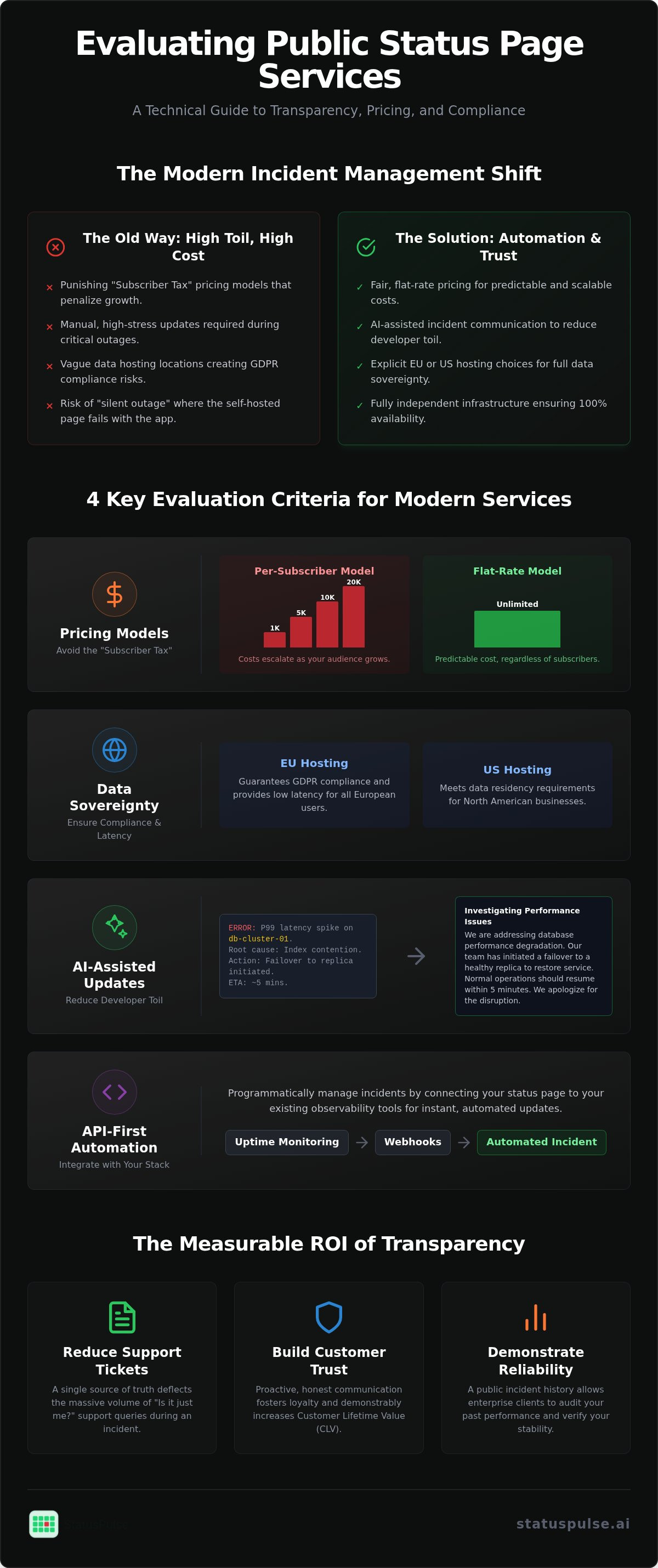
Pricing shouldn't be a penalty for being popular. Most legacy providers use a model that tracks how many people care about your uptime. Then they charge you for it. This is the "subscriber tax." It creates a perverse incentive for technical teams. You might hesitate to promote your status page to avoid a higher bill next month. A professional public status page service should encourage transparency, not tax it. We advocate for a grounded approach where your costs remain predictable regardless of your user base growth.
Total Cost of Ownership (TCO) often surprises teams as they scale. For a page with 5,000 subscribers, the difference between flat-rate and per-user pricing can be thousands of dollars annually. Beyond the subscriber count, feature gating remains a major ethical hurdle in the industry. Security shouldn't be a luxury add-on. SSO, custom domains, and SSL management are basic requirements for any professional team. Locking these behind "Enterprise" tiers is a tactical move by corporate incumbents to inflate their margins. We believe these features are essential for integrity and should be accessible to everyone.
The Problem with Success-Based Pricing
Success shouldn't lead to a budgetary crisis. Per-subscriber fees make your monthly spend unpredictable. This model punishes you for doing your job well. If your marketing team brings in a new wave of users, your infrastructure costs shouldn't spike just for the sake of notifications. Many teams find themselves trapped in "free" tiers that quickly become expensive once they cross a small threshold. Comparing traditional entry prices with flat-rate alternatives reveals the true cost of these success taxes. Ethical pricing means you pay for the quality of the tool, not the size of your audience. It ensures that your commitment to transparency doesn't have a hidden price tag.
Predictable Budgeting for DevOps Teams
Predictability is a core virtue for DevOps and SRE teams. Flat-rate pricing aligns perfectly with the architecture of incident communication transparency. It allows you to consolidate your stack. You get the combined value of uptime monitoring, status pages, and AI-powered assistants without managing multiple contracts. When evaluating different services, use a strict checklist. Look for hidden API limits or surcharges for email and SMS notifications. These "small" fees often balloon during a major incident when you need the tool the most. Transparency starts with the bill. If you're tired of complex pricing and corporate bloat, choose a flat-rate public status page service that respects your budget.
Implementing a Status Page: Best Practices for 2026
Implementation begins with a clear map. Group your infrastructure into logical components: API, Dashboard, and Database. This granularity prevents a single failing microservice from making your entire stack look offline. Once mapped, define your communication threshold. Decide exactly when an incident becomes public. Assigning a clear owner for these updates prevents the bystander effect. It ensures that when a public status page service is needed, someone is already in the driver's seat. We value precision over panic.
Automation handles the initial detection. Link your website uptime monitoring tools directly to your status components. This "automating the yellow" approach allows the system to flag performance degradation before it becomes a total outage. Finally, treat incident response like any other deployment. Run quarterly drills. If your team only logs into the status dashboard during a SEV-1 incident, they'll make mistakes. Practice ensures the tool remains an asset, not a hurdle.
Writing Updates That Build Trust
A good update follows a specific anatomy. Acknowledge the issue. State the impact clearly. Describe the action being taken. Provide a time for the next update. This structure removes the guesswork from communication. Silence is the enemy of trust. Even if the root cause is unknown, "Investigating" is a valid and honest status. Avoid using marketing filler like "seamless" or "effortless" when users are experiencing errors. Plain-spoken truth is the only way to maintain a professional reputation during a crisis. It's about being a reliable partner, not just a vendor.
Closing the Loop with Post-Mortems
The incident isn't over when the system is back online. Publishing a public post-mortem is a powerful tool for long-term trust. It shows you've analyzed the failure and implemented future monitoring improvements. This level of transparency differentiates principled teams from faceless corporations. It proves you value your users' time and business. Each report is an opportunity to show your meticulous approach to reliability. If you're ready to move away from complex pricing and corporate bloat, start your trial with StatusPulse today. It's time for a public status page service that respects your integrity and your budget.
Building a Resilient Future for Incident Transparency
Incident transparency is no longer a luxury. It's a technical requirement for any SaaS team that values long-term trust. We've explored how a modern public status page service should work for you, not against your budget. You now know why data sovereignty isn't just a checkbox but a legal necessity. You understand that AI should be a meticulous assistant that drafts updates while you focus on the fix. Most importantly, you recognize that ethical pricing shouldn't punish your growth through hidden subscriber taxes.
Consolidating your monitoring and communication into a single, straightforward platform reduces toil and restores focus. Choosing a partner that prioritizes integrity and simplicity allows you to spend less time on manual reporting and more time on technical precision. It's time to move past the corporate bloat and complex models of industry incumbents. You've built a great product. Now, give it the transparent voice it deserves.
Build a transparent status page with StatusPulse and benefit from flat pricing, regional hosting choices in the EU and US, and AI-powered incident summaries that respect your time.
Frequently Asked Questions
What is a public status page service?
A public status page service is a dedicated platform that communicates your system health to users independently of your own infrastructure. It acts as a central hub for reporting outages, maintenance, and performance metrics. Hosting this separately ensures your communication channel remains online even when your primary servers go dark. It's a foundational tool for building trust through technical transparency.
Why shouldn't I build my own status page?
Building your own status page creates a single point of failure. If your status page shares the same cloud region or DNS provider as your app, they'll likely crash together. A professional service provides the necessary decoupling. It also removes the maintenance burden of building notification systems for email and Slack. Focus on your core product. Let specialists handle the resilience.
How does AI incident management actually work?
AI incident management functions as a meticulous assistant that drafts your communication during high-stress outages. It analyzes technical logs and monitoring data to suggest human-readable updates. This reduces the cognitive load on your engineers. You maintain human agency by reviewing and approving every message before it goes live. It's about speed and clarity when every second of downtime counts for your users.
Do status pages help with SEO?
Yes, status pages protect your brand's search reputation. When your service is down, users often search for your brand status. A public status page service allows you to own that search result. Without one, users might land on third-party sites filled with frustration. Controlling the narrative through your own domain keeps your SEO profile professional. It's a strategic move for any serious SaaS.
Is EU hosting better than US hosting for my status page?
EU hosting is superior if you need to comply with strict data sovereignty and GDPR requirements. Storing subscriber data within European borders simplifies legal compliance for FinTech and HealthTech companies. It's about respecting user privacy and regulatory standards. US hosting remains a valid choice for teams with a primarily North American audience. Just ensure the service maintains high performance and security standards globally.
How much does a public status page service cost?
Costs vary significantly between flat-rate providers and corporate incumbents who charge subscriber taxes. Many traditional services increase their fees as your audience grows. We believe in ethical pricing that remains predictable regardless of your success. Look for a plan that includes essential features like custom domains and SSO without forcing you into an Enterprise tier. Transparency in pricing is as important as transparency in uptime.
Can I use my own custom domain for the status page?
Using a custom domain like status.yourbrand.com is a standard best practice. It reinforces trust by keeping the user within your brand's ecosystem. A professional public status page service provides automated SSL certificate management for these domains. This ensures a secure, seamless experience for your customers. It prevents the confusion of sending users to a generic third-party URL during a critical service disruption.
Does a status page reduce support tickets?
A status page drastically reduces ticket volume by providing immediate answers to affected users. When customers see an active incident report, they don't need to email your support team. This deflection allows your staff to focus on the resolution rather than answering the same question repeatedly. Proactive communication turns a potential PR crisis into a controlled technical event. It's the most efficient way to manage user expectations.


