

Your HTTP status code is 200, yet your users see a "Site Not Found" error. Standard website availability monitoring often misses the silent failure of a misconfigured A record or a stalled TTL propagation. It is a common frustration for DevOps teams; the dashboard stays green while global traffic drops to zero because of a DNS resolution hang. These failures bypass traditional checks, leaving your team blind to outages until the support tickets start piling up.
We agree that standard uptime checks are no longer enough for complex, distributed systems. This guide will teach you how to monitor and configure DNS to eliminate single points of failure and maintain global infrastructure resilience. You will learn to move past marketing buzzwords and build a strategy that prioritizes technical utility over flashiness. We will examine practical health check configurations, strategies for reducing MTTR through better incident communication, and how to implement the latest 2026 standards like RFC 10026 for DNSSEC automation. This is about building a reliable foundation that respects both your time and your data sovereignty.
Key Takeaways
- Identify DNS as a critical single point of failure in multi-region stacks to prevent silent outages that bypass standard checks.
- Enhance your website availability monitoring by tracking resolution latency and verifying RDATA consistency across all authoritative name servers.
- Evaluate the trade-offs between synthetic probing and real-user monitoring (RUM) to capture accurate global resolution data.
- Configure fast failover using TTL values between 60 and 300 seconds combined with automated, multi-region health-check routing.
- Integrate DNS metrics with public status pages to automate incident communication and reduce your mean time to resolution (MTTR).
Why DNS is the Critical Path for High Availability
High availability isn't just about server uptime. It's about reachability. In a multi-region stack, the Domain Name System (DNS) acts as the global switchboard. If this switchboard fails, your redundant infrastructure in Frankfurt or Virginia becomes invisible. Most teams focus on server health, yet DNS remains a common single point of failure (SPOF) that can negate millions in infrastructure investment.
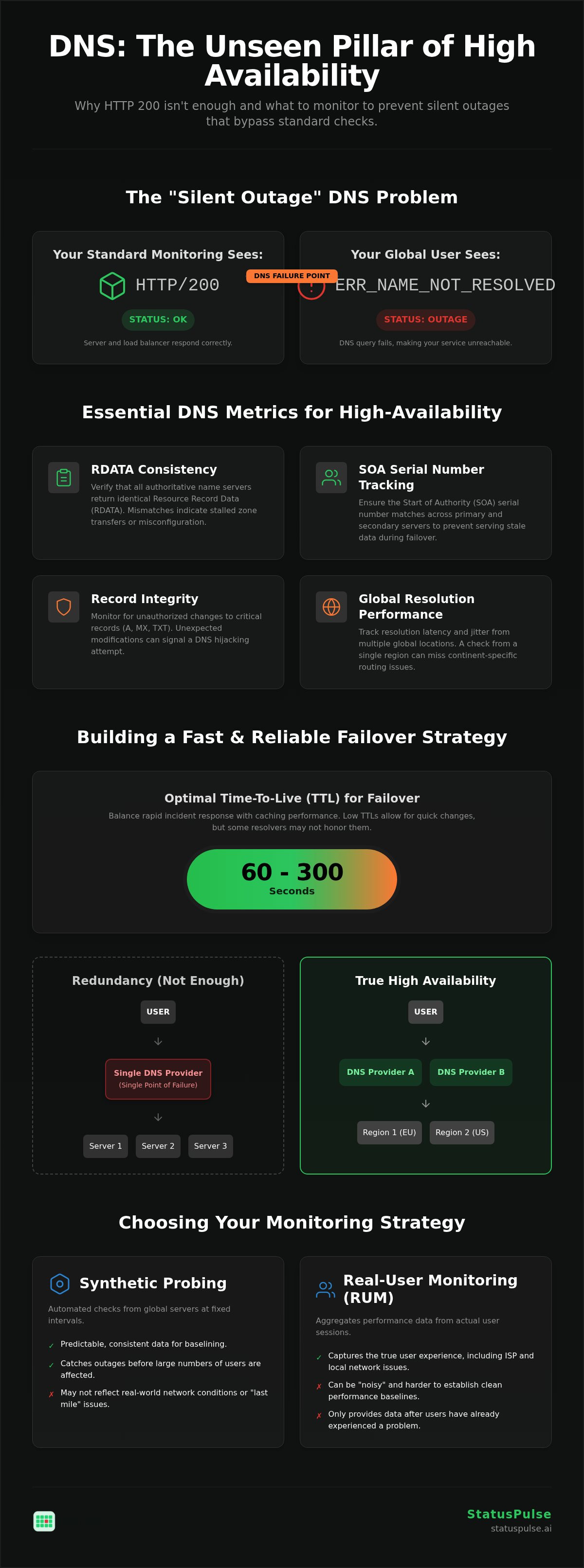
We see "silent failures" often in production environments. Your load balancer returns a 200 OK status, and your internal logs show zero errors. However, users experience a total outage because the DNS query timed out or returned a stale record. Effective website availability monitoring must validate the entire resolution chain, not just the final IP address. Relying on standard A-record checks is risky; you need monitoring that mimics Global Traffic Management (GTM) to ensure routing logic actually works across different geographies.
The Anatomy of a DNS-Related Outage
Propagation delays are a primary culprit during an incident. Even if you set a low Time-To-Live (TTL) of 60 seconds, some recursive resolvers ignore these values to save bandwidth. This creates a "long tail" of downtime where some users see the fix instantly while others remain disconnected for hours. Beyond configuration, external risks like cache poisoning or registrar-level failures can take you offline. If your registrar's authoritative servers are unreachable, your managed DNS provider's uptime becomes irrelevant. You're effectively dark.
High Availability vs. Redundancy in DNS
Having multiple servers behind one DNS provider is redundancy, not true high availability. True HA requires diversity at the DNS layer itself. Anycast networks help by broadcasting the same IP from multiple global locations, reducing regional latency and providing basic failover. However, you must weigh the trade-offs between different architectural choices.
Self-hosting BIND or PowerDNS offers total control but introduces significant operational bloat. For instance, BIND shifted to a monthly security patch cadence in 2026 to combat a rise in vulnerability reports. Managed services are often preferred for their scale, though they can hide complex failure modes. We prefer a grounded approach: use a reliable provider that offers a choice between EU or US hosting for data sovereignty, but monitor them as if they will fail.
Essential DNS Metrics for High-Availability Monitoring
Monitoring a single A-record doesn't provide a complete picture of health. To maintain a resilient architecture, you must track metrics that reveal the underlying state of your name servers. High-level website availability monitoring should go beyond simple "UP" or "DOWN" statuses to investigate the technical health of your zone files.
- RDATA Consistency: This involves verifying that every authoritative name server in your delegation returns the exact same Resource Record Data (RDATA). Inconsistent records often signal a stalled zone transfer or a configuration error on a specific node.
- SOA Serial Number Tracking: The Start of Authority (SOA) serial number must match across primary and secondary servers. If the serials diverge, your secondary servers are serving stale data, which can break DNS failover logic during a crisis.
- Record Integrity: Monitor for unauthorized changes to MX, TXT, or A records. A sudden change in a TXT record might indicate a compromised registrar account or a DNS hijacking attempt.
Global Resolution Performance
Resolution latency varies wildly by geography. In 2025, Cloudflare's 1.1.1.1 resolver averaged 6.95 ms in Europe, while others exceeded 12 ms. If you only check performance from a single region, you'll miss routing issues affecting a specific continent. You should also measure DNS jitter. This variance in resolution time across multiple queries often points to overloaded name servers or unstable ISP peering. Testing from diverse global vantage points is the only way to ensure your website availability monitoring reflects the true user experience.
Health Check Frequency and Sensitivity
Frequency is a trade-off between cost and reaction time. A 1-minute interval catches outages fast but can increase query costs on metered providers like AWS Route 53. Conversely, a 5-minute interval might leave you blind to a significant portion of an outage. We recommend a high-frequency approach for critical records, balanced by multi-node validation. Never trigger a failover based on a single failed check from one location; this leads to "flapping" due to minor network blips. Require at least two or three nodes to confirm a failure before taking action. If you're tired of complex enterprise bloat, monitoring your DNS performance with a focused tool can simplify this entire process.
Synthetic vs. Real-User DNS Monitoring: Choosing Your Strategy
Choosing the right strategy for website availability monitoring depends on whether you value proactive control or environmental realism. Synthetic monitoring uses a network of global probes to query your DNS records at fixed intervals. It's a clean, predictable method that provides a consistent baseline. Real-User Monitoring (RUM) takes a different path by collecting resolution data from actual client browsers. While RUM captures the messy reality of regional ISP peering, it often introduces noise that makes automated alerting difficult.
- Synthetic Monitoring: High predictability, low implementation cost, and ideal for testing failover logic.
- Real-User Monitoring: High granularity for specific user segments, but requires significant traffic to generate statistically relevant data.
For most DevOps teams, the complexity of RUM isn't worth the effort until you reach massive scale. Enterprise tools often push RUM as a "must-have" feature, but this is often just marketing bloat. We find that a well-configured synthetic strategy catches 99% of DNS-related failures. It provides a cleaner alternative for website availability monitoring without the performance overhead of client-side scripts.
The Case for Synthetic DNS Probes
Synthetic probes allow you to establish a "ground truth" for your infrastructure. Because the environment is controlled, you can isolate variables like resolver cache behavior or Anycast routing shifts. This is particularly useful when you need to verify that a record change has propagated across all authoritative servers. You can use a simple script to automate this verification during a deployment:
# Verify A-record consistency across authoritative servers
dig @ns1.your-dns-provider.com example.com +short
dig @ns2.your-dns-provider.com example.com +short
These probes allow you to test your failover records safely. You don't want to find out your backup IP is unreachable during a live incident. By probing the backup records directly, you ensure they're ready to handle traffic before the primary fails. It's a straightforward way to maintain high availability without the stress of "silent" failover failures.
Hybrid Monitoring: The Realistic Approach
A principled SRE team leads with synthetic monitoring for HA but uses RUM as a secondary forensic tool. If your synthetic nodes report a failure, RUM data can help you determine if the outage is global or limited to a specific network provider. This prevents "alert fatigue" by providing a second layer of validation. This integrated approach to visibility is similar to the principles discussed in our guide on API Monitoring: The Developer’s Guide to High Availability in 2026. By combining these signals, you create a resilient strategy that respects your time and your users' privacy.
Best Practices for Implementing DNS Health Checks and Failover
Building a resilient DNS strategy requires moving beyond basic record management. You must implement a structured approach to health checks that accounts for both network volatility and the economic trade-offs of high-frequency probing. Effective website availability monitoring isn't just about detection; it's about the precision of your automated response.
- Step 1: Set realistic TTL values. We recommend a range of 60 to 300 seconds for failover records. While lower values allow for faster recovery, they also increase query costs on metered providers like AWS Route 53, which starts at $0.40 per million queries.
- Step 2: Deploy multi-region health checks. Configure checks across at least three distinct geographic regions to ensure a local ISP outage doesn't trigger a global failover.
- Step 3: Conduct "Dry Run" tests. Regularly update a test record and monitor how long it takes to propagate across global resolvers. This validates your TTL assumptions before a real incident occurs.
- Step 4: Monitor the monitors. Ensure your monitoring nodes are healthy. If your monitoring provider has a regional outage, it shouldn't cause your DNS to fail over unnecessarily.
- Step 5: Link triggers to your status page. Automated monitoring should instantly update your public status page to maintain transparency with your users during a shift in traffic.
Configuring Automatic Failover
You must choose between Active-Active and Active-Passive routing. Active-Active strategies distribute traffic across all healthy endpoints, maximizing resource utilization. Active-Passive keeps a standby environment that only receives traffic when the primary fails. To prevent "flapping," where a record toggles rapidly due to minor network noise, use a consensus-based failure threshold. We prefer requiring a majority of nodes to confirm a failure before rerouting traffic.
# Example health check threshold configuration
health_check:
  id: "dns-failover-api"
  target: "api.example.com"
  type: "A"
  failure_threshold: 3 # Requires 3 consecutive failures
  regions: ["eu-west-1", "us-east-1", "ap-southeast-1"]
  consensus: 2 # At least 2 regions must agree
Managing TTL and Propagation
It's an honest reality that some ISPs ignore low TTL settings to reduce their own bandwidth costs. You can't control every recursive resolver on the internet. To mitigate this, practice "record warming" before planned migrations by gradually lowering TTLs 24 hours in advance. This ensures that when you finally flip the switch, the majority of the internet's cache is already primed for the change. If you want to simplify this process, you can automate your DNS health checks and status updates with a tool designed for technical precision rather than corporate bloat.
Integrating DNS Monitoring into Your Uptime Strategy with StatusPulse
Effective website availability monitoring requires more than just knowing a server is down. It requires understanding the root cause behind the failure. By combining DNS metrics with uptime monitoring, you gain a granular view of the entire request path from the global resolver to the application layer. Most tools treat DNS as an afterthought, forcing you to use separate platforms for routing checks and incident communication. StatusPulse integrates these functions, allowing you to automate status page updates the moment a resolution issue is detected.
We prioritize technical integrity by offering a choice between EU and US hosting. This is a critical design constraint for teams navigating the EU Data Act and the NIS2 directive. Data sovereignty shouldn't be a premium add-on; it's a fundamental requirement for modern infrastructure. Our flat-rate pricing model removes the stress of per-subscriber fees. This positions us as a fair, ethical alternative to the bloated corporate models used by industry incumbents.
Unified Visibility for DevOps Teams
Managing SSL certificates, APIs, and DNS records within a single dashboard reduces the cognitive load on your SRE team. You don't need to navigate multiple complex tools to find the root cause of a regional outage. This unified approach helps reduce alert fatigue by grouping related infrastructure incidents into a single event. It prevents your team from being buried under a mountain of redundant notifications during a site-wide crisis. For a deeper look at how this impacts your team, see The Architecture of Incident Communication Transparency.
Honest Incident Communication
DNS outages often involve propagation delays that are outside your direct control, even with low TTL settings. During these times, transparency is your most effective tool for maintaining user trust. StatusPulse uses AI incident management to help you draft technical post-mortems for DNS-related failures. These AI-driven drafts act as an assistant, providing a logical starting point for your communication while leaving the final technical verification to your specialists. This ensures your updates are accurate, technical, and free of marketing fluff.
We believe that website availability monitoring should be reliable, straightforward, and easy to understand. If you're tired of enterprise bloat and unpredictable pricing models, it's time to switch to a platform built by specialists for specialists. Start monitoring your DNS and uptime with StatusPulse today.
Securing Your Global Reachability
High availability is a deliberate architectural choice. You've seen how silent DNS failures bypass standard checks and how regional latency degrades the user experience even when servers are healthy. Relying on a single provider without global validation creates a dangerous single point of failure. By implementing multi-node health checks and maintaining technical transparency through automated status updates, you protect your infrastructure from the unpredictability of global routing.
Modern website availability monitoring must evolve beyond simple pings to include deep DNS inspection and data sovereignty. StatusPulse offers an integrated approach that combines uptime, API, and SSL monitoring with public status pages. You get the choice between EU and US hosting to meet strict compliance standards without the burden of per-subscriber pricing models. It's a focused tool built for specialists who value precision over corporate bloat. Build a more resilient stack with StatusPulse uptime monitoring and take control of your global infrastructure today. Stay focused on building; we'll handle the watch.
Frequently Asked Questions
How does DNS monitoring improve high availability?
DNS monitoring identifies "silent failures" where your server is healthy but the routing path is broken. It ensures that global traffic is correctly directed to available nodes by validating A, MX, and CNAME records. This visibility allows for automated failover triggers, preventing users from seeing "Site Not Found" errors even when your backend is up. It's a critical component of website availability monitoring that bridges the gap between infrastructure health and user reachability.
What is the ideal TTL for a high-availability DNS record?
The ideal TTL for failover records is typically between 60 and 300 seconds. This range balances the need for fast propagation during an incident with the increased query costs associated with very low values. While some enterprise providers suggest sub-60 second TTLs, many recursive resolvers ignore these values to save bandwidth. Staying within the 1 to 5 minute window ensures better compatibility with global ISP caching policies while still allowing for rapid traffic redirection.
Can DNS monitoring detect a DDoS attack?
Yes, DNS monitoring detects DDoS attacks by tracking resolution latency and query success rates. A sudden spike in resolution time or a high volume of failed queries often indicates that your authoritative name servers are under heavy load or being targeted by an amplification attack. While monitoring doesn't mitigate the attack, it provides the early warning signals needed to shift traffic to a protected Anycast network or a secondary DNS provider.
What is the difference between DNS monitoring and uptime monitoring?
Uptime monitoring typically checks if a specific IP or endpoint returns a valid HTTP status code. DNS monitoring validates the resolution process itself, checking if the domain points to the correct record and if the name servers are responding correctly. Effective website availability monitoring requires both. Without DNS checks, your uptime dashboard might stay green while users remain unable to resolve your domain name due to a record misconfiguration or a stale cache.
How do I prevent DNS propagation delays during a failover?
You can't fully prevent delays, but you can minimize them by lowering your TTL values at least 24 hours before a planned migration. This "warms" the records by ensuring that recursive resolvers check back more frequently. For unplanned failovers, using an Anycast DNS network helps by updating records across global nodes simultaneously. It's also vital to monitor SOA serial numbers to ensure secondary servers stay synchronized with your primary configuration.
Is multi-provider DNS necessary for high availability?
Multi-provider DNS is a best practice for mission-critical stacks but adds significant complexity. It eliminates the managed DNS provider as a single point of failure. However, it requires careful synchronization of zone files and health checks to prevent routing loops. For many SaaS teams, a single reliable provider with a robust Anycast network is sufficient, provided you have a distinct monitoring strategy that alerts you to provider-level outages immediately.
How often should I run DNS health checks?
We recommend running checks every 1 minute for critical production records. This frequency provides a good balance between detection speed and query cost. Checking every 5 minutes might leave you blind to a significant portion of an outage, while sub-minute checks often lead to "flapping" alerts caused by minor network blips. Always use a consensus-based threshold, requiring at least two or three nodes to confirm a failure before triggering an alert.
Does StatusPulse support monitoring from multiple global regions?
StatusPulse provides monitoring from diverse global locations to ensure your infrastructure is reachable from every major market. You can choose between EU or US hosting for your data to maintain strict compliance with regional data sovereignty laws. This multi-region approach prevents false positives caused by local network issues and gives you a realistic view of how users in different geographies experience your site's availability and resolution performance.


