

Industry reports for 2026 indicate that website downtime costs businesses an average of $5,600 per minute. When a critical service fails, every second spent manually drafting status updates is a second taken away from remediation. You know the pressure of an active incident. Support tickets spike because communication lags behind the technical reality. It's a stressful cycle. It drains engineering resources. It frustrates users.
An AI powered status page changes this dynamic by transforming raw monitoring logs into clear, technical summaries. You don't have to choose between speed and accuracy. This article explains how AI-driven incident management maintains stakeholder trust and reduces support overhead. We will look at how to automate updates while keeping a human in the loop to prevent hallucinations. You'll learn to move from reactive firefighting to transparent, automated communication that respects your time and your technical integrity.
Key Takeaways
- Learn how an AI powered status page converts raw monitoring data into clear technical updates for stakeholders.
- Understand the underlying logic of using pattern recognition to differentiate between regional latency and global outages.
- Compare manual incident entry against AI-assisted drafting to reduce response times from minutes to seconds.
- Follow a practical checklist for connecting uptime monitoring and API sources to your incident management workflow.
- Explore why an integrated platform with flat-rate pricing eliminates the "per-subscriber tax" common in legacy tools.
What is an AI-Powered Status Page?
An AI powered status page is more than a static dashboard. It is a technical co-pilot that integrates directly with your monitoring stack to draft incident summaries in real-time. This tool acts as a bridge between your observability platforms and your public communication channels. It translates raw system logs into language that stakeholders and customers can understand. An AI powered status page functions as an augmentation tool for SRE teams that automates incident documentation while keeping engineers in control of the final message.
Modern incident management requires speed and precision. When a service fails, the gap between detection and communication is where trust is lost. By utilizing machine learning, these pages ensure that your external narrative matches your internal telemetry without requiring a dedicated communications officer on call.
The Core Components of AI-Driven Communication
Effective AI-driven communication relies on three technical layers. Each layer works to simplify the complexity of a system failure.
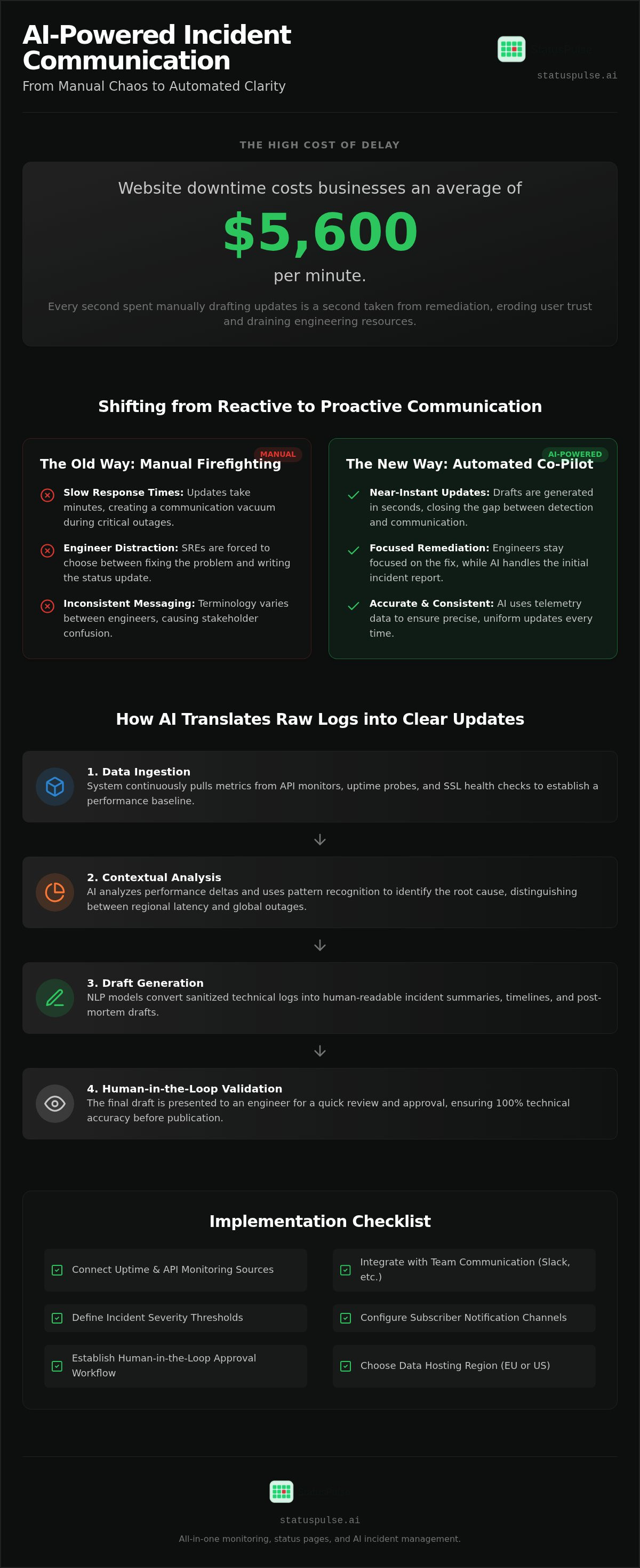
- Data Ingestion: The system continuously pulls metrics from API monitors, uptime probes, and SSL health checks.
- Contextual Analysis: The AI identifies the root cause by analyzing the delta between normal performance and current latency spikes. It determines the impact area, such as a specific region or a single microservice.
- Draft Generation: It creates human-readable timelines and post-mortems. These drafts are ready for a final human review, ensuring technical accuracy before they go live.
Why Traditional Status Pages Fail Under Stress
Traditional status pages are often manual. They rely on human input during the most stressful minutes of an engineer's day. This manual approach has several critical failure points.
Manual updates are usually the first thing forgotten during a P0 outage. Engineers prioritize the fix over the status update. This leads to a communication vacuum. Inconsistent terminology is another issue. One team member might report "minor issues" while another describes "critical failure," causing stakeholder confusion. Finally, there is the "blank page" problem. Writing clear, calm updates while production is down is difficult. AI removes this friction. By using an integrated platform like StatusPulse, teams can generate accurate drafts immediately. This allows them to focus on the technical resolution instead of struggling with word choice during a crisis.
How AI Processes Incident Metrics into Status Updates
An AI powered status page doesn't guess. It calculates. The process begins by establishing a baseline of normal system behavior. When a latency spike occurs, AI models analyze the delta between current performance and this historical baseline. This distinguishes a temporary network blip from a systemic failure. By using pattern recognition, the system identifies whether an outage is regional or global based on data from distributed monitoring nodes. If three nodes in Europe fail while North American nodes remain healthy, the AI identifies a localized incident.
Natural Language Processing (NLP) then takes over. It parses technical logs to generate a concise Impact Statement. This removes the burden from engineers who might otherwise struggle to summarize complex stack traces for a general audience. The system also categorizes the incident automatically. It assigns labels like Degraded, Partial Outage, or Major Outage based on your predefined thresholds. This ensures your communication is as precise as your telemetry.
From Raw Log to Public Update
The journey from a failed health check to a public notification is automated but controlled. It starts with log aggregation from API monitoring sources. A critical step in this pipeline is data sanitization. AI models filter out sensitive system data, such as internal IP addresses or authentication tokens, to prevent security leaks in public updates. Once sanitized, the update is formatted for different channels. Whether it's a brief Slack notification or a detailed email for enterprise clients, the core message remains consistent.
Maintaining Technical Accuracy
Automation shouldn't mean a loss of control. The application of artificial intelligence (AI) capabilities in operations is most effective when grounded in real-time metrics, not just text patterns. This grounding prevents hallucinations. We advocate for a Human-in-the-Loop approach. AI drafts the technical summary, but a human provides the final validation before publication. This prevents the "everything is fine" bias that can occur in poorly tuned automated systems. If you're looking for a platform that balances automation with human oversight, StatusPulse provides the tools to manage this workflow effectively.
Comparing Manual vs. AI-Powered Incident Management
Speed is the primary differentiator. While an engineer is diagnosing a database lock, an AI powered status page is already drafting the notification. Manual entry typically takes several minutes because it requires context switching. AI drafts in seconds. This immediacy is backed by research on AI's impact on incident management, which indicates that automated systems can lead to a 42% reduction in mean time to resolution by streamlining communication workflows.
Consistency often suffers during a crisis. Manual updates vary based on the engineer's communication style and stress level. One person might be overly technical while another is too vague. AI maintains a standardized tone across all incidents. It also handles scalability. If your service experiences concurrent outages across multiple regions, the AI processes these telemetry streams simultaneously. It generates distinct updates for each affected node without increasing the workload on your DevOps team. After the incident, the system automatically summarizes the entire timeline for a post-mortem, saving hours of manual reconstruction.
When to Stick with Manual Updates
Automation is not a universal solution. Some scenarios demand the precision of human judgment. High-sensitivity security breaches require legal and compliance review before any public statement is made. AI cannot yet navigate the legal nuances of a data leak. Similarly, if you encounter an extremely niche architectural failure that your models haven't seen before, manual intervention is safer. For very small teams with infrequent incidents, the overhead of configuring an AI powered status page might exceed the immediate benefit.
The ROI of Automated Communication
The financial and operational benefits are measurable. Faster updates lead to a direct reduction in support tickets. This lowers support overhead and prevents your help desk from being overwhelmed. Beyond cost, you improve brand reputation through incident communication transparency. Customers value honesty and speed. By removing the "blank page" problem, you reduce the cognitive load on your engineers. They can focus on fixing the bug while the system manages the narrative. This integrated approach ensures that transparency becomes a standard feature of your stack rather than a manual chore.
Implementation Checklist: Setting Up Your AI Status Page
Deploying an AI powered status page requires more than just toggling a switch. You must align the automation with your existing incident response framework. It's about creating a reliable pipeline from system failure to customer notification. This ensures that the AI functions as a precise assistant rather than an unpredictable bot. Follow these steps to build a robust configuration.
- Step 1: Connect your primary uptime and API monitoring sources to the platform.
- Step 2: Define your 'Source of Truth' for incident data. Decide whether raw logs or high-level metrics should trigger the drafting logic.
- Step 3: Configure AI drafting rules. Choose a technical tone that matches your brand's voice.
- Step 4: Establish a review process. This Human-in-the-Loop requirement ensures a technical peer validates the update before it goes live.
- Step 5: Test the flow. Simulate a regional outage in a staging environment to verify the webhook triggers and draft accuracy.
Integrating Monitoring and Communication
Effective communication starts with deep integration. You should link your website uptime monitoring tools directly to the status engine. This allows the system to ingest telemetry in real-time. Set up webhooks to trigger AI draft generation the moment a probe fails. This removes the manual step of opening a dashboard to start an incident. You can also configure SSL certificate alerts. The AI can then draft pre-emptive notifications weeks before expiry, helping you maintain trust through proactive transparency.
Training the AI on Your Infrastructure
The AI's utility depends on the context you provide. Feed the model your service architecture map so it understands how components interact. This helps the AI perform more accurate impact analysis, such as linking a CDN failure to specific regional latencies. You must also define 'Safe' versus 'Unsafe' terms. For example, you might prefer the AI to describe a "read-only state" rather than "database failure." This is an iterative process. By correcting early drafts, you train the system to match your specific technical vocabulary. To begin automating your incident updates with these precise controls, get started with StatusPulse.
Why StatusPulse is the Logical Choice for Technical Teams
StatusPulse was built to solve the fragmentation in modern incident response. Many teams juggle separate tools for uptime monitoring, SSL tracking, and status communication. This sprawl creates friction during critical outages. We offer a unified platform that manages the entire lifecycle of an incident. By using an AI powered status page within this ecosystem, you ensure that your monitoring data flows directly into your public updates. There are no middle-ware layers or manual exports required.
We reject the industry standard of per-subscriber pricing. This model acts as a tax on your growth. Whether you have ten subscribers or ten thousand, your costs should remain predictable. Our flat pricing model is designed for transparency. It allows you to scale your communication without worrying about a ballooning monthly bill. This approach is a deliberate choice to support growing technical teams. Incumbent providers like [VERIFY: competitor X entry price] often hide the true cost of scaling behind complex tiers. We prioritize ethics over corporate bloat.
- Integrated Monitoring: Native uptime, API, and SSL tracking in one dashboard.
- Predictable Costs: Flat-rate pricing with no hidden subscriber fees.
- Technical Precision: Built for engineers who value data over marketing hype.
- Regional Flexibility: Choose your hosting location to match your compliance needs.
Data Sovereignty and Compliance
Reliability isn't just about uptime. It's about where your data lives. We provide a choice between EU-based and US-based hosting. For teams managing GDPR-sensitive applications, EU hosting ensures compliance with regional data sovereignty standards. For North American users, US hosting offers optimized latency for monitoring probes. Every action taken by our AI tools is recorded in transparent audit logs. You maintain full visibility into how drafts are generated and who approved them. This ensures your security standards are met without compromise.
A Unified Stack for SREs
StatusPulse is a tool for specialists. We don't believe in "autopilot" incident management. Our AI is designed to assist, not replace, the engineer. This means every automated draft requires a final human action before it is published to your AI powered status page. This native integration between monitoring and communication reduces the cognitive load on SREs during a crisis. You get a streamlined workflow that prioritizes integrity. Is StatusPulse right for your team? Compare our features and regional hosting options to see how we fit your existing architecture.
Scaling Incident Transparency with AI
Effective incident management isn't about eliminating downtime. It's about how you respond when it happens. By deploying an AI powered status page, you bridge the gap between raw telemetry and stakeholder trust. You've seen how automation reduces the time to first update and maintains a consistent technical tone during high-pressure outages. This shift moves your team from reactive firefighting to proactive, transparent communication that respects your users' time.
Integrating your uptime monitoring with AI-driven drafting ensures your engineers stay focused on the fix. You don't have to sacrifice control for speed. With human-in-the-loop validation, your updates remain accurate and secure. StatusPulse provides the infrastructure to make this happen. With EU and US hosting options and transparent flat pricing, you can scale your communication without the per-subscriber tax. It's a principled approach to reliability that values technical integrity over corporate bloat.
Start building technical trust with StatusPulse today. Your team deserves tools that respect their bandwidth and your customers' need for clarity. Reliability is a constant journey; we provide the map to keep your stakeholders informed every step of the way.
Frequently Asked Questions
How does an AI powered status page differ from a standard one?
An AI powered status page automates the translation of raw telemetry into human-readable text. Standard pages require manual input for every update. AI versions use pattern recognition across multiple monitoring nodes to identify the scope of an outage and draft summaries instantly. This reduces the time engineers spend writing instead of fixing. It bridges the gap between observability data and stakeholder transparency.
Can AI post status updates without human approval?
You can configure the system for full automation, but we recommend a human-in-the-loop approach. This ensures a technical peer validates the draft before publication. This safeguard prevents hallucinations and ensures the tone matches your brand's specific technical standards. It keeps the final decision in human hands while speeding up the initial drafting phase. Maintaining trust requires this final layer of human oversight.
Is my monitoring data safe when using AI incident management?
Yes. The system sanitizes logs to remove sensitive data like internal IP addresses or auth tokens before processing. With an AI powered status page from StatusPulse, you also have the choice of EU or US hosting. This supports your data sovereignty requirements and ensures compliance with regional privacy standards. We provide transparent audit logs for all AI actions to maintain full technical accountability.
Does an AI status page integrate with Slack or Microsoft Teams?
Yes. You can configure webhooks to push AI-drafted updates directly to Slack, Microsoft Teams, or email. This ensures that your internal teams and external stakeholders receive consistent information across all channels simultaneously. It simplifies the notification pipeline during active incidents. By integrating with your API monitoring, the system ensures that every channel reflects the same real-time status.
What happens if the AI generates an incorrect status update?
The review process is your primary defense. If a draft is inaccurate, you can edit it before publication. Correcting the AI also functions as a training signal. The model learns from your feedback to improve the accuracy of future incident summaries and technical descriptions. This iterative process ensures that the AI adapts to your specific infrastructure and preferred technical terminology over time.
How much time can AI save my DevOps team during an incident?
AI reduces the drafting process from minutes to seconds. During a major outage, this time is critical for your mean time to resolution. It eliminates the "blank page" problem. This allows your engineers to focus entirely on remediation while the system manages the narrative for your stakeholders. Faster communication leads to fewer support tickets and reduced cognitive load on your DevOps team.
Do I need to be an AI expert to set up StatusPulse?
No. Setting up StatusPulse is straightforward and requires no specialized machine learning knowledge. You simply connect your monitoring sources, such as SSL and API monitors, and define your preferred tone. The system handles the complex architectural analysis in the background. It is built for specialists who want to solve problems effectively without navigating complex corporate software bloat.
Is there a limit to how many status pages I can create?
Limits depend on your selected plan. The Free plan includes one status page. Our Starter plan offers five. The Pro plan includes 10, and the Business plan allows up to 25 status pages. All plans follow our flat pricing model with no per-subscriber fees. This ensures transparent billing regardless of how many users follow your updates. It is a fair alternative to complex enterprise pricing.


