

Why should your uptime monitoring budget be tied to the volume of your application logs? For many engineering teams, bundled log management is a hidden tax on reliability. If you already use a dedicated observability stack, paying for redundant storage in your status page tool is an expensive inefficiency. Seeking specialized monitoring alternatives for teams that prioritize uptime without needing log management is a logical step when you want to avoid dual-platform complexity and volumetric pricing spikes during critical incidents.
We understand that a bloated feature set often masks a lack of focus. You need high-signal uptime monitoring and clear incident communication, not another place to store gigabytes of data. This guide identifies specialized monitoring stacks that prioritize uptime and incident communication without charging for redundant log storage. We will compare tools that offer predictable flat-rate pricing, GDPR-compliant EU hosting, and AI-driven incident response. You will learn how to prioritize precision over corporate bloat while keeping your monitoring costs transparent and ethical.
Key Takeaways
- Identify and eliminate the "log tax" by decoupling uptime monitoring from redundant, high-volume log storage.
- Prioritize technical requirements like global probe distribution and sub-minute check intervals over a secondary log indexing pipeline.
- Evaluate Better Stack Alternatives for Teams That Don't Need Log Management based on flat-rate pricing models and regional data sovereignty.
- Audit your existing observability stack to determine if integrated log querying provides actual value or just adds dual-platform complexity.
- Reduce your Mean Time to Communicate (MTTC) by utilizing AI-powered incident drafting for faster, more accurate status updates.
The 'Log Tax': Why Teams Are Moving Away from Bundled Monitoring
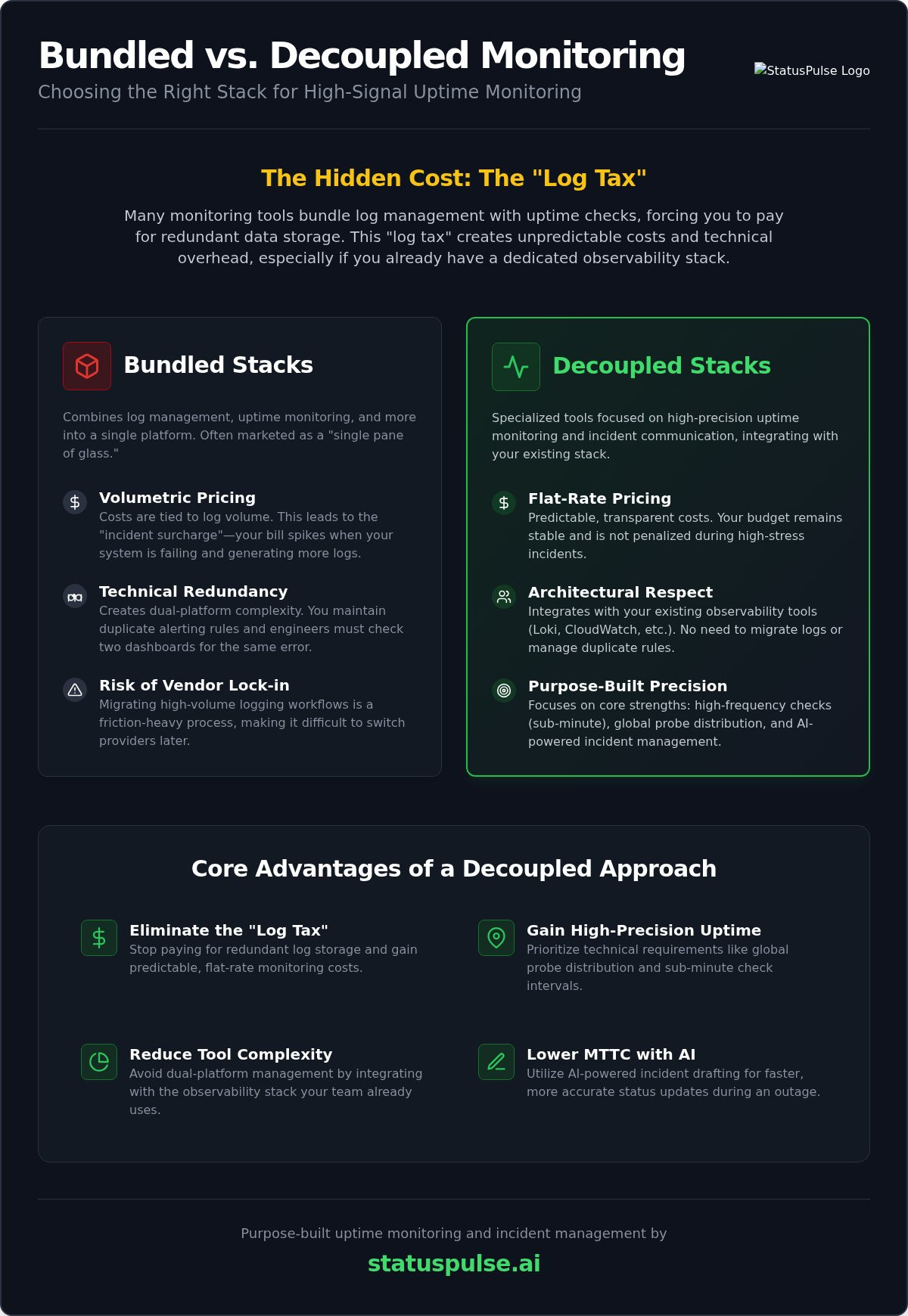
The "Log Tax" is the premium you pay for redundant data ingestion and storage. Better Stack offers a polished interface, but its log management module can feel bolted onto its core monitoring features. For teams that already have a dedicated logging infrastructure, this creates a financial and technical overlap. You are essentially paying twice for the same byte of data. It's an inefficiency that lean DevOps teams can't afford to ignore.
Searching for Better Stack Alternatives for Teams That Don't Need Log Management is often a response to this architectural friction. Specialized tools focus on high-precision uptime without forcing you to migrate your entire observability stack. This allows your team to maintain its existing workflows while gaining better visibility into external availability. It's about choosing the right tool for a specific job rather than accepting a compromise.
The Redundancy Problem in Modern DevOps
Most mature engineering teams already use tools like Loki, CloudWatch, or Datadog. Forcing logs into an uptime platform creates technical debt. You have to maintain duplicate alerting rules across two separate environments. If a service fails, you don't want to check two dashboards to see the same error message. This duplication increases the cognitive load on your on-call engineers during a crisis.
The "single pane of glass" promise is a common marketing angle used by platforms like OneUptime. They argue that bundling everything simplifies correlation. In reality, it often hides vendor lock-in. Migrating high-scale logging workflows is a friction-heavy process that rarely yields a positive ROI for lean teams. It's more efficient to keep your logs where your engineers are already comfortable. Precision in website monitoring shouldn't require a total overhaul of your backend data strategy.
Predictable vs Volumetric Pricing
Standard uptime monitoring should rely on flat-rate pricing. Better Stack’s model introduces variables based on log volume. This leads to unpredictable billing during traffic surges or system failures. If your log retention limits are reached on a "Business" plan, you might lose visibility or face unexpected overages. It makes financial planning difficult for growing startups.
We call this the "incident surcharge." When your application is under stress, it generates more logs. If your monitoring tool bills by volume, your costs spike exactly when your team is most stressed. Volumetric pricing is a budget risk for SRE teams that prioritizes vendor profit over predictable operations. It turns a technical crisis into a financial one.
Choosing a specialized platform like StatusPulse allows you to decouple these costs. You get high-signal uptime monitoring and AI-powered incident management without the volatility of log-based billing. This approach respects your existing architecture rather than demanding a total rewrite of your logging strategy. It ensures your budget stays as stable as your uptime.
Evaluating Uptime Precision vs Log Observability
Engineering requirements for a 30-second uptime check differ fundamentally from those of a log ingestion pipeline. Logs are reactive and high-volume, designed for post-mortem deep dives. Synthetic monitoring is proactive and lightweight, designed to trigger immediate action. When these functions are bundled, the precision of the uptime check often suffers. High-frequency monitoring at 1-minute or 30-second intervals is essential for verifying service availability before users start reporting issues.
Global probe distribution is a critical factor that log indexing speed cannot replace. If your monitoring tool relies on a limited number of nodes, regional network congestion can trigger false alarms. Teams searching for Better Stack Alternatives for Teams That Don't Need Log Management often realize that high-frequency synthetic checks provide more immediate value than a massive, unindexed log stream. Specialised tools use verification logic to confirm an outage from multiple geographic locations before sending an alert, reducing the "false positive" noise common in bundled platforms.
The Architecture of a High-Precision Check
A dedicated monitoring stack relies on a wide network of Points of Presence (PoPs). This distribution ensures that your API or website is accessible from various global regions, preventing local routing issues from being flagged as total outages. Beyond simple HTTP pings, a technical stack must include SSL certificate monitoring and API monitoring to ensure the entire handshake and data exchange process is functional.
Multi-step API checks add another layer of verification. These scripts simulate complex user flows, such as logging into a dashboard or adding an item to a cart. If the login succeeds but the data fetch fails, a log-only approach might miss the nuance of the partial failure. A high-precision check catches these discrepancies by asserting specific response body content or status codes at each step of the journey.
Why Status Pages Deserve a Dedicated Focus
Internal monitoring and external incident communication serve two different audiences. Your engineers need raw technical data, but your customers need clear, reassuring updates. Implementing Modern IT Incident Management requires a clear separation between the data you use to debug and the data you use to inform customers. This is why public status pages should reside on a completely independent infrastructure from your primary cloud provider.
Hosting your communication tools separately ensures that even if your main data center goes dark, your status page remains reachable. It maintains customer trust during your worst-case scenarios. If you are looking for a way to streamline this process, you might consider how StatusPulse uses AI to draft incident updates, allowing your team to focus on the fix while the system handles the messaging. This specialized focus eliminates the complexity of dual-platform log management while keeping your uptime data high-signal and actionable.
Comparative Framework: Bundled vs Decoupled Monitoring Stacks
Choosing between a bundled platform and a decoupled stack is a question of architectural philosophy. Bundled tools offer the convenience of a single login but often impose a "one size fits all" technical constraint. Decoupled stacks allow you to select the best-of-breed tool for each layer of your observability. When searching for Better Stack Alternatives for Teams That Don't Need Log Management, the goal is to find a platform that excels at uptime without the secondary baggage of log ingestion pipelines.
The trade-off usually centers on integration depth versus operational simplicity. A specialized tool focuses its engineering resources on probe reliability and incident communication logic. It doesn't split focus between indexing terabytes of text and executing sub-minute synthetic checks. This focus results in a more resilient monitoring layer that remains functional even when your primary logging provider experiences latency or ingestion backlogs.
Feature Mapping: What You Actually Use
Most DevOps teams require a specific subset of features for external reliability. Heartbeat monitoring is essential for verifying specialized cron jobs and background workers that logs might miss. You need a tool that handles these signals with the same precision as a standard HTTP check. The following table compares core capabilities across common industry options for 2026.
| Feature | Better Stack | StatusPulse | Uptime Robot |
|---|---|---|---|
| Check Interval | 30 Seconds (Team) | 30 Seconds | 1 Minute (Pro) |
| SSL/API Monitoring | Included | Included | Included |
| AI Incident Drafting | Yes | Yes | No |
| Log Management | Yes (Bundled) | No (Decoupled) | No |
| Hosting Options | Global | EU & US Choices | Global |
The Hidden Cost of Integration Maintenance
Specialized tools often provide cleaner API documentation because their scope is narrower. This makes it easier to build custom DevOps workflows or automate status updates via CI/CD pipelines. You can use OpenTelemetry for your internal traces and metrics while keeping your external uptime checks simple and direct. It prevents your monitoring configuration from becoming as complex as the application it's supposed to watch.
Data sovereignty is another critical factor in this framework. Many teams in Europe require strict adherence to local regulations, making the choice between EU and US hosting a technical necessity rather than a preference. For more detailed comparisons on reliability, you can refer to this guide on website uptime monitoring tools. Selecting a platform like StatusPulse ensures your incident management doesn't rely on log data that might be inaccessible during a regional cloud outage. It keeps your communication lines open and your technical stack lean.
Selection Guide for Lean DevOps Teams in 2026
Finding Better Stack Alternatives for Teams That Don't Need Log Management requires a systematic audit of your current observability workflows. Start by reviewing your log query history within your existing uptime tool. If your engineers are only looking at logs in ELK or Loki, you are paying for redundant ingestion. Map your incident communication flow next. Determine if you require automated public status pages or if internal-only webhooks are sufficient for your current scale.
Technical performance must be verified through a "Time to Alert" test. This measures the interval between a regional service failure and the moment your on-call engineer receives a notification. Regional failures are often masked by global averages in lower-tier tools. A specialized stack should provide granular data on how fast it detects and verifies an outage from multiple Points of Presence (PoPs) before escalating the incident.
Assessing Your Observability Maturity
Bundled platforms like Better Stack are often effective for early-stage startups that lack a formal observability strategy. They provide a quick way to get basic logs and pings in one place. However, as your infrastructure scales, the cost of this convenience rises. The growth inflection point is the moment when the financial overhead of redundant log storage outweighs the convenience of a unified monitoring interface. At this stage, decoupling your monitoring layers becomes a technical and financial necessity for maintaining lean operations.
Compliance and Hosting Considerations
European organizations face specific legal hurdles when using monitoring tools hosted primarily in the US. The US Cloud Act allows federal authorities to compel providers to disclose data, regardless of where servers are located. This makes native EU hosting a critical requirement for GDPR compliance. You must verify that your provider offers a clear Data Processing Agreement (DPA) and allows you to choose your data residency. A specialized provider often handles these requirements with more precision than a global conglomerate.
- Data Residency: Does the provider offer a choice between EU and US hosting?
- DPA Availability: Is a signed Data Processing Agreement available upon request?
- Sub-processor Transparency: Are all third-party data processors clearly listed and vetted?
- Access Controls: Does the platform support SSO for secure team management?
Selecting a specialized provider ensures that your data remains within your preferred jurisdiction while providing the precision your SRE team requires. If you are ready to eliminate the log tax and focus on high-signal uptime, consider switching to a specialised monitoring stack that prioritises transparency and regional compliance.
StatusPulse: Purpose-Built for Incident Transparency
StatusPulse is designed for engineering teams that value technical precision over feature bloat. It addresses the core frustrations of Better Stack Alternatives for Teams That Don't Need Log Management by stripping away the "log tax" and focusing on high-signal uptime. We provide a specialized stack that prioritizes incident communication and data sovereignty without the unpredictability of volumetric pricing. By focusing on a narrow set of critical tools, we ensure that our platform remains fast and reliable during your most stressful outages.
Our philosophy is built on transparency and quiet confidence. We don't believe in charging per-subscriber fees or scaling your costs based on your log volume. Instead, we offer a flat-rate pricing model that remains predictable regardless of traffic spikes or incident frequency. This ethical approach to billing allows your team to focus on resolving technical issues rather than managing a fluctuating monitoring budget. It is a grounded alternative for those tired of corporate bloat and complex pricing structures.
AI-Driven Incident Communication
Most observability platforms use AI for root-cause analysis, which necessitates massive log ingestion and high costs. StatusPulse takes a different path by focusing on human agency and clarity. Our AI incident management assistant helps reduce your Mean Time to Communicate (MTTC) by drafting status updates in real-time. It translates technical impact into clear, accessible language for your customers and non-technical stakeholders.
This automated drafting assistant allows your SREs to stay focused on the recovery effort while the system handles the messaging. You retain final control over every update, ensuring that the human element of incident response is never lost. By focusing AI on communication rather than ingestion, we help you maintain customer trust without the need for a secondary log indexing pipeline. It is a practical tool built by specialists for specialists.
Uptime Monitoring Without the Noise
Our monitoring engine is optimized for high-signal alerts that matter. We focus on SSL certificate monitoring, API monitoring, and 1-minute uptime checks to ensure your external services are fully functional. Because we exclude log management, our platform avoids the latency and complexity associated with bundled tools. This focus ensures that your alerts are accurate and your dashboard remains responsive when you need it most.
Data sovereignty is a core virtue of our architecture. We provide dual-region hosting options, allowing you to choose between EU and US data residency. This ensures that your monitoring data complies with local regulations like GDPR without defaulting to a single global region. If you are ready to move away from the complexity of dual-platform log management, you can start a free trial on StatusPulse to see how a specialized monitoring stack improves your reliability.
Prioritizing Precision Over Redundant Data
Decoupling your observability layers is a strategic move for growing engineering teams. It eliminates the financial friction of redundant log ingestion and allows you to prioritize high-signal uptime data. By choosing specialized tools, you ensure that your incident communication remains functional even when your primary logging backend experiences high latency or ingestion backlogs. This approach respects your existing technical architecture rather than demanding a total rewrite of your data strategy.
Evaluating Better Stack Alternatives for Teams That Don't Need Log Management helps you reclaim your budget while improving your Mean Time to Communicate. You deserve a platform that offers AI-powered incident drafting, flat-rate pricing with zero per-subscriber fees, and a choice between EU and US hosting for true data sovereignty. It's about building a stack that works for your specific needs, not one that forces you into a "one size fits all" billing model.
Stop paying the 'Log Tax' and switch to StatusPulse for high-precision monitoring. Streamlining your stack is a direct path toward a more resilient and ethical infrastructure. Your team is ready for a tool that values precision as much as you do.
Frequently Asked Questions
Is Better Stack free for small teams?
Yes, Better Stack provides a free plan for hobbyists and very small projects. It includes 10 monitors with 3-minute check intervals and 1 GB of monthly log storage. Teams requiring higher precision, such as 30-second checks or on-call responder seats, will need to move to paid tiers starting at a competitive paid plan.
Why should I separate my log management from my uptime monitoring?
Separation prevents technical redundancy and financial volatility. When logs are bundled with uptime monitoring, you often pay a "log tax" for data you already store in tools like Loki or CloudWatch. Decoupling ensures your monitoring budget remains predictable even when your application generates a high volume of logs during a failure.
Does StatusPulse support 30-second uptime checks?
Yes, StatusPulse supports 30-second check intervals as a standard feature for high-precision monitoring. This frequency is critical for detecting intermittent failures and micro-outages that 1-minute or 5-minute intervals often miss. It ensures your team is notified of service degradation long before it impacts a significant portion of your users.
Can I migrate my status page from Better Stack to an alternative easily?
Migration is generally a direct process of mapping your existing endpoints and notification webhooks to the new platform. While manual setup is common for smaller stacks, most Better Stack Alternatives for Teams That Don't Need Log Management provide clean APIs. This allows you to automate the transition of your monitors and status page configurations without significant downtime.
What is the best Better Stack alternative for GDPR compliance?
StatusPulse is a strong candidate for organizations prioritizing GDPR and data sovereignty. We offer native EU hosting options, ensuring your monitoring data stays within European jurisdiction. Unlike many global providers that default to US-based infrastructure, we provide clear Data Processing Agreements and regional hosting choices to meet strict compliance standards.
Do I need log management for basic website uptime monitoring?
No, log management is not a requirement for verifying website availability. Uptime monitoring relies on synthetic HTTP pings from global Points of Presence to confirm your site is reachable. Logs are a secondary observability layer used for debugging the root cause of an issue after your monitoring tool has already alerted you to the outage.
How does AI incident management work in StatusPulse?
Our AI incident management functions as a specialized drafting assistant for your status page. It analyzes the technical data from an active outage and generates a human-readable update for your stakeholders. This reduces your Mean Time to Communicate (MTTC) by handling the initial writing, allowing your engineers to focus entirely on the technical fix.
Does StatusPulse offer on-call scheduling like Better Stack?
StatusPulse focuses on high-precision monitoring and incident communication rather than responder rotations. While we integrate with major alerting platforms, we do not provide native on-call scheduling or complex responder heartbeat checks. This specialization allows us to maintain a lean, ethical platform dedicated to uptime and status transparency.


