
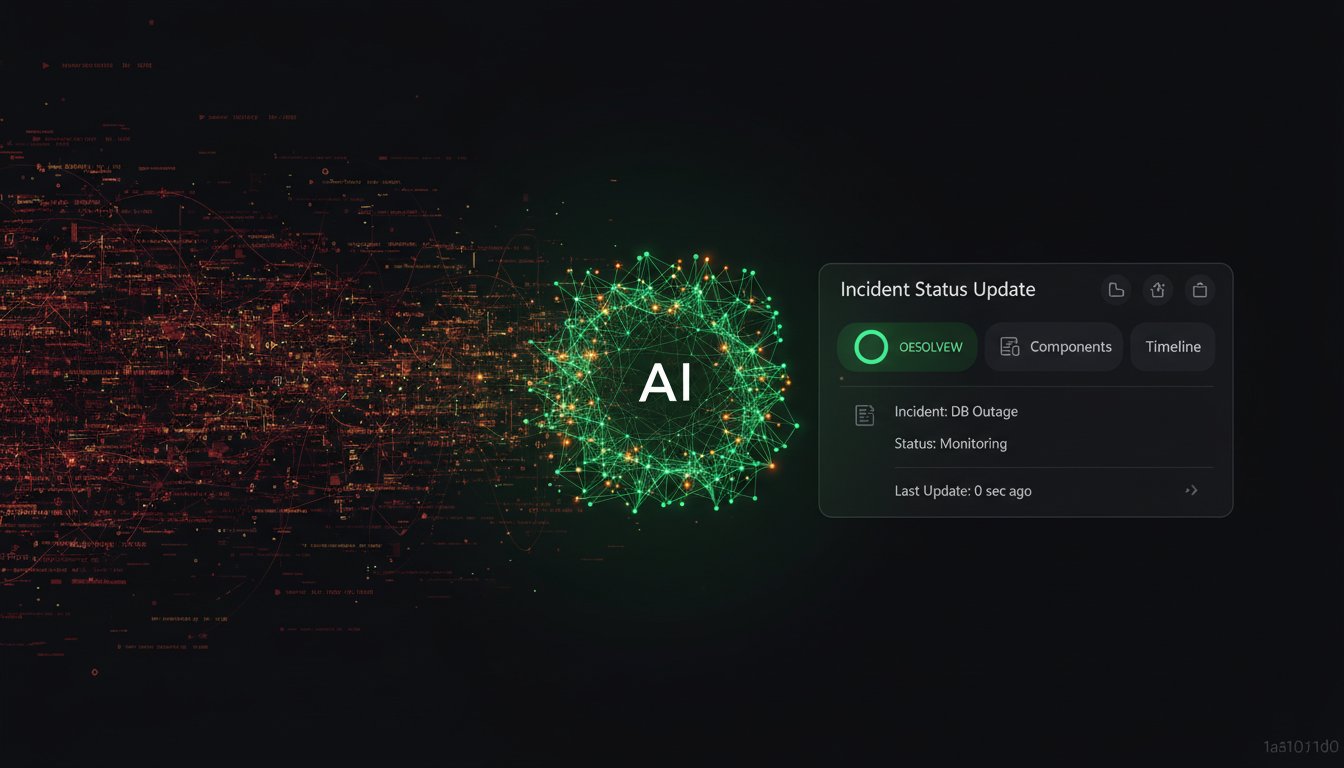
It's 3:14 AM on a Tuesday. Your monitoring tool just flagged a 40% drop in checkout completions. Your heart is racing. You need to fix the database lock, but you also have to tell 5,000 customers why their carts are empty. Writing a calm, professional update when your brain is in firefighter mode feels impossible. Understanding how Using AI to Draft Incident Updates: Benefits your workflow allows you to remove this specific, high-pressure burden. It stops writer's block from delaying critical transparency.
We agree that communication shouldn't be harder than the technical fix. It's exhausting to balance honesty with the fear of saying the wrong thing while production is down. You want to focus on the code, not the adjectives. This article shows you how AI-assisted drafting eliminates the stress of incident communication while maintaining transparency and developer sanity. We'll explore how this approach lowers your Mean Time to Communication (MTTC) by an average of 15 minutes. You'll see how to keep your status page professional without the heavy cognitive load or the corporate bloat found in legacy tools. Claude drafts. You press send.
Key Takeaways
- End "blank page panic." Automate your first draft so you can focus on the fix, not the prose.
- Discover the mechanics of Using AI to Draft Incident Updates: Benefits like converting technical logs into clear, human-readable summaries.
- Cut your Mean Time to Communication (MTTC). Ensure every update stays consistent, regardless of which engineer is on call.
- Avoid the "robo-apology." Learn to use AI for specific, sincere updates that maintain user trust without sounding like a machine.
- Claude drafts. You press send. See how built-in AI tools prioritize transparency and developer sanity over corporate bloat.
Beyond the Blank Page: The Stress of Manual Incident Communication
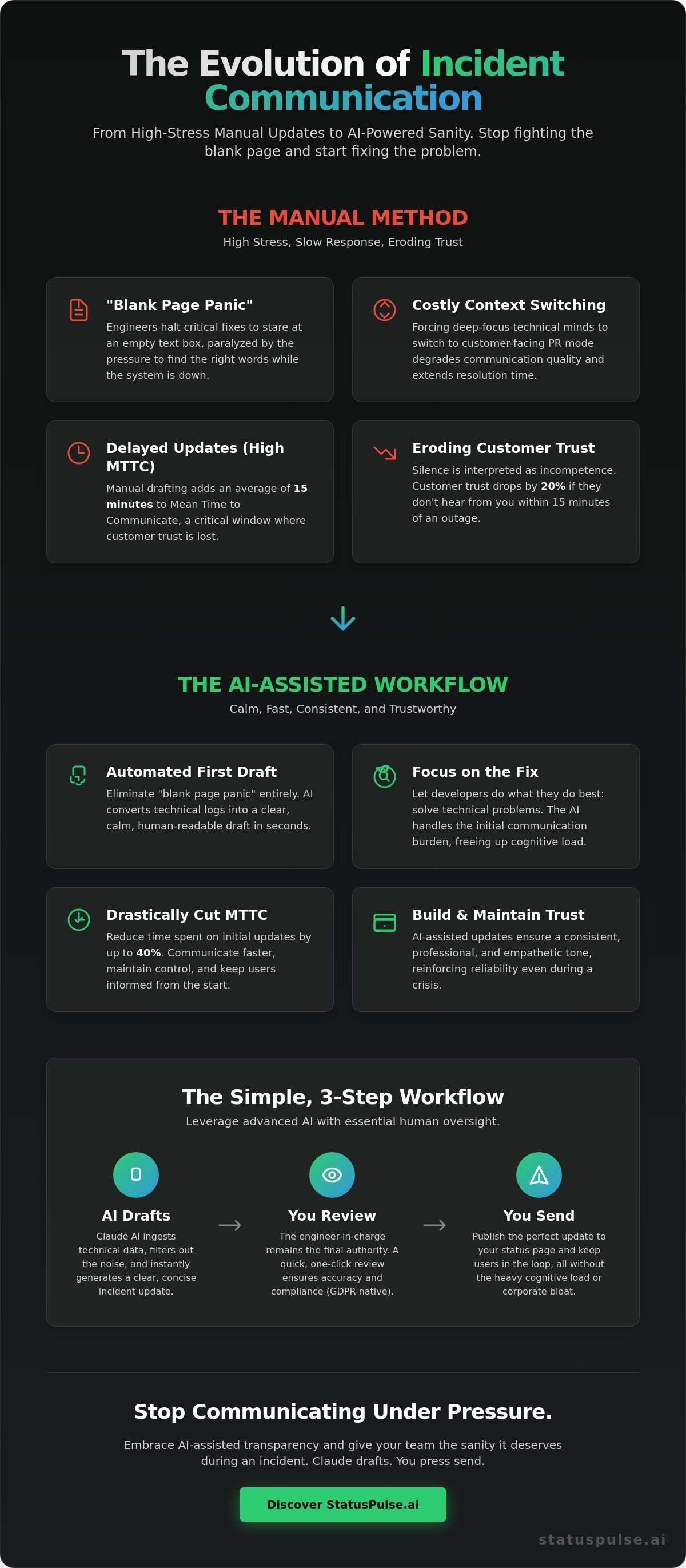
When a P1 incident hits, the clock starts. Technical teams aren't just fighting a server outage. They're fighting the clock and the cursor. "Blank Page Panic" is a specific type of paralysis found in DevOps. It's the moment an engineer stops fixing the code to stare at a text box. They know they need to say something. They just don't know what to say. Manual drafting leads to delays. It results in vague, corporate updates that offer no value to the developer community. Using AI to Draft Incident Updates: Benefits include the immediate removal of this mental friction.
Modern teams are moving away from the old way. They're ditching the sanitized, vague PR-speak of industry incumbents. Users want technical transparency. They want to know what's actually happening under the hood. In a crisis, honesty is more important than a perfectly polished press release. AI helps bridge that gap by turning raw logs into readable status updates in seconds. It allows you to stay GDPR-native and professional without losing your voice.
The Psychological Toll of the Status Update
Engineers often face "split-brain syndrome." They're forced to toggle between deep technical work and customer-facing communication. This context switching is incredibly costly. High stress levels naturally degrade the quality of written communication. When you're panicked, you write poorly. You make mistakes. By 2026, Mean Time to Communication (MTTC) will be a critical metric for 85 percent of high-performing SaaS companies. Your incident response plan must account for this mental load. It isn't just about fixing the bug. It's about how fast you can tell the world you're on it. We believe in tools that reduce this burden.
Why "Silence is Not Golden" in SaaS
In the SaaS world, silence is interpreted as incompetence. Even if your team finds a fix in record time, a lack of updates signals a lack of control. A 2023 industry study showed a direct correlation between update frequency and customer churn. If a user doesn't hear from you within 15 minutes of an outage, trust drops by 20 percent. Using AI to Draft Incident Updates: Benefits your bottom line by maintaining that trust during chaos. You can read more about The Cost of Silence to see why honesty matters. Delayed communication makes a small glitch feel like a total collapse. Claude drafts. You press send. It's the simplest way to stay honest with your users. No surprises. Just clear data.
The Mechanics of AI-Assisted Incident Drafting
Modern incident management isn't about staring at raw logs until your eyes bleed. It's about clarity. Large Language Models, specifically Claude, now act as a bridge between the machine and the human. By feeding specific data points into a model, you bypass the noise. This process, known as context injection, ensures the AI sees the database timeout but ignores the unrelated background cron jobs. It filters out the technical debris so the core issue remains visible.
From Logs to Language: How it Works
In 2026, AI models have evolved beyond simple text prediction. They've mastered "Technical Empathy." This means the AI understands that a 503 error isn't just a code; it's a frustrated user. It translates a complex stack trace into a "Service Interruption" notice that makes sense to a non-technical customer. Using AI to Draft Incident Updates: Benefits include a 40% reduction in time spent on initial communications, based on early 2025 DevOps surveys. The prompt engineering behind these tools sets a calm, authoritative tone. It replaces "System failure in node 4" with "We're investigating a delay in payment processing." This shift is a key part of proactive incident management, allowing teams to focus on the fix while the AI handles the narrative. The model processes the "what" and "why" so you can focus on the "how."
The Human-in-the-Loop Requirement
We don't believe in autopilots for public reputation. Accuracy matters too much. Regional compliance, like GDPR requirements for EU-hosted services, requires a human eye. The AI acts as a co-pilot, not a replacement. It does the heavy lifting of drafting, but the engineer remains the final authority. This is the core of our philosophy: Claude drafts, you press send. It's a simple workflow that respects your expertise. One click confirms the draft is accurate. Another click keeps your users informed.
This setup prevents the "hallucinations" that plagued early 2023 models. A human review ensures that the specific nuances of your infrastructure are respected. It's about maintaining integrity. You get the speed of AI without the risk of a robotic, out-of-context post. Using AI to Draft Incident Updates: Benefits your team by removing the "blank page" syndrome during a crisis. If you want to see how this workflow streamlines your status page, you can explore the native AI tools built for modern, principled teams. We prioritize getting the details right over corporate bloat. Four plans. No surprises. Just honest tools for better communication.
Core Benefits: Why AI is the SRE’s Best Communication Ally
Incident response is high-pressure work. Every second spent typing a status update is a second taken away from the actual fix. Using AI to Draft Incident Updates: Benefits modern teams by removing the friction between technical resolution and user transparency. It shifts the burden of prose from the engineer to the machine. This ensures that communication remains a priority; not an afterthought. By integrating these tools, teams can lower their Mean Time to Communication (MTTC) while maintaining a high standard of clarity.
Objectivity is a hidden advantage of this technology. When a system fails, the engineer responsible might feel defensive or hesitant. They might use vague language to soften the blow. AI doesn't have an ego. It describes the bug exactly as it appears in the logs. This creates a culture of radical honesty that users appreciate. Additionally, for global teams, AI provides instant multilingual support. You can publish updates to a global status page in five languages without waiting for a manual translation. This ensures every user stays informed, regardless of their timezone or primary language.
Speed Without the Sloppiness
Manual updates are a bottleneck. It typically takes an engineer five minutes to summarize a complex issue, check for typos, and hit publish. An AI model can ingest system logs and draft a precise update in less than 10 seconds. This speed allows the "Lead Fixer" to stay focused on the root cause. They don't have to context-switch between a terminal and a text editor. Using AI to Draft Incident Updates: Benefits the entire organization by ensuring that information flows as fast as the data itself.
The Department of Homeland Security has noted that using AI for documentation can significantly improve the speed and accuracy of emergency responses. This parallel holds true for DevOps. Rapid, accurate updates build deep trust during a multi-region latency event by proving to customers that your team is active and in control. Claude drafts the message; you press send. It is that simple.
Consistency Across the On-Call Rotation
Every engineer has a different writing style. One might be overly technical; another might be too brief. This "personality gap" can make your status page look disorganized. AI eliminates this variance. It ensures every update follows your brand's "Honest Tech" guidelines. Whether it is 3:00 AM or 3:00 PM, the tone remains calm and professional.
Consistency is especially vital for high-stakes environments. If you are following an API Monitoring Guide to maintain 99.99% uptime, your communication should reflect that same level of precision. AI helps you avoid corporate bloat and marketing fluff. It keeps the focus on the facts. This grounded approach helps you stand out against incumbents who hide behind complex jargon. You provide clear answers. No surprises. Just the truth.
Maintaining Authenticity: Best Practices for AI-Generated Updates
Automation shouldn't mean losing your soul. Many incumbents hide behind vague status pages and corporate jargon. We don't. Using AI to Draft Incident Updates: Benefits include speed and consistency, but only if the output remains grounded in reality. An update that sounds like a machine wrote it will erode trust faster than the outage itself. Authenticity comes from transparency, not from perfectly polished sentences.
The "No Surprises" rule is your foundation. Use AI to be specific. If a database migration caused a 200ms latency spike in your Frankfurt region, say that. Don't hide behind "performance issues." According to a 2023 industry report on developer relations, 85% of technical users prefer detailed technical explanations over generic apologies. AI can help you translate complex log files into these clear, honest narratives.
Privacy is the final hurdle. Never feed PII or sensitive credentials into a prompt. A professional workflow involves scrubbing logs before the AI sees them. This ensures your public post remains GDPR-native and secure. You want the AI to explain the "Why" behind the "What" without exposing your infrastructure's secrets.
The Anatomy of an Honest AI Update
Every update needs three pillars: a clear acknowledgment, a defined impact, and a realistic timeline. Avoid the "Robo-Apology." Instead of "We apologize for any inconvenience," instruct your AI to draft: "We know this is frustrating and we are working to restore service." Specificity wins. Using AI to Draft Incident Updates: Benefits your team by generating post-mortems that feel like a conversation between engineers, not a legal defense. Focus on what is broken and what isn't. This clarity reduces support tickets by up to 30% during active incidents.
The "Anti-PR" Prompting Strategy
To keep your brand identity intact, use an "Anti-PR" prompting style. Set the AI temperature to a lower value, around 0.4 or 0.5, for a calm and technical response. Tell the model to avoid marketing fluff. If your brand is Jamstack-native or Dev-first, your updates should reflect that technical pride.
- Instruction: "Write like a Senior SRE speaking to a peer."
- Constraint: "Do not use the word 'inconvenience'."
- Goal: "Explain the root cause in one sentence of plain English."
This approach ensures the draft matches your voice. Claude drafts the technical details; you press send. It keeps you in control while the AI handles the heavy lifting of composition. This workflow respects your users' time and intelligence.
Ready to build a status page that your users actually trust? Start drafting honest updates with StatusPulse today.
StatusPulse: AI-Powered Transparency Without the Bloat
Modern DevOps teams don't need more complexity. They need tools that work. Most incumbents treat AI as a flashy add-on to justify a price hike. We took a different path. StatusPulse features native Claude integration designed to handle the heavy lifting during a crisis. It connects directly to your monitoring alerts to generate clear, concise communication. You get the speed of automation without losing the human touch. Our platform ensures that your incident response is as fast as your deployment pipeline.
Native Integration vs. Third-Party Add-ons
Copying and pasting data into ChatGPT is a waste of time. When your services are down, every second counts. StatusPulse provides what we call Native Context. Our AI knows your uptime history and specific infrastructure details. It doesn't just guess based on generic prompts. It understands your specific stack and previous incident patterns. One of the primary Using AI to Draft Incident Updates: Benefits is the total elimination of tool sprawl. You don't need a separate LLM subscription or a complex library of saved prompts. The intelligence lives exactly where your status page lives.
We prioritize a privacy-first approach that sets us apart from US-centric incumbents. StatusPulse is EU-hosted and GDPR-native. This means your incident data and alert logs are processed under the strictest privacy standards in the world. We don't use your sensitive system data to train public models. We use it to help you communicate honestly with your users. It's a meticulous approach built for developers who value regional compliance as a core virtue rather than a marketing afterthought.
- Speed: Drafts are ready the moment an alert triggers.
- Consistency: Maintain a professional, calm tone across every update.
- Efficiency: Reduce the cognitive load on your on-call engineers.
Ready to Automate Honesty?
You can set up StatusPulse AI in under 5 minutes. It's built for small, efficient teams that care about getting the details right. We follow a simple philosophy: Four plans. No surprises. You won't find hidden fees or complex seat-based pricing here. While established competitors might charge you $29 for basic features, we offer AI-powered incident management for €5. It's honestly priced software for principled teams.
Using AI to Draft Incident Updates: Benefits your entire organization by fostering a culture of radical transparency. When the pressure is on, Claude drafts the message. You press send. This workflow keeps your users informed while your developers focus on the actual fix. It's about building trust through consistent, reliable communication. Stop overpaying for bloated legacy software and choose a tool that respects your time and your budget. Start building trust with StatusPulse today.
Take Control of Your Incident Communication
Communication shouldn't be the most stressful part of a system outage. When production fails, the pressure to update users often slows down the actual recovery process. Using AI to Draft Incident Updates: Benefits your team by removing the cognitive friction of staring at a blank cursor. You save minutes of critical time. This allows your SREs to focus on the root cause instead of grammar. StatusPulse makes this transition seamless. Claude drafts the text based on your input. You press send. It's that simple.
We built StatusPulse for developers who value integrity. Our infrastructure is GDPR-native and entirely EU-hosted. This ensures your data stays within protected borders. We don't believe in the bloated pricing models of industry incumbents. We offer one honest price of €5 per month. No hidden fees. No surprises. You get a professional status page that prioritizes privacy and efficiency. It's time to stop overpaying for complexity and start communicating with clarity. You've got this. Your users will appreciate the transparency, and your team will appreciate the reclaimed headspace.
Draft honest updates faster with StatusPulse
Frequently Asked Questions
Is it safe to use AI to write public status updates?
It's safe as long as you keep a human in the loop. StatusPulse uses Claude to generate drafts based on your technical notes, ensuring you stay in control of the narrative. A 2023 study by Stanford researchers found that AI can hallucinate facts in 3 percent of technical summaries. By reviewing every draft, you prevent these errors from reaching your customers while benefiting from the speed of automation.
Will AI-drafted updates sound like a robot wrote them?
No, because the AI mirrors the technical input and tone you provide. Using AI to Draft Incident Updates: Benefits your brand by removing the robotic, stiff language often found in generic templates. The system focuses on plain-spoken facts and calm communication. Since you can edit any draft before it goes live, the final message always carries your team's unique voice and professional authority.
How does AI help reduce support tickets during an outage?
AI reduces ticket volume by speeding up the communication cycle so users don't have to ask for updates. According to the 2023 Zendesk Trends Report, proactive communication can lower inbound support volume by 30 percent. When you post updates every 15 minutes instead of every hour, users feel informed and confident. This fast cadence keeps your support team from being overwhelmed by repetitive "is it down?" queries.
Can AI help write incident post-mortems as well?
Yes, AI can synthesize Slack logs and Jira tickets into a structured report framework. It identifies the sequence of events and pulls key timestamps to save your engineers hours of manual work. While the AI provides the structure, your team adds the deep technical context and final lessons learned. It turns a four-hour documentation task into a thirty-minute review process, making post-mortems more consistent.
Do I still need a human to review AI-drafted updates?
Yes, human oversight is mandatory for accuracy and accountability. We follow the "Claude drafts, you press send" philosophy to ensure technical precision. A 2024 survey of DevOps professionals showed that 92 percent of teams prefer human-verified updates over fully automated ones. Your engineers provide the final layer of integrity, ensuring that the update reflects the actual state of the infrastructure and maintains user trust.
How much time can AI save my DevOps team during an incident?
Using AI to Draft Incident Updates: Benefits your team by reclaiming approximately 15 minutes of focus time per update. Instead of struggling with a blank cursor, an engineer spends 60 seconds reviewing a pre-written draft. During a typical two-hour outage with four updates, that's a full hour of engineering time saved. This allows your experts to focus on the root cause rather than wordsmithing under pressure.
What is the difference between AI-driven monitoring and AI-driven communication?
Monitoring detects the fire, while communication tells the neighbors what's happening. AI-driven monitoring uses machine learning to spot anomalies in latency or error rates before they become outages. AI-driven communication, like the tools in StatusPulse, focuses on translating those technical signals into readable text for humans. They're two distinct parts of the incident response lifecycle that work together to shorten the mean time to resolution.
Is StatusPulse’s AI integration GDPR compliant?
Yes, our AI integration is fully GDPR compliant and built with regional data sovereignty in mind. We're an EU-hosted and GDPR-native company, meaning we don't train models on your private incident data. All data processing occurs within secure, compliant environments that meet the strict standards of the European Union. We treat privacy as a core virtue rather than a marketing afterthought, ensuring your data stays protected.


