

The most expensive status page won't keep your servers online; it just makes the outage more expensive. For a growing SaaS, paying a high monthly enterprise tax for a tool that still requires manual updates is a distraction you don't need. In 2024, you deserve a system that works while you're busy fixing the actual code. This guide evaluates Atlassian Statuspage vs Instatus vs StatusPulse: Which One Fits a SaaS Under $10K MRR? to help you avoid the bloat typical of industry incumbents. Four plans. No surprises.
We know the struggle of managing a growing product. You want to be honest with your users, but you don't want to manage three different monitoring tools just to send one incident update. We'll show you how to get automated monitoring and AI assisted communication without the corporate headache. You'll learn how to move from manual stress to a workflow where Claude drafts the update and you simply press send. We are breaking down the Jamstack reliability, regional compliance, and honest pricing of these three options to find your perfect fit. It's time for a status page that respects your time and your budget.
Key Takeaways
- Stop paying the "enterprise tax" for bloated features. Learn how honest pricing and simple plans keep your margins healthy while you scale.
- Compare Atlassian Statuspage vs Instatus vs StatusPulse: Which One Fits a SaaS Under $10K MRR? to find the perfect balance of automation and simplicity.
- Evaluate the power of native monitoring. Discover why integrated status checks are more reliable than relying on manual updates or expensive third-party triggers.
- Future-proof your brand with regional compliance. Understand why being EU-hosted and GDPR-native is a vital competitive advantage for global SaaS teams.
The Status Page Dilemma for Growing SaaS Teams
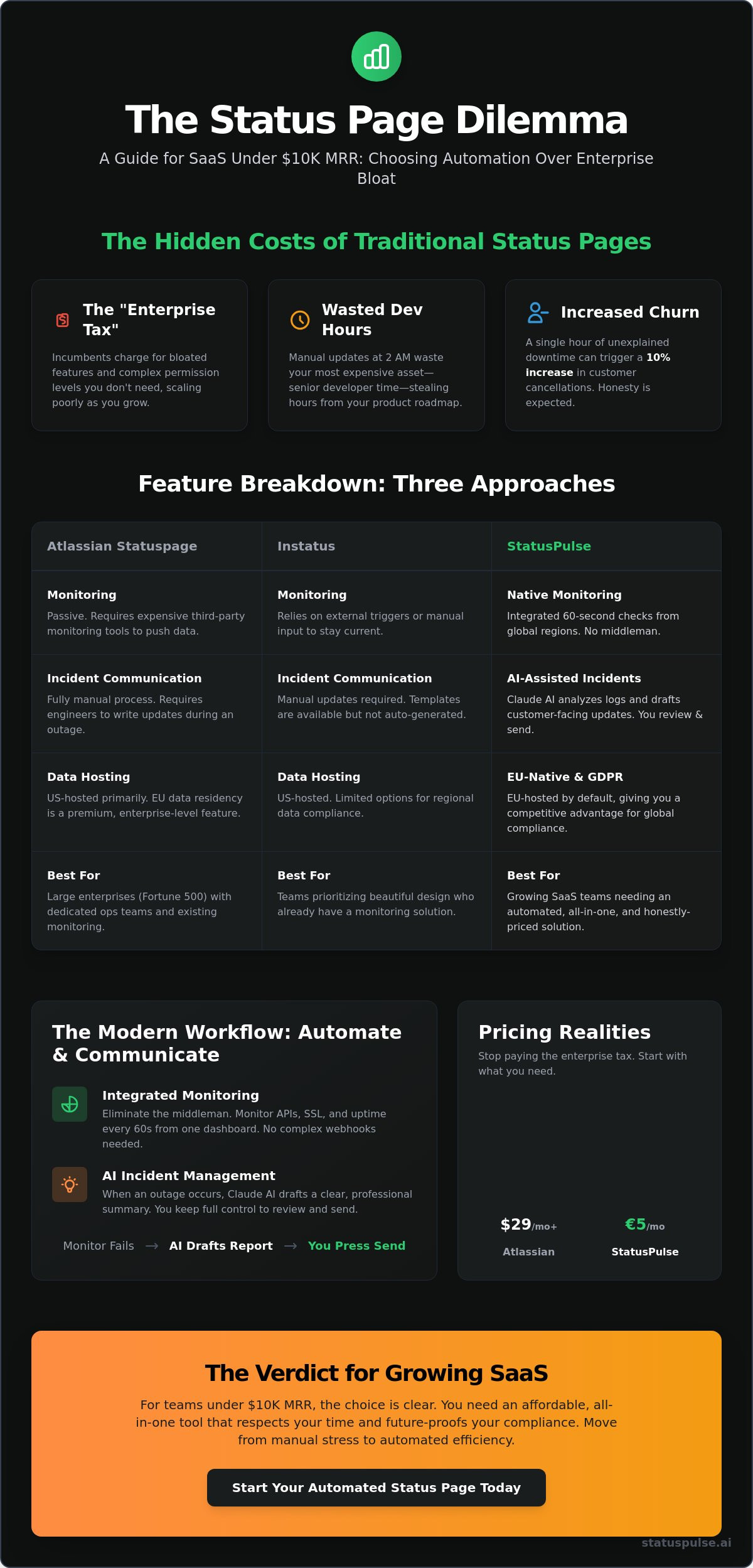
Transparency is your best defense against churn. For a SaaS under $10K MRR, a single hour of unexplained downtime can trigger a 10% increase in cancellations according to recent industry surveys. Customers don't expect perfection. They expect honesty. This reality sits at the heart of the Atlassian Statuspage vs Instatus vs StatusPulse: Which One Fits a SaaS Under $10K MRR? debate.
The incumbents built their tools for the Fortune 500. You get complex permission levels and enterprise pricing that scales poorly. You don't need corporate bloat yet. You need a tool that works without a sales call. StatusPulse represents a new era for small teams. It is honestly priced and focuses on essentials. No surprises. Just a reliable way to tell your users what is happening when things go wrong.
Why "Free" Plans Usually Aren't Enough
Entry-level tiers are designed to be outgrown. Atlassian limits their free plan to 100 subscribers and two team members. These numbers look fine on day one. By day 90, they become a bottleneck. Most free versions also strip away custom branding. Your status page ends up looking like a generic template. This hurts your professional image when you are trying to prove your reliability to early adopters.
Independence is another critical factor. Your status page should live on a separate infrastructure. If your primary cloud provider fails, your status page must remain online. StatusPulse uses a multi-region Jamstack architecture to ensure 100% uptime. This is a technical standard that many free tiers from incumbents ignore. Four plans. No surprises. You get the professional features you need to stay credible.
The Hidden Cost of Manual Updates
Manual work is the enemy of growth. A server outage at 2 AM is stressful enough. Forcing a developer to manually update a page and send emails is a waste of resources. Senior developer time is your most expensive asset. In 2024, every hour spent on manual status updates is an hour stolen from your product roadmap.
Automation shifts the burden. It ensures you meet your service-level agreement without manual intervention. When a monitor fails, the system reacts. Claude drafts the incident report. You press send. This efficiency is vital when you are balancing product development with customer support. Choosing the right tool in the Atlassian Statuspage vs Instatus vs StatusPulse: Which One Fits a SaaS Under $10K MRR? comparison means choosing a tool that respects your time. Check out StatusPulse for a more streamlined approach to incident communication.
Feature Breakdown: Native Monitoring vs. Manual Updates
Choosing between Atlassian Statuspage vs Instatus vs StatusPulse: Which One Fits a SaaS Under $10K MRR? often comes down to how much "glue" you want to manage. Atlassian Statuspage is the heavy incumbent. It's powerful; however, it acts as a passive receiver. You must pay for and configure third-party monitoring tools to push data to it. For a small team, this is another point of failure and another subscription to track.
Instatus offers beautiful pages. It's a massive step up from manual HTML pages. Yet, it still largely relies on external triggers or manual input to stay current. If your monitoring tool fails, your status page stays green while your app is down. StatusPulse takes a different path by building uptime monitoring directly into the core product. It's a native experience designed to reduce your mental overhead.
The Power of Integrated Uptime Checks
Managing a separate monitoring tool creates a middleman problem. You pay two bills. You manage two sets of configurations. StatusPulse eliminates this by checking your services every 60 seconds from multiple global regions. This isn't a premium add-on; it's the standard. You can monitor SSL certificates and specific API endpoints within the same dashboard. This unified view ensures that when your certificate expires or an endpoint returns a 500 error, your status page knows instantly. No webhooks required. No delays. Just honest data.
- Eliminate the middleman tool between your server and your status page.
- 1-minute check intervals come standard to ensure high-frequency accuracy.
- Monitor SSL certificates and APIs in the same dashboard for total visibility.
AI Incident Management: Claude Drafts, You Send
The worst part of an outage isn't the code. It's the communication. When your server is down at 2:00 AM, writing a calm, professional update is difficult. The psychological barrier is real. StatusPulse uses AI to bridge this gap. It analyzes your technical logs and drafts a customer-facing summary in seconds.
The philosophy is simple: Claude drafts, you press send. You keep human agency. The AI doesn't post automatically; it simply removes the blank page problem. It translates complex server errors into clear language your customers actually understand. For a SaaS under $10K MRR, this saves precious minutes during a crisis. You focus on the fix; the AI handles the draft. It's efficient. It's straightforward. If you want a tool that actually helps during an outage, see how StatusPulse simplifies incident communication for small teams.
This approach respects your time. It understands that you are likely a small team, perhaps even a solo founder, who can't afford to spend twenty minutes crafting a perfect status update while your database is locked. You stay in control. The AI does the heavy lifting. No fluff. No corporate bloat. Just the facts, delivered fast.
Pricing Realities: €5 vs. $29 and Beyond
For a SaaS founder earning under $10K MRR, every subscription is a trade-off. You need professional tools, but you cannot afford the "Enterprise tax" that incumbents demand. Atlassian Statuspage starts at $29 per month for its first paid tier. Instatus sits at $20 per month for a Pro page. StatusPulse takes a different path. We offer four plans. No surprises. Our entry point is €5 per month. It is honestly priced because we believe reliability shouldn't be a luxury for small teams.
Total Cost of Ownership (TCO) Comparison
The sticker price is rarely the final price. To run a professional operation, you need a status page, an uptime monitor, and an SSL checker. With many competitors, these are separate costs. You pay for the page, then you pay another $10 or $20 for a monitoring service. StatusPulse includes native monitoring and SSL checks in its base price. This consolidation simplifies your stack and your billing.
When evaluating Atlassian Statuspage vs Instatus vs StatusPulse: Which One Fits a SaaS Under $10K MRR?, look at the subscriber limits. Atlassian often charges more as your audience grows. By choosing StatusPulse over Atlassian for a 500-subscriber list, a small SaaS saves approximately $280 every year while maintaining the same level of professional communication. That is capital better spent on your product or customer acquisition.
- Atlassian: High entry cost, complex tiers, and subscriber overages.
- Instatus: Simple pricing, but often requires external monitoring tools for full automation.
- StatusPulse: Flat €5 entry, native monitoring included, and zero hidden fees.
Transparency in Billing
Viral growth should be a celebration, not a cause for a surprise bill. We prioritize "Honestly Priced" as a core value. We don't hide extra costs in the fine print. For European tech startups, StatusPulse offers the added benefit of EU-based billing. This means your invoices are GDPR-compliant and your data stays within the region. It is a principled approach to software that respects your privacy and your budget.
The ROI of a status page for a $10K MRR business is found in the time you save. Every minute you spend answering "Is the site down?" is a minute you aren't building features. Atlassian Statuspage vs Instatus vs StatusPulse: Which One Fits a SaaS Under $10K MRR? comes down to value. You want a tool that works quietly in the background without draining your runway. StatusPulse delivers that quiet confidence for the price of a coffee. €5, not $29. It is that simple.
Regional Compliance: Why EU Hosting Matters in 2026
Privacy isn't a marketing buzzword. By 2026, it's a baseline requirement for any SaaS aiming for global reach. When comparing Atlassian Statuspage vs Instatus vs StatusPulse: Which One Fits a SaaS Under $10K MRR?, the location of your servers carries heavy legal weight. Most incumbents rely on US-centric infrastructure. This forces you into a maze of data processing agreements and legal uncertainty. We built StatusPulse differently. It's EU-hosted. It's GDPR-native. It's built for founders who value their users' digital rights.
Choosing a European provider isn't just about avoiding fines. It's a competitive advantage. Your customers care about where their email addresses and phone numbers live. When you use a privacy-first tool, you signal that you're a responsible steward of their data. This builds trust faster than any flashy feature list ever could. It's about integrity. It's about being honest with your users about their data footprint.
GDPR and Data Residency
Where is your subscriber data actually stored? Many tools claim compliance while routing traffic through US servers. StatusPulse keeps your data within the EU. This eliminates the need for complex legal gymnastics. We use a multi-region setup to ensure low latency and high availability. If one node fails, your status page stays online. You get compliance without the headache. It's simple, secure, and ready for the 2026 regulatory shift that Gartner predicts will cover 75% of the world's population.
Building a Principled Tech Stack
Your tech stack reflects your values. Supporting independent software over corporate incumbents is a choice. It's a move toward a more ethical web. StatusPulse is built by a small team that obsesses over the details. We don't have a board of directors to please. We only have you. For a deeper look at maintaining high availability while staying lean, check out our API monitoring guide. It covers the technical depth needed for modern systems.
The decision in the Atlassian Statuspage vs Instatus vs StatusPulse: Which One Fits a SaaS Under $10K MRR? debate often settles on ethics. Do you want to fund a giant corporation or a team that shares your developer DNA? We choose the latter. We value privacy as a core virtue, not a marketing afterthought. No bloat. No legal surprises. Just a status page that works and respects the law.
Ready to host your status page on infrastructure that respects privacy? Start your EU-hosted status page today.
Verdict: Which Tool Fits Your SaaS Stage?
Choosing a status page is about more than just a public URL. It's about how you handle pressure. In the comparison of Atlassian Statuspage vs Instatus vs StatusPulse: Which One Fits a SaaS Under $10K MRR?, the right choice depends on your current stack and your values. You need a tool that scales with you without adding technical debt or administrative overhead.
Select Atlassian Statuspage if you are already locked into the Jira and Opsgenie ecosystem. Large teams with complex enterprise requirements often choose this path because they already pay for the full suite. Choose Instatus if you only need a UI layer. It works well if you have dedicated external monitoring and just need a place to display those results. It's a specialized tool for a specific visual need that requires you to bring your own data.
For the $10K MRR founder, StatusPulse is the clear winner. It offers integrated, AI-powered reliability. It's honestly priced. You don't have to stitch together multiple tools or worry about "active subscriber" limits that punish your growth. We built this for those who value their time and their customers' trust. It's a complete solution that monitors your services and communicates with your users from a single dashboard.
The "Small Team" Advantage
Small teams move faster. At StatusPulse, we provide personalized support that bypasses the typical enterprise ticket queues. You don't wait days for a response from a faceless department. Our feature releases happen quickly. We listen to real developer feedback to improve the product every week. This makes StatusPulse the native choice for modern Jamstack apps. We focus on the details that matter, like multi-region monitoring and GDPR-native hosting. We are a small team that cares about getting things right for other builders.
Getting Started Without the Bloat
Efficiency is our core principle. You can complete your setup in under 5 minutes. This isn't a marketing claim; it's a promise. We help you transition from manual, stressful status updates to automated peace of mind. When a server goes down, the system detects it immediately. Claude drafts the incident report. You press send. This workflow keeps you in control while removing the friction of technical writing during a crisis. It's a streamlined approach for founders who have better things to do than manage complex status software.
Build Trust Without the Corporate Bloat
Choosing the right communication tool shouldn't feel like a compromise between your budget and your integrity. The comparison of Atlassian Statuspage vs Instatus vs StatusPulse: Which One Fits a SaaS Under $10K MRR? reveals a clear divide. Incumbents often trap small teams with complex tiers that start at $29 or more. You need a system that respects your margins while meeting the strict regional requirements of the 2026 EU hosting landscape. Reliability shouldn't be a luxury.
StatusPulse offers a principled alternative for developers who value precision. Our platform includes integrated uptime and API monitoring to catch issues before your users do. When incidents happen, Claude drafts the update; you press send. It's a streamlined workflow that keeps you focused on building, not managing crises. You get a GDPR-native, EU-hosted solution that's honestly priced. No surprises. Just a clear window into your system's health.
Start your honest status page for €5/month
Your team deserves a tool that grows with you. Let's keep your uptime visible and your users informed.
Frequently Asked Questions
Is Atlassian Statuspage too expensive for a small SaaS?
Yes, Atlassian Statuspage is often cost prohibitive for companies with less than $10,000 in monthly revenue. Their standard plan starts at $99 per month. This represents a full 1% of your gross revenue just for a status page. When evaluating Atlassian Statuspage vs Instatus vs StatusPulse: Which One Fits a SaaS Under $10K MRR?, it's clear that incumbents favor enterprise budgets. Small teams need honest pricing, not expensive corporate bloat.
Does Instatus include uptime monitoring?
Instatus primarily functions as a status page and often requires third party tools like Better Stack for actual monitoring. While they've added basic checks, many users find they still need two separate subscriptions. StatusPulse solves this by offering native, multi region monitoring built directly into the core product. You get 60 second check intervals from 3 global locations. This setup eliminates the complexity of managing multiple API keys and invoices.
How does StatusPulse compare to Uptime Robot?
Uptime Robot is a dedicated monitoring tool, whereas StatusPulse is a unified platform for both monitoring and incident communication. Uptime Robot's free tier limits you to 5 minute intervals. StatusPulse provides 1 minute intervals as a standard to ensure you're the first to know about a crash. We provide a Jamstack status page that stays online even if your primary infrastructure fails. It's a more resilient choice for developers.
Can I use StatusPulse for SSL certificate monitoring?
Yes, StatusPulse monitors your SSL certificates automatically to prevent 40% of common downtime causes. The system tracks your certificate validity and sends alerts 7 days, 3 days, and 24 hours before expiration. These three distinct stages give your team ample time to renew. It's a native feature designed to replace manual calendar reminders. You can manage your certificates and your status page from a single, quiet dashboard.
Is StatusPulse GDPR compliant for EU users?
StatusPulse is GDPR native and 100% hosted on German servers. We don't use US based sub processors for your data, which satisfies the strict requirements of the Schrems II ruling. Many incumbents host data in US regions, creating legal friction for European SaaS companies. We built our infrastructure in the EU to prioritize regional data sovereignty. It's a principled choice for founders who value privacy and legal compliance.
What is AI incident management and how does it work?
AI incident management uses large language models to draft professional updates during high pressure outages. StatusPulse integrates Claude to analyze your technical logs and suggest clear language for your users. Claude drafts the update, then you press send. This process reduces the cognitive load on your engineers during a crisis. It ensures your customers receive calm, accurate information while your team focuses on the actual fix.
Can I migrate my existing status page to StatusPulse easily?
Migration takes less than 5 minutes using our automated import tools. You can bring over your existing components and subscriber lists from Atlassian or Instatus without losing any historical data. When considering Atlassian Statuspage vs Instatus vs StatusPulse: Which One Fits a SaaS Under $10K MRR?, ease of transition is a major factor. Our team handles the technical heavy lifting so your monitoring remains continuous during the switch.


