

A single misconfigured edge node can quietly break dozens of production subdomains while your certificate authority dashboard insists everything is fine. Wildcard certificates simplify infrastructure, but they also consolidate risk into a single failure domain. Now that public certificate validity is capped at 200 days, renewal cycles run twice as fast, multiplying the chances of silent deployment drift. Reliable wildcard SSL certificate monitoring can't rely on static expiration trackers; it must inspect live handshakes across every endpoint where your traffic terminates.
You shouldn't need an enterprise CLM deployment that takes months of setup and opaque per-seat pricing just to catch a broken intermediate chain. You will learn how to evaluate dedicated monitoring solutions that verify live certificates without adding unnecessary software bloat to your stack. We will cover technical evaluation criteria, compare dedicated monitors against legacy enterprise tools, and establish a clear alert framework for production edge infrastructure.
Key Takeaways
- Effective wildcard SSL certificate monitoring requires synthetic TLS handshake verification across every terminating endpoint, not just checking the root domain expiration date.
- Granular alert schedules at 30, 14, 7, and 1-day intervals catch broken intermediate chains and edge configuration drift before certificates expire.
- Dedicated monitoring tools provide actionable visibility without the multi-month onboarding cycles and opaque per-seat pricing of legacy enterprise CLM suites.
- Auditing wildcard coverage requires inventorying third-party CDN distributions, cloud ingress controllers, and internal reverse proxies where keys are duplicated.
- Unifying certificate checks with uptime monitoring and public status pages prevents tool sprawl and keeps stakeholders informed during renewal incidents.
What Is Wildcard SSL Certificate Monitoring and Why Does It Differ?
Wildcard SSL certificate monitoring is the continuous verification of live TLS handshakes across every active subdomain and terminating endpoint using a shared certificate. A standard certificate binds to an explicit fully qualified domain name. In contrast, an RFC-compliant wildcard certificate uses an asterisk (*.example.com) to secure an entire tier of subdomains under a single public key pair.
This design creates an architectural tradeoff: operational convenience in exchange for a centralized point of failure. If a single-domain certificate expires, one web property drops offline. If a wildcard certificate expires, your primary API, documentation portal, customer dashboard, and internal tooling fail simultaneously. Checking only your root apex domain misses failures on edge nodes where subdomains terminate independently.
The Mechanics of Wildcard Certificate Failure
Wildcard failures rarely strike an entire architecture at the exact same second. Content delivery networks, cloud load balancers, and regional origins cache TLS sessions and certificates differently. When an automated renewal executes, edge nodes often update out of sequence, leaving stale certificates serving traffic in isolated regions.
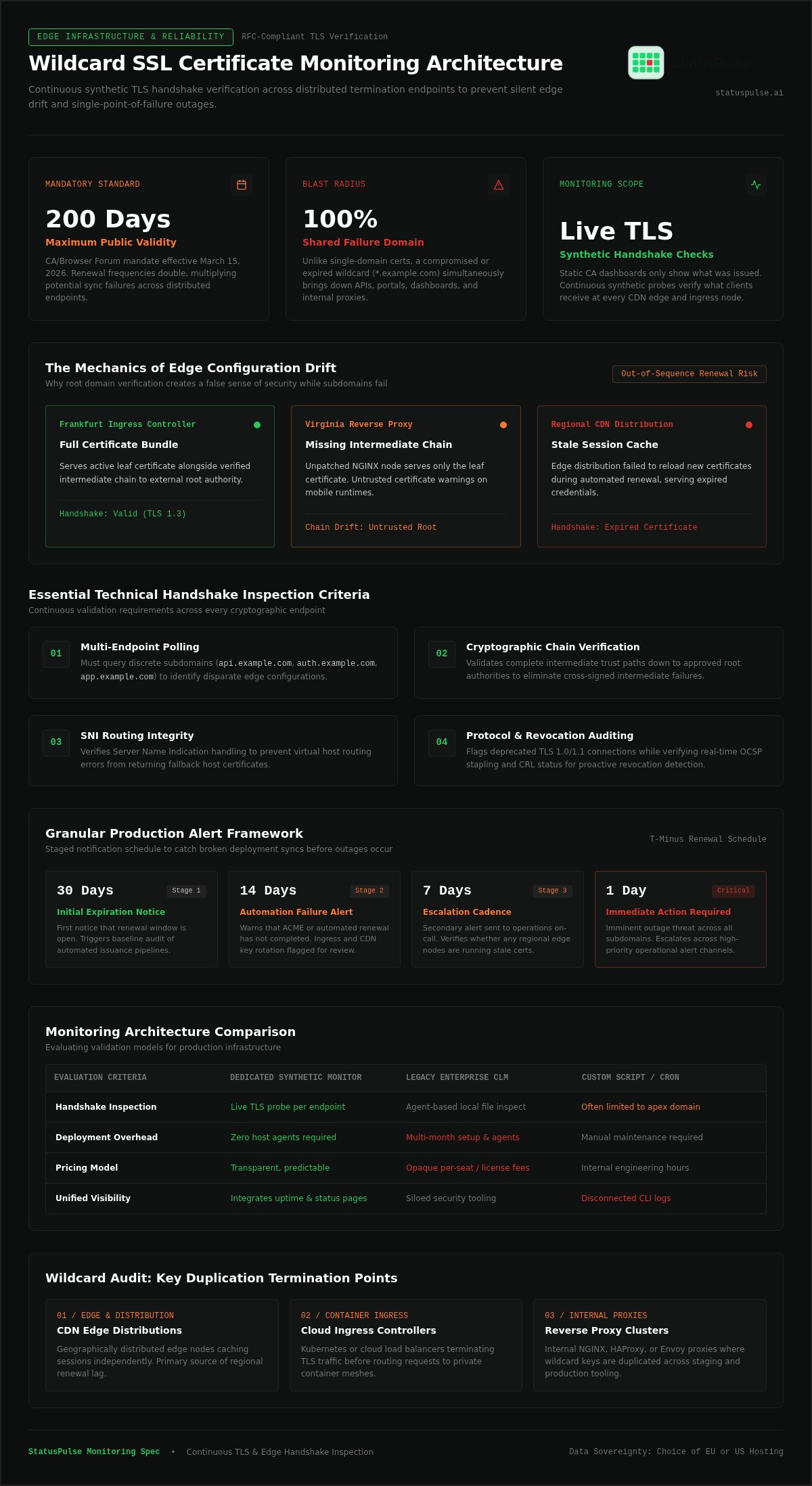
Configuration drift also breaks intermediate chains. An ingress controller in Frankfurt might serve the complete certificate bundle, while an unpatched NGINX proxy in Virginia serves only the leaf certificate. Because the CA/Browser Forum reduced public certificate validity to 200 days as of March 15, 2026, teams must now run renewals twice as often. This tight turnaround turns small deployment sync gaps into active customer-facing outages.
Wildcard Monitoring vs Single-Domain Tracking
Single-domain monitoring is straightforward. A probe queries one IP, executes a handshake, and tracks the leaf certificate's remaining days. Wildcard monitoring requires distributed validation across dynamic infrastructure.
- Multi-Endpoint Polling: Probes must query distinct subdomains (
api.example.com,auth.example.com,app.example.com) to verify that background deployments haven't drifted. - SNI Routing Integrity: Server Name Indication (SNI) routing rules can route traffic to a fallback host serving an incorrect certificate if the virtual host configuration contains typos.
- Chain Verification: Validation checks must crawl the full chain to an approved root authority from external vantage points, preventing cross-signed intermediate failures on mobile or legacy clients.
Comprehensive wildcard SSL certificate monitoring treats every subdomain as a distinct cryptographic endpoint. Tracking the asset at your certificate authority tells you what was issued. Validating the live handshake tells you what your users actually receive.
Essential Technical Criteria for Evaluating Wildcard Monitoring Tools
Evaluating tools for wildcard SSL certificate monitoring requires prioritizing external verification over internal agents. Legacy IT suites force you to install proprietary software on every host. Modern teams instead require external, multi-region synthetic probes that simulate authentic client requests against edge load balancers, CDN distributions, and container ingress controllers.
Security agencies have documented the architectural dangers of wildcard certificates, particularly how compromised private keys or misrouted protocols impact multiple services. Synthetic monitoring acts as a continuous sanity check against these vulnerabilities from the public internet.
Handshake Verification and Chain Inspection
A capable monitor does not stop at expiration dates. It must validate the entire certificate chain down to trusted root authorities, identifying missing cross-signed intermediates that break trust on mobile runtimes.
- Protocol and Cipher Auditing: The engine must flag deprecated TLS 1.0 or 1.1 handshakes, ensuring traffic stays on modern TLS 1.2 or TLS 1.3 standards.
- Revocation Status: Real-time checks must parse OCSP stapling responses and CRL endpoints to detect revoked certificates before browser warnings display.
- SAN Coverage: Handshake probes must confirm that requested hostnames match the Subject Alternative Name attributes configured on the active cert.
Alerting Precision and Escalation Logic
Alert fatigue quickly renders monitoring useless. Your evaluation framework must prioritize tools with staged notification intervals, escalating at fixed thresholds like 30, 14, 7, and 1-day marks. When an outage is 24 hours away, the monitor should route critical alerts directly to on-call rotations via webhooks, Slack, or SMS rather than burying them in team email threads.
Hosting Location and Data Sovereignty
For organizations operating under European regulatory standards or US federal frameworks, where your telemetry lives matters. Monitoring systems should offer a clean choice between EU or US data hosting. This ensures synthetic check logs, endpoint metadata, and operational reports comply with regional governance models without exposing uptime records to untracked third parties.
If you prefer a transparent platform that pairs external checks with operational status pages, evaluating StatusPulse gives your team focused handshake validation without enterprise pricing bloat.
Wildcard SSL Monitoring Architecture: SaaS vs Enterprise CLM vs Custom Scripts
Engineering teams face three architectural paths for tracking certificates: writing internal cron jobs, deploying enterprise Certificate Lifecycle Management (CLM) suites, or adopting dedicated SaaS monitors. Each model reflects distinct operational tradeoffs between direct maintenance costs, setup velocity, and cryptographic visibility. NIST outlines clear baseline discovery and inventory principles in their special publication on TLS Server Certificate Management, but translating those standards into production does not require sprawling enterprise software.
| Criterion | Custom In-House Scripts | Enterprise CLM Platforms | Dedicated SaaS Monitors |
|---|---|---|---|
| Setup Velocity | Hours to write initial wrapper | Months of onboarding and agents | Minutes via UI or basic API |
| Maintenance Overhead | High; ongoing dev maintenance | High; dedicated PKI operators | Zero infrastructure overhead |
| Reliability | Fragile; single-host blindspots | High across internal networks | High multi-region synthetic checks |
| Cost Model | Hidden in developer labor | High, often exceeding five figures annually | Flat, transparent subscription |
The Hidden Costs of In-House Cron Checks
Most internal monitors start as simple bash scripts wrapping OpenSSL s_client calls. They quickly show their limits in production environments.
Basic scripts rarely test modern SNI handshakes correctly across dynamic multi-cloud setups. When the host running your cron job runs out of memory or hits rate limits, alerting stops completely without an internal warning. Your engineers end up maintaining alert routing logic, parsing changing TLS cipher errors, and keeping webhook integrations alive instead of building your product.
Enterprise CLM vs Lightweight Monitoring Platforms
Enterprise CLM platforms suit complex environments managing private internal PKI roots, automated hardware security module deployments, and automated key generation workflows. If your organization provisions millions of internal machine identities across air-gapped data centers, full-scale CLM provides necessary governance.
For modern web stacks, these platforms bring massive operational baggage. They typically involve closed sales cycles, complex deployment agents, and per-seat or per-certificate licensing structures that penalize growth. A lightweight SaaS platform dedicated to wildcard SSL certificate monitoring gives development teams immediate visibility into customer-facing handshakes, intermediate trust integrity, and expiration timers without requiring custom infrastructure or dedicated PKI administrators.
Step-by-Step Implementation: Auditing and Monitoring Your Wildcard Domains
Implementing reliable wildcard SSL certificate monitoring requires mapping your infrastructure before configuring checks. Deploying probes blindly leaves legacy endpoints vulnerable. A methodical implementation eliminates monitoring gaps across cloud boundaries.
- Audit DNS zones and ingress assets: Query DNS zones to extract all active
CNAMEandArecords pointing to your wildcard domains. Include load balancers, CDN distributions, and Kubernetes ingress routers. - Map certificate distribution across providers: Document everywhere private keys live, including internal proxies and third-party SaaS services like customer support portals or API gateways.
- Configure synthetic handshake probes: Target discrete functional subdomains rather than just the apex host. Validate that every entry point returns an identical, unexpired certificate chain.
- Establish graduated alerting schedules: Configure notification rules to ping engineering channels at 30, 14, 7, and 1-day windows to prevent surprise renewal lapses.
- Tie monitors directly to incident response: Connect certificate alerts to your primary communication tooling so failed renewals instantly mobilize engineering teams.
Discovering Rogue and Untracked Endpoints
DNS records often hide decommissioned services that still terminate TLS handshakes. Querying certificate transparency logs via tools like crt.sh reveals auxiliary certificates obtained by separate teams. Unmonitored staging environments frequently share production wildcard keys, creating blind spots where expired local configurations escape notice.
Connecting Monitoring to Incident Communication
When a certificate expires, customers notice before your support inbox fills up. Fast communication preserves user trust. As detailed in our guide on the architecture of incident communication transparency, tying automated monitoring triggers directly to public status updates prevents operational confusion.
Pairing automated endpoint alerts with customer status notifications keeps support queues manageable during unexpected certificate rotation failures. For teams looking to unify endpoint checks and user alerts without enterprise bloat, you can monitor your wildcard infrastructure with StatusPulse to automate both handshake tracking and subscriber notifications.
Selecting the Right Monitoring Tool: Aligning Features with Team Size
Tool selection comes down to organizational complexity and deployment scale. Solo developers and small teams need fast setup and clear alerts without the burden of maintaining monitoring infrastructure. Growth-stage engineering teams manage dozens of dynamically routed subdomains across multiple cloud regions, requiring robust synthetic checks without punitive per-seat pricing. While giant enterprises with private CAs may require heavy PKI management suites, most agile engineering teams simply need dependable, external validation.
Fragmented observability creates operational delays. When TLS handshakes fail, troubleshooting across isolated dashboards wastes critical recovery minutes. Selecting a unified platform keeps your operational state clear and actionable during active incidents.
Eliminating Tool Fragmentation with Unified Monitoring
Managing certificates in isolation creates critical blind spots. A certificate error is fundamentally an availability incident. Pairing certificate validation directly with broader website availability monitoring ensures that your on-call engineers see both network reachability and cryptographic health in one place.
Similarly, connecting handshake verification with active api monitoring confirms that token exchanges and secure webhooks aren't quietly failing on edge nodes due to outdated intermediate bundles. Consolidating these checks prevents alert fatigue and spares your team from paying multiple vendor subscriptions for overlapping network telemetry.
StatusPulse: Practical SSL Monitoring for Engineering Teams
StatusPulse delivers a focused observability model built for modern development teams. The platform provides continuous synthetic checks for wildcard SSL certificate monitoring alongside comprehensive uptime and API health tracking. You get immediate visibility into leaf expirations, intermediate trust chains, and regional handshake drift without enterprise configuration overhead.
When an edge node serves an invalid certificate, alerts route directly to your team's incident workflow. From there, native status pages with AI-assisted update drafting let engineers communicate transparently with impacted users in seconds. To support data sovereignty requirements, teams can choose between EU or US cloud hosting. Built with transparent flat pricing that eliminates per-seat and per-subscriber fees, StatusPulse provides unified monitoring and status pages designed to keep your infrastructure reliable without bloated software contracts.
Build Resilient Edge Infrastructure Beyond Expiration Dates
Managing wildcard certificates across dozens of dynamic hosts requires active handshake verification rather than passive calendar alerts. Rapid renewal cycles make manual tracking untenable, but heavyweight enterprise suites add unnecessary operational debt. Effective wildcard SSL certificate monitoring comes down to testing live endpoints from multiple external vantage points before broken chains impact production users.
Unifying these handshake checks with your public incident reporting simplifies the entire recovery workflow. StatusPulse combines uptime, API, and SSL monitoring with public status pages into a single platform. Built with independent EU or US cloud hosting to guarantee data sovereignty, you get complete operational visibility under transparent flat-rate pricing with zero per-subscriber penalties.
Monitor your SSL certificates and automate status updates with StatusPulse to keep your fleet secure, validated, and resilient against unexpected rotation failures.
Frequently Asked Questions
How does wildcard SSL certificate monitoring differ from standard SSL monitoring?
Wildcard SSL certificate monitoring inspects multiple terminating endpoints independently rather than evaluating a single static hostname. Standard checks test one domain name against a single IP address. Because wildcard certificates cover multiple distinct subdomains across different servers, load balancers, and CDNs, monitoring must query each live endpoint separately to catch configuration drift, intermediate chain errors, and regional deployment sync issues.
Can wildcard SSL certificate monitoring detect issues on subdomains hosted across different cloud providers?
Yes, wildcard SSL certificate monitoring detects issues across heterogeneous environments by querying subdomains over public DNS and standard TLS handshakes. Because synthetic probes evaluate handshakes from external network locations, hosting providers don't limit visibility. An API hosted in AWS, a documentation portal running in Google Cloud, and a static site served via Cloudflare are each verified from the user perspective.
Why do custom bash scripts often fail to catch wildcard certificate expiration?
Custom bash scripts fail because they typically query only the apex domain and run on unmonitored internal cron servers without alerting redundancy. A basic OpenSSL wrapper won't catch regional edge drift, missing intermediate certificates, or Server Name Indication routing errors across isolated staging environments. If the script host runs out of memory or hits rate limits, alerting stops completely without warning your engineering team.
How frequently should synthetic monitors check wildcard SSL certificate status?
Synthetic monitors should verify wildcard TLS certificates at least once every 12 to 24 hours under normal operation, increasing frequency as renewal windows approach. With modern certificate lifespans reduced to 200 days, renewal failures develop quickly. Daily checks provide enough lead time to catch failed ACME renewals, deployment sync delays, and broken trust chains weeks before edge nodes serve browser security warnings to customers.
What happens if a wildcard certificate expires on a CDN distribution but not the origin?
Visitors hitting that edge point of presence receive immediate browser security warnings, even if the origin server hosts an updated certificate. Because CDNs terminate TLS sessions directly at the edge, edge caches must receive the renewed certificate bundle independently. If a CDN distribution fails to deploy the update, users experience localized downtime while internal origin checks falsely report that the certificate is healthy.
Does wildcard certificate monitoring require installing local software agents on production servers?
No, dedicated monitoring relies on external synthetic checks rather than local software agents. Remote monitoring nodes initiate standard TLS handshakes over port 443 just like real web browsers and API clients. This external architecture eliminates security overhead, avoids agent maintenance on host operating systems, and validates exactly what external users encounter across your production subdomains.
Can certificate monitoring alerts automatically trigger public incident status updates?
Yes, unified platforms like StatusPulse connect synthetic certificate alerts directly to public status pages to speed up customer incident communication. When an edge handshake failure or broken trust chain triggers an alert, the system notifies on-call engineers and can draft status announcements. This direct integration eliminates manual coordination and helps engineering teams reassure users before support ticket queues fill up.


