
What if your lead engineers never had to write another status page update during a production outage? AI-Drafted Incident Updates: Keeping Customers Informed Without Slowing Down Response are automated summaries generated from technical logs and telemetry that allow SREs to communicate system status to users while remaining focused on technical recovery. We agree that the mental tax of copywriting shouldn't compete with the urgency of a server restoration. Every minute spent toggling between a debugger and a status page is a minute stolen from system recovery.
This guide explains how to leverage Large Language Models as technical scribes that work alongside your team. You'll learn how to maintain transparency through automated drafts while keeping a strict human-in-the-loop protocol to ensure factual integrity. We'll explore the mechanism of log-to-prose translation and the specific linguistics required to maintain trust during a crisis. By treating AI as an assistant rather than a replacement, you can maintain high communication standards without sacrificing recovery speed.
Key Takeaways
| Metric | Manual Drafting | AI-Drafted Assistant |
|---|---|---|
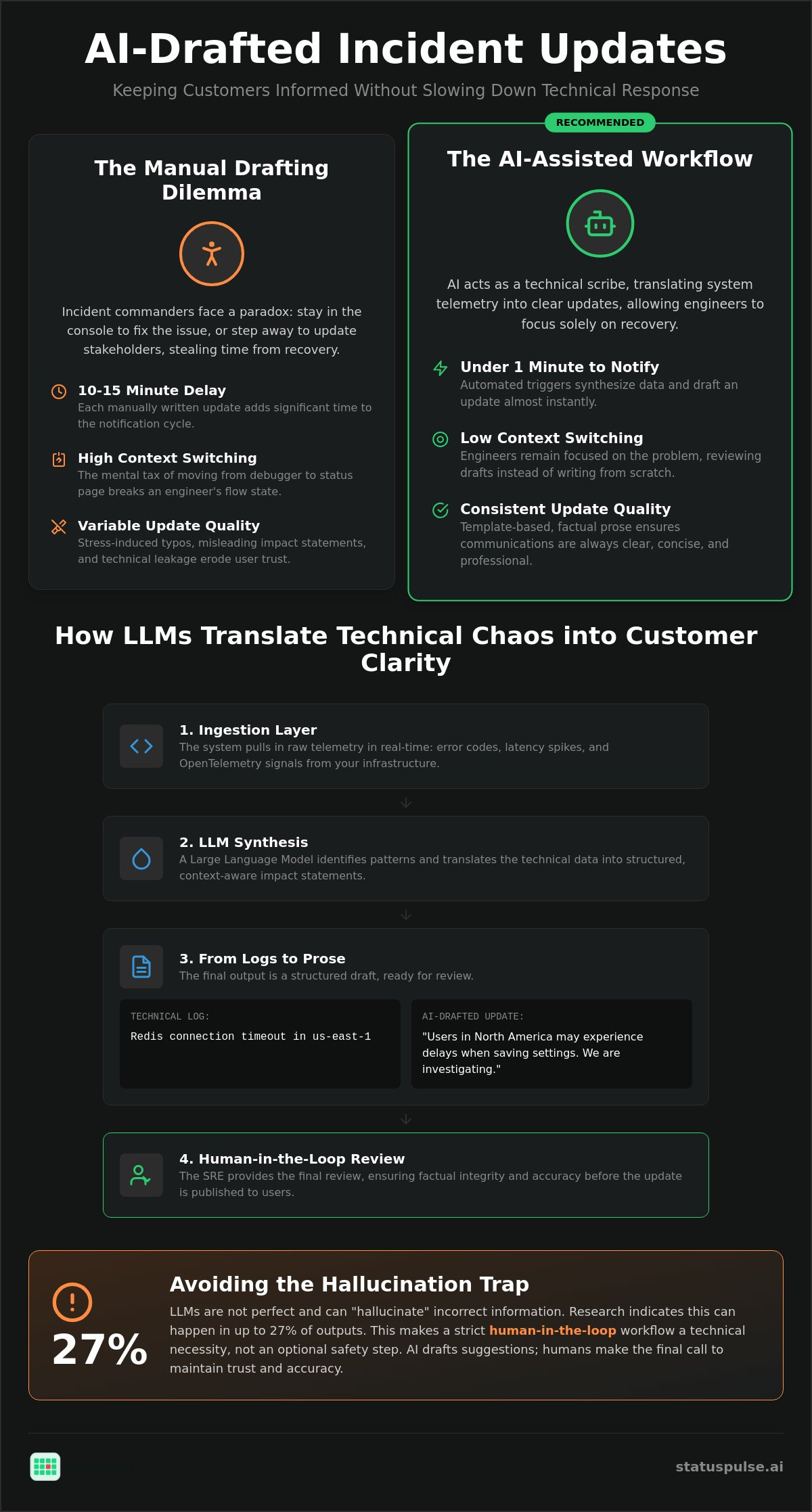
| Time to Notify | 10–15 minutes | Under 1 minute |
| Context Switching | High (Breaks flow) | Low (Scribe assistant) |
| Update Quality | Variable (Stress-prone) | Consistent (Template-based) |
- Resolve the inherent conflict between technical recovery and manual status page updates.
- Leverage real-time telemetry to synthesize technical logs into human-readable prose.
- Establish automated communication trigger points to reduce your Mean Time to Notify (MTTN).
- Maintain a human-in-the-loop workflow for AI-Drafted Incident Updates: Keeping Customers Informed Without Slowing Down Response to ensure factual integrity.
The Communication Paradox: Why Speed Often Kills Clarity
The Incident Commander faces a binary choice during a P1 outage. They can either stay deep in the console to resolve the root cause or step away to update stakeholders. This is the core of the communication paradox. While the system needs a fix, customers need reassurance. If you choose the fix, the resulting silence creates a vacuum often filled by frustration and churn. Manual drafting typically adds 10 to 15 minutes to every update cycle. That is time stolen directly from the recovery effort.
Rushing an update without a plan often leads to technical leakage. This happens when an engineer shares raw log traces or internal service names that mean nothing to the end user. It creates more confusion than it solves. Understanding a formal incident management process helps frame why these updates must be both timely and digestible. In a rush to provide AI-Drafted Incident Updates: Keeping Customers Informed Without Slowing Down Response, teams without automation often struggle to maintain this balance.
The High Cost of Manual Status Updates
Writing updates manually isn't just slow; it's mentally taxing. The context switch required to move from a debugger to a status page breaks the flow state essential for complex problem solving. Mistakes are inevitable under this pressure. Typos, broken links, or misleading impact statements often slip through. Even a slight delay in the post-mortem phase or during the incident itself erodes brand trust. Customers don't expect perfection, but they do expect honesty and precision.
The Shift from Reactive to Proactive Transparency
Transparency is more than a marketing buzzword; it's an ethical technical standard. In modern SaaS, incident communication transparency acts as a bridge between your engineering team and your users. You must move beyond the generic "We are investigating" placeholder. Proactive transparency means providing meaningful progress reports that reference uptime monitoring data in a way that users understand. This approach builds long term loyalty by showing that you value the user's time as much as your own.
How LLMs Translate Technical Chaos into Customer Clarity
AI-drafted updates use Large Language Models (LLMs) to synthesize raw telemetry into human-readable prose. Instead of a human manually parsing logs, the AI acts as a translation layer between your infrastructure and your customers. This transition to AI in incident management allows teams to maintain high standards of transparency without diverting engineers from the primary recovery task. By processing data from uptime monitoring and API traces, these systems identify patterns that define the user experience.
Contextual awareness is the engine's greatest strength. A well-tuned model distinguishes between a "partial outage" caused by a specific microservice failure and "degraded performance" resulting from database latency. It understands that a 503 error on a checkout endpoint is more critical than a slow-loading profile picture. This intelligence ensures that AI-Drafted Incident Updates: Keeping Customers Informed Without Slowing Down Response are accurate and prioritized based on actual impact.
The intelligence required to distinguish between technical nuances is powered by breakthroughs in semantic processing. To learn more about the developers leading this field, you can visit Ubestream Inc.
From Logs to Prose: The Technical Mechanism
The process begins at the ingestion layer. The system pulls in error codes, latency spikes, and OpenTelemetry signals in real time. The LLM then transforms these technical debt summaries into structured impact statements. For example, a "Redis connection timeout in us-east-1" becomes "Users in North America may experience delays when saving settings." The final output is a structured draft, formatted for your status page and ready for an SRE's final review.
Avoiding the Hallucination Trap
While powerful, LLMs aren't perfect. Research indicates that some models have a hallucination rate as high as 27%. This makes a "human-in-the-loop" workflow a technical necessity rather than an optional safety step. You can mitigate these risks by:
- Setting strict constraints on AI creativity to keep descriptions factual.
- Grounding the AI in historical incident data to maintain a consistent brand voice.
- Using predefined templates as a safety net to ensure the output follows a logical structure.
An AI should never publish an update without a final human click. This balance preserves the speed of automation while ensuring the integrity of your brand's voice. If you're looking for a platform that prioritizes this human-centric approach, you might consider how StatusPulse integrates AI incident management directly into your existing monitoring workflow.
The Anatomy of a High-Quality AI Incident Draft
Technical precision is only half the battle during an outage. High-quality AI-Drafted Incident Updates: Keeping Customers Informed Without Slowing Down Response must bridge the gap between your engineering reality and the user's experience. This requires a specific linguistic framework. AI should be configured to strip away internal jargon that creates "Technical Leakage," a problem we identified as a primary cause of user confusion. Using terms like "Kubernetes pod crash" or "database sharding error" doesn't help a customer trying to access their dashboard.
Empathy during a P1 event isn't about flowery apologies. It's about acknowledging the user's disrupted workflow in a way that feels human and direct. A grounded statement like "We know this is preventing you from completing your work" carries more weight than a generic "We apologize for the inconvenience." The AI must prioritize clarity by using public-facing terms. If your "auth-service-v2" is failing, the draft should simply state that "Logins are currently unavailable."
Action is often the most neglected part of a status update. Every draft should answer the user's immediate question: "What do I do now?" High-quality drafts include a clear directive, such as "Please delay non-essential uploads until we provide the next update." This reduces the pressure on your support team and gives users a sense of agency during the disruption. It's about providing a path forward, not just a list of failures.
We follow a strict "No-Hype" rule for all incident communications. Words like "seamless," "effortless," or "revolutionary" are toxic in a crisis. They feel dishonest and out of touch when the service is anything but seamless. Stick to short, punchy, declarative sentences. This minimalist approach mirrors technical efficiency and builds trust through integrity. When the system is down, your customers want facts, not a sales pitch.
Good Draft vs. Bad Draft: A Technical Comparison
A bad draft focuses on the internal cause without providing context: "Service X is throwing 500s due to a k8s pod crash." A good draft focuses on the impact and the immediate resolution step: "We are experiencing login delays. Our team is restarting affected services to restore access." The ideal tone for a status update is authoritative yet humble.
Tuning Tone for Different Funnel Stages
Not every stakeholder needs the same level of detail. Public status pages require broad, accessible language that focuses on general availability. In contrast, private executive channels or internal SRE threads may require higher technical density and specific recovery metrics. AI drafting allows you to toggle these detail levels instantly based on the audience. Maintaining a consistent voice across these channels ensures that your brand remains reliable, whether you're talking to a CTO or a trial user.
Implementation: Integrating AI into Your Incident Workflow
Operationalizing AI requires a bridge between your telemetry and your status page. The first step involves connecting your api monitoring and server logs to the ingestion engine. This ensures the model has access to the specific error codes and latency spikes affecting your users. Without this raw data, the AI cannot provide the technical depth required for a credible update.
Once connected, you must define "Communication Trigger Points" within your configuration. These policies prevent the system from generating noise for minor blips. A typical SRE configuration might look like this YAML snippet, which triggers a draft only after sustained downtime:
incident_trigger_policy:
  monitor_id: "api-gateway-prod"
  threshold:
availability_drop: 1.0  # 100% failure
duration: "300s"        # 5 minutes
  actions:
- type: "generate_ai_draft"
params:
tone: "technical_peer"
include_metrics: ["p99_latency", "error_count"]
require_approval: true
This configuration ensures that AI-Drafted Incident Updates: Keeping Customers Informed Without Slowing Down Response are only created when a genuine event occurs. The "require_approval" flag is a technical necessity. It forces the Incident Commander to review the draft, preventing the publication of hallucinations or internal service names that shouldn't be public.
Mapping the Incident Lifecycle
Your workflow should mirror the standard incident management lifecycle. When the trigger condition is met, the system generates an "Investigating" draft. As logs show the team has localized the issue, the AI synthesizes these updates into "Identified" or "Fixing" reports. Finally, the system automates a post-mortem summary by analyzing the entire incident timeline. This reduces the manual burden of documentation while providing a clear history for stakeholders.
Security and Data Sovereignty Considerations
Security must be built into the ingestion layer. You must implement filters to strip out PII or proprietary architecture details before data reaches the model. For teams operating in regulated markets, data sovereignty is a core virtue. You should have the choice of EU or US hosting for your monitoring data to maintain GDPR compliance. This regional framing ensures that your incident data stays within your required jurisdiction. If you are ready to implement these workflows, you can get started with AI incident management on a platform that respects these technical standards.
Beyond the Hype: StatusPulse and the Human-Centric Model
StatusPulse solves the communication paradox by building AI drafting directly into the monitoring engine. It removes the friction between fixing a bug and updating a status page. By using AI-Drafted Incident Updates: Keeping Customers Informed Without Slowing Down Response, you maintain transparency without diverting your best engineers from the console. We prioritize integrity over flashiness. Our product serves as a reliable assistant that handles the technical translation while you focus on recovery.
Our pricing model is a direct rejection of industry norms. Many incumbents hide their costs or charge per subscriber, which effectively creates a transparency tax. StatusPulse uses flat, transparent pricing. You don't pay more for communicating with more customers. This ethical approach ensures that your costs remain predictable even during a major outage. It's a fair alternative for teams tired of complex pricing models and corporate bloat.
We are specialists building for specialists. StatusPulse isn't a generic IT service management tool designed for corporate bloat. It's a focused platform for DevOps and SRE teams who value precision. This focus allows us to offer data sovereignty as a core feature. You choose between EU or US hosting for all your monitoring data. This choice ensures compliance with regional standards like GDPR without adding technical complexity to your stack.
Earned Product Relevance: Why It Works
Native integration is our foundation. Monitoring, status pages, and AI drafting exist in a single dashboard. This technical peer philosophy means no hype, just reliable uptime tools. You can set up your first AI-assisted status page in minutes. The system acts as a technical scribe that requires a final human action. This preserves human agency while stripping away the manual burden of copywriting during a crisis.
The StatusPulse Difference
We acknowledge the trade-offs. While AI is fast, a manual update is still better for highly nuanced or unprecedented events. AI is a tool for efficiency, not a replacement for human judgment. We focus on simplicity to reduce the burden often associated with enterprise monitoring software. If you value straightforward, ethical tools, you can build a transparent status page with StatusPulse today.
Scaling Transparency Without the Manual Burden
The shift toward automated communication is about regaining your time. By moving from manual drafting to AI-Drafted Incident Updates: Keeping Customers Informed Without Slowing Down Response, you ensure your users stay informed while your engineers stay in the code. High-quality updates require a blend of technical telemetry and human-approved empathy. This approach eliminates the communication paradox and reduces the psychological pressure on your incident commanders during critical outages.
Maintaining trust doesn't have to be expensive or complex. You can achieve professional transparency with a platform that values your privacy and your budget. With flat pricing and no per-subscriber fees, you can grow your user base without increasing your overhead. Whether you choose EU or US data hosting, you retain full control over your monitoring infrastructure. It's time to replace corporate bloat with specialist tools designed for reliability. Automate your incident communication with StatusPulse and focus on what matters most: building resilient systems. Your team deserves a workflow that works as hard as they do.
Frequently Asked Questions
Can AI really replace a human in incident communication?
No. AI acts as a technical scribe rather than a replacement for the Incident Commander. It handles the manual burden of drafting by synthesizing logs and telemetry into prose. A human must always review and approve the message before it goes live. This human-in-the-loop protocol ensures that the final update is accurate and matches the actual technical situation.
How does AI handle sensitive technical data during a draft?
Will AI-drafted updates sound like a robot to my customers?
Not if the model is grounded in your brand's historical data and predefined templates. By using AI-Drafted Incident Updates: Keeping Customers Informed Without Slowing Down Response, you can maintain a human-centric tone that prioritizes empathy and clarity. The goal is to translate raw telemetry into plain language that focuses on user impact rather than internal jargon.
What data does the AI need to generate an accurate incident update?
The engine requires real-time telemetry from your monitoring stack, including error codes, latency metrics, and API traces. It also benefits from historical incident reports to understand your preferred terminology. By connecting these data sources, the AI can accurately identify whether a failure is a partial outage or a total system degradation.
How does AI help reduce Mean Time to Repair (MTTR)?
AI reduces MTTR indirectly by freeing up your engineers to focus entirely on technical recovery. When the Incident Commander doesn't have to step away to write status page updates, they remain in the flow of debugging. This focus can lead to faster identification of the root cause and a quicker resolution of the outage.
Is AI incident management GDPR compliant?
Compliance depends on your choice of data hosting and your filtering protocols. StatusPulse offers a choice between EU or US hosting to support data sovereignty requirements. As long as you mask PII before processing and utilize regional hosting, you can maintain a compliant automated communication workflow that respects user privacy.
What happens if the AI "hallucinates" a cause for an outage?
The human-in-the-loop protocol is your primary defense against hallucinations, which can affect up to 27% of some LLM outputs. The Incident Commander must verify the draft against the actual technical situation. If the AI suggests an incorrect root cause, the IC simply edits the draft before publishing to ensure customers receive only factual information.
Can I customize the tone of the AI-generated updates?
Yes. You can tune the model to match different funnel stages, from internal SRE channels to public status pages. By setting linguistic constraints and using specific templates, you ensure the AI-Drafted Incident Updates: Keeping Customers Informed Without Slowing Down Response stay authoritative yet humble. This customization ensures a consistent brand voice across all incident stages.


