

Your database backups are a liability if you're relying on encryption that lacks integrity checks. Most engineering teams understand that plain text is a non-starter, yet the complexity of managing Initialization Vectors (IVs) and bulky client certificates often leads to fragile implementations. If your decryption process adds significant latency to high-frequency monitoring, you've traded security for system stability. Achieving Encrypted Secrets by Design Using AES-GCM for Credentials Auth Headers and Client Certs requires more than just a library import; it demands a principled approach to Authenticated Encryption with Associated Data (AEAD).
We agree that security shouldn't be a performance bottleneck or a source of operational dread. This guide shows you how to implement a secure, AEAD-compliant encryption layer for sensitive monitoring credentials using AES-256-GCM. We'll break down the mechanics of cryptographic integrity, provide a strategy for secret lifecycle management, and explore how to handle large blobs without compromising speed. By the end, you'll have a production-ready pattern that protects your data sovereignty while keeping your monitoring stack lean and responsive.
Key Takeaways
- Master the transition from simple symmetric encryption to AEAD-compliant AES-GCM to ensure monitoring secrets are both private and untampered.
- Implement Encrypted Secrets by Design Using AES-GCM for Credentials Auth Headers and Client Certs to secure sensitive API keys and PEM-encoded certificates.
- Protect your infrastructure by enforcing strict Initialization Vector (IV) management and separating encryption keys from primary database backups.
- Optimize performance for high-frequency monitoring checks by using a schema that handles complex headers without excessive decryption overhead.
- Establish a robust security lifecycle using a Master Key and Data Encryption Key (DEK) architecture to simplify regulatory compliance and key rotation.
Why AES-GCM is the Standard for Monitor Authentication
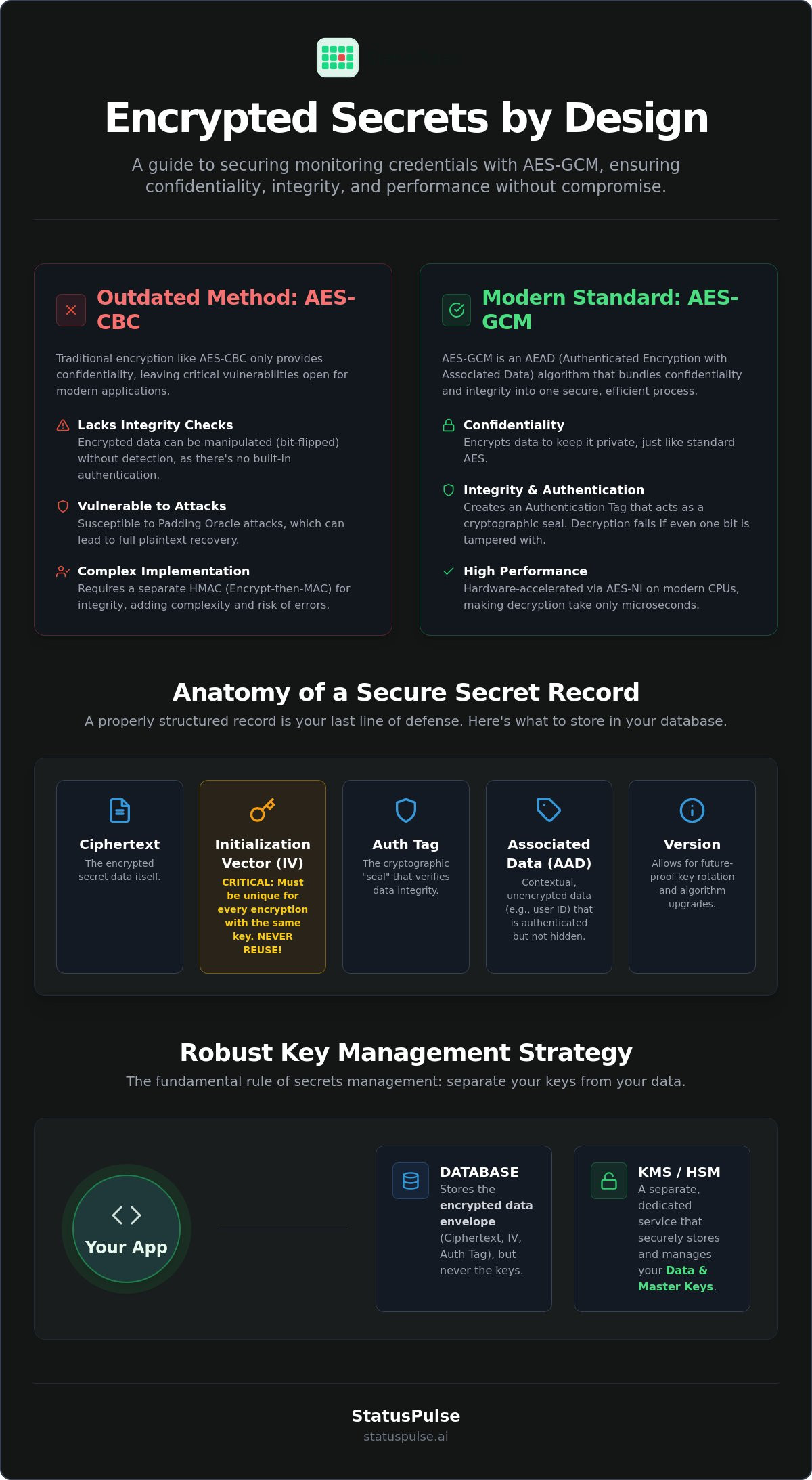
Encryption often stops at confidentiality. We focus on hiding the data, but we forget to verify its integrity. For monitoring secrets like API keys and OAuth tokens, hiding the value is only half the battle. If an attacker can manipulate the encrypted bits without you knowing, they can bypass security controls or redirect monitoring traffic. Standardized as an AEAD algorithm, Galois/Counter Mode (GCM) combines the counter mode of encryption with a Galois field multiplier for authentication. It ensures that if even a single bit of the ciphertext is altered, the decryption process fails immediately.
When building a monitoring architecture, implementing Encrypted Secrets by Design Using AES-GCM for Credentials Auth Headers and Client Certs provides the necessary assurance that your authentication data hasn't been tampered with in transit or at rest. This is critical for API monitoring where headers are frequently injected into outgoing requests. Without the integrity checks provided by GCM, your system might be vulnerable to bit-flipping attacks. These attacks allow a malicious actor to change encrypted data into a different, predictable value without needing the original key. GCM stops this by generating an authentication tag that acts as a cryptographic seal.
The Failure of AES-CBC in Modern SaaS
AES in Cipher Block Chaining (CBC) mode was the industry standard for years, but it's fundamentally flawed for modern web applications. It's notoriously susceptible to padding oracle attacks, which can lead to full plaintext recovery. To make CBC secure, you're forced to add a separate HMAC (Hash-based Message Authentication Code) to handle integrity. This "Encrypt-then-MAC" approach adds architectural complexity and increases the risk of implementation errors. GCM solves this by integrating the authentication tag directly into the cipher's operation. It's a cleaner, safer pattern that reduces the surface area for cryptographic mistakes.
Performance Characteristics for Monitoring Agents
Performance shouldn't be a trade-off for security. Modern CPUs include AES-NI (Advanced Encryption Standard New Instructions), which provides hardware acceleration for GCM operations. This makes decryption incredibly fast, even during high-frequency checks. For example, decrypting a standard API token takes only a few microseconds. This efficiency is vital for server uptime monitoring where agents must process thousands of concurrent checks. At StatusPulse, our monitoring agents utilize these hardware instructions to ensure that security layers don't introduce latency into your availability metrics. You get the highest level of AEAD protection without sacrificing the sub-second precision your status pages require.
Designing the Encryption Schema: Metadata and AAD
A secure database schema is your last line of defense. Even if an attacker gains full access to your database, they shouldn't be able to decrypt your secrets. This starts with a hard rule: never store your encryption keys in the same database as the encrypted data. Keys belong in a dedicated Key Management Service (KMS) or a hardware security module (HSM). When implementing Encrypted Secrets by Design Using AES-GCM for Credentials Auth Headers and Client Certs, your database should only hold the "envelope" required for the KMS to perform its job.
The most critical component of this envelope is the Initialization Vector (IV). According to NIST Special Publication 800-38D, you must never reuse an IV with the same key. Reusing an IV in GCM mode is a catastrophic failure that can lead to the recovery of the authentication key and the plaintext itself. Each secret record must have its own unique, cryptographically strong random IV stored alongside the ciphertext. If you rotate a key, you must also generate a new IV for the re-encrypted data.
The Anatomy of a Secure Secret Record
Your database record needs to be self-describing to handle future migrations. A "Version" field is mandatory. It allows you to update your cryptographic primitives or key lengths without breaking existing records. If you decide to move from AES-128 to AES-256, the version field tells your application which logic to apply. A standard GCM encryption envelope should include the following fields:
- Version: An integer representing the encryption scheme version.
- KeyID: A reference to the specific key used in your KMS.
- IV: The 96-bit (12-byte) unique initialization vector.
- Auth Tag: The 128-bit tag generated by GCM to verify integrity.
- Ciphertext: The actual encrypted credential data.
{
  "version": 1,
  "key_id": "alias/monitoring-key-2026",
  "iv": "8f3a92b1c4e5...",
  "auth_tag": "d9e8f7a6b5c4...",
  "ciphertext": "z2x1c3v4b5n6..."
}
Binding Secrets with AAD
Standard encryption ensures only the key holder can read the data. Additional Authenticated Data (AAD) goes further by ensuring the data is only read in the correct context. By including a Tenant ID or Workspace ID as AAD, you bind the secret to a specific user account. If an encrypted blob is stolen and someone tries to decrypt it within a different account context, the authentication tag verification will fail. This prevents "cross-tenant" decryption attacks where a vulnerability in one account might expose data from another.
AAD is the non-encrypted metadata that must match for decryption to succeed. At StatusPulse, we use this pattern to ensure your API monitoring credentials are contextually locked to your specific organization. It's a fundamental part of our commitment to data sovereignty. By using Workspace IDs as AAD, we ensure that even an internal database leak wouldn't allow a malicious actor to swap secrets between different monitoring environments.
Handling Auth Headers and Client Certificates
Most encryption tutorials focus on short, single-line strings like a basic API key. Real-world monitoring demands more. You'll often need to manage complex Authorization headers or multi-line PEM-encoded client certificates for mutual TLS (mTLS). Implementing Encrypted Secrets by Design Using AES-GCM for Credentials Auth Headers and Client Certs means handling these varied data types without compromising the integrity of the underlying formatting. AES-GCM is particularly suited for this because it treats the input as a binary buffer, ensuring that every byte, including invisible newline characters, is preserved and verified.
When deciding what to encrypt, we recommend encrypting the entire header string rather than just the secret value. If you only encrypt the token, an attacker who gains access to your database could potentially modify the header type, for example, changing a "Bearer" prefix to something else to exploit application logic. By following the NIST Recommendation for AES-GCM and encrypting the full string, you ensure the context of the credential is just as secure as the credential itself. For storage, using binary fields like BYTEA or BLOB is more efficient than Base64-encoding your ciphertext, as it avoids the 33% storage overhead associated with Base64.
Encrypting PEM-Encoded Client Certificates
PEM files are sensitive and bulky. They contain multiple lines of text, including header and footer boundaries that must remain intact. When you encrypt a private key for mTLS, you're handling a blob that is significantly larger than a standard token. GCM handles these larger payloads efficiently, but you must ensure your decryption routine doesn't accidentally trim trailing whitespace or convert line endings. At StatusPulse, we treat these certificates as immutable binary objects during the encryption roundtrip. This prevents the "invalid certificate format" errors that frequently plague less rigorous implementations.
Dynamic Auth Headers in Monitoring
Modern monitoring website uptime often requires dynamic headers. You might store a template like Bearer {{TOKEN}} where the token is decrypted at runtime. This adds a layer of complexity: you must decrypt the secret, inject it into the template, and then validate the final string before it ever leaves your internal network. We suggest a strict validation checklist for decrypted headers:
- Verify the GCM authentication tag passes before any string manipulation.
- Ensure no control characters were injected into the decrypted plaintext.
- Confirm the final header matches the expected regex pattern (e.g., Bearer followed by a JWT).
- Check that the decrypted value is not empty or null before the monitoring agent initiates the request.
This "validate after decryption" pattern ensures that even if a key was compromised, a malformed or malicious header won't be sent to your target API, protecting both your monitoring agent and the third-party service.
Key Rotation and Secrets Lifecycle Management
Static encryption keys are a liability. If a single key remains in use for years, the potential blast radius of a credential leak grows every day. Regulatory frameworks like GDPR require robust risk mitigation strategies, which include periodic key rotation to ensure data remains protected even if older keys are eventually compromised. Implementing Encrypted Secrets by Design Using AES-GCM for Credentials Auth Headers and Client Certs isn't a one-time setup; it requires a lifecycle strategy that handles key updates without interrupting your uptime monitoring service.
There are two primary ways to handle rotation: lazy rotation and batch re-encryption. Lazy rotation updates the encrypted blob only when a user or system performs a write operation. This is computationally cheap but leaves "stale" data encrypted with old keys in your database for long periods. Batch re-encryption uses a background worker to cycle through every record, decrypting with the old key and re-encrypting with the new one. While more resource-intensive, batch processing ensures that deprecated keys can be fully decommissioned on a predictable schedule.
The Envelope Encryption Pattern
We recommend using envelope encryption to manage this process. In this pattern, you generate a unique Data Encryption Key (DEK) for each tenant or region. This DEK is used to encrypt the actual credentials. You then use a Master Key (also known as a Key Encryption Key or KEK), managed by a dedicated KMS or HSM, to "wrap" or encrypt the DEK. Envelope encryption separates key access from data access, ensuring that even if an application server is compromised, the master keys remain isolated within the secure perimeter of the KMS.
At StatusPulse, we use this architecture to support data sovereignty. By generating unique DEKs for our EU and US hosting regions, we ensure that keys never cross geographic boundaries. This meticulous approach to key isolation is part of our commitment to being a principled alternative to bloated enterprise providers who often overlook these regional cryptographic nuances.
Zero-Downtime Rotation Strategy
You shouldn't have to take your monitoring offline to rotate a key. By utilizing the KeyID field we established in the previous sections, your application can support a "dual-key window." During a rotation period, the system identifies which master key was used for a specific record via its ID. The decryption logic is updated to accept both the old and new keys, while the encryption logic is configured to use only the new key for any incoming writes.
A successful rotation strategy follows this workflow:
- Generate a new Master Key in your KMS.
- Update application configuration to recognize the new KeyID as the primary for encryption.
- Maintain the old KeyID in the "allowed" list for decryption.
- Monitor logs for any "stale" records still utilizing the deprecated key.
- Once all records are migrated via lazy or batch re-encryption, decommission the old key.
This approach keeps your status pages live and your monitoring active. If you are looking for a platform that handles these complexities with technical rigor, you can explore our API monitoring capabilities to see how we manage secret lifecycles for high-availability environments.
Zero-Knowledge Patterns in Uptime Monitoring
Security by obscurity is a failed strategy. In the monitoring industry, many providers hide their cryptographic practices behind proprietary labels, asking for blind trust. We take a different path. By implementing Encrypted Secrets by Design Using AES-GCM for Credentials Auth Headers and Client Certs, we ensure that your most sensitive data is contextually isolated and cryptographically verified. A zero-knowledge pattern means that while our agents use your credentials to perform checks, the raw secrets are never exposed to our internal logging, support interfaces, or AI-driven analysis tools.
Balancing modern AI incident management with strict encryption boundaries requires a disciplined architecture. Our AI models analyze response patterns, latency spikes, and status codes to identify root causes, but they do so without ever accessing the decrypted content of your auth headers. This separation of concerns ensures that you get the benefit of intelligent alerting without creating a privacy vacuum. We believe that professional monitoring tools should be assistants that respect human agency and data boundaries rather than black boxes that ingest everything they see.
Data Sovereignty and EU Hosting
Data sovereignty is not just a checkbox for GDPR compliance; it is a fundamental requirement for securing credentials. StatusPulse offers a choice between EU and US hosting to ensure your data stays where you want it. By utilizing regional master keys, we prevent cross-border data access risks. If you choose our EU-based hosting, your encryption keys are generated and stored within European data centers, ensuring that the legal and technical protections of the region are upheld. We don't believe in "security surcharges" or complex pricing models. Our commitment to transparency means that these high-level security features are built into our flat pricing, making professional-grade encryption accessible to every team.
Just as we prioritize technical rigor for monitoring, other regulated sectors require similar standards for data integrity. For instance, if you're navigating the complexities of digital finance and need a secure platform for asset exchange, you can visit Pallapay to see how they apply these principles to their financial technology services.
Implementing Your Own Encrypted Secrets
If you are building your own internal tooling or evaluating website performance monitoring tools, adopting a "Secrets by Design" mindset is essential. AES-GCM provides the foundation, but the implementation details determine your actual risk profile. Use this final checklist to validate your approach:
- Unique IVs: Ensure every single encryption operation uses a fresh, non-repeating initialization vector.
- AAD Binding: Always use account or workspace IDs as Additional Authenticated Data to prevent cross-tenant decryption.
- Envelope Encryption: Separate your data encryption keys from your master keys using a dedicated KMS.
- Hardware Acceleration: Utilize AES-NI instructions to keep decryption latency low for high-frequency monitoring.
- Validation: Always verify the authentication tag before attempting to use the decrypted plaintext in a request.
Building secure systems is a continuous process of refinement. If you prefer to focus on your core product while relying on a monitoring partner that understands these cryptographic necessities, you can explore how StatusPulse handles your monitoring security. We've built our platform with the same technical rigor we've described here, ensuring your API credentials and client certificates remain private, verified, and under your control.
Securing Your Monitoring Pipeline
Implementing robust security for your monitoring stack requires moving beyond simple encryption. You now have a blueprint for Encrypted Secrets by Design Using AES-GCM for Credentials Auth Headers and Client Certs that prioritizes both data integrity and operational agility. By using AAD to bind secrets to specific workspaces and adopting envelope encryption for easier rotation, you reduce your attack surface without sacrificing performance. These patterns ensure that even in the event of a database leak, your sensitive credentials remain contextually locked and cryptographically unreadable.
If you're ready to offload the complexity of cryptographic lifecycle management, we've built a platform that handles these details with precision. StatusPulse provides specialized API monitoring with EU-based data sovereignty, AI-powered incident management for technical teams, and flat pricing with no per-subscriber fees. It's an architecture designed by specialists who value privacy and technical rigor over corporate bloat. Start monitoring securely with StatusPulse today and gain the peace of mind that your credentials are as resilient as your infrastructure. Your uptime is our priority, and your security is our foundation.
Frequently Asked Questions
Is AES-GCM better than AES-CBC for storing API keys?
AES-GCM is superior because it provides authenticated encryption (AEAD) in a single pass. Unlike AES-CBC, which only ensures confidentiality and requires a separate HMAC for integrity, GCM detects if any part of the ciphertext has been altered. This prevents padding oracle attacks and bit-flipping vulnerabilities that often plague CBC implementations in SaaS environments.
How do I prevent IV reuse in AES-GCM?
Use a cryptographically secure random number generator to produce a unique 96-bit (12-byte) IV for every single encryption call. Never reuse an IV with the same key, as this allows an attacker to recover the authentication key. If you are using a KMS, many providers handle IV generation automatically to ensure uniqueness across your secret lifecycle.
What is the ideal length for an AES-GCM authentication tag?
A 128-bit (16-byte) authentication tag is the ideal length for maximum security. While GCM supports shorter tags, they significantly lower the resistance against forgery attacks. Sticking to the 128-bit standard ensures that your system maintains the high integrity required for sensitive monitoring credentials and regulatory compliance.
Can I use AES-GCM to encrypt large files like SSL certificates?
Yes, AES-GCM handles larger blobs like PEM-encoded SSL certificates efficiently. It treats the data as a binary stream, which preserves the formatting and newline characters of the certificate. Implementing Encrypted Secrets by Design Using AES-GCM for Credentials Auth Headers and Client Certs ensures that even these larger files are protected with the same AEAD rigor as a simple API token.
What should I use for Additional Authenticated Data (AAD)?
Additional Authenticated Data (AAD) should include context-specific metadata that isn't secret but must be verified. Good candidates include your internal Workspace ID, Tenant ID, or a specific Monitor ID. By binding the secret to this data, you ensure that an encrypted credential stolen from one account cannot be decrypted or used within another account context.
Does AES-GCM encryption affect the performance of my monitoring checks?
The performance impact is minimal due to AES-NI hardware acceleration on modern CPUs. Decryption happens in microseconds, which is a fraction of the time required for a network request during an uptime check. At StatusPulse, we use these hardware instructions to ensure that our security layer doesn't introduce measurable latency into your high-frequency monitoring metrics.


