

Data residency in monitoring allows you to choose exactly where your uptime logs and incident metadata are stored geographically. To achieve this from the start, you should Pick Your Data Region at Signup with US or EU Multi-Region from Day One, ensuring your monitoring stack aligns with your legal jurisdiction and compliance requirements.
Why should a simple health check force your metadata into a legal gray zone? With regulatory frameworks facing fresh scrutiny in 2026, where you store your data is no longer just a checkbox; it's a core architectural decision. We agree that residency shouldn't be an enterprise-tier negotiation or a complex migration project you tackle six months from now. It's a technical choice that defines your data perimeter.
This guide explains how to architect your monitoring stack for compliance by selecting your preferred data residency during initial account configuration. You'll learn the technical distinction between global probes and regional storage while keeping your infrastructure costs predictable. We'll show you the exact steps to lock in your data location to meet the latest regulatory standards.
Key Takeaways
- Understand why data residency is a technical requirement for SOC2 and GDPR audits in 2026. Legal certainty depends on the physical location of your monitoring metadata.
- Differentiate between global uptime probes and regional storage databases. This architecture maintains performance while keeping your data in its designated jurisdiction.
- Learn how to Pick Your Data Region at Signup with US or EU Multi-Region from Day One. Configuring your hosting location at the start prevents complex migration paths.
- Follow a strategic approach to identify the correct jurisdiction for your legal entity. Reviewing your existing customer DPAs helps you choose between US or EU hosting with confidence.
- Maintain full transparency over your monitoring logs without hidden fees. Predictable pricing means you won't face surprises when choosing a specific geographic region.
Why Data Residency Matters for DevOps in 2026
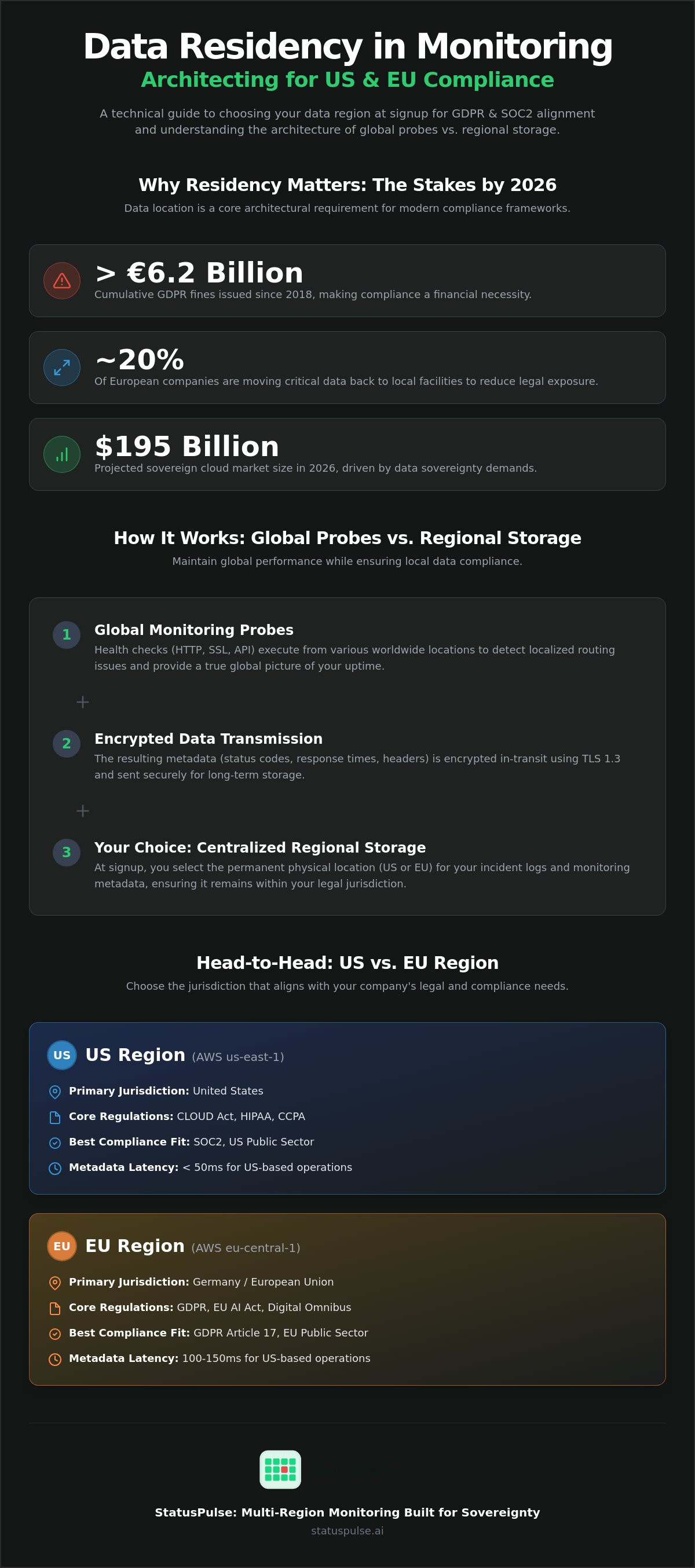
Data residency is no longer just a legal footnote; it's a fundamental architectural constraint. As the global sovereign cloud market is projected to reach $195.35 billion in 2026, DevOps teams are increasingly treating data location as national infrastructure. When you Pick Your Data Region at Signup with US or EU Multi-Region from Day One, you're establishing the legal home for every uptime log and incident metadata entry. This choice is vital because approximately 20% of European companies have begun moving business-critical data back to local facilities to reduce cross-border legal exposure.
| Feature | US Region (AWS US-East-1) | EU Region (AWS EU-Central-1) |
|---|---|---|
| Primary Jurisdiction | United States | Germany / European Union |
| Core Regulations | CLOUD Act, HIPAA, CCPA | GDPR, EU AI Act, Digital Omnibus |
| Compliance Fit | SOC2, US Public Sector | GDPR Article 17, EU Public Sector |
| Metadata Latency | < 50ms for US-based ops | 100ms - 150ms for US-based ops |
Choosing a region at signup prevents the need for complex database migrations later. Moving years of historical monitoring data between regions is a high-risk operation that often results in data loss or extended downtime. With cumulative GDPR fines surpassing €6.2 billion since 2018, the cost of a configuration error is too high to ignore. Setting your residency early ensures your monitoring stack remains compliant through SOC2 and GDPR audits without emergency refactoring.
The Legal Reality of Data Sovereignty
Data sovereignty is the principle that data is subject to the laws of the country where it is physically located. For EU-based startups, this creates a direct conflict between the US Cloud Act and GDPR requirements. The Cloud Act allows US authorities to request data from US-based providers regardless of where the servers sit. This is why residency isn't the same as sovereignty. Legal, IT, and Security stakeholders all care about this choice because it determines which government can issue a subpoena for your incident logs or system metadata.
Performance vs. Compliance Trade-offs
A common myth in DevOps is that choosing an EU region for a US-based team will destroy dashboard performance. In reality, the latency difference for a human operator viewing a status page is negligible. Your real-time alerting remains fast because the probes are global, even if the storage is regional. When you Pick Your Data Region at Signup with US or EU Multi-Region from Day One, you also avoid the "US-first" feature lag common in older SaaS platforms. Modern tools like StatusPulse release features to US and EU regions simultaneously, ensuring you don't trade technical capability for regulatory compliance.
Regional Storage vs. Global Probes: A Technical Distinction
Monitoring architecture separates the execution of global telemetry from its long-term storage in a centralized regional bucket. While your uptime checks must run from various global vantage points to detect localized routing issues, the resulting metadata should live where you choose. This distinction is vital for compliance. When you Pick Your Data Region at Signup with US or EU Multi-Region from Day One, you're selecting the permanent home for your incident logs, SSL heartbeats, and API response headers. The probes are ephemeral; the database is regional.
Latency between a US-based probe and an EU storage region is functionally irrelevant for uptime monitoring. A 150ms delay in writing a check result to a database doesn't impact the accuracy of the "up" or "down" status. Your dashboard might take a few extra milliseconds to fetch a graph, but your alerting remains real-time. This setup allows you to maintain a strict data perimeter without sacrificing the global reach needed to monitor a distributed user base.
How Global Monitoring Probes Communicate
Every time a probe executes a health check, it generates a small packet of telemetry. This includes the HTTP status code, response time, and any error strings. For SSL certificate monitoring, it includes expiry dates and chain validation details. This data is encrypted in transit using TLS 1.3 before moving across regional boundaries. If you're managing complex API monitoring, the response payloads are captured and sent directly to your selected region for analysis. This ensures that even if a check originates in Tokyo, the data never touches a disk until it reaches your chosen US or EU environment.
Multi-Region Storage and Egress Costs
Infrastructure providers often obscure the true cost of data movement. In standard cloud setups, moving data between regions can incur significant egress fees [VERIFY: AWS S3 cross-region egress rates]. These costs scale with your monitoring frequency and the size of your API payloads. Most legacy monitoring tools pass these "hidden" costs to you through complex usage tiers or regional surcharges. We believe that compliance shouldn't come with a financial penalty. By utilizing a flat pricing model, StatusPulse ensures your costs remain predictable regardless of which side of the Atlantic you store your data. You can explore our regional hosting options to see how we handle these architectural requirements without per-subscriber fees or storage markups.
Navigating the EU-US Data Privacy Framework requires clear visibility into these data paths. Choosing a single regional bucket for all telemetry simplifies your legal burden. It's much easier to sign a Data Processing Agreement (DPA) when you can point to a specific geographic location for every log entry your monitoring stack generates.
GDPR and the EU-US Data Privacy Framework: Navigating Compliance
The legal status of trans-Atlantic data transfers remains a moving target. While the EU-US Data Privacy Framework (DPF) provides a current legal mechanism for transfers, its long-term stability is questioned by privacy advocates following the U.S. Supreme Court's June 2026 ruling in Trump v. Slaughter. This decision regarding FTC independence has led the European Commission to re-evaluate the framework's adequacy. For many EU enterprises, the most reliable way to mitigate this risk is to avoid the transfer entirely. Choosing a provider that allows you to Pick Your Data Region at Signup with US or EU Multi-Region from Day One ensures that your compliance doesn't rest on a fragile political agreement.
DPF Certification vs. EU-Only Residency
DPF certification is often sufficient for basic SaaS usage, but your high-value customers may still demand EU-only residency in their Data Processing Agreements (DPAs). Standard Contractual Clauses (SCCs) remain the fallback mechanism; however, they require complex Transfer Impact Assessments (TIAs) if data leaves the EEA. SREs should care about physical log location because monitoring data often inadvertently captures PII. An API error log might contain a user's email address or an IP address, which are personal data under GDPR. Storing these logs in the EU by default simplifies your legal burden and reduces the scope of your compliance audits.
Architecting for Data Privacy
Compliance is more than server location; it's about data minimalism. We believe in storing only the telemetry necessary for uptime monitoring and incident response. Some providers, like OpenAI, have started charging a 10% uplift for regional processing as of March 2026. We don't follow that model. When using StatusPulse for AI incident management to generate outage summaries, it's critical to ensure that PII is filtered before it reaches the model. Selecting a regional bucket is the first step in a broader incident communication transparency strategy. This approach builds trust with your users by being explicit about what data you collect and where it lives. By configuring this at the start, you avoid the administrative nightmare of re-mapping your data flow after your first major security review.
Strategic Selection: Choosing Your Region at Signup
Most monitoring providers treat data residency as a hidden configuration or a high-priced "Enterprise" add-on. They force you into a default region and require a manual migration or a sales call to move your data later. We don't believe in that friction. You can Pick Your Data Region at Signup with US or EU Multi-Region from Day One through a simple radio button in our onboarding flow. This ensures your monitoring metadata is legally and physically situated exactly where your compliance team expects it to be from the very first health check.
Before you commit to a region, run through this technical readiness checklist to ensure your choice aligns with your long-term infrastructure goals:
- Entity Jurisdiction: Does your legal entity or its parent company fall under the US Cloud Act or EU data sovereignty laws?
- Customer DPAs: Do your existing contracts specify that "Service Provider shall store all personal data within the EEA"?
- Egress Mapping: If your core infrastructure is in AWS
us-east-1, does your compliance requirement outweigh the latency of cross-region metadata writes? - Metadata Retention: Does your chosen region support the specific retention periods required by your industry's regulators?
Once you select a region, your monitoring endpoints will be pinned to that specific geography. For example, if you are using an Infrastructure-as-Code (IaC) approach to manage your monitoring, your configuration might look like this:
{
  "workspace_name": "production-monitoring",
  "data_region": "eu-central-1",
  "storage_policy": "sovereign-only",
  "alerts": {
"channel": "slack",
"retention_days": 90
  }
}
When to Choose the US Region
The US region is often the logical choice for startups with a primarily domestic customer base. If your core infrastructure resides in US-East-1 or US-West-2, storing your monitoring data nearby can optimize latency for your internal dashboards. While HIPAA doesn't strictly mandate US-only storage, many US healthcare entities prefer it to simplify their security safeguards and Business Associate Agreements (BAAs). It's about aligning your monitoring stack with the geographic center of your business operations to ensure the fastest possible incident response times.
When the EU Region is Non-Negotiable
For European SaaS providers, EU-only residency is frequently a hard requirement for public sector or healthcare contracts. It significantly reduces the complexity of GDPR audits by keeping personal data, such as IP addresses in logs, within the EEA. This choice is especially critical when you are performing website availability monitoring for clients who demand strict data sovereignty. Storing your telemetry in our EU region helps you meet the European Data Protection Board’s enforcement priorities for 2026 without administrative overhead. You can start your compliant monitoring setup today by choosing the region that fits your legal and technical requirements.
StatusPulse: Multi-Region Monitoring Built for Sovereignty
Legacy monitoring platforms often treat data residency as a lever for price discrimination. They hide regional choices behind "Enterprise" paywalls or manual provisioning tickets that require days of back-and-forth. We don't. At StatusPulse, we provide US and EU data regions as a standard feature across all pricing tiers. You can Pick Your Data Region at Signup with US or EU Multi-Region from Day One without negotiating with a sales representative or waiting for a manual account setup. This approach eliminates the corporate bloat typical of incumbents that prioritize vendor lock-in over user agency.
Our pricing remains flat and transparent. We don't believe in charging a "sovereignty tax" or the 10% regional processing uplifts that have become common among AI and cloud providers in 2026. Whether you choose to host your telemetry in the EU or the US, your monthly cost is identical. We also omit per-subscriber fees for your status pages. This makes regional scaling predictable; you won't face a massive bill just because your incident communication reaches a wider audience during a regional outage. This philosophy of cost transparency is mirrored in other privacy-centric sectors; for example, you can explore Platform Transaction Commission Fees on Private Space to see how they handle monetization for creators.
The All-in-One Advantage
Consolidating your monitoring stack reduces the surface area for compliance failures and security gaps. By housing uptime, SSL, and API monitoring in a single regional account, you maintain a unified audit trail for your SOC2 or GDPR reviews. Our AI Incident Management tool is built specifically to respect these geographic boundaries. It processes telemetry and generates summaries within your selected region, ensuring that incident metadata never drifts into unauthorized jurisdictions. This focused toolset replaces the fragmented approach of using three or four different vendors, each with their own murky data residency policies.
Transparency as a Feature
Most platforms force a "Contact Sales" conversation to enable regional hosting. We consider this a major friction point that SREs and DevOps teams shouldn't have to endure. Technical transparency is a functional requirement, not just a marketing slogan. By allowing you to Pick Your Data Region at Signup with US or EU Multi-Region from Day One, we put the control of the architecture back in your hands. It's a principled choice that reflects our commitment to data sovereignty. You can Set up your regional monitoring stack on StatusPulse in minutes and verify your hosting location immediately within your account dashboard.
Secure Your Monitoring Architecture
Data residency is a fundamental technical choice that determines your long-term compliance posture. By separating global telemetry probes from regional database storage, you maintain performance while respecting strict legal boundaries. This setup prevents the technical debt of future migrations and protects your organization from shifting regulatory landscapes. You can Pick Your Data Region at Signup with US or EU Multi-Region from Day One to lock in your sovereignty requirements from the moment your account is created. It's a direct way to ensure your logs and metadata stay within the jurisdiction your customers demand.
StatusPulse provides a streamlined alternative to corporate bloat. We offer EU and US data residency as standard, paired with flat-rate pricing and no per-subscriber fees. Our AI-powered incident management is included to help you communicate outages with clarity and precision. You don't need a sales call to architect a compliant monitoring stack; you just need a platform that values transparency. Take control of your infrastructure today.
Start your 14-day trial and pick your region at signup to build a monitoring stack that respects your data sovereignty from the very first check.
Frequently Asked Questions
Can I change my data region after I have already signed up?
No, you cannot automatically migrate data between regions after your account is created. This limitation exists to protect the integrity of your compliance audit trail and prevent accidental data leakage between jurisdictions. If you need to move to a different region, you must create a new workspace and reconfigure your checks. Choosing correctly at the start prevents this technical overhead.
Does choosing the EU region affect the performance of my global uptime checks?
No, your data storage location has zero impact on the execution speed of global probes. Our monitoring checkpoints run from edge locations worldwide to detect localized routing issues. These probes send telemetry back to your selected regional database. While you might notice a slight difference in dashboard load times if you are physically distant from Frankfurt, your real-time alerting remains unaffected.
Is there an extra cost for choosing the EU region over the US region?
No, StatusPulse maintains a flat pricing model regardless of your hosting location. We don't believe in "sovereignty taxes" or the regional uplifts that some AI providers have introduced in 2026. Your subscription cost is identical whether you host your metadata in the US or the EU. This transparency ensures your compliance budget remains predictable as you scale.
Where exactly are the StatusPulse EU and US data centers located?
Our US region is hosted in AWS US-East-1 (North Virginia). Our EU region is located in AWS EU-Central-1 (Frankfurt). We selected these locations for their high availability and robust physical security standards. Both regions utilize the same underlying architecture to ensure that feature parity is maintained across all geographic hosting options.
Does StatusPulse store any data outside of my chosen region?
No, all monitoring logs, metadata, and status page configurations reside exclusively in the region you select. While probes execute health checks globally, they do not persist data locally at the edge. Every piece of telemetry is encrypted and sent directly to your chosen US or EU bucket. This centralized approach simplifies your data mapping and regulatory reporting requirements.
Is StatusPulse GDPR compliant if I choose the US region?
Yes, we maintain compliance in the US region through the EU-US Data Privacy Framework and Standard Contractual Clauses. However, the legal landscape for US transfers is increasingly complex following recent court rulings. Many European teams choose our EU region to eliminate the need for Transfer Impact Assessments and to keep their data entirely within the EEA's legal jurisdiction.
How does the AI incident management tool handle data in different regions?
Our AI tool processes incident data within the same geographic boundary as your workspace. When you Pick Your Data Region at Signup with US or EU Multi-Region from Day One, the AI summaries and outage analysis stay within that specific jurisdiction. This ensures that any PII captured during an incident is never transferred across borders for processing or model training.
Can I have workspaces in both the US and EU regions simultaneously?
Yes, you can create and manage multiple workspaces under a single account, each assigned to a different region. This is a common setup for global organizations that must satisfy different data residency requirements for their US and European branches. Each workspace remains logically and physically isolated, maintaining a clean separation of data for your compliance audits.


