
Your customers don't care that you're deep in a trace file; they just want to know when the service is coming back. During a P1 incident, every second spent staring at a blank status page editor is a second stolen from the actual technical resolution. It's a high-stakes trade-off between fixing the system and managing stakeholder expectations.
We've all felt the friction of context switching between a terminal and a communication dashboard while the clock is ticking. Implementing AI-Drafted Incident Updates That Keep Customers Informed in Seconds allows you to maintain transparency without sacrificing your focus on the root cause. It's about offloading the communication toil so your team can prioritize the fix.
This guide explains how to leverage generative AI to eliminate the blank-page syndrome that often stalls communication during critical outages. You'll learn how to transform technical logs into clear, human-readable updates that build trust while you keep your hands on the keyboard. We'll look at how to maintain a consistent update cadence that satisfies your users while staying compliant with evolving transparency standards like the EU AI Act.
Key Takeaways
- Stop the communication tax by automating repetitive status updates. This allows your team to focus on resolving the root cause rather than wrestling with a blank page.
- Move beyond static templates. Learn how LLMs ingest technical logs to create context-aware updates that are more accurate than generic boilerplate.
- Implement AI-Drafted Incident Updates That Keep Customers Informed in Seconds to maintain a consistent communication cadence. This builds trust without adding to your team's workload.
- Set clear severity-based triggers. Automating updates ensures transparency even during high-pressure P1 incidents when human bandwidth is limited.
- Ensure compliance by selecting a platform that offers dedicated EU or US hosting. Data sovereignty should be a core feature of your incident management strategy.
The Hidden Cost of Communication Toil During Outages
Communication toil is the manual, repetitive labor that scales linearly with incident frequency. It isn't just the act of writing; it's the friction of translating technical telemetry into customer-facing prose while your infrastructure is burning. For most SRE teams, this toil represents a significant drain on cognitive resources. When you're managing a P1 outage, every minute spent in a status page editor is a minute stolen from technical resolution.
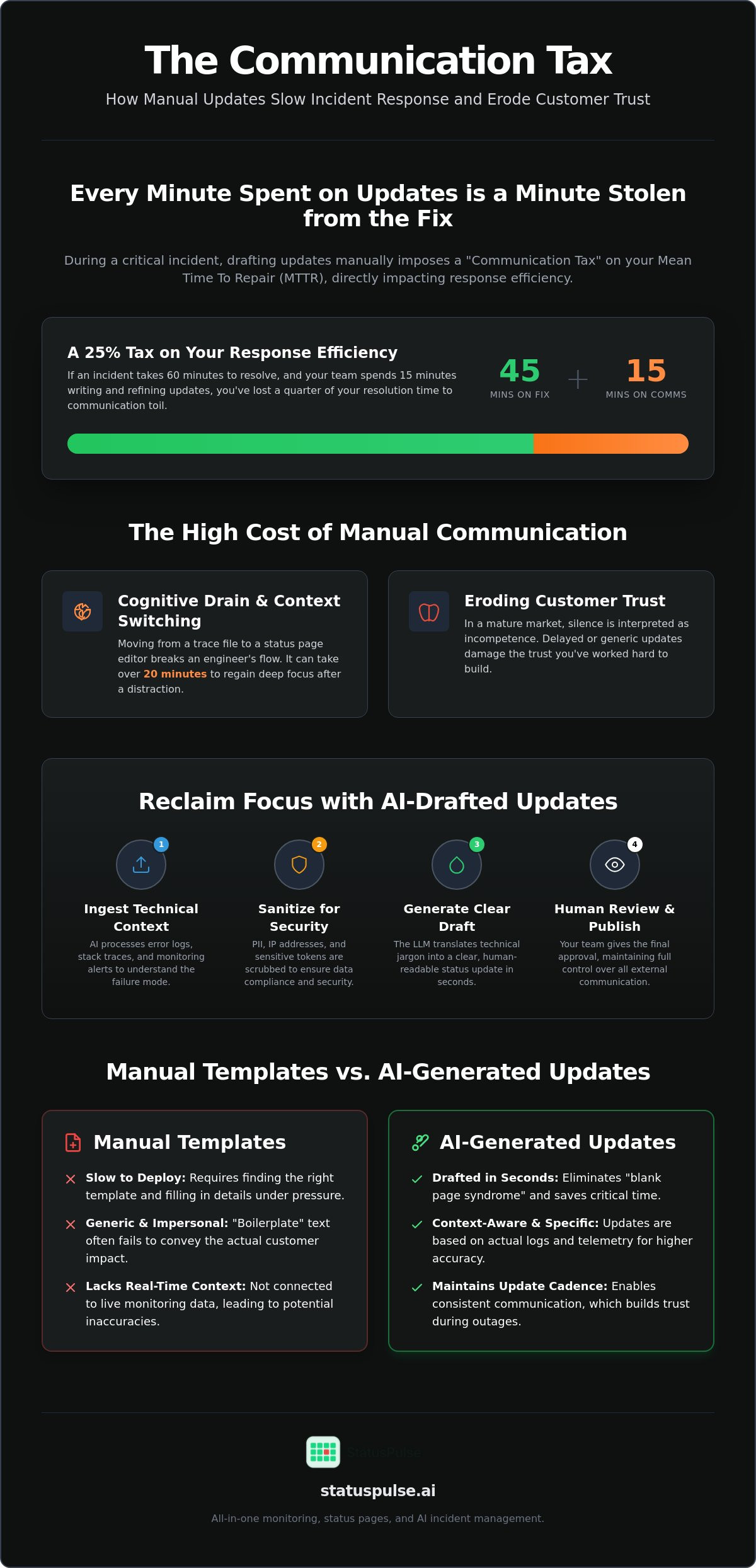
We can quantify this as a "Communication Tax" on your Mean Time to Repair (MTTR). If an incident takes 60 minutes to resolve and your team spends 15 minutes drafting and refining updates, you've paid a 25% tax on your response efficiency. This tax becomes heavier as stakeholder expectations rise. Relying on "better discipline" or "remembering to post" is a failed strategy. Under pressure, human memory defaults to the immediate technical problem. Systems fail because humans are busy fixing them; they don't fail because of a lack of empathy for the user.
The rise of Artificial Intelligence for IT Operations (AIOps) has introduced a way to break this cycle. By utilizing AI-Drafted Incident Updates That Keep Customers Informed in Seconds, teams can offload the linguistic heavy lifting to a specialized assistant. This isn't about removing the human from the loop. It's about ensuring the human doesn't have to start from a blank page when the stakes are highest.
The Context-Switching Penalty
Moving from a complex trace file to a public-facing dashboard breaks your cognitive flow. Research from the University of California, Irvine, suggests it can take over 20 minutes to regain deep focus after a significant distraction. When updates are manual, you're essentially forcing your best engineers to distract themselves every 30 minutes. This context switching doesn't just slow down the fix; it increases the likelihood of errors in both the code and the communication. Delays in posting also lead to an immediate spike in support ticket volume, creating a secondary wave of toil for your customer success team.
Transparency as a Competitive Advantage
In a mature SaaS market, silence is interpreted as incompetence. Modern customers don't expect 100% uptime, but they do expect 100% honesty. Maintaining The Architecture of Incident Communication Transparency is a critical retention tool. If you can provide AI-Drafted Incident Updates That Keep Customers Informed in Seconds, you demonstrate control over the situation. This level of transparency builds a foundation of trust that survives technical disruptions. It transforms a service failure into an opportunity to prove your operational maturity.
How AI Incident Management Automates the Drafting Process
Modern incident management systems don't just alert you to a problem; they act as a translation layer between your infrastructure and your customers. The mechanism relies on Large Language Models (LLMs) that ingest technical context from your stack. This includes error logs, stack traces, and monitoring alerts. By analyzing these inputs, the AI identifies the specific failure mode and maps it to human-readable impact levels. It's a structured workflow that starts the moment an alert triggers, moving from raw telemetry to a refined draft ready for review.
Security is a primary concern when using AI in production environments. Before any technical data is processed for drafting, systems must strip out Personally Identifiable Information (PII). This involves scrubbing IP addresses, customer IDs, and sensitive tokens from the logs. This ensures that your AI-Drafted Incident Updates That Keep Customers Informed in Seconds remain compliant with data sovereignty requirements while providing the necessary context for the update.
If you're looking for a way to bridge the gap between technical monitoring and customer communication, exploring AI incident management can help your team regain focus during critical events.
Ingesting Technical Context
AI excels at distilling high-volume monitoring data into concise summaries. It can distinguish between a transient timeout and a systemic database lockup. Effective API monitoring provides the specific endpoint context that allows the AI to determine which customer features are currently degraded. This prevents the common mistake of sending generic updates that don't actually tell the user what's broken. The AI filters out internal jargon, like "OOMKilled" or "Race Condition," replacing it with clear descriptions of service availability.
The Human-in-the-Loop Model
Automation should never bypass human judgment. AI-Drafted Incident Updates That Keep Customers Informed in Seconds are most effective when framed as a "first draft" assistant. According to the NIST Computer Security Incident Handling Guide, effective communication is a core component of the response lifecycle. However, a human should always click the final "publish" button.
The speed advantage is undeniable. Editing a pre-written draft takes about 10 seconds; writing a clear, empathetic update from scratch can take 10 minutes or more. This prevents the "uncanny valley" of robotic incident updates. By allowing an engineer to tweak the tone or add a specific ETA, you maintain a human connection with your users. You get the speed of a machine with the accountability of a specialist.
Manual Templates vs. AI-Generated Status Updates
Templates were once the industry standard for reducing communication latency. They provided a basic structure that saved engineers from formatting issues during a crisis. However, static templates are inherently rigid. They rely on pre-defined severity levels and generic placeholders that often fail to capture the nuance of a specific technical failure. If every update begins with "We are investigating reports of connectivity issues," your customers will eventually succumb to template fatigue and stop reading entirely.
The transition to AI in incident management represents a shift from static to dynamic communication. Unlike a template, which requires an engineer to manually fill in the "what" and "why," AI-Drafted Incident Updates That Keep Customers Informed in Seconds generate content based on real-time telemetry. This removes the burden of translation from the responder. You move from a system of "fill-in-the-blanks" to a system of "verify-and-publish."
When Templates Fail
Static templates struggle with edge cases. If an incident doesn't fit neatly into your P1 or P2 categories, the template often feels forced or inaccurate. There's also a significant reputational risk; we've all seen public status pages that accidentally leave "Insert Service Name Here" in a live update. Even with a template, the cognitive load remains high. The engineer must still interpret the logs, decide which template fits, and manually type the specific details. This process is prone to human error when the team is under pressure.
The AI Advantage in 2026
By 2026, the expectations for transparency have evolved. Customers now demand updates that adapt as the scope of an incident changes. AI-Drafted Incident Updates That Keep Customers Informed in Seconds can automatically adjust the technical depth of an update based on the audience. It can also handle multi-language support for global user bases, eliminating the need for manual translation during a regional outage. Perhaps most importantly, AI can summarize complex post-mortems into digestible summaries for non-technical stakeholders, ensuring that everyone from the SRE to the CEO understands the path to resolution without requiring a custom-written report for each group.
Best Practices for Implementing AI-Drafted Updates
Effective use of AI-Drafted Incident Updates That Keep Customers Informed in Seconds depends on clear severity-based triggers. You don't need AI for every minor blip. Instead, configure your system to trigger drafting assistance only when an incident reaches a specific threshold, such as a 5% error rate on your checkout service. This ensures that your technical responders aren't overwhelmed by drafts for trivial issues while receiving critical support during major outages.
One often overlooked benefit is the ability to generate dual-stream communication. AI can simultaneously produce an internal draft filled with technical jargon for your SRE team and a customer-facing draft that focuses on service impact. This keeps your internal stakeholders aligned without confusing your users with low-level kernel logs or database locking details. To maximize the value of your automation, you should implement AI incident management that integrates directly with your existing monitoring stack.
Setting Up the Drafting Workflow
The initial configuration defines the quality of the output. Follow these three steps to build a reliable pipeline:
- Step 1: Connect your monitoring stack. Ensure your incident tool has read access to your monitoring alerts and technical logs. This provides the context the AI needs to understand the failure.
- Step 2: Map your services. Define which infrastructure components affect specific customer-facing features. If the 'auth-db' is down, the AI should know to mention login issues, not general performance.
- Step 3: Configure the tone. Set parameters for how the AI should sound. For technical audiences, a direct and transparent tone is usually more effective than an overly apologetic one.
Refining the Output
Technical updates should prioritize facts over sentiment. Use the "Show, Don't Tell" principle to build credibility. Instead of stating that your team is "working hard," the update should describe specific actions, such as "restarting the secondary database cluster." This level of detail proves competence more effectively than any superlative.
Avoid industry hype words. Terms like "seamless" or "revolutionary" have no place in an incident update. During an outage, these words feel dishonest and corporate. If the root cause is still unknown, be direct about it. An AI-Drafted Incident Updates That Keep Customers Informed in Seconds can state that the team is currently investigating the networking layer, which is far more useful than a generic "we are aware of the issue" message. Periodically audit these drafts to refine your prompts and ensure the AI isn't hallucinating technical details.
Scaling Transparency with StatusPulse AI Incident Management
StatusPulse is built on the principle that incident management should be straightforward and ethical. We've integrated uptime monitoring directly with our status pages to create a unified workflow. This allows for AI-Drafted Incident Updates That Keep Customers Informed in Seconds without requiring you to stitch together multiple expensive tools. By keeping monitoring and communication in one place, we reduce the technical debt often associated with complex incident stacks.
Data sovereignty is not an afterthought for us. We offer a choice between dedicated EU and US hosting for your incident logs and status pages. This ensures you can meet regional privacy requirements without compromising on performance. Many legacy platforms default to US-based infrastructure, leaving European teams to navigate complex compliance hurdles on their own. We believe privacy is a core virtue, not a marketing checkbox.
Our pricing model reflects our commitment to fairness. We don't charge per-subscriber or per-incident fees. You pay a flat rate for the platform, which removes the financial penalty for being transparent with your users. It's a principled approach that contrasts with the corporate bloat and complex pricing models common among industry incumbents. We view our AI tools as assistants that require a final human action; you always maintain agency over your message.
Technical Precision Without the Bloat
We've stripped away the unnecessary filler that plagues enterprise software. Our UI is designed for high-stress situations where you need to find information quickly. You won't find cluttered dashboards or buried settings here. This minimalist approach means you can get started with AI incident management in under 5 minutes. While legacy platforms focus on feature bloat, we focus on the precision required by specialists.
Reliability Built for Developers
StatusPulse offers native integration with SSL and uptime monitoring. These proactive alerts feed directly into our drafting engine, providing the context needed for AI-Drafted Incident Updates That Keep Customers Informed in Seconds. This integration ensures that your status page is always in sync with your actual service availability. It's a reliable system built by specialists who understand the cost of downtime.
Start your free trial of StatusPulse to see how AI-powered transparency can improve your incident response.
Reclaiming Your Focus During Critical Incidents
Managing a P1 incident is demanding enough without the added burden of manual communication toil. By offloading the initial draft to a context-aware assistant, you protect your team's cognitive flow and reduce the context-switching penalty that often delays resolution. This approach transforms transparency from a difficult chore into a reliable operational standard.
Implementing AI-Drafted Incident Updates That Keep Customers Informed in Seconds ensures your users stay updated while your engineers stay focused on the root cause. StatusPulse provides the infrastructure to make this possible; offering dedicated EU or US hosting for data sovereignty and a flat, transparent pricing model that avoids per-subscriber fees. You maintain full control with a drafting engine that functions as an assistant, ensuring every update meets your technical standards before it goes live.
It's time to stop paying the communication tax and prioritize your response efficiency. Automate your incident updates with StatusPulse and build long-term trust through consistent, honest transparency.
Frequently Asked Questions
Is AI-drafted incident communication safe for public status pages?
Yes, it is safe as long as you maintain a human-in-the-loop workflow. AI functions as a drafting assistant that transforms technical logs into readable text, but an engineer should always review and approve the content before it goes live. This prevents hallucinations and ensures that sensitive internal details aren't accidentally disclosed to the public.
How does AI know the technical details of my specific outage?
The AI ingests data from your connected monitoring stack, including error logs, stack traces, and API telemetry. It analyzes these inputs to identify the failure mode and service impact. By mapping infrastructure components to customer-facing features, the system provides specific context rather than generic boilerplate messages.
Can I customize the tone of the AI-generated updates?
Yes, you can set specific parameters for tone and technical depth. Most teams configure the AI to remain direct and technical for SRE-focused updates while using a more accessible, empathetic tone for public status pages. This ensures that AI-Drafted Incident Updates That Keep Customers Informed in Seconds align with your established brand voice.
Does using AI for incident management comply with GDPR?
Compliance depends on where your data is stored and how PII is handled. StatusPulse supports data sovereignty by offering dedicated EU or US hosting options. Most obligations for high-risk systems under the EU AI Act come into force on August 2, 2026, so choosing a provider that prioritizes regional hosting and PII scrubbing is critical for regulatory alignment.
What is the difference between an AI SRE agent and AI drafting?
AI SRE agents focus on remediation and automated root cause analysis, often attempting to fix the issue directly. AI drafting is a communication tool that focuses strictly on stakeholder transparency. Drafting is generally lower risk because it doesn't execute code; it simply assists the human responder in managing the narrative during a crisis.
How much does AI incident management typically cost?
Market pricing varies significantly between legacy providers and modern platforms. Competitors like incident.io offer AI features starting at $25 per user per month as of April 2026, while PagerDuty charges monthly add-on fees of $415 or more for generative AI. StatusPulse uses a flat, transparent pricing model to avoid the complexity of per-subscriber or per-incident fees.
For founders and business leaders looking for this same level of clarity in other AI-driven tools, you can explore Platform Subscription Fees to see how WeGain supports sellers and learners with predictable, transparent costs.
Can AI help with post-mortem reports after the incident is resolved?
Yes, AI can automatically generate a structured timeline and summary based on the incident logs and chat history. This eliminates the manual effort of reconstructing the event from scratch. It ensures that post-mortems are completed quickly while the technical details are still fresh, leading to better long-term architectural improvements.
Will AI-drafted updates reduce my support ticket volume?
Yes, increasing the speed and frequency of updates directly correlates with lower ticket volume. When you provide AI-Drafted Incident Updates That Keep Customers Informed in Seconds, you satisfy user curiosity before they reach out to your support team. Transparency proves that you're aware of the issue, which prevents a secondary wave of manual support toil.


