
Your primary AWS region just went dark. Is your status page currently a 404 error? If your dashboard is hosted on the same cluster it's supposed to monitor, you aren't just flying blind; you've locked the cockpit door from the inside. It's a frustrating irony. You need to tell your customers what's happening, but you can't even log in to the tool meant to send the update. The average cost of IT downtime is now $5,600 per minute. Silence makes that bill even harder to swallow.
Understanding Why Your Status Page Shouldn't Run on the Same Infrastructure It Monitors is the difference between keeping customer trust and losing it to a technical lie. 89% of SaaS buyers check vendor status pages before purchasing. They want transparency, not a page that crashes alongside the app. Learn why infrastructure decoupling is the only way to ensure your status page remains a source of truth during a total system collapse. We'll explore how to build a 100% independent communication layer with automated triggers that keep your team focused on the fix, not the fallout.
Key Takeaways
- Eliminate circular dependencies to ensure your status page remains live when your main app fails.
- Recognize why sharing DNS or deployment pipelines creates invisible failure domains that threaten your reliability.
- Learn Why Your Status Page Shouldn't Run on the Same Infrastructure It Monitors to maintain a source of truth during total system collapses.
- Compare the long-term costs and Mean Time to Acknowledge (MTTA) benefits of third-party isolation versus in-house integration.
- Use a practical checklist to decouple your hosting and management layers for maximum crisis resilience.
The Circular Dependency Trap: When the Messenger Fails
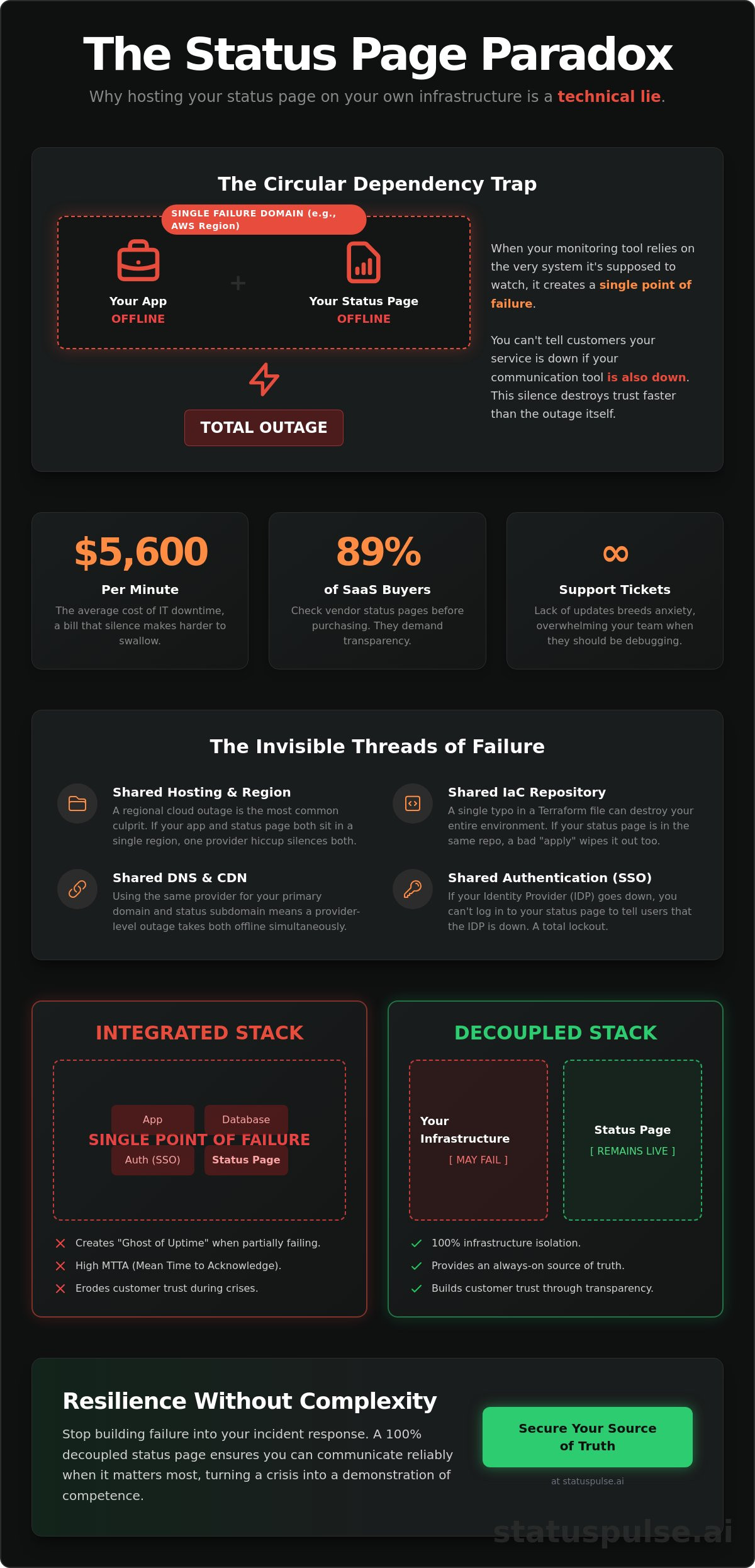
A circular dependency occurs when your monitoring tool relies on the very system it's supposed to watch. It's a technical loop. If your primary server goes down, the status page goes with it. This creates a dangerous single point of failure. It's the equivalent of a security guard locking himself inside the vault he's guarding. You can't report a fire if the phone line is currently melting.
When a customer sees a "503 Service Unavailable" on your status page, the damage is immediate. It's a brand killer. It suggests a lack of foresight. It proves you weren't prepared for the inevitable. This is exactly Why Your Status Page Shouldn't Run on the Same Infrastructure It Monitors. You need a messenger that can survive the message. Anything else is just theater.
Then there's the "Ghost of Uptime." This happens when your status page remains green while your users are seeing errors. Usually, it's because the internal script responsible for updating the status has crashed along with the database. A green light during a total outage is a technical lie. It destroys trust faster than the downtime itself. Customers would rather hear bad news than be told everything is fine when it clearly isn't.
The paradox is simple. Your status page is only useful when your primary infrastructure is failing. If it shares the same fate as your app, it provides zero value. True redundancy requires total isolation. Not just a different server. A different world.
The Psychology of Incident Communication
Silence is loud. During an outage, a lack of updates breeds customer anxiety. This leads to support ticket storms that overwhelm your team when they should be debugging. Transparency isn't just a feature; it's an ethical obligation to the people who pay for your service. A reliable status page is also critical for proving SLA compliance. It provides a neutral record of uptime that both parties can trust. Honest communication reduces churn. It turns a crisis into a demonstration of competence.
Common Failure Scenarios in 2026
Regional cloud outages are the most common culprits. If your app and status page both sit in a single region, one provider hiccup silences both. We also see the "Shared Pipe" problem. A networking failure might isolate an entire data center. If your monitoring probes are internal, they might think everything is fine. They can still talk to the local database. They fail to see that the rest of the world can't reach them. External connectivity issues require external monitoring. Period.
Identifying Shared Failure Domains: The Invisible Threads
Isolation is often an illusion. You might think hosting your status page on a separate VPS is enough. It isn't. The threads that bind your systems together are often invisible until they snap. This is Why Your Status Page Shouldn't Run on the Same Infrastructure It Monitors. If your main application and your status page share a management console, a deployment pipeline, or a single set of credentials, they are effectively the same system. One failure cascades into the other.
Shared management layers are a silent killer. Imagine your CI/CD pipeline fails. If that same pipeline manages your status page updates, you lose the ability to communicate. You are stuck. Similarly, shared authentication is a major risk. Many teams use SSO for everything. If your Identity Provider (IDP) goes down, you can't log in to your status page to tell users that the IDP is down. It's a total lockout. You need a backdoor that doesn't rely on your primary stack.
DNS and CDN overlaps are equally dangerous. If you use the same provider for your primary domain and your status subdomain, a provider-level outage takes both offline. Using a secondary, independent provider ensures resilience when main services fail. True isolation means having no shared dependencies. Zero. This includes your network routing, your security layers, and your administrative access.
Infrastructure as Code (IaC) Overlap
Automation is great until it isn't. A single typo in a Terraform file can destroy your entire environment. If your status page is defined in the same repository as your production infrastructure, a bad "apply" can wipe out your communication channel. IaC isolation prevents cascading configuration errors by ensuring that a failure in one environment cannot physically reach or modify the other. Use separate repositories. Use separate state files. Keep them air-gapped to prevent a single script from silencing your brand.
DNS and SSL Dependencies
Your status page should live on a different TLD or at least a different DNS provider. This prevents a single configuration error or registrar issue from blacking out your entire web presence. SSL certificates are another common trap. If you use a shared renewal pipeline and it breaks, both your site and your status page will show browser warnings. Implementing SSL Certificate Monitoring adds a final layer of protection. It alerts you before a shared dependency becomes a public failure.
Building this level of redundancy manually is exhausting and expensive. Most teams prefer a turnkey status page that handles this isolation by design, ensuring your voice stays online when your app goes quiet.
Decoupled vs. Integrated: A Technical Comparison
Choosing between a DIY status page and a third-party solution is a choice between perceived savings and actual reliability. An integrated status page feels convenient. It lives in your existing repo. It uses your existing database. But this convenience is a liability. Why Your Status Page Shouldn't Run on the Same Infrastructure It Monitors comes down to Mean Time to Acknowledge (MTTA). When your primary stack fails, an integrated page often fails too. You spend the first 15 minutes of an outage trying to fix your status page instead of fixing your product. That is a waste of expensive engineering talent.
The "Skinning" trap is a common rookie mistake. You build a beautiful status page. You link it to your main application's CSS and JavaScript files to keep the branding consistent. Then your primary CDN or asset server goes down. Your status page becomes a broken mess of unstyled text and missing icons. It looks unprofessional. It signals chaos. A decoupled page must be entirely self-contained. It should load its own assets from a completely independent network. Reliability is more important than matching your site's exact hover-state hex code.
The True Cost of In-House Status Pages
Engineering hours are your most expensive resource. Building a status page takes time. Maintaining it takes even more. You have to manage security patches, database migrations, and scaling issues for a tool that isn't your core product. This leads to incident fatigue. During a crisis, your engineers are forced to fight on two fronts. They are debugging the app and the communication tool simultaneously. Dedicated uptime monitoring services provide a higher ROI by removing this burden. They allow your team to focus on the fix. The average cost of IT downtime is $5,600 per minute. Every second spent fixing a status page is money disappearing from your bottom line.
Third-Party Isolation Benefits
Third-party providers offer global probe networks. They check your services from dozens of locations worldwide. Internal health checks can't do this. They only see what is happening inside your network. SaaS providers also offer native multi-region redundancy. If one cloud region fails, their infrastructure automatically fails over to another. This level of resilience is difficult and costly to build in-house. Finally, these tools use zero-trust access models. They remain functional even if your internal LDAP or SSO provider is offline. You can still log in. You can still update your customers. You stay in control when everything else is falling apart.
Implementation Checklist for Infrastructure Isolation
Achieving true isolation requires a disciplined approach. It isn't just about moving a few files. It's about severing every technical link between your application and your status page. Follow this checklist to ensure your communication remains bulletproof. This is the practical side of Why Your Status Page Shouldn't Run on the Same Infrastructure It Monitors. If you miss one step, you leave a bridge for failure to cross.
- Host on a different cloud provider. If your main stack lives on AWS, host your status page elsewhere. StatusPulse, for example, uses isolated EU-cloud infrastructure to ensure geographic and provider redundancy.
- Use an independent DNS provider. Do not use the same registrar or DNS service for your status subdomain. A single configuration error or registrar lockout shouldn't be able to black out your entire web presence.
- Decouple all assets. Ensure 0% of your CSS, images, or JS load from your primary domain. If your main CDN fails, your status page must still look and function perfectly.
- Implement external monitoring probes. Use multiple global regions to verify availability from the user's perspective. Internal health checks are often blind to external routing issues.
- Separate your authentication. Use magic links or independent credentials for incident responders. Do not rely on your primary SSO or LDAP, as these are often the first things to fail during a major outage.
Establishing External Probes
Probes are your early warning system. You need 1-minute checks from at least 3 global regions to get an accurate picture of service health. This prevents local network hiccups from triggering false alarms. Configuring "Confirmation Counts" is essential. Require at least two regions to report a failure before you alert the team. For a deeper look at setting up these checks, see our API Monitoring guide. Reliable data leads to faster resolution.
The 'Clean Room' Status Page
Audit your status page for hidden dependencies. Open your browser dev tools and check the "Network" tab. If you see any requests going to your primary domain, your isolation is compromised. Your incident communication tools must never rely on your primary database to fetch data or render content. A static status page is more resilient than a dynamic one because it removes the database as a potential failure point. It serves information even when your backend is in total collapse.
Ready to move your status page to a truly isolated environment? Start your free trial with StatusPulse today and secure your communication bridge.
Resilience Without Complexity: The StatusPulse Solution
StatusPulse is built on a simple premise. You shouldn't have to build a second infrastructure just to monitor the first one. We provide a turnkey solution that handles the heavy lifting of isolation for you. It's ready to go. No complex configuration. No shared dependencies. This is the ultimate answer to Why Your Status Page Shouldn't Run on the Same Infrastructure It Monitors. We host your status page on an entirely different cloud provider. We use independent DNS. We ensure your assets are self-contained. It works because it's separate. Our team is small and focused on precision. We aren't a faceless corporation with complex, bloated pricing. We offer a fair, ethical alternative for users tired of corporate bloat and hidden costs.
Automated triggers are a core part of the experience. They reduce your Mean Time to Acknowledge (MTTA) by "waking up" the status page the moment a failure is detected. You don't have to manually trigger an incident while you're still trying to figure out what broke. The system starts the conversation for you. It's about human agency assisted by smart tools. This logical flow moves you from problem to solution without the usual enterprise fluff. It respects your time and your intelligence by providing a product that's reliable and straightforward.
AI as the Incident Responder's Assistant
Outages are high-stress events. Your engineers are under fire. They don't have time to write poetic updates for your customers. StatusPulse uses AI Incident Management to solve "blank page syndrome." The AI can summarize technical logs into customer-friendly updates in seconds. It maintains a consistent, calm brand voice using your predefined templates. You review the draft. You click send. The tool acts as an assistant, but you retain final control. This ensures transparency without slowing down the recovery process. It's an ethical approach to automation that values human oversight and reduces the mental load on your team during a crisis.
Global Reliability, Local Privacy
Physical isolation is only half the battle. Regulatory isolation matters too. We host our infrastructure in the EU. This provides a distinct regional signature and ensures strict GDPR compliance for modern enterprises. Privacy isn't a marketing afterthought here. It's a core virtue. Global probe networks are essential for detecting regional ISP issues that internal monitoring misses. You get a clear view of how the world sees your app. It's about truth. It's about precision. You can trust the data because the domains are truly decoupled and hosted with integrity.
Don't wait for your next outage to realize your status page is down too. Build your resilient status page with StatusPulse today.
Secure Your Communication Bridge
True resilience requires total isolation. You've seen how shared failure domains and circular dependencies can silence your brand during a crisis. By severing the technical links between your main application and your status page, you protect your most valuable asset: customer trust. A decoupled strategy ensures that even if your primary cloud region fails, your voice remains online. The logic behind Why Your Status Page Shouldn't Run on the Same Infrastructure It Monitors is undeniable. It's about being prepared before the first alert sounds.
StatusPulse offers a straightforward path to this level of reliability. We provide EU-based cloud hosting for physical isolation and regulatory compliance. Our platform includes API and SSL monitoring to catch issues before they become outages. With AI-powered incident management, you can draft clear updates in seconds, keeping your focus on the fix. You don't need a massive engineering budget to achieve enterprise-grade redundancy. You just need a principled approach. Start building a resilient status page for free with StatusPulse today. Stay online when it matters most.
Frequently Asked Questions
What is a shared failure domain in cloud architecture?
A shared failure domain is a group of technical components that fail together because they share a single dependency. In cloud environments, this often includes sharing a specific region, a networking stack, or a management layer. If your application and your status page rely on the same underlying resources, they reside in the same failure domain. One technical glitch or provider outage will silence both simultaneously.
Can I host my status page on a different region of the same cloud provider?
You can, but it's a half-measure that leaves you vulnerable. While regional isolation protects against local hardware failures, you still share the provider's global control plane and identity management systems. A provider-wide authentication error or billing issue would still take your status page offline. This is a primary reason Why Your Status Page Shouldn't Run on the Same Infrastructure It Monitors. True resilience requires switching providers entirely.
Why shouldn't I use the same DNS for my status page and website?
Using the same DNS provider creates a dangerous single point of failure. If your DNS provider suffers a DDoS attack or a major configuration error, both your main site and your status page will disappear from the internet. By using an independent DNS provider for your status subdomain, you ensure customers can always find your incident updates even when your primary domain is completely unreachable.
How does StatusPulse ensure its own infrastructure stays up?
We use a multi-cloud architecture designed for maximum survival. Our core infrastructure is physically isolated in EU-based data centers, keeping us independent of the major US-based cloud giants. We also employ global probe networks to verify our own availability in real-time. This tiered redundancy ensures our status pages stay online and functional even when the rest of the web is experiencing a major disruption.
Is it possible to automate status page updates without shared dependencies?
Yes, you can achieve this by using external monitoring probes that communicate via webhooks. These probes live outside your network and check your services from the public internet. When they detect a failure, they send a signal directly to your status page. This workflow doesn't rely on your internal cron jobs or local scripts. It maintains total independence between your monitoring logic and your primary application stack.
What happens to my status page if my SSO provider goes down?
If you rely solely on a shared SSO provider, you'll be locked out of your status page during an identity provider outage. StatusPulse prevents this by offering independent login methods like magic links and dedicated credentials. You need a reliable backdoor that stays open when your primary authentication stack is in total collapse. This ensures your team can still communicate with customers during the most critical moments.
How many monitoring regions do I need for a reliable status page?
You should use at least 3 global regions to ensure data accuracy. Checking from multiple locations prevents false positives caused by local ISP issues or regional routing hiccups. It provides a holistic view of your service health. If two out of three regions report a failure, you know it's a real incident. This multi-region approach gives you the confidence to trigger automated alerts without worrying about false alarms.
Does a third-party status page impact my site's SEO performance?
It has a positive impact on your brand's trust signals and professional reputation. While it doesn't directly change your main site's keyword rankings, it provides a transparent history of reliability that search engines and AI assistants can index. A well-maintained status page on a dedicated subdomain shows that you are a trustworthy vendor. It builds the credibility necessary to convert high-value enterprise leads who prioritize uptime and transparency.


