
The biggest cost of your last outage wasn't the handful of refunded subscriptions. It was the three days of roadmap progress your team lost while recovering. For a small team, momentum is everything. When you are trying to understand The True Cost of Downtime for a 20-Person SaaS (With a Calculator), you have to look beyond the Stripe dashboard. You're paying senior DevOps engineers an average of $143,000 per year to fight fires instead of building features. It's frustrating. It's expensive. Honestly, it's avoidable.
We know the struggle of explaining "lost productivity" to a non-technical founder who only sees a green status icon. It feels like a losing battle. This article provides a precise framework to help you stop guessing and start measuring. We will show you how to calculate exactly what an outage costs your team, from hidden AWS fees to the erosion of customer trust. We'll break down the math behind developer burnout and infrastructure waste. By the end, you'll have a clear dollar figure for your next board meeting and a strategy to reduce support tickets during your next incident.
Key Takeaways
- Stop relying on Fortune 500 statistics that don't reflect your reality. Learn why small team downtime is primarily about lost momentum rather than just theoretical revenue.
- Use our step-by-step formula to calculate The True Cost of Downtime for a 20-Person SaaS (With a Calculator) by combining hourly revenue leakage with actual employee payroll costs.
- Quantify the productivity drain that happens when your developers are pulled away from roadmap features to manage emergency incidents.
- Reduce support ticket volume and protect customer trust with automated one-minute uptime checks and native public status pages.
- Avoid the "Startup Tax" by choosing monitoring tools that are honestly priced and designed specifically for modern Jamstack and multi-region architectures.
Why Enterprise Downtime Stats are Irrelevant for Small SaaS Teams
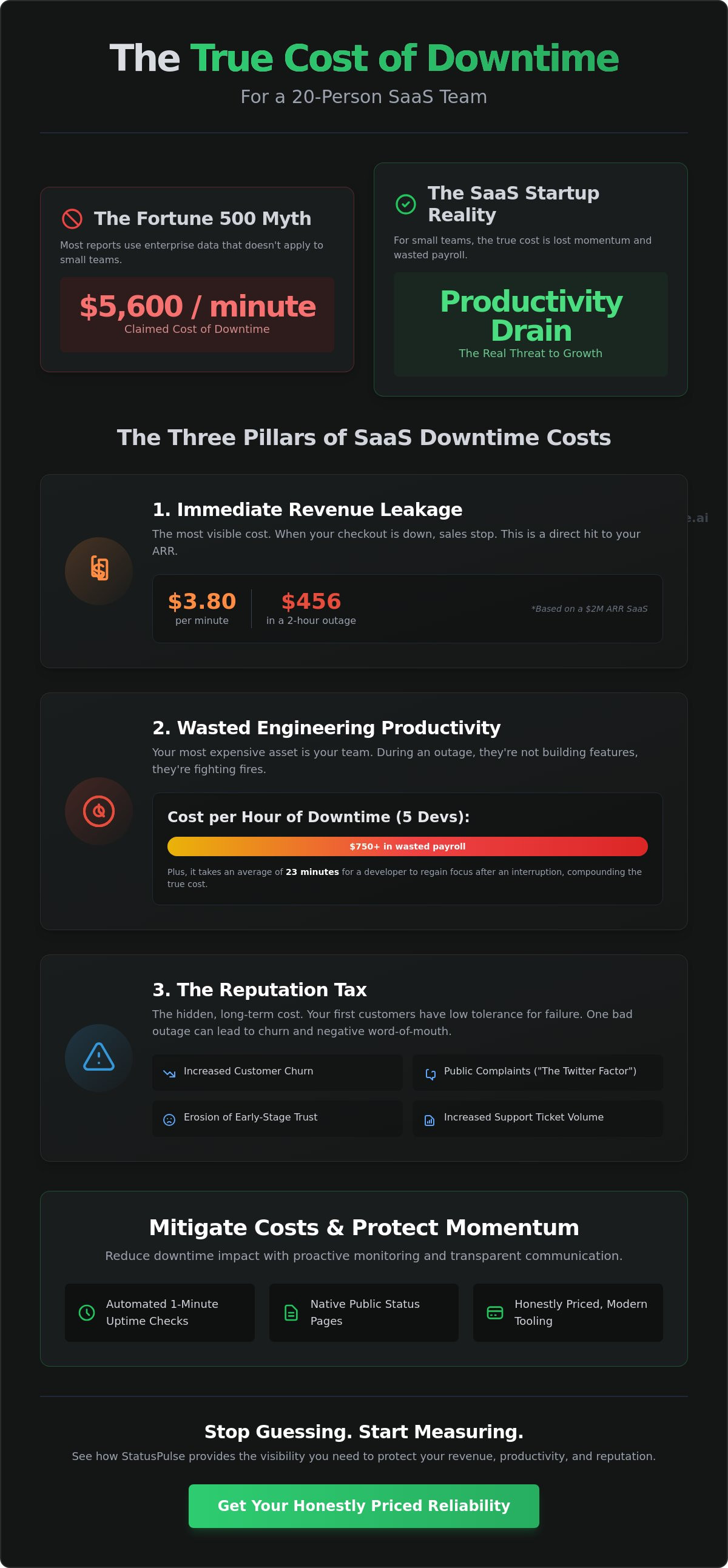
Most industry reports claim downtime costs $5,600 per minute. That is a Fortune 500 number. It is designed to scare enterprise CTOs into signing six-figure contracts with massive incumbents. For a 20-person team, that figure is meaningless. It does not help you plan a budget or justify your monitoring stack. You need a realistic way to measure The True Cost of Downtime for a 20-Person SaaS (With a Calculator) that reflects your actual payroll and revenue.
Enterprise giants can absorb an hour of silence. Their brand is a fortress. Your brand is a glass house. While a global bank might lose millions in transactions, a small SaaS loses something more valuable: momentum. We define "True Cost" as the sum of immediate revenue leakage, wasted engineering productivity, and the long-term impact of early-stage churn. Achieving high availability is not just a technical goal. It is a financial necessity for survival.
The math for a 20-person org is different. You aren't losing $100k an hour in sales. You're losing the focus of your only three senior developers. You're paying for their time while they stare at logs instead of building your next core feature. That is the real drain on your bank account.
The Fragility of Early-Stage Trust
Your first 100 customers have a low tolerance for silence. They took a risk on a smaller provider. When your app goes dark, they wonder if you'll ever come back. This is the "Twitter Factor." One public complaint from a frustrated user can reach your entire prospect pool. Transparency is your only survival mechanism. If you don't have a public status page, you're letting the rumors define your reliability. Small teams must be more honest than the giants. It's how you build a moat.
Hard Costs vs. Soft Costs in a 20-Person Org
Hard costs are the ones you see in your accounting software. These include direct revenue loss from a broken checkout flow or SLA penalties. If your infrastructure provider fails, you might still owe your customers credits. It's a double hit to your margins. Soft costs are harder to track but often more expensive. Think about the "Support Spike." Answering 50 identical emails asking "Is it down?" is a massive waste of human capital. It prevents your team from doing work that actually grows the business. We focus on reducing these frictions so you can stay lean and focused.
The Three Pillars of SaaS Downtime Costs
Thinking of downtime as a single bill is a mistake. It's more like a high-interest debt that you pay in three distinct installments. For a 20-person team, these costs hit harder because you don't have the "corporate bloat" to absorb the impact. Every minute your app is dark, your burn rate stays the same while your output hits zero. This creates what we call "Downtime Compound Interest." You lose cash today, talent tomorrow, and customers next month. To understand The True Cost of Downtime for a 20-Person SaaS (With a Calculator), you must look at the three pillars that support your business: Revenue, Productivity, and Reputation.
The first pillar is immediate revenue leakage. It's the most obvious. If your checkout flow is broken, you aren't making money. While big incumbents might worry about the average cost of downtime reaching millions, your leak is proportional. A $2 million ARR company loses about $3.80 every minute. It sounds small. But over a two-hour outage, that's nearly $500 in raw sales. That doesn't include the marketing spend you wasted on ads that sent traffic to a 404 page.
Productivity: Your Most Expensive Asset is Idling
Your team is your biggest expense. In a 20-person org, you likely have five to eight developers. At a fully-loaded cost of $150 per hour per developer, a total site failure costs you $750 to $1,200 per hour in idling talent. This is the "Waiting Room" effect. It's not just the devs. Sales can't demo. Support is underwater. Marketing has to pause campaigns. Context switching is the silent killer here. Research shows it takes about 23 minutes to regain focus after a distraction. A 30-minute blip actually costs you two hours of meaningful work. Setting up automated uptime monitoring ensures your team finds out from a bot, not a screaming customer, saving precious recovery time.
The Reputation Tax and Customer Churn
The third pillar is the Reputation Tax. This is the most dangerous because it's hidden. We call these users "Silent Churners." They don't cancel during the outage. They cancel three months later because they've lost confidence in your reliability. For an early-stage SaaS, keeping a frustrated customer is significantly cheaper than acquiring a new one. A public status page acts as a trust insurance policy. It shows you're honest and in control. Without it, you're just another "unreliable startup" in the eyes of your users. Transparency turns a technical failure into a brand-building moment.
The 20-Person SaaS Downtime Formula: Step-by-Step
Calculating The True Cost of Downtime for a 20-Person SaaS (With a Calculator) requires more than just looking at your Stripe dashboard. You need a formula that accounts for both visible leaks and invisible drains. Big companies use complex spreadsheets, but you don't have time for that. You need a fast, honest assessment of what happened. Follow these five steps to build your internal report.
- Step 1: Calculate Hourly Revenue. Take your Total Annual Recurring Revenue (ARR) and divide it by 525,600 minutes. This gives you your baseline leakage per minute.
- Step 2: Define Employee Cost per Hour. Divide your total annual payroll by 2,080 working hours. This represents the idling cost of your team.
- Step 3: Factor in the 'Context Switching' Multiplier. Apply a 1.5x to 2x multiplier to your technical team's hourly rate to account for lost focus.
- Step 4: Estimate the 'Support Load'. Multiply the number of incident-related tickets by your average cost per ticket, which typically ranges from $15 to $25 for a growing SaaS.
- Step 5: Add the 'Churn Projection'. Estimate a 0.5 percent to 1 percent increase in monthly churn for the specific cohorts affected by the outage.
Understanding The True Cost Of Downtime is about seeing the full picture. It's not just about the missed sales. It's about the total operational disruption that stalls your company's growth.
A Practical Example: The 'Tuesday Morning' Outage
Imagine a SaaS with $2M ARR and 20 employees. A 60-minute outage on a Tuesday morning hits. The revenue loss is roughly $228. However, the payroll cost for 20 people averages $2,000 per hour. When you add a context switching tax of $1,000 and an extra $750 for support tickets, the total cost jumps to $3,978. That is for one hour. This number makes a €5 per month monitoring tool look like a rounding error. It's an investment in your team's sanity and your company's bank account.
The 'Context Switching' Multiplier Explained
Developers don't just go back to work the minute the server is up. They have to rebuild complex mental models. This takes time. Cognitive re-engagement studies suggest that deep work requires a specific flow state that is fragile. When an incident breaks that flow, the recovery phase is often longer than the outage itself. Context Switching Tax is the time required to rebuild mental models after an incident. This is why we prioritize simple, reliable status pages that keep customers informed without distracting your engineers from the fix.
Mitigation: How to Lower the Cost Without Hiring More Devs
Mitigation doesn't require a bigger engineering team. It requires smarter systems. Many small teams think they can save money with manual checks or "free" monitoring scripts. This is a mistake. If your senior developer spends three hours a month managing a home-grown script, that's $500 in lost productivity. For a 20-person team, that's more expensive than any professional tool. You need to automate the boring parts to protect your focus and truly understand The True Cost of Downtime for a 20-Person SaaS (With a Calculator).
Professional monitoring isn't just about knowing if a server is "up" or "down." It's about catching failures before they reach the user. One-minute uptime checks are essential for modern Jamstack sites and APIs. They allow you to respond before the support tickets start piling up. We believe in human agency. That's why our AI integration works simply: Claude drafts your incident update. You press send. It keeps the human in the loop while removing the friction of a crisis. No complex setups. No enterprise bloat.
Proactive Monitoring: Catching SSL and API Failures
Latency is the silent killer. If your API is slow, users treat it as down. Automating SSL certificate lookups prevents those embarrassing "Connection Not Private" errors that kill conversion rates. For a deeper dive into technical resilience, check out our API Monitoring: The Developer’s Guide. Catching these issues early saves you from the context switching tax we discussed earlier. It keeps your developers focused on the roadmap, not the fires.
Transparent Communication as a Cost Saver
Trust is a currency. Being GDPR-native and EU-hosted isn't just a compliance box. It's a signal to European customers that you care about their data integrity. A public status page can reduce your support ticket volume by up to 80 percent during an outage. Instead of answering dozens of identical emails, you provide one source of truth. StatusPulse helps small teams look enterprise-grade without the "Startup Tax." It's about being honestly priced and reliable. Stop wasting your team's time and start building trust with a status page that reflects your commitment to transparency.
The StatusPulse Advantage: Honestly Priced Reliability
Incumbents in the monitoring space often charge a premium just because they can. They call it enterprise pricing. We call it a "Startup Tax." For a 20-person team, every euro in the budget needs to justify its existence. That is why we are honestly priced. Our entry point is €5, not $29. We don't believe in hiding essential features like multi-region checks or SSL monitoring behind a massive paywall. Understanding The True Cost of Downtime for a 20-Person SaaS (With a Calculator) means choosing a partner that respects your margins while protecting your uptime.
Our platform is built for the modern web. We are native to Jamstack and multi-region architectures. This isn't a legacy system with a fresh coat of paint. It's a streamlined tool designed to catch latency and outages before your customers do. We also handle the stress of communication. Our AI incident management follows a simple rule: Claude drafts the update, you press send. It respects your agency. It removes the panic of staring at a blank text box during a crisis. You stay in control without the manual friction.
Privacy is not a marketing afterthought for us. We are EU-hosted and GDPR-native from the ground up. This gives you a distinct advantage when building trust with European customers who value data sovereignty. Silence during an outage is a choice, and it's usually a costly one. By providing a clear, honest status page, you turn a technical failure into a demonstration of integrity. It's about being the principled underdog that gets the details right.
Built by Developers, for Developers
We stripped away the corporate bloat. You won't find complex menus or unnecessary features that slow you down. StatusPulse is designed for a five-minute setup. You can integrate your first check and launch a public status page before your next stand-up meeting ends. This efficiency allows you to get back to your product roadmap instead of babysitting your monitoring stack. For more on how to build a reliable system, read our Uptime Monitoring: A Developer’s Guide. No surprises. Just reliability.
Your Next Step to 99.99% Uptime
Stop losing sleep over server blips and forgotten SSL renewals. You don't need a massive DevOps team to maintain high availability. You just need the right tools and a commitment to transparency. Draft your first honest incident update today and see how much easier recovery becomes when your customers are on your side. It's time to move away from overpriced incumbents and embrace a fairer way to monitor your stack. Protect your SaaS with StatusPulse and start measuring what matters.
Protect Your Team's Momentum and Your Bottom Line
Measuring The True Cost of Downtime for a 20-Person SaaS (With a Calculator) is the first step toward building a more resilient company. You've seen that the real drain isn't just a few missed sales. It's the thousands of dollars in idling developer talent and the long-term erosion of customer trust. By moving away from bloated enterprise statistics and focusing on your actual payroll and productivity, you can make better decisions for your infrastructure.
Reliability doesn't have to be expensive or complex. You can stop the support ticket avalanches and the context switching tax today. With 1-minute uptime checks and AI-assisted incident updates, you stay in control without wasting hours on manual reporting. Our platform is EU-hosted and GDPR-native. It's built for developers who care about the details. We provide the tools you need to stay honest with your users and focused on your roadmap.
Start monitoring for €5/month; honestly priced. No surprises. Just uptime. You've got a product to build. We'll watch the servers.
Frequently Asked Questions
How do you calculate the cost of downtime per hour?
Calculate the cost by adding your hourly revenue leakage to the idling cost of your team. For a 20-person SaaS, you divide your annual recurring revenue by the minutes in a year and add your total hourly payroll. Don't forget to apply a context switching multiplier for your technical team. This method provides an accurate look at the financial drain during an outage.
Is a 99.9% uptime really good enough for a small SaaS?
Three nines of uptime allows for nearly nine hours of downtime every year. For a growing company, that is over a full working day of silence and lost progress. While it sounds high, those nine hours often occur during peak traffic. Aiming for 99.99% reduces that window to just 52 minutes, which is much safer for protecting customer trust and early-stage momentum.
How does a public status page reduce support costs?
It acts as a single source of truth that deflects repetitive inquiries automatically. Instead of your support team answering dozens of identical "Is the site down?" emails, users check the status page first. This can reduce ticket volume by up to 80 percent during an incident. It frees your team to focus on the fix rather than managing a crowded, frustrated inbox.
What is the difference between hard and soft costs of downtime?
Hard costs are direct financial losses like missed sales, wasted ad spend, and SLA credits. Soft costs are less visible but often more damaging over time. They include developer burnout, lost productivity, and the "reputation tax" that leads to churn months later. Understanding both is essential when evaluating The True Cost of Downtime for a 20-Person SaaS (With a Calculator) for your next meeting.
Can AI really help manage server incidents?
AI streamlines communication without taking away human agency or control. Our approach uses AI to draft incident updates based on technical data. You review the draft and press send. This removes the "blank page" panic that happens during a crisis. It ensures your communication stays calm and professional while your engineers focus entirely on the technical resolution.
Why should a 20-person team care about SSL monitoring?
Forgotten SSL certificates cause "Connection Not Private" warnings that kill user trust instantly. For a small team, a single expired certificate makes your entire application look abandoned or unsafe. Automated monitoring catches these expiration dates weeks in advance. It is a simple way to prevent a high-impact, low-effort failure from damaging your brand's reputation with early adopters.
How much does StatusPulse cost compared to incumbents?
StatusPulse is honestly priced at €5 per month. Many incumbents charge $29 or more for similar features, often adding a "Startup Tax" for essential tools like public status pages. We avoid corporate bloat and complex pricing models. We offer a fair, straightforward alternative for teams that value transparency and regional compliance within the EU.
What is the 'Opportunity Cost' of downtime for a developer?
The opportunity cost is the feature roadmap progress you lose while fighting fires. When a senior developer spends four hours fixing a server, they aren't building the next revenue-generating feature. This delay compounds over weeks and months. It makes The True Cost of Downtime for a 20-Person SaaS (With a Calculator) much higher than the simple cost of their hourly salary.


