
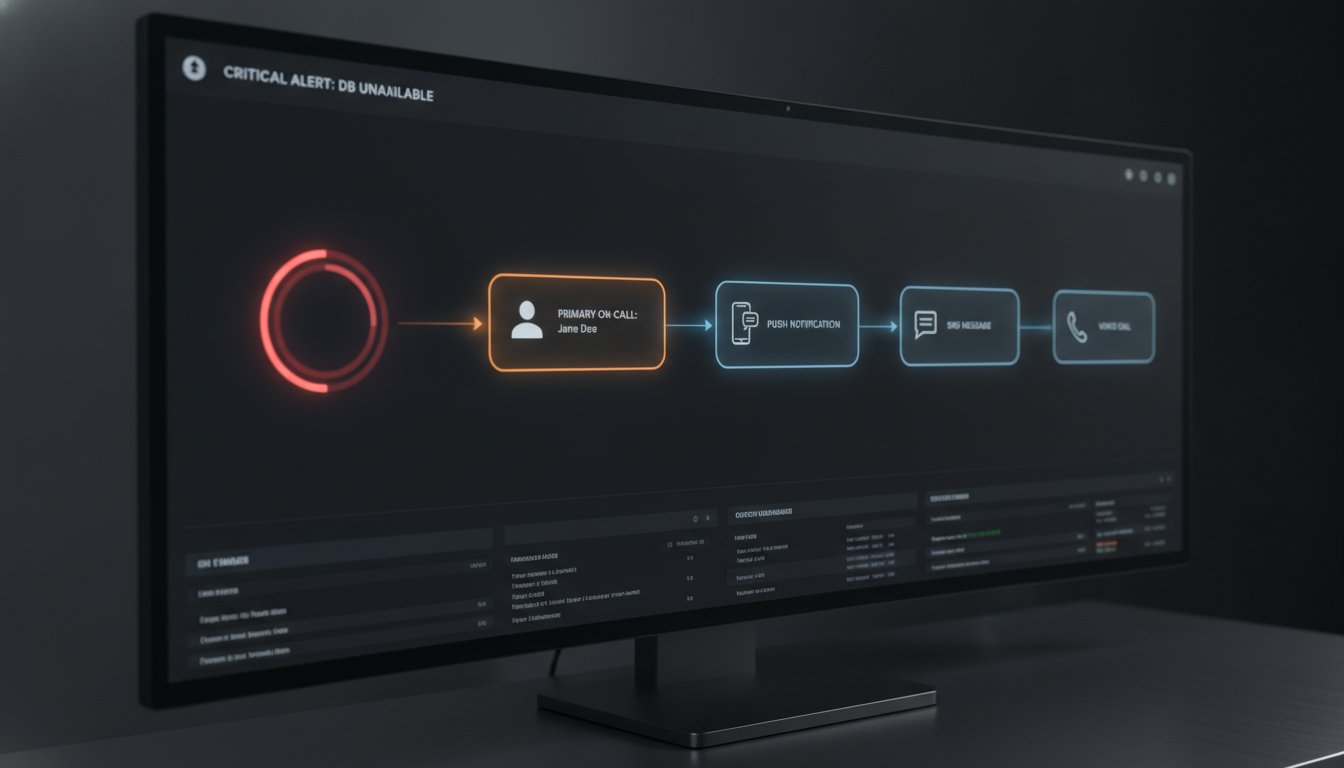
Why pay for a monitoring tool and then pay a second vendor just to tell you the first tool found a problem? Many teams accept this "integration tax" as a cost of doing business, but it introduces unnecessary lag and complexity when every second counts. Between managing brittle webhooks and paying high per-seat licensing fees, the overhead of separate on-call management often creates more friction than it solves.
We agree that incident response should be a unified experience. You need a system where the alert and the paging trigger live in the same environment. This guide explains how to architect a native workflow using Built-In On-Call with Rotations Multi-Step Escalation and Multi-Channel Paging. This approach eliminates the delay between detection and notification while ensuring 100% incident acknowledgement.
We will walk through building reliable rotations, setting up escalation paths that actually reach the right person, and moving toward a predictable pricing model that doesn't penalize your team for growing. You will learn how to lower your Mean Time to Acknowledge (MTTA) without the fatigue of a "fan-out" paging strategy.
Key Takeaways
- Eliminate the 30-120 second "integration tax" by using a native system that triggers alerts directly from the monitoring state.
- Configure timezone-aware rotations to ensure primary and secondary responders never miss a handoff during global shift changes.
- Implement Built-In On-Call with Rotations Multi-Step Escalation and Multi-Channel Paging to build a fail-safe notification path for every incident.
- Deploy multi-channel alerts across push, SMS, and voice to guarantee delivery even when a specific communication layer fails.
- Reduce total cost of ownership by moving to a transparent pricing model without per-user licensing for on-call rotations.
The Architecture of Native On-Call Systems
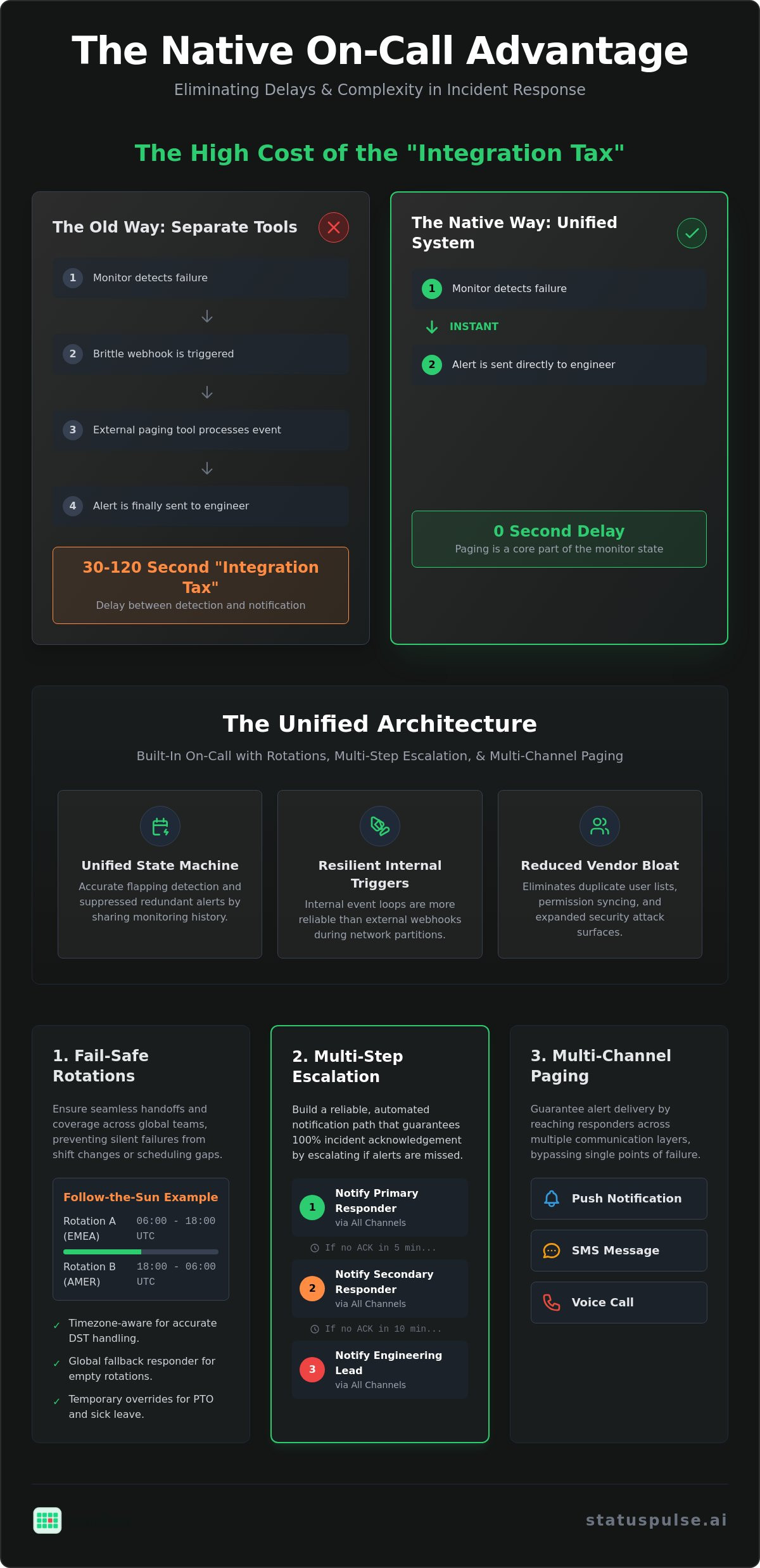
Native on-call systems treat notification logic as a core property of the monitoring state. In traditional setups, a monitor detects a failure, triggers a webhook, and sends data to an external service. This creates an "Integration Tax." You often see a 30 to 120 second lag between the actual failure and the external API trigger. In a high-stakes environment, that delay is unacceptable. Minutes of silence during a database outage can cost thousands in lost revenue.
A native architecture moves paging into the same event loop as the monitor itself. This reduces the moving parts in your DevOps stack. Instead of a "fan-out" approach that blasts every channel at once, native logic allows for more surgical precision. It ensures that the incident management process starts the millisecond a check fails. By adopting Built-In On-Call with Rotations Multi-Step Escalation and Multi-Channel Paging, you remove the middleman entirely.
The Unified State Machine Advantage
When monitoring and paging share the same database, the system gains historical context. Flapping detection becomes more accurate. If a service is intermittently failing, a standalone paging tool might see five separate incidents. A native system knows it is one unstable state. It can suppress redundant alerts based on real-time monitor history. Internal triggers are also more resilient than external webhooks during network partitions. If the public internet is shaky, an internal event loop still executes the next step in your rotation.
Reducing the "Second Vendor" Bloat
Maintaining two separate user lists is a hidden time sink. You have to sync permissions, schedules, and contact methods across two platforms. This increases the risk of a stale on-call roster. Security is another factor. Sharing sensitive incident data across multiple third-party vendors expands your attack surface. Using a unified monitoring and incident platform keeps your data in one place.
Honesty requires acknowledging trade-offs. Pure-play paging tools sometimes offer niche legacy integrations, like physical pagers or specialized hardware. If your team relies on 1990s-era hardware, a standalone vendor might be necessary. For most modern teams, the Built-In On-Call with Rotations Multi-Step Escalation and Multi-Channel Paging approach provides the speed and simplicity needed for rapid response. It eliminates the friction of managing a complex web of integrations during a crisis.
Designing Fail-Safe Rotations and Timezone-Aware Handoffs
A rotation is a recurring schedule that dictates which engineer is responsible for a set of services at any given time. Without strict logic, handoffs become a primary source of failure in the incident lifecycle. Effective systems use Built-In On-Call with Rotations Multi-Step Escalation and Multi-Channel Paging to ensure that transitions happen without human intervention. This prevents the "silent failure" where an alert is sent to someone whose shift ended ten minutes ago.
The "empty rotation" problem is a common technical risk. It occurs when a schedule has a gap due to a holiday or a hiring transition. A robust architecture requires a global fallback responder. This is usually a senior lead or a catch-all group that remains active if the primary rotation fails to find a match. Overrides allow for temporary changes, like PTO or sudden sick leave, without editing the base rotation. This maintains the integrity of the long-term schedule while handling real-world interruptions. Following Google's on-call best practices helps teams maintain balance by ensuring no one is stuck on a shift they cannot cover.
Follow-the-Sun vs. Weekly Shifts
Follow-the-sun (FTS) reduces burnout by moving the primary responder role across timezones. A team in Berlin might cover 08:00 to 16:00 CET, while a team in New York takes over for the next 8 hours. Managing Daylight Savings (DST) is a critical pitfall here. If your system isn't timezone-aware, a handoff scheduled for 09:00 UTC might suddenly occur an hour late for the local engineer. A 12-hour shift split between EU and US teams often provides the best balance of coverage and continuity for smaller teams.
A typical configuration looks like this:
- Rotation A (EMEA): 06:00 to 18:00 UTC
- Rotation B (AMER): 18:00 to 06:00 UTC
- Global Fallback: Engineering Lead
The Secondary Responder: Avoiding Single Points of Failure
High-availability SRE teams use a secondary, or shadow, responder. This person acts as a backup if the primary is unavailable or overwhelmed. Automatic promotion logic is essential. If the primary doesn't acknowledge within a set window, such as five minutes, the system immediately pages the secondary. This logic depends on your uptime monitoring triggers being tuned correctly. You want to prevent false positives from waking up two people unnecessarily. Managing these complex schedules shouldn't require a separate, expensive subscription. You can configure these rotations and overrides directly within StatusPulse to keep your monitoring and paging logic in one place.
Multi-Step Escalation: Moving Beyond Simple Notifications
An escalation policy is more than a list of names. It is a logic-based path that routes alerts through different tiers of your organization as time passes. Without this structure, a single missed notification can lead to hours of undetected downtime. Tiered escalation serves as your primary defense against catastrophic failure. By using Built-In On-Call with Rotations Multi-Step Escalation and Multi-Channel Paging, you ensure that the responsibility for a fix moves up the chain until someone intervenes.
The "Ack-to-Stop" mechanism is central to this logic. When an engineer acknowledges an incident, the system immediately halts the escalation chain. This prevents unnecessary "fan-out" alerts from waking up the entire leadership team for a resolved issue. Severity matters here. A P1 database outage requires an immediate, aggressive escalation path. Conversely, a P3 cosmetic bug might only notify the primary responder during business hours.
Building an Escalation Policy
Effective policies follow a predictable rhythm. You want to give the primary responder a fair chance to react before involving others. A standard three-step policy often looks like this:
- Step 1: Immediate alert to the Primary responder via mobile push or SMS.
- Step 2: Re-alert the Primary and notify the Secondary responder if no action is taken within 5 minutes.
- Step 3: Trigger a voice call to the Lead Engineer or CTO if the incident remains unacknowledged after 15 minutes.
This tiered approach balances urgency with the need to protect senior engineers from alert fatigue. It creates a safety net that scales with the duration of the incident.
Handling Non-Acknowledgements
Sometimes notifications fail to reach a human. Dead-man switches are necessary for critical infrastructure. If your monitoring state doesn't receive a "heartbeat" or an acknowledgement, the system must assume the responder is unavailable. You can configure "looping" escalations that repeat the entire chain until the status changes. This is particularly vital for API monitoring where silent failures in third-party services can cascade quickly.
Reliability experts often discuss these patterns in publications like USENIX ;login: Magazine. They emphasize that the goal isn't just to send a message, but to guarantee a response. While some specialized tools offer complex logic for thousands of users, StatusPulse provides the essential multi-step logic most teams need without the complexity of enterprise bloat. You get a direct, honest system that prioritizes resolution over notification volume.
Multi-Channel Paging: Ensuring Delivery in Every Scenario
Relying on a single notification channel is a structural failure. Email alerts often land in spam or arrive minutes late due to greylisting. In a production crisis, those minutes are the difference between a minor blip and an SLA breach. Redundancy across multiple protocols is the only way to guarantee a human actually sees the alert. By implementing Built-In On-Call with Rotations Multi-Step Escalation and Multi-Channel Paging, you build a delivery system that survives carrier outages and local network issues.
High-context payloads are essential for rapid triage. A page that simply says "Site Down" is useless. The notification must include the target URL, the specific error code, such as a 503 Service Unavailable, and the measured latency. This allows the responder to assess the severity before even opening their laptop. Without these details, the Mean Time to Repair (MTTR) increases as the engineer struggles to find the starting point of the failure.
The Role of Voice and SMS
Voice calls are the most intrusive but effective layer of the stack. Systems typically use providers like Twilio to route global voice delivery. This is your final line of defense. Modern mobile apps can bypass "Do Not Disturb" settings, but a physical phone call often breaks through the noise when push notifications are ignored. International SMS delivery can be expensive and occasionally unreliable during peak network congestion. Many enterprise vendors charge per-message fees that make testing your rotations a financial burden. Choosing a system with flat pricing encourages teams to test their paging paths frequently without worrying about fluctuating costs.
Push Notifications and App Integration
Mobile apps utilize persistent connections to provide sub-second delivery. This is significantly faster than waiting for a carrier to route an SMS. On iOS and Android, "Critical Alerts" allow the app to play a sound even if the device is muted or in a focus mode. This requires specific entitlements from Apple and Google to ensure the feature is used only for legitimate emergencies. You can embed real-time website availability monitoring data directly into these notifications. This gives the SRE immediate visual confirmation of the failure. To build a resilient alerting pipeline that doesn't rely on fragile third-party integrations, consider setting up your infrastructure with StatusPulse.
Integrated On-Call with StatusPulse
StatusPulse functions as a unified platform that brings monitoring, status pages, and on-call under one roof. This consolidation solves the "integration tax" by ensuring that Built-In On-Call with Rotations Multi-Step Escalation and Multi-Channel Paging is a native feature rather than an afterthought. When the monitoring state changes, the notification logic triggers immediately within the same environment. This architectural choice removes the 30-120 second delay typically seen with external API webhooks.
Once a page is resolved, the platform utilizes AI incident management to draft post-mortems. It parses the incident timeline, alert history, and response times to generate a technical summary. This reduces the administrative burden on your SRE team. Instead of spending an hour reconstructing events, engineers can review an AI-generated draft that identifies the root cause and the delta between detection and resolution. It turns a stressful disruption into a documented lesson without the manual overhead.
Flat Pricing vs. Per-User Tax
Traditional industry incumbents often use seat-based models that penalize your team for growing. A typical entry price for a competitor might be [VERIFY: PagerDuty Professional price] per user, per month. This creates an ethical dilemma for managers. You might limit on-call access to a few "licensed" responders to save costs, which leads to burnout and single points of failure. StatusPulse uses a flat pricing model with no per-user fees for on-call rotations. This encourages better team coverage by allowing every engineer to participate in the rotation. You can enable on-call on any monitor with a single toggle in the dashboard, making it easy to scale your response strategy as your infrastructure expands.
EU/US Hosting and Compliance
Data sovereignty is a critical requirement that many paging tools ignore. Incident logs, error codes, and responder phone numbers are sensitive data points. StatusPulse allows you to choose between EU or US hosting for your entire account. This creates regional silos where your on-call data remains within your preferred jurisdiction. It simplifies GDPR compliance because responder PII, like mobile numbers used for SMS and voice alerts, is stored and processed according to regional standards. You don't have to worry about your team's private contact details crossing borders unnecessarily during a crisis. To build a more resilient and compliant incident response workflow, you can get started with StatusPulse on-call today.
Optimizing Your Incident Response Pipeline
Reliable incident response depends on the speed and accuracy of your notification loop. Moving away from fragmented paging tools reduces the "integration tax" and ensures your team responds to actual incidents rather than just managing webhooks. By unifying monitoring and notification logic, you gain a clearer picture of system health while reducing the complexity of your DevOps stack.
Implementing Built-In On-Call with Rotations Multi-Step Escalation and Multi-Channel Paging provides the redundancy needed for high-availability services. It moves your workflow from "best effort" notifications to a guaranteed acknowledgement loop. This approach respects your team's time by preventing alert fatigue through surgical escalation logic that targets the right person at the right time.
You don't have to accept complex per-seat licensing or opaque pricing models to protect your uptime. StatusPulse offers flat-rate pricing for the whole team, native AI incident assistance, and the choice between EU or US data hosting to support your compliance needs. Replace your expensive on-call tool with StatusPulse and start building a more resilient, transparent infrastructure today.
Frequently Asked Questions
What is the difference between an alert and a page?
An alert is a system-generated event indicating that a monitor has detected a failure or a threshold breach. A page is the specific notification sent to a human responder according to an escalation policy. You might alert a Slack channel for a minor latency spike but only page an engineer for a total service outage to prevent unnecessary fatigue.
How does multi-step escalation work if the primary responder is offline?
If a primary responder is offline or fails to acknowledge, the system waits for the configured timeout period before moving to the next tier. This is where Built-In On-Call with Rotations Multi-Step Escalation and Multi-Channel Paging becomes vital. The logic automatically promotes the incident to a secondary responder or a lead engineer to ensure the failure is never ignored.
Can I use built-in on-call with third-party monitoring tools?
StatusPulse is designed as an all-in-one platform where monitoring and on-call live in the same state machine. While you can trigger pages via API from external sources, the primary benefit is the elimination of integration lag between native monitors and the paging engine. This unified approach reduces the number of moving parts and potential failure points in your incident response stack.
Why is timezone-awareness critical for on-call rotations?
Timezone-awareness ensures that handoffs happen at the correct local time regardless of Daylight Savings changes. Without it, an engineer in London might start their shift an hour late or early relative to a teammate in New York. This prevents "ghost rotations" where no one is technically on-call during a one-hour gap caused by UTC offsets.
Does StatusPulse charge per responder for on-call rotations?
No, StatusPulse does not charge per responder or per seat for on-call features. We provide a flat-rate pricing model that allows you to include your entire engineering team in rotations without increasing your monthly bill. This removes the financial pressure to limit on-call access, which often leads to responder burnout and single points of failure.
What happens if no one acknowledges an escalation policy?
If an entire escalation chain is exhausted without an acknowledgement, the system can be configured to loop the policy or trigger a global fallback. A global fallback is typically a senior lead or a catch-all group. This ensures that a critical incident continues to generate noise across multiple channels until a human takes ownership of the resolution.
How do multi-channel notifications bypass "Do Not Disturb" on mobile phones?
Multi-channel notifications bypass "Do Not Disturb" using "Critical Alerts" entitlements on iOS and Android. These are high-priority push notifications that play a sound even if the phone is muted. Voice calls also serve as a reliable bypass, as many users configure their devices to allow repeated calls from specific system numbers to break through silent modes during emergencies.
Is incident data hosted in the EU or the US?
You have the choice to host your incident data in either the EU or the US. This regional silo ensures that responder phone numbers and incident logs remain within your preferred jurisdiction for GDPR or data sovereignty requirements. We maintain separate infrastructure in both regions to give teams full control over where their sensitive on-call data resides.


