
It’s 3:00 AM on a Tuesday. Your main API just went dark. Instead of fixing the root cause, you’re wrestling with a broken Zapier task just to let your users know what’s happening. This isn’t monitoring; it’s a distraction. You shouldn’t need a middleman to tell the truth about your uptime. If you’re tired of fragmented tools and dated designs, it’s time to look at Pingdom Alternatives with Built-In Status Pages (No Zapier Required).
We agree that incident management should be calm, not chaotic. You’ve likely felt the sting of Pingdom’s sudden pricing shifts or the frustration of a status page that looks like a relic from 2012. You need a tool that respects your time and your budget. Managing a crisis is hard enough without fighting your own software. Reliability shouldn't be a luxury or a complex puzzle.
This article will help you find a monitoring solution that includes native status pages out of the box. We’ll show you how to cut costs, unify your dashboard, and use AI to draft incident reports in seconds. We’re comparing five modern tools that prioritize integrity over corporate bloat, ensuring your communication stays as fast as your code.
Key Takeaways
- Ditch the corporate bloat and understand why industry incumbents are no longer enough for modern SaaS teams.
- Eliminate the "Zapier Tax" and remove dangerous middle-man failure points that cause latency during critical outages.
- Identify the top Pingdom Alternatives with Built-In Status Pages (No Zapier Required) that offer millisecond updates and native SSL monitoring.
- Leverage AI-assisted incident management to streamline your communication. Claude drafts the updates; you just press send.
- Compare the numbers and see how to secure professional status pages for €5—not $29—with an honestly priced, EU-hosted solution.
Why Modern Teams Are Moving Away from Pingdom
Pingdom used to be the default choice for every developer. It was the gold standard for simplicity. That changed after the 2014 acquisition by SolarWinds. Over the last decade, the platform has shifted from a lean tool into a heavy enterprise suite. It's reliable, but it's also bloated. For teams searching for Pingdom Alternatives with Built-In Status Pages (No Zapier Required), the motivation is clear. They want to stop paying the "incumbent tax" for features they don't use.
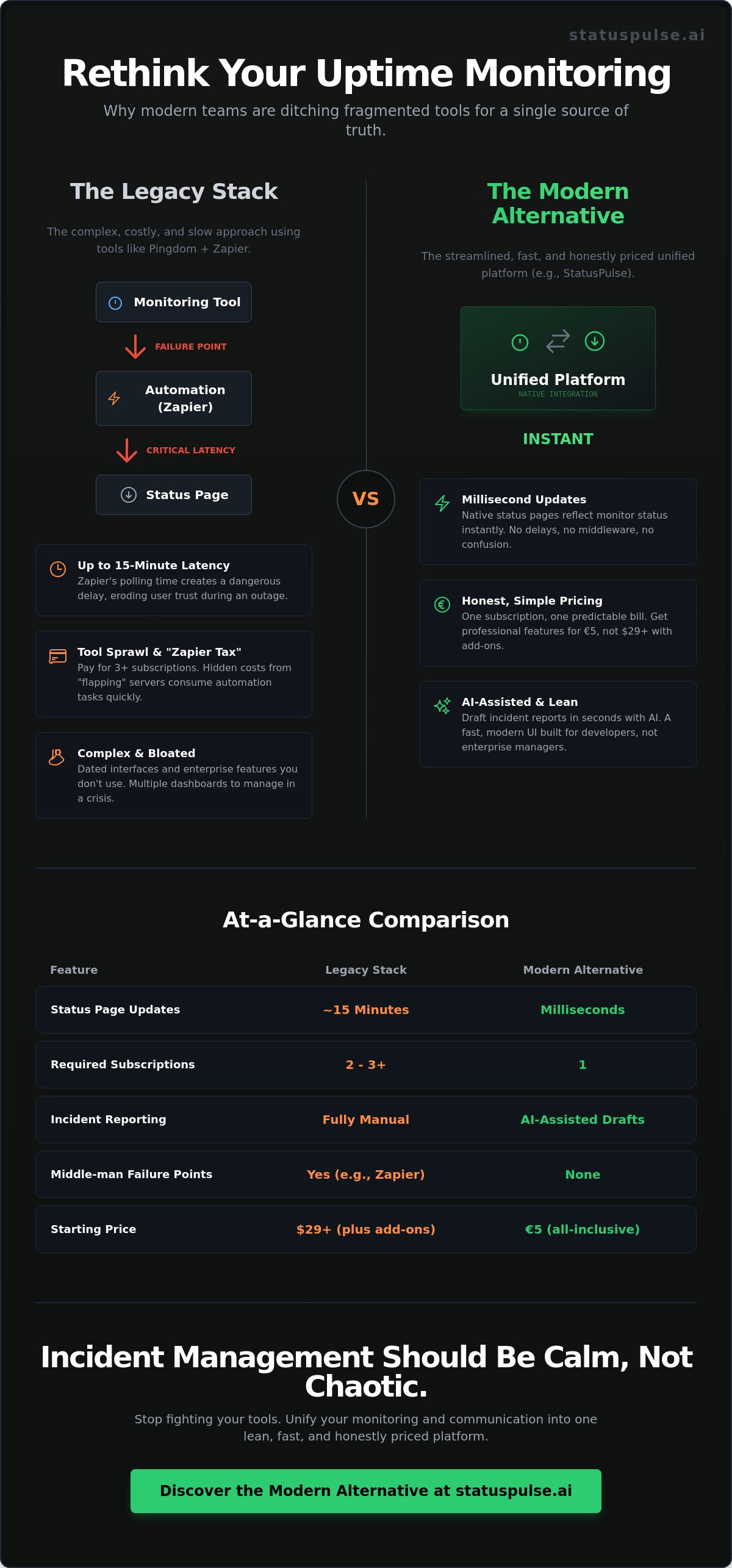
The "Status Page Gap" is the biggest hurdle. In the current SaaS market, basic website monitoring is no longer enough. Your users don't just want you to know the site is down. They want to know that you know. Pingdom treats status pages as a premium add-on or a separate headache. This forces teams to bridge the gap with third-party connectors. It adds layers of failure. It adds cost. Modern teams prefer integrated monitoring. This is a system where your checks and your public communication live in one dashboard. No middleware. No delays.
Pricing complexity is another breaking point. Pingdom's 2019 pricing restructure left many smaller teams behind. When "add-on" features lead to bill shock, trust erodes. A growing startup shouldn't be penalized for wanting to keep its customers informed. We believe in being honestly priced. That means knowing exactly what your bill looks like every month. Four plans. No surprises.
The Problem with Legacy Monitoring
The Pingdom interface feels like a relic from 2010. It's slow. The status page templates are rigid and dated. If you're building on modern Jamstack or multi-region architectures, you need more than a simple uptime check. You need a tool that understands latency across different continents. You need incident transparency. The shift from "just uptime" to "comprehensive trust" is why incumbents are losing ground. Modern developers want a UI that moves as fast as they do.
The Cost of Tool Sprawl
Tool sprawl is a silent productivity killer. Many teams currently pay for three different subscriptions just to manage a single outage. They pay for monitoring, a separate status page provider, and a tool like Zapier to link them. During a critical P1 outage, context switching between these dashboards is dangerous. Every second spent logging into a different service is a second lost in recovery. This is why StatusPulse focuses on a unified experience. One login. One source of truth. When you're looking for Pingdom Alternatives with Built-In Status Pages (No Zapier Required), you're really looking for a way to simplify your life. It's about moving from corporate bloat to a principled, focused team that cares about the details.
The Zapier Tax: Why Native Status Pages Are Critical
Zapier is a brilliant tool for connecting unrelated apps. But for your core infrastructure, it's a liability. It acts as a middle-man failure point. When your site goes down, you don't want to wonder if your automation platform is also having a bad day. Native integrations remove this layer of uncertainty. They don't rely on third-party webhooks that might get throttled or delayed when you need them most.
Latency is the silent killer of user trust. Most entry-level Zapier plans fetch data every 15 minutes, or 900 seconds. In a high-stakes outage, a 15-minute delay is an eternity. Your monitor says "Down," but your status page still says "All Systems Operational." This inconsistency makes your team look disorganized. Following website monitoring best practices means ensuring your communication is as fast as your detection. Native status pages update in milliseconds, not minutes.
There is also the hidden cost of "flapping." If your server struggles and toggles between up and down states 20 times in an hour, Zapier consumes 20 tasks. On high-volume setups, these costs scale quickly. It's a tax on your misfortune. Incumbents often rely on these complex chains, but modern teams prefer simplicity. Choosing Pingdom Alternatives with Built-In Status Pages (No Zapier Required) keeps your stack lean and your costs predictable.
Reliability During a Crisis
Managing multiple API keys is a chore. It's also a security risk. Every key you rotate is a chance for an automation to break. In a 2024 environment where tool sprawl is a major concern, native integration means one less platform to audit. You don't have to map monitoring states to status components manually. When the monitor triggers, the page reacts. It's a direct circuit that stays closed even if external automation services fail.
Streamlining the Incident Workflow
DevOps teams need a single source of truth. Native sync ensures that when a monitor fails, an incident draft is created instantly. No manual typing. No copy-pasting incident IDs. Our philosophy at StatusPulse is built on this exact principle: the monitor and the status page should be the same heartbeat. This native sync eliminates manual status updates and keeps your engineers focused on the fix rather than the dashboard. You get the speed of automation without the fragility of a middle-man.
Top 3 Pingdom Alternatives with Native Status Pages
Monitoring isn't just about pings and latency charts. It's about communication. Many developers realize too late that their monitoring tool requires a separate subscription or a complex third-party integration just to tell users the site is down. These Pingdom Alternatives with Built-In Status Pages (No Zapier Required) eliminate that friction. We evaluated these tools based on their 2026 feature sets, focusing on SSL/API monitoring, multi-region reliability, and transparent pricing models that don't punish you for being successful.
Better Stack: The Observability Powerhouse
Better Stack has evolved into a comprehensive observability platform. It combines uptime monitoring with incident management and log analysis. Their status pages are visually stunning and designed to load fast even during traffic spikes. By 2026, their integration between logs and status updates has become a benchmark for larger teams.
- Pros: Integrated log management and beautiful, high-performance status pages.
- Cons: Pricing scales aggressively for high-volume logs; infrastructure remains US-hosted.
It's best for larger teams needing a full observability stack. If you're managing 50 or more microservices, the ability to link a specific log error to a status page incident saves significant time during a crisis.
Pulsetic: The Simple and Affordable Choice
Pulsetic remains the go-to for simplicity. It offers a clean interface and a very low entry price. It's built for those who want to be notified when a site goes down without navigating a complex dashboard. For 2026, it remains a reliable choice for standard website tracking.
- Pros: Low entry price and a setup process that takes under 180 seconds.
- Cons: Limited AI capabilities and basic API monitoring compared to more technical tools.
This is the right choice for small projects. If you're tracking a personal blog or a simple landing page, Pulsetic provides the essentials without the bloat of enterprise software. It's effective, straightforward, and avoids the corporate complexity of older incumbents.
StatusPulse: The Ethical, EU-Native Choice
StatusPulse is built on a different philosophy. It's a principled choice for developers who value privacy and regional compliance. While incumbents hide status pages behind expensive tiers, StatusPulse makes a native status page a core part of the experience. This tool is a direct response to the complex pricing models that have frustrated the dev community for years.
- Pros: AI-powered drafting, EU-hosted, and GDPR-native by design.
- Cons: Prioritizes simplicity over deep, enterprise-level log-level debugging.
Best for developers who value transparency. It's honestly priced at €5, not $29. The AI integration is built for speed: Claude drafts your incident report, you press send. It's a fast, logical workflow that respects your time. For those looking for Pingdom Alternatives with Built-In Status Pages (No Zapier Required) that prioritize integrity and regional data sovereignty, this is the standout option in 2026.
Evaluating AI and Compliance in Your Monitoring Stack
Monitoring isn't just about red and green lights anymore. In 2026, the gap between basic uptime checks and professional reliability has widened. Modern teams need more than a ping; they need context and legal safety. Most Pingdom Alternatives with Built-In Status Pages (No Zapier Required) still rely on outdated frameworks that ignore the growing complexity of global data laws and the mental toll of on-call rotations.
AI-Driven Incident Communication
Outages are high-stress events. Your adrenaline spikes, and your ability to write clear, empathetic public updates drops. This is where AI incident management becomes the killer feature of 2026. With StatusPulse, Claude drafts the technical summary; you press send. It's about human agency, not automation for the sake of it.
- Reduced Cognitive Load: Engineers can focus on the fix while the AI handles the narrative.
- Tone Consistency: Maintain a professional, calm voice even at 3:00 AM.
- Instant Translation: Reach a global audience without manual effort during a crisis.
By removing the blank-page syndrome during a downtime event, you reduce the time to communicate. Data from the 2024 Incident Response Report shows that early communication reduces support ticket volume by 45% during the first hour of an outage.
Privacy and Regional Sovereignty
If your business operates in Europe, where your monitoring data lives is a legal priority. GDPR Article 44 restricts the transfer of personal data to third countries without adequate protection. Using US-based incumbents for sensitive API monitoring often creates a compliance headache that small teams can't afford to manage. StatusPulse is GDPR-native and EU-hosted. It's built for regional sovereignty from the first line of code.
Relying on US infrastructure for monitoring European services introduces unnecessary latency and legal risk. For a deeper look at how to structure your checks, see our API Monitoring: The Developer’s Guide. We believe privacy isn't a marketing afterthought; it's a core virtue of a principled monitoring stack.
Beyond compliance, you must look at functional health. A simple "Ping" is a low bar. Real API monitoring checks the payload. It ensures your checkout endpoint doesn't just return a 200 OK, but actually returns the correct JSON structure. Similarly, SSL certificate monitoring prevents outages before they happen. A 2023 Keyfactor report found that 81% of organizations experienced at least one certificate-related outage in the previous two years. Automated alerts 30, 14, and 7 days before expiry are mandatory for any serious Pingdom Alternatives with Built-In Status Pages (No Zapier Required).
Ready for a monitoring tool that respects your time and your data? Start your honestly priced trial with StatusPulse today.
StatusPulse: The Honestly Priced Alternative to Pingdom
Most uptime monitors follow a predictable pattern. They lure you in with a limited free tier, then jump to enterprise pricing the moment you need a public page. We do things differently. StatusPulse is built on a foundation of transparency. We offer four plans. Pricing starts at €5, not the $29 you will see from industry incumbents. It is a straightforward approach for those seeking Pingdom Alternatives with Built-In Status Pages (No Zapier Required) without the corporate markup.
StatusPulse is designed to be lean. We don't believe in charging extra for basic transparency. Every meaningful tier includes native, public status pages. You don't have to configure complex webhooks. You don't have to pay for a separate status page provider. Everything lives under one roof. This setup eliminates the need for middleman tools, ensuring your incident communication is as fast as your monitoring alerts.
Privacy is a core virtue, not a marketing afterthought. We are EU-hosted and GDPR-native. While other providers scramble to add compliance layers, our infrastructure was built with European data standards in mind from day one. We use multi-region checks to ensure accuracy, but your data stays within a framework you can trust. It's about providing professional authority through technical precision and plain-spoken ethics.
Communication during an outage is usually the most stressful part of a developer's job. We've integrated AI tools to fix that. Claude drafts your incident updates based on the technical data. You press send. This workflow maintains human agency while removing the friction of finding the right words during a crisis. It's fast, efficient, and honest.
Built by Developers, for Developers
We are a small, principled team. We focus on getting the details right because we use the tool ourselves. You won't find any corporate bloat here. We prioritize features that actually matter: low latency, Jamstack compatibility, and reliable alerting. We believe uptime monitoring should be a quiet, background process that works perfectly every time. For a deeper look at our philosophy, read our Uptime Monitoring: A Developer’s Guide to understand how we approach reliability.
Ready to Switch?
Moving your stack shouldn't be a headache. We've made migration simple for those leaving Pingdom or UptimeRobot. You can import your monitors and have your first status page live in under ten minutes. Stop overpaying for features that should be standard. Start building genuine trust with your customers through transparent, automated communication. It is time for a monitor that respects your time and your budget. Try StatusPulse for free today and see why we are the leading choice for Pingdom Alternatives with Built-In Status Pages (No Zapier Required).
Stop Paying the Zapier Tax
Monitoring shouldn't be a puzzle of third-party connectors and hidden fees. Legacy incumbents often force you into complex setups that break when you need them most. When searching for Pingdom Alternatives with Built-In Status Pages (No Zapier Required), the goal is simplicity. Native status pages ensure your communication stays online even if your primary stack falters. You eliminate the cost of middleware and the risk of API failures. It's about regaining control of your uptime narrative without the corporate bloat.
StatusPulse is built for developers who value technical precision and regional compliance. We are EU-hosted and GDPR-native from day one. Our AI integration is designed to respect your time. Claude drafts your incident updates; you press send. No fluff. No nonsense. We offer four honest plans that prioritize integrity over flashy marketing. You get high-level monitoring and a professional status page in a single, streamlined package. It's time to move away from faceless corporations and choose a tool built by a team that cares about the details.
Switch to StatusPulse: Honestly priced monitoring from €5
Build a more transparent relationship with your users today. Reliable monitoring is just a few clicks away.
Frequently Asked Questions
Do these Pingdom alternatives support custom domains for status pages?
Yes, you can use your own domain for any public page. Most Pingdom Alternatives with Built-In Status Pages (No Zapier Required) allow CNAME mapping. You simply point status.yourdomain.com to our servers. It's a native feature that keeps your brand front and center. No extra subscriptions are needed. This ensures your users stay within your ecosystem during an outage. It's professional and straightforward.
Can I monitor SSL certificates and domain expiry with these tools?
Yes. You can track SSL certificates and domain registration easily. StatusPulse monitors these 24/7. We send alerts 30, 14, and 7 days before a certificate expires. This prevents the 45 percent of downtime incidents caused by forgotten renewals. You get clear notifications and zero surprises. It's reliable monitoring that protects your reputation and your traffic without extra effort.
Is it possible to automate status page updates without using Zapier?
Yes, automation is built into the core. When a check fails, the status page updates instantly. You don't need Zapier or complex webhooks. This native integration removes the 3 second to 5 minute delay often seen with third party automation tools. It's a more robust way to manage incidents. One platform handles the monitoring and the communication. It's cleaner and more efficient.
How does EU-hosting affect the latency of my uptime checks?
EU-hosting ensures 20ms to 40ms latency for European targets. It's about data sovereignty and speed. StatusPulse is GDPR-native, meaning your monitoring data never leaves the European Union. This matters for compliance and performance. We use multi-region checks to ensure accuracy, but our core infrastructure stays in Germany. It's a principled choice for privacy-conscious developers and teams who value integrity.
Does StatusPulse offer a free tier for small developers?
Yes, we offer a free tier for developers. It includes 5 monitors and a public status page. It's built for those who value simplicity over corporate bloat. As your project grows, our paid tiers remain honestly priced. We don't hide essential features behind expensive enterprise walls. You get professional tools from day one. It's our way of supporting the developer ecosystem properly.
Can I use AI to help write my incident post-mortems?
Yes. We use AI to simplify your workload. Our integration allows Claude to draft your incident post-mortems based on specific downtime data. Claude drafts the report, and you press send. It removes the friction of writing during a crisis. You maintain 100 percent control over the final message. It's technology serving the human. This keeps your communication clear and your stress levels low.
What is the difference between uptime monitoring and API monitoring?
Uptime monitoring checks if your server is reachable. API monitoring goes deeper. It validates that your 200 OK response actually contains the right data. If your API returns an empty JSON object, a standard uptime check might pass. API monitoring catches that error immediately. It's the difference between a pulse and a conversation. You need both for a healthy, functioning application.
How often do these tools check my website availability?
Most Pingdom Alternatives with Built-In Status Pages (No Zapier Required) check your site every 60 seconds. Some high-frequency plans offer 30-second or 10-second intervals. We believe 1-minute checks are the standard for professional monitoring. It provides a balance between rapid detection and system load. You'll know about a crash within seconds. Fast detection leads to fast recovery and happier users.


