
Manual translation during an active outage is a liability that your engineering team shouldn't have to carry. When your infrastructure fails, the priority is recovery; it's not auditing 20 different email templates for linguistic accuracy. If your subscribers in Paris receive an incident alert in English, you aren't just failing at communication. You're actively increasing your support ticket volume. Implementing Status Pages in 7 Languages with Per-Recipient Localized Alert Emails ensures that your technical updates reach every user in their preferred language without manual intervention.
We agree that incident communication should be as automated as your monitoring. You need a way to bridge the gap between a localized UI and the alerts that land in a user's inbox. In this guide, you'll learn how to automate multi-language incident communication and deliver localized alerts to every subscriber without the manual template burden. We'll cover per-recipient language detection, maintaining brand consistency across regions, and how to lower the stress of global incident management.
Key Takeaways
- Localized interfaces create an expectation for localized communication. English-only alerts during outages increase support volume and friction for international users.
- Moving to recipient-level metadata allows for precise language targeting. We explain the architecture required to identify subscriber preferences automatically.
- Implementing Status Pages in 7 Languages with Per-Recipient Localized Alert Emails removes the burden of maintaining dozens of manual templates. This reduces the risk of translation errors during critical incidents.
- Mapping ISO 639-1 language codes to your alert framework simplifies setup. You can establish a global communication strategy in minutes without per-subscriber surcharges.
- Regional data sovereignty is maintained through a choice of EU or US hosting. This ensures your status infrastructure aligns with local privacy standards and ethical pricing.
The Friction of English-Only Alerts in a Multi-Language Market
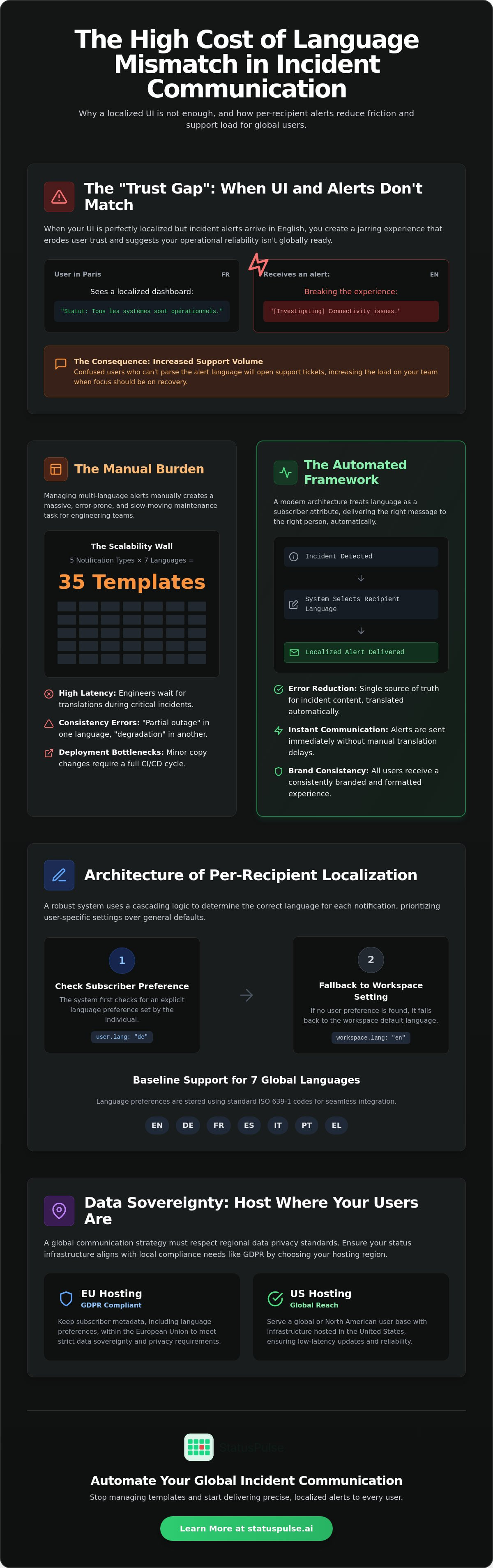
When your SaaS dashboard is localized into German or French, you've established a specific standard for user experience. If that same user receives an "Investigating connectivity issues" alert in English during a critical outage, the experience breaks. This language mismatch creates a "Trust Gap" where the user feels like a second-class citizen in your ecosystem. It signals that while your sales team is ready for their region, your operational reliability isn't fully integrated.
Proper Internationalization and localization isn't just about the static UI elements or your landing pages. It's about the dynamic communication that happens when your infrastructure fails. For global SaaS companies, support for seven essential languages has become the baseline: English (EN), German (DE), French (FR), Spanish (ES), Italian (IT), Portuguese (PT), and Greek (EL). Mismatching these languages during a crisis suggests a system failure before you've even explained the technical issue.
Systems like StatusPulse address this by ensuring the communication layer matches the user's chosen interface. If you don't align your alerts with your UI, you're effectively inviting a surge in support tickets from confused users. They'll reach out to ask for clarification on an alert they can't fully parse, even if your status page technically has the information they need.
Why Manual Translation Fails During Incidents
During an active P0 incident, every second counts for your SRE team. Asking an engineer to wait for a marketing or localization team to provide a translated update is a recipe for high-latency communication. High-pressure environments are the worst time for manual translation. It's easy to make consistency errors where one language describes a "partial outage" while another says "service degradation," causing unnecessary confusion across your global user base.
The Scalability Wall: Templates vs. Languages
Maintaining alert infrastructure is a volume problem that scales poorly. If you have five standard notification types (Investigating, Identified, Monitoring, Resolved, and Scheduled Maintenance), supporting seven languages requires managing 35 separate templates. Hard-coding these into your codebase creates deployment bottlenecks because every small copy change requires a pull request and a CI/CD cycle. Implementing Status Pages in 7 Languages with Per-Recipient Localized Alert Emails solves this by decoupling the content from the delivery logic.
The maintenance tax of manual localization is the cumulative time your engineering team spends editing JSON files and managing template sprawl instead of resolving technical debt.
Architecture of Per-Recipient Localized Alert Emails
Standard status page localization typically relies on a global toggle that changes the language of the public-facing UI. This approach fails global teams because it assumes all subscribers share the same linguistic preference. A robust architecture shifts the logic from the page level to the individual recipient. By treating language as a subscriber attribute rather than a site-wide setting, you ensure that a user in Berlin receives German alerts even if your primary workspace is set to English.
The system relies on a cascading logic to determine the correct language for every outgoing notification. It first checks for an explicit subscriber preference. If none is found, it falls back to the workspace-level setting, and finally to a global system default. This hierarchy ensures that no user is left without a notification, while prioritizing the most specific data available. Adhering to W3C internationalization best practices during this process helps manage character encoding and regional date formats correctly across different locales.
Data sovereignty is equally critical in this architecture. Delivering Status Pages in 7 Languages with Per-Recipient Localized Alert Emails requires a backend that respects regional hosting preferences. For teams prioritizing GDPR or local compliance, the choice between EU or US hosting ensures that subscriber metadata, including language preferences, remains within the desired jurisdiction. This regional alignment prevents the legal friction often associated with centralized US-only status providers.
Metadata and Subscriber Attributes
Language preferences are stored as standard ISO 639-1 codes within the subscriber database. When a user signs up for updates via a status page, the system can detect their browser's `Accept-Language` header to set an initial preference. For enterprise environments, syncing these attributes through SSO or existing user profiles ensures consistency between your application and your incident communication. For "Unknown" users, the system applies an intelligent regional default based on the specific status page they are viewing.
The Delivery Pipeline: From Incident Update to Localized Inbox
When an incident is created, the alert engine does not send a single bulk email. It resolves the correct template variant for each recipient in real-time. Dynamic variables, such as component names or incident duration, are injected into the localized framework to maintain technical accuracy. This logic extends to automated alerts from SSL and API monitoring. If an API endpoint fails, the notification logic checks the recipient's metadata before dispatching the alert. Using an integrated platform like StatusPulse allows you to manage these complex delivery rules without writing custom middleware.
Manual Templates vs. Automated Localization Frameworks
Managing incident communication across multiple regions often leads to a "template explosion." If you rely on manual duplication, a single update to your incident workflow requires editing every language variant individually. This process is not just slow; it's fragile. By utilizing Status Pages in 7 Languages with Per-Recipient Localized Alert Emails, teams move from managing static files to a dynamic framework where the system handles the heavy lifting of translation mapping.
The risk of human error is highest during high-stress P1 incidents. A tired engineer might copy-paste a French description into a German template, or worse, miss a template entirely. Automated frameworks eliminate this by using validated localized strings that are pre-approved. This shift improves DevOps velocity by allowing SREs to focus on the technical fix while the communication layer automatically resolves the correct language for each recipient. For a deeper look at how this fits into your overall strategy, see The Architecture of Incident Communication Transparency.
Efficiency Metrics for SRE Teams
Time-to-Notify (TTN) is a critical metric for global operations. In a manual environment, TTN increases with every additional language you support because of the "Communication Lag" created by manual drafting and verification. An automated framework reduces this lag to near zero. Below is a comparison of how different architectures handle the maintenance burden as your user base grows.
| Feature | Manual Template Duplication | StatusPulse Cascading Logic |
|---|---|---|
| Update Workflow | N updates for N languages | Single update, auto-resolved |
| Translation Risk | High (Human copy-paste error) | Low (Validated frameworks) |
| Deployment Speed | Slow (Manual verification) | Instant (Real-time resolution) |
| Maintenance Tax | Scales linearly with languages | Constant, regardless of locale |
Cost Implications of Global Communication
Traditional status providers often use per-subscriber pricing models. As you scale to thousands of global users across different regions, these costs become unpredictable and bloated. [VERIFY: Industry average for per-subscriber notification fees in 2026]. Choosing a platform with flat-rate pricing ensures that your budget remains stable even as your international audience expands. There is also a hidden cost to "Silent API Failures." When users receive alerts they cannot understand, they are more likely to ignore future notifications or open unnecessary support tickets, further straining your team's resources.
StatusPulse offers a principled approach by providing native support for 7 languages without per-subscriber surcharges. This allows you to scale your global communication strategy based on technical needs rather than budget constraints. By integrating API monitoring with localized alerts, you ensure that technical disruptions are communicated clearly to every stakeholder, regardless of their location.
Implementation: Setting Up 7-Language Support in 5 Minutes
Setting up Status Pages in 7 Languages with Per-Recipient Localized Alert Emails shouldn't require a consultant or a weeks-long "localization journey." In your workspace settings, you simply select your target locales from the supported list. This action initializes the template framework for the 7 essential languages. It's a binary choice that prepares your infrastructure for global delivery without complex configuration files.
Mapping subscriber preferences is handled via ISO 639-1 language codes. When a subscriber is added through your API or manual entry, attaching a code like "de" or "fr" ensures they are routed to the correct alert variant. This metadata-driven approach allows you to automate the delivery logic at the point of ingestion. It's more efficient than asking users to manually toggle settings on a public page every time they visit.
Testing the localized delivery path is a mandatory step before going live. Use a sandbox incident to trigger notifications to a set of internal test accounts assigned different language codes. This allows you to verify that the cascading logic correctly resolves the template and that dynamic variables, like timestamps, are localized. Never test your localization logic during a live P1 incident.
AI-Assisted Incident Management for Multi-Language Drafts
Drafting an incident summary in five languages manually is a significant bottleneck for SRE teams. Using AI to draft Status Pages in 7 Languages with Per-Recipient Localized Alert Emails allows your team to move faster without sacrificing clarity. The AI generates the initial technical summary in all supported languages simultaneously, ensuring that the core message remains consistent across every region.
Always maintain a human-in-the-loop for these drafts. AI can handle the linguistic structure, but it might miss the specific technical weight of a "degraded" vs "failed" state. An engineer should perform a final check to ensure the technical accuracy matches the reality of the infrastructure. For more on this workflow, see How to Draft Honest Incident Updates with AI.
Best Practices for Localized Technical Copy
Technical alerts must be precise and devoid of regional idioms that don't translate well. Keep component names like "API Gateway" or "Load Balancer" in their original technical form if that's how your users recognize them in your documentation. Translating technical nouns can often lead to more confusion than it solves. Stick to a plain, direct style that prioritizes information density over marketing fluff.
Use this checklist to verify your global alert strategy:
- Confirm ISO 639-1 codes are correctly mapped for all test recipients.
- Standardize technical nouns (e.g., "Database Cluster") across all 7 variants.
- Check that dynamic variables like %component% are formatted for the locale.
- Verify the "Resolved" state is clear and unambiguous in every language.
- Ensure the link to the status page correctly preserves the user's language session.
You can start automating your global communication by configuring API monitoring with localized alerts today.
StatusPulse: Principled Localization for Global Teams
Technical incident communication shouldn't be a luxury feature locked behind enterprise tiers. StatusPulse provides native support for Status Pages in 7 Languages with Per-Recipient Localized Alert Emails as a core part of the infrastructure. This ensures your global audience receives updates in their preferred language without the complexity of managing multiple disjointed tools or high-latency manual processes.
We offer a deliberate choice between EU or US hosting to support regional data sovereignty. This isn't a marketing checkbox; it's a fundamental architectural decision for teams managing strict compliance and privacy requirements. By keeping subscriber metadata and language preferences in your preferred jurisdiction, you reduce legal friction and maintain technical integrity across your stack.
Our platform functions as a unified engine for uptime monitoring, status pages, and AI-driven alerts. This integration means your monitoring data flows directly into your communication layer. When an API endpoint fails, the system already knows which recipients need an alert and which language variant to dispatch. It's a straightforward approach that prioritizes reliability over corporate bloat.
Transparent Pricing, No Bloat
Many industry incumbents rely on complex per-subscriber or per-seat models that punish you for growing your audience. StatusPulse uses flat-rate pricing that remains predictable regardless of how many people subscribe to your updates. We avoid the "maintenance tax" of traditional enterprise software by keeping our feature set focused and our pricing honest. Every tier includes 1-minute uptime checks, ensuring your monitoring is as precise as your localized communication.
We prioritize integrity and simplicity over marketing hype. You won't find hidden fees for adding more languages or surcharges for high volumes of localized emails. By stripping away unnecessary filler, we've created a tool that respects your time and your budget. This minimalist approach mirrors the efficiency we expect from the systems we monitor.
Built for SREs, by SREs
StatusPulse is built by a dedicated team focused on technical precision rather than corporate expansion. We handle regulatory compliance and data privacy without the friction typically associated with large-scale incumbents. Our personality is characterized by a lack of pretension; we're more interested in resolving your P1 incidents effectively than in sounding like a traditional enterprise software provider.
There is a rebellious edge to our engineering philosophy. We don't use words like "seamless" or "revolutionary" because we know that reliability is built on consistent performance and clear logic, not adjectives. We provide a fair, ethical alternative for teams tired of complex pricing and opaque hosting standards. If you're ready to simplify your global communication, you can start building your localized status page on StatusPulse today.
Scaling Your Global Incident Strategy
Effective incident communication requires moving past manual template duplication. By centralizing your logic and utilizing Status Pages in 7 Languages with Per-Recipient Localized Alert Emails, you eliminate the friction that typically slows down international SRE teams. Recipient-level metadata ensures that every subscriber receives technical updates in their preferred language without the risk of manual translation errors during high-stress outages.
Your infrastructure deserves a communication layer that respects both your users and your compliance requirements. Choosing a platform that offers EU-based hosting for data sovereignty and AI-powered incident management ensures your team stays focused on recovery rather than administrative overhead. With transparent flat-rate pricing, you can scale your global reach without the unpredictable costs of per-subscriber fees. It's a straightforward approach to a complex problem.
Align your status infrastructure with your international user base today. Deploy a multi-language status page in minutes and start delivering precise, localized alerts that match your brand UI.
Frequently Asked Questions
Can I send different alerts to different users based on their language?
Yes. StatusPulse uses per-recipient metadata to resolve the correct template variant for each individual subscriber. This allows you to maintain Status Pages in 7 Languages with Per-Recipient Localized Alert Emails without sending a single bulk email in one language. The system identifies the preference at the delivery layer, ensuring your German users receive German alerts while your English users see the English equivalent.
Which 7 languages does StatusPulse support out of the box?
StatusPulse currently supports English (EN), German (DE), French (FR), Spanish (ES), Italian (IT), Portuguese (PT), and Greek (EL). These locales cover the primary requirements for global SaaS operations. You can enable or disable specific languages within your workspace settings to align with your regional user base. This native support eliminates the need for manual translation during active incidents.
Does a multi-language status page cost more than a single-language one?
No. We believe localization is a core technical requirement for global teams; it's not a premium add-on. StatusPulse offers flat-rate pricing that includes all supported languages without per-subscriber surcharges or hidden fees. This avoids the unpredictable billing models common among corporate incumbents who charge extra for international communication. Our goal is to provide honest, transparent pricing for all users.
How accurate are AI-generated incident translations?
Our AI models are optimized for technical precision, but they aren't a replacement for human oversight. The system drafts incident summaries that are linguistically correct and technically relevant. However, we insist on a human-in-the-loop to verify the final copy before dispatch. This ensures the technical nuances of the outage are captured correctly while the AI handles the linguistic heavy lifting.
Can I customize the translations for specific technical terms?
Yes. You can define specific technical nouns to remain in their original form across all language variants. This is a best practice for terms like "API Gateway" or "Load Balancer" that are universally recognized by technical users. Decoupling these terms from the translation engine prevents confusion and ensures your Status Pages in 7 Languages with Per-Recipient Localized Alert Emails remain technically accurate across all regions.
What happens if a subscriber’s language is not one of the 7 supported ones?
The system follows a cascading logic to ensure no alert is missed. If a subscriber's language is not supported, the alert engine falls back to your workspace default language, which is typically English. This prevents delivery failures and ensures the recipient still receives critical information. You can change your workspace default at any time to match your primary audience.
Is per-recipient localization GDPR compliant?
Yes. Storing a language preference is a standard functional attribute for delivering a requested service. We support data sovereignty by offering a choice between EU or US hosting. This ensures that all subscriber metadata, including language preferences, is stored and processed within your chosen jurisdiction. This principled approach to data privacy is a core part of our infrastructure design.


