

Your mail server is down. The culprit isn't a server crash; it's a silent DNS change that your monitoring tool missed because the record technically still exists. Most teams treat DNS monitoring as a simple change log, but this passive approach fails to catch configuration drift or breaking changes in SSL validation. Implementing DNS Monitoring Across 7 Record Types with Three Assertion Modes ensures you aren't just watching for changes, but validating that your records point exactly where they should. With 87% of organizations experiencing DNS attacks in 2026, simple change detection is no longer a sufficient defense.
You likely already know the frustration of false positives triggered by TTL updates that don't actually impact your traffic. This guide moves you beyond basic uptime checks to turn your monitoring into a proactive validation engine. We'll break down how to assert specific values for A, CNAME, MX, and TXT records. This provides a technical framework for zero-downtime migrations and automated security audits that respect your time and your infrastructure's integrity.
Key Takeaways
- Move beyond passive change detection to active validation. This prevents silent outages that break mail flow and SSL certificate renewals.
- Implement DNS Monitoring Across 7 Record Types with Three Assertion Modes to verify that records like MX and CNAME resolve correctly worldwide.
- Use Exact Match and Presence assertions to automate security audits for TXT and CAA records. This ensures your security posture remains intact.
- Configure monitoring intervals that respect TTL values. This approach eliminates false positives caused by standard propagation delays during expected updates.
- Integrate DNS validation into a broader uptime monitoring strategy. This provides your team with specific, actionable data when resolution failures occur.
Why DNS Monitoring Requires Active Assertion Over Passive Detection
The Domain Name System (DNS) is the most critical single point of failure in modern web architecture. If your DNS fails, your entire stack disappears from the internet. Most traditional monitoring tools approach this problem through passive detection. They watch for any change in your records and send an alert when a diff is detected. This method is fundamentally flawed for technical teams managing complex environments. It treats every change as a potential crisis, regardless of whether that change was intended or valid.
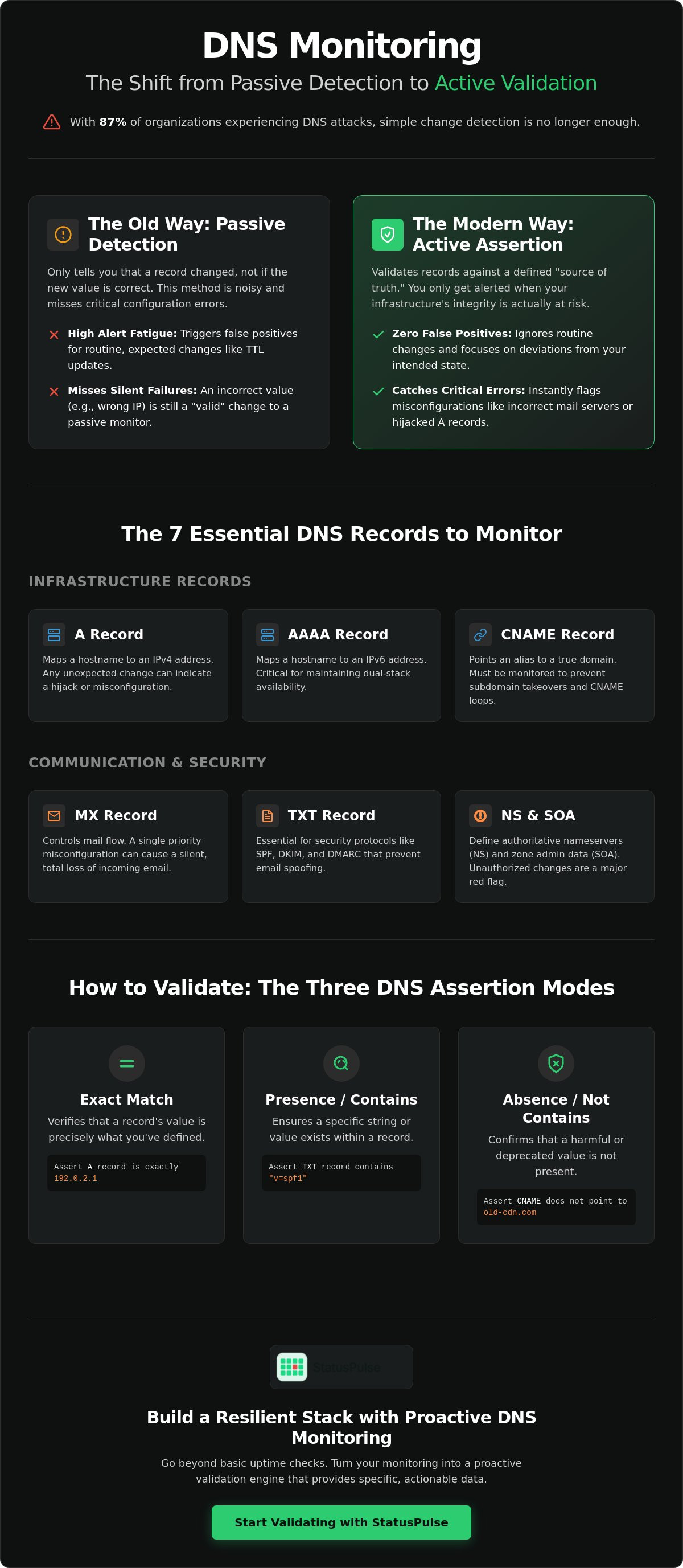
Passive detection only tells you that something changed. It doesn't tell you if the new value is correct. This leads to heavy alert fatigue. You get paged for routine, expected updates like rotating an IP address or updating a TTL. Conversely, a malicious or accidental change to an invalid value might look exactly like a valid one to a passive monitor. Effective DNS Monitoring Across 7 Record Types with Three Assertion Modes requires a shift toward active validation. You must define a "source of truth" and force the monitor to validate against it. This ensures you only receive alerts when your infrastructure's integrity is actually at risk.
The Risk of Silent DNS Failures
DNS failures are often silent and devastating. A misconfigured MX record won't crash your website, but it will cause your organization to lose incoming mail immediately. You might not notice the loss for hours or days. CNAME loops are another common trap. These occur when an alias points to another alias that eventually points back to the first. This creates an infinite resolution path that breaks site availability for your users. Unauthorized A record redirects are perhaps the most dangerous. Attackers can hijack your traffic by pointing your domain to a malicious mirror. Without active value assertion, these changes can go unnoticed until the damage is done.
Defining the Source of Truth
To monitor effectively, you must understand the difference between authoritative nameserver data and recursive resolver results. Recursive resolvers cache data for performance. If you only monitor via public resolvers like Google or Cloudflare, you are seeing a cached version of the truth. You should target your authoritative nameservers directly. This provides the most accurate view of your DNS zone. Time-to-Live (TTL) also plays a vital role here. It dictates how long a record stays in a resolver's cache. Monitoring frequency must be calibrated to your TTL values. High TTLs provide stability but slow down propagation during a migration. Low TTLs allow for fast recovery but can increase the load on your DNS infrastructure. Active assertion allows you to monitor these values precisely, ensuring your configuration drift is zero.
The 7 Essential DNS Record Types to Monitor
While the DNS protocol supports dozens of specialized entries, seven specific records form the operational core of almost every modern web service. Monitoring these correctly is the difference between a resilient infrastructure and one that fails silently. A comprehensive strategy for DNS Monitoring Across 7 Record Types with Three Assertion Modes ensures that your critical endpoints, mail flow, and security policies remain exactly as you intended. This isn't just about checking for existence; it's about validating the technical integrity of each entry.
Infrastructure Records: A, AAAA, and CNAME
A and AAAA records are the foundation. They map hostnames to IPv4 and IPv6 addresses. In static environments, any shift in these IPs is a red flag. It often indicates an unauthorized change or a serious configuration error. Monitoring AAAA records is particularly important to maintain dual-stack availability, as IPv6 failures often go unnoticed by teams only testing IPv4 paths. CNAME records manage alias chains. They are useful for pointing your domain to third-party services like CDNs or load balancers. However, they introduce the risk of subdomain takeovers. If a CNAME points to a decommissioned service, an attacker can reclaim that service and hijack your traffic. You can find detailed technical breakdowns of these common types of DNS record to better understand their specific syntax and limitations.
Communication and Security: MX, TXT, NS, and SOA
MX records control your mail flow. A single priority misconfiguration can cause emails to bounce or be routed through an insecure backup server. Using DNS Monitoring Across 7 Record Types with Three Assertion Modes allows you to assert that your primary and secondary mail servers are always in the correct order. TXT records have become essential for security. They hold SPF, DKIM, and DMARC data, which verify your outgoing mail and prevent spoofing. Asserting the exact string value of these records ensures your email deliverability remains high and your domain isn't used for phishing.
NS and SOA records define the authority of your zone. NS records specify which nameservers are authoritative for your domain. If these are changed without your consent, you lose control of your entire DNS zone. SOA (Start of Authority) records include a serial number that increments with every change. Monitoring the SOA serial is a precise way to detect configuration drift between your primary and secondary nameservers. For teams managing multiple zones, monitoring these records with StatusPulse provides a unified view of your DNS health alongside your standard uptime checks. This layered approach catches registrar-level attacks that simple endpoint pings would miss entirely.
Implementing the Three DNS Assertion Modes
Passive monitoring tools alert you on every change. This creates noise. To build a reliable system, you need to define how a record should be validated. Effective DNS Monitoring Across 7 Record Types with Three Assertion Modes allows you to filter out expected updates while catching the silent failures that actually break your stack. By moving from simple diffs to active assertions, you define the technical boundaries of what constitutes a "healthy" record.
Choosing the right assertion mode depends on the volatility and sensitivity of the record. Static infrastructure requires strict matching; dynamic cloud environments need more flexibility. Implementing DNS Monitoring Across 7 Record Types with Three Assertion Modes provides the granularity needed to manage both without overwhelming your DevOps team with false positives.
Presence and Exact Match Logic
Presence assertion is the most basic form of validation. It verifies that a record exists in the zone file, regardless of its value. This is useful for dynamic environments where IPs change frequently, such as CNAME records pointing to elastic load balancers. In these cases, the specific hostname might rotate, but the existence of the link is non-negotiable. If the record disappears, your service is unreachable.
Exact Match assertion is far more rigorous. It compares the returned value against a specific string you define as the source of truth. This is your primary defense against "fat-finger" errors during manual updates. Use Exact Match for your primary A records, MX priorities, and NS entries. If a single digit in an IP address is typed incorrectly, an Exact Match assertion will catch it immediately, even though a Presence check would technically pass.
Regex Assertions for Complex Records
Complex records require more than a simple string match. SPF strings, CAA records, and SOA entries often contain multiple tags that can change order or include dynamic elements. Regex assertions allow you to validate the internal structure of these records. For example, you can ensure your SPF record always contains your primary mail provider's include tag while allowing for secondary tags to be added or removed.
Consider this regex pattern for an SPF record validation:
^v=spf1.*include:_spf\.google\.com.*(~|-)all$Regex is also the tool of choice for monitoring SOA serial numbers. You can assert that the serial follows the YYYYMMDDNN format. This confirms your provisioning scripts are functioning correctly. A serial that hasn't incremented after a change suggests a failure in your master-to-slave replication. For CAA (Certificate Authority Authorization) records, regex ensures that only specific CAs are authorized to issue certificates for your domain. This prevents unauthorized SSL/TLS certificate issuance, a critical step in maintaining your security posture.
Operationalizing DNS Monitoring: TTL and Propagation
Configuring assertions is only half the battle. DNS is a distributed database, and changes don't propagate instantly. To implement DNS Monitoring Across 7 Record Types with Three Assertion Modes effectively, you must account for the temporal and geographic nature of the system. Without this context, your monitoring will produce false positives that erode your team's trust in the alerting pipeline. Reliability isn't just about the value; it's about the timing.
Propagation delays occur because DNS records are cached at multiple levels. Your monitor needs to understand that a change at the authoritative nameserver won't be visible to every user immediately. Setting alert thresholds too tight during a planned migration is a common mistake. You should allow for a grace period that aligns with your highest TTL values to avoid noise while the global cache clears. This prevents the "alert storm" that often follows a routine infrastructure update.
TTL-Aware Monitoring Strategies
Time-to-Live (TTL) is the most overlooked variable in DNS health. It defines how many seconds a record should be cached by recursive resolvers. A standard best practice is to set your monitoring check frequency to 50% of your TTL value. If your TTL is 3600 seconds, checking every 1800 seconds ensures you catch stale data without excessive polling. This balance maintains technical accuracy while keeping your monitoring costs predictable.
During active migrations, teams often drop TTLs to 60 or 300 seconds. This allows for rapid cutovers if a rollback is needed. Your monitoring stack should be flexible enough to handle these high-frequency windows without triggering rate limits or false alerts. Once the migration is stable, you can revert to higher TTLs and longer monitoring intervals to reduce infrastructure overhead. Honesty requires admitting that high-frequency monitoring is more resource-intensive, but it's a necessary trade-off for critical infrastructure changes.
Multi-Region Validation and Sovereignty
A record that resolves correctly in London might be hijacked or blocked in another jurisdiction. Regional discrepancies, often called split-horizon DNS, can hide significant outages from your local development team. Validating your records from multiple geographic locations is the only way to ensure global availability. This is especially critical for teams managing international traffic or those concerned with regional data sovereignty.
Data residency is a core ethical requirement for modern monitoring. We believe you should have a choice where your monitoring data lives. Whether you require EU or US hosting to meet compliance standards, your tools should respect that boundary. Integrating your DNS checks into StatusPulse uptime monitoring allows you to select regional nodes that match your actual user base. This ensures your assertions are tested against the same resolvers your customers use, providing a true reflection of your service health. You can configure your first regional DNS monitor in minutes to start protecting your domain integrity across all seven record types.
Building a Resilient Stack with StatusPulse DNS Monitoring
DNS doesn't exist in a vacuum. It is the first link in your application's request chain. Integrating DNS Monitoring Across 7 Record Types with Three Assertion Modes into your broader uptime monitoring strategy ensures you catch failures before they impact your users. This unified approach provides a single source of truth for your infrastructure health. It prevents the fragmented visibility that often plagues DevOps teams using multiple disconnected tools.
We built StatusPulse to be an ethical alternative to bloated enterprise software. Many platforms penalize your growth with per-subscriber fees or complex pricing tiers. We don't. Our pricing is flat and transparent. We also prioritize data sovereignty by offering a choice between EU and US hosting. This ensures your monitoring data stays within your preferred legal jurisdiction, whether you're complying with GDPR or local US regulations. This is a principled choice for teams that value integrity as much as performance.
Unified Visibility for DevOps
Modern stacks require more than simple pings. Combining API monitoring with active DNS validation creates a layered defense. When a record fails an assertion, StatusPulse doesn't just send a generic alert. Our AI incident management analyzes the failure and provides a technical summary. This gives SRE teams immediate context. You'll know if the issue is a TTL propagation delay or a malicious A-record shift. Setting up your first DNS assertion takes less than two minutes. The interface is built by specialists for specialists, prioritizing precision over flashy dashboards.
Transparency Through Public Status Pages
Technical disruptions are stressful. Honest communication reduces that stress. You can link your DNS health checks directly to your public status page. If a record fails its assertion mode, your status page updates automatically. Our AI helps you draft clear, technical incident updates that explain the situation without marketing fluff. This builds trust with your users. It shows you are in control of your infrastructure, even during a crisis. If you're ready to move beyond passive change detection, you can start a free trial at statuspulse.ai. Test our DNS Monitoring Across 7 Record Types with Three Assertion Modes against your current setup. See the difference that active validation makes for your reliability.
Secure Your Infrastructure with Active Validation
Passive monitoring is a legacy approach. It leaves your infrastructure vulnerable to configuration drift and silent failures. By shifting to active validation, you ensure your records don't just exist; they contain the precise values your services require. Implementing DNS Monitoring Across 7 Record Types with Three Assertion Modes allows your team to catch breaking changes in mail flow and SSL validation before your users do. This technical precision is essential for maintaining a resilient stack.
Reliability shouldn't depend on enterprise bloat or per-subscriber fees. StatusPulse offers a straightforward alternative with flat-rate pricing and a choice between EU or US hosting to support your data sovereignty. You gain AI-powered incident summaries that turn complex DNS failures into actionable insights for your DevOps team. This approach respects your time and your budget while providing professional-grade oversight without the corporate overhead.
Stop reacting to outages. Start preventing them. You can Start Monitoring Your DNS with StatusPulse to gain full visibility into your zone health today. Build with confidence and keep your infrastructure secure.
Frequently Asked Questions
What is the difference between DNS change detection and DNS assertion?
DNS change detection is a passive process that alerts you whenever a record's value differs from the previous check. In contrast, DNS assertion is an active validation method where you define a specific source of truth that the record must match. This allows you to ignore intentional updates while catching invalid or malicious changes that might otherwise look legitimate to a simple diff tool.
How often should I monitor my DNS records for a production environment?
Your monitoring frequency should ideally be set to 50% of your record's Time-to-Live (TTL) value. If your production records have a TTL of 3600 seconds, a check every 1800 seconds ensures you detect stale or incorrect data without creating unnecessary load. For critical migrations where TTLs are lowered to 60 seconds, you should increase frequency accordingly to maintain real-time visibility into propagation.
Can DNS monitoring prevent a subdomain takeover?
Yes, DNS monitoring can prevent subdomain takeovers by tracking CNAME targets and asserting their expected values. If a CNAME points to a decommissioned cloud resource or a third-party service you no longer control, an attacker could claim that resource and hijack your traffic. By using DNS Monitoring Across 7 Record Types with Three Assertion Modes, you can verify that your aliases only point to authorized and active endpoints.
Why should I monitor my SOA record serial number?
Monitoring the Start of Authority (SOA) serial number is the most precise way to detect configuration drift between primary and secondary nameservers. The serial number should increment every time a change is made to the zone file. If the serial remains static after an update, it indicates a failure in zone transfers or replication, meaning your global DNS records are likely out of sync.
What is the best assertion mode for an SPF TXT record?
The best assertion mode for an SPF TXT record is the Regex/Pattern mode. SPF records often contain multiple tags for different mail providers that can change order or include dynamic includes. A Regex assertion allows you to verify that critical tags, like your primary mail server's include string, are present without failing the check when minor, non-breaking additions are made to the record.
How does DNS monitoring interact with my SSL certificate validity?
DNS monitoring interacts with SSL validity because Certificate Authorities (CAs) use DNS records to verify domain ownership during issuance and renewal. If your CAA records are misconfigured or your CNAME validation records disappear, your SSL certificates won't renew, leading to browser security warnings. Active DNS Monitoring Across 7 Record Types with Three Assertion Modes ensures these validation paths remain open and correct.
Does StatusPulse support multi-region DNS checks?
StatusPulse supports multi-region DNS checks, allowing you to validate your records from various geographic locations. This is vital for detecting regional hijacking or split-horizon DNS issues that might not be visible from a single point. You can choose to host your monitoring data in either the EU or the US, ensuring your data sovereignty requirements are met while maintaining global visibility.


