
The 2025 sunset of WHOIS created a dangerous blind spot for teams relying on legacy monitoring scripts. With ICANN 2026 reforms reducing transfer locks to just 30 days, a domain can be hijacked and moved before your team even realizes the credentials were compromised. To stay secure, you must monitor domain expiration — RDAP-first with WHOIS fallback; two-tier alerts; registrar drift detection. This approach moves beyond simple date checking to protect the very integrity of your ownership.
We understand the anxiety of a silent expiration. A missed renewal doesn't just kill your site; it breaks SSL certificates and halts critical API traffic. You've likely dealt with the noise of poorly configured alerts that bury real threats under a mountain of routine notifications. It's time for a more disciplined, ethical approach to infrastructure health that prioritizes precision over flashiness.
This article teaches you how to secure your portfolio using machine-readable RDAP data and intelligent alerting. We'll show you how to detect unauthorized registrar changes instantly while maintaining zero downtime. You'll gain a clear framework for automated transparency that keeps every stakeholder informed without the corporate bloat or complex pricing of legacy providers.
Key Takeaways
- Modernize your stack by moving from unstructured WHOIS text to machine-readable RDAP data for reliable, automated parsing.
- Protect your ownership by tracking registrar drift to identify unauthorized changes to nameservers or registrar IDs instantly.
- Learn to monitor domain expiration — RDAP-first with WHOIS fallback; two-tier alerts; registrar drift detection for total portfolio resilience.
- Deploy a two-tier alerting strategy that separates early administrative warnings from critical, high-frequency emergency escalations.
- Connect domain health to your public status pages to automate transparency and simplify incident management for your stakeholders.
The Evolution of Domain Monitoring: Why Expiry Dates Aren’t Enough
Domain ownership is the bedrock of your technical stack. It is the root of trust for every service you run. If your domain fails, your entire infrastructure collapses. This isn't just about a website being offline. It's about every API call, every email, and every secure connection failing simultaneously. In a landscape with 392.5 million registrations as of Q1 2026, the complexity of managing these assets has never been higher.
You cannot rely on a registrar's dashboard alone. To ensure resilience, you must monitor domain expiration — RDAP-first with WHOIS fallback; two-tier alerts; registrar drift detection. This proactive approach moves beyond the "set it and forget it" mentality. It acknowledges that your domain is a dynamic asset that requires constant verification from an independent source.
The High Cost of Silent Expirations
A silent expiration is a systemic failure. When a domain lapses, the impact is immediate. DNS stops resolving. This breaks your uptime monitoring and halts API traffic. SSL certificates fail because validation cannot occur. Customer trust evaporates quickly. Auto-renew is a gamble; expired cards or missed emails have downed major enterprises. You need an independent layer of truth to verify your registration status and prevent these single points of failure.
Hijacking and Unauthorized Transfers
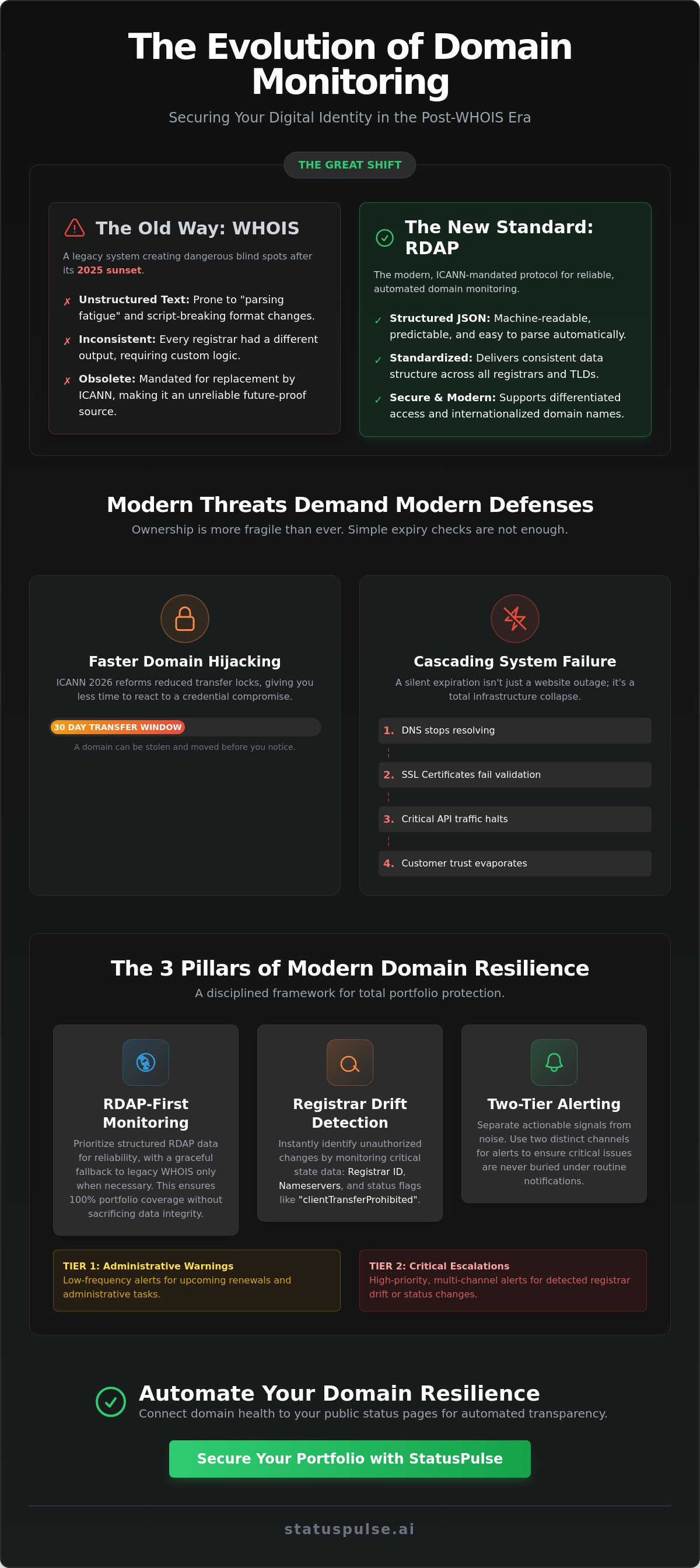
Hijacking is more sophisticated in 2026. ICANN reforms reduced transfer locks to 30 days. Attackers often target registrant data to gain legal control. Under the 2025 Registration Data Policy, the entity in the "Organization" field is the legal owner. Monitoring the Registration Data Access Protocol (RDAP) lets you see these metadata changes in real-time. If your "clientTransferProhibited" flag disappears, you need an alert immediately before the domain is moved.
The transition from manual lookups to automated infrastructure monitoring is no longer optional. Modern teams treat domain metadata as code. They track registrar drift with the same rigor they apply to server performance. By focusing on the machine-readable data provided by RDAP, you can identify unauthorized nameserver swaps or registrant changes before they lead to a total service outage. This level of precision is what separates a secure portfolio from one waiting for a disaster.
RDAP-First Architecture: Why Legacy WHOIS is the Fallback, Not the Standard
Legacy WHOIS is a relic of an earlier internet. For decades, it served its purpose, but its unstructured text responses became a nightmare for modern automation. Every registrar formatted their WHOIS output differently. This led to "parsing fatigue" as developers struggled to write thousands of unique regular expressions just to find a simple expiration date. The industry needed a change. That change arrived with the Registration Data Access Protocol (RDAP), which ICANN mandated as the new standard.
RDAP delivers data in structured JSON format. It is predictable, machine-readable, and inherently more secure. Unlike the old text-based queries, RDAP allows for standardized access control and better handling of internationalized domain names (IDNs). Following the full sunsetting of WHOIS on January 28, 2025, any serious monitoring strategy must prioritize this protocol. To maintain 100% uptime, you should monitor domain expiration — RDAP-first with WHOIS fallback; two-tier alerts; registrar drift detection.
The Technical Superiority of RDAP
The move to JSON eliminates the guesswork. When you query an RDAP server, the response is deterministic. You don't have to worry about a registrar suddenly changing their text layout and breaking your monitoring scripts. This reliability is the foundation of data integrity. RDAP also supports differentiated access, allowing registries to provide more granular data to authenticated users while protecting public privacy. It is a cleaner, more ethical way to handle registration data.
When to Use WHOIS Fallback
While RDAP is the future, the transition across 1,500+ extensions isn't always uniform. Some niche or legacy TLDs may still experience intermittent RDAP availability or rate-limiting issues. A resilient system doesn't just fail when the primary protocol stutters. It falls back gracefully to WHOIS to ensure no domain in your portfolio goes unchecked. This "thick" vs "thin" server logic ensures that whether a domain is a popular .com or a rising .ai, your visibility remains constant.
We built our platform on these principles of precision and reliability. We don't treat protocols as equal; we treat RDAP as the source of truth and WHOIS as the safety net. If you are tired of corporate bloat and want a straightforward way to protect your assets, you can monitor your infrastructure with a team that values technical accuracy over marketing hype. By automating these checks, you remove human error and ensure your domain state is always exactly what you expect it to be.
Detecting Registrar Drift: Securing Your Domain State
Registrar drift is a silent threat to your core infrastructure. In the world of DevOps, teams focus on configuration drift for servers and containers. Domain metadata deserves the same scrutiny. Drift occurs when the actual state of your domain registration deviates from your intended baseline. This isn't just about a simple name change. It involves unauthorized modifications to your nameservers, registrar IDs, or security flags. These subtle shifts often happen without a single notification from your registrar.
Reliable Uptime Monitoring depends on a stable domain state. If your nameservers change without your knowledge, your uptime checks might still pass while your customers are being redirected to a malicious clone. Establishing a baseline is the first step toward true resilience. This baseline serves as a "known-good" record of your domain's metadata. Any deviation from this record should trigger an immediate investigation.
To maintain this security posture, you must monitor domain expiration — RDAP-first with WHOIS fallback; two-tier alerts; registrar drift detection. By treating your domain records as critical infrastructure components, you move beyond reactive alerts. You gain a proactive defense against the small changes that precede a total hijacking attempt. Precision in monitoring these fields is what separates an ethical, secure team from one that is merely lucky.
Monitoring Nameserver Integrity
Nameserver integrity is the front line of your DNS security. An unauthorized change here allows an attacker to intercept all traffic, including email and sensitive API requests. You should also verify your DNSSEC status constantly. If your cryptographically signed records are removed, your domain becomes vulnerable to cache poisoning. Additionally, alerting on the removal of the "clientTransferProhibited" flag is vital. This flag is your primary defense against unauthorized transfers. Its sudden disappearance is a red flag that requires an emergency response.
Ownership and Contact Data Drift
Ownership drift often starts with small changes to Administrative or Technical contact fields. These fields are frequently used to verify identity during a transfer request. Attackers may attempt "Registrar Hopping," moving a domain through multiple registrars quickly to obscure the trail. Automated auditing of your entire portfolio state prevents this. By tracking every field in the RDAP response, you can detect these shifts before they become legally binding. Meticulous tracking ensures that your organization remains the documented legal owner, as mandated by the 2025 Registration Data Policy. We believe in providing the tools for this level of precision without the corporate bloat of legacy providers.
Implementing a Two-Tier Alerting Strategy for Domain Health
Alert fatigue is a productivity killer. When domain alerts are mixed with standard server pings, they often get ignored. This is a dangerous mistake. Domain issues require a different response rhythm than a temporary CPU spike. To secure your infrastructure, you must monitor domain expiration: RDAP-first with WHOIS fallback; two-tier alerts; registrar drift detection. By separating administrative tasks from technical emergencies, you ensure that every notification gets the right level of attention.
We believe in a disciplined approach to notifications. Tier 1 is the Warning Phase. This covers the window from 90 to 30 days before a domain expires. These alerts are administrative. They belong in a Slack channel or an email inbox where the billing team can see them. Tier 2 is the Critical Phase. This is the 14 day countdown to service failure. These alerts are emergencies. They should bypass standard chat channels and trigger your primary on-call rotation. This separation prevents routine renewals from becoming midnight crises.
Configuring Your Alert Thresholds
Precision starts with a clean audit. Group your domains by business criticality. Not every domain requires a 7 day emergency escalation. For standard assets, a 60 day warning provides ample time for manual renewal or updating expired payment methods. For high-value production domains, set a 7 day critical alert. This threshold acts as the final safety net. It ensures that if the billing team misses their window, the technical team can step in before the DNS stops resolving.
Operationalizing the Response
Assigning ownership is the key to a fast recovery. Billing teams should own Tier 1 warnings. They handle the credit cards and registrar accounts. Technical teams own Tier 2 criticals. When a critical alert triggers, use AI Incident Management to draft stakeholder notifications immediately. This removes the stress of writing "the site is down" messages during a live event. Once the renewal is processed, your monitoring should verify the new expiration date via RDAP. This final verification is the only way to auto-resolve the alert with total confidence.
Our goal is to reduce the stress of technical disruptions. We provide a straightforward path from problem to solution without the corporate bloat of legacy providers. By automating these tiered responses, you protect your uptime and your reputation. It's a principled way to manage a complex portfolio with a small, dedicated team.
Automating Domain Resilience with StatusPulse
Domain health is not a siloed technical metric. It is the foundation of your public reputation. When a domain drifts or nears expiration, the impact ripples through your entire stack. StatusPulse provides a centralized dashboard that unifies your SSL, API, and domain health into a single source of truth. We built this for specialists who value precision over corporate bloat. By choosing to monitor domain expiration — RDAP-first with WHOIS fallback; two-tier alerts; registrar drift detection, you ensure that your infrastructure remains as resilient as your code.
Our platform handles the technical heavy lifting of RDAP parsing and drift detection. This allows your team to focus on resolution rather than manual lookups. Privacy and regulatory compliance are core virtues of our architecture. We are a small, dedicated team focused on precision. Our EU-hosted infrastructure ensures your data stays within strict geographic and ethical boundaries. We offer a fair alternative to the complex pricing models of industry incumbents.
From Alert to Transparent Communication
StatusPulse bridges the gap between a technical alert and stakeholder trust. When our system detects a registrar drift event, it doesn't just ping your on-call team. It uses AI Incident Management to draft a clear, honest status update. This assistant frames the issue for your users: "Your domain is expiring, here is the impact." You maintain human agency by reviewing the draft before it goes live on your Public Status Pages. This proactive disclosure prevents the panic that follows a silent outage. Integrating these checks with our API Monitoring gives you full-stack visibility from the root domain to the final endpoint.
Why StatusPulse is the Ethical Alternative
We believe in transparency. Our pricing scales with your portfolio, not your revenue. You won't find unnecessary filler or marketing fluff here. We provide a streamlined tool designed for technical teams who need reliability without the corporate baggage. This commitment to Uptime Monitoring integrity is why specialists trust us. We don't just alert you to problems. We provide the automated transparency needed to solve them effectively. Secure your domain portfolio with a team that values technical truth as much as you do.
Secure Your Digital Foundation
Domain ownership is too critical to leave to chance or outdated protocols. Moving to RDAP provides the technical precision your team needs. Structured JSON data eliminates the guesswork of legacy WHOIS parsing. It's the only way to catch registrar drift before it leads to a hijacking event or a total service failure. To keep your infrastructure resilient, you must monitor domain expiration — RDAP-first with WHOIS fallback; two-tier alerts; registrar drift detection.
We built our platform for technical specialists who value truth over marketing hype. Our developer-first architecture respects your time and your privacy. We offer EU-based hosting and strict privacy standards to ensure your data stays secure. With AI-powered incident management, you can automate transparency without adding corporate bloat to your workflow. It's a straightforward approach to a complex problem. No hidden fees. No complex models. Just reliable tools built by a dedicated team.
Secure your domain portfolio with StatusPulse RDAP monitoring today. Take control of your infrastructure with a partner that prioritizes integrity. You've worked hard to build your reputation. We'll help you protect it.
Frequently Asked Questions
What is the difference between WHOIS and RDAP for domain monitoring?
RDAP provides structured JSON data while WHOIS delivers unstructured text. This technical difference is critical for automation. RDAP is deterministic and machine-readable, which eliminates the need for complex regular expressions. It ensures your monitoring remains stable even if a registrar changes their display format. It's a more reliable, modern foundation for your technical stack.
How many days before expiration should I set my domain alerts?
We recommend a two-tier strategy for your portfolio. Set your first alert at 60 days for routine administrative action. This gives your billing team plenty of time to update payment methods. Set a second critical alert at 7 days for emergency escalation. This disciplined approach prevents routine renewals from turning into high-stress service disruptions.
Can RDAP-first monitoring detect if my domain was hijacked?
Yes. Hijacking often starts with subtle changes to domain metadata. RDAP-first monitoring tracks these shifts in real-time. If an attacker removes a transfer lock or changes a nameserver, you'll know immediately. To stay protected, you should monitor domain expiration — RDAP-first with WHOIS fallback; two-tier alerts; registrar drift detection. This proactive stance stops threats before they result in a full transfer.
Does StatusPulse monitor all TLDs for expiration?
We provide comprehensive coverage for the entire domain landscape. Our system supports over 1,500 extensions. While we prioritize RDAP for its technical superiority, we maintain a robust WHOIS fallback. This ensures that even legacy or niche TLDs are monitored with the same level of precision as a .com address. You won't have to worry about blind spots in your portfolio.
Why do I need domain monitoring if I have auto-renew turned on?
Auto-renew is helpful but it isn't a guarantee. Expired credit cards, failed billing APIs, or missed registrar emails can all cause a domain to lapse silently. Independent monitoring acts as a vital safety net. It verifies the actual registration state from a third-party perspective. This prevents a single billing error from taking down your entire technical stack and breaking your SSL certificates.
What is registrar drift and why should I care?
Registrar drift refers to any unexpected change in your domain's registration data. This includes modifications to nameservers, registrant information, or status flags. You should care because drift is a leading indicator of unauthorized access. Detecting these changes early allows you to lock down your assets before a full hijacking occurs. It is about maintaining a known-good baseline for your core infrastructure.
How does domain monitoring integrate with my public status page?
Our system converts technical alerts into actionable incident drafts. When a drift or expiration event occurs, you can quickly post an update to your public status page. This maintains customer trust through proactive disclosure. It informs your stakeholders that you're aware of the issue and working on a resolution. It's a straightforward way to manage transparency during critical infrastructure events.
Is RDAP monitoring more secure than traditional WHOIS lookups?
RDAP is significantly more secure. It uses HTTPS for encrypted transport and supports standardized access control. This protocol was designed with modern privacy standards in mind. It replaces the anonymous, unencrypted queries of legacy WHOIS with a structured and authenticated system. By choosing an RDAP-first approach, you're opting for a more ethical and technically precise way to manage your registration data.


