

What if the incident review gets the cause wrong because the timeline is scattered across alerts, chat threads, and deployment logs? Service may be restored, but the review can still become a debate over incomplete evidence or who made the wrong call. Knowing how to run an effective incident review means making the facts easier to discuss than the blame.
A useful review leads to learning, not finger-pointing. The challenge is building a shared account of what happened when people remember events differently and technical details threaten to crowd out the decisions that matter. A review should be blameless without avoiding hard questions. It examines evidence, system conditions, and response choices.
This guide shows how to prepare a reliable timeline, facilitate a focused discussion, and distinguish incident response from deeper investigation. You’ll learn how to identify practical improvements, assign each action an owner, and track it through completion. The aim is a review that produces more than a document: it should reduce the chance that the same conditions lead to another disruption.
Key Takeaways
- Learn how to run an effective incident review by grounding discussion in evidence, not blame or memory.
- Build a reliable timeline by collecting records, normalizing timestamps, and marking gaps or uncertainty.
- Examine how technical conditions, processes, information, and workload contributed to the incident.
- Turn findings into verifiable actions with one owner, a clear outcome, a priority, and a review date.
- Use monitoring and communication records to reconstruct events, while leaving interpretation to people.
What an effective incident review should achieve
A checkout service starts returning errors after a deployment. The team rolls back, traffic recovers, and customers can place orders again. But the incident channel contains conflicting timestamps, and no one knows whether the deployment caused the errors or exposed an existing dependency problem. Knowing how to run an effective incident review starts with a shared, evidence-based account and improvements the team can verify.
Response and review have different jobs. Incident response focuses on limiting impact and restoring service. The review happens after or alongside recovery to examine the conditions that shaped the incident, how the response unfolded, and what could reduce risk next time.
Success isn’t a lengthy report or a single “root cause.” It’s an account participants can use, learning tied to evidence, and follow-up actions with owners and outcomes. A review may identify several contributing conditions rather than one cause. That makes improvement work more practical: teams can address detection, dependencies, process, or recovery without pretending one change explains everything.
A review also isn’t a compliance report or an individual performance assessment. It may produce records that support other processes, but its purpose is to understand system behavior and improve operations. Keep discussion focused on decisions and working conditions, not judgments about competence. This helps people share what they saw, including uncertainty and mistakes, while preserving accountability for agreed actions.
Choose the review scope before investigating
Start with one question linked to customer impact, reliability, or response. For example: “Why did API errors continue after the rollback?” Define the incident window, affected services, and dependencies that could have influenced the outcome. A focused scope is central to how to run an effective incident review: include enough context to understand the event, but don’t turn it into an unrelated architecture audit. Record what’s out of scope so the discussion can return to it if evidence warrants it.
Decide when an incident merits a formal review
Use consistent criteria rather than relying on how visible or recent an incident feels. Consider severity and user impact, whether the event has recurred, how uncertain the cause remains, and whether recovery happened in an unexpected way. A lower-impact event can still deserve attention if it reveals a weak detection signal or a confusing handoff.
Not every event needs the same level of investigation. A short review or written note may be enough for a contained incident with a clear lesson. Set the threshold in advance and apply it across teams. This gives recurring patterns a chance to surface even when no single incident attracts broad attention, and reserves deeper analysis for events that justify it.
Build an incident timeline from evidence, not memory
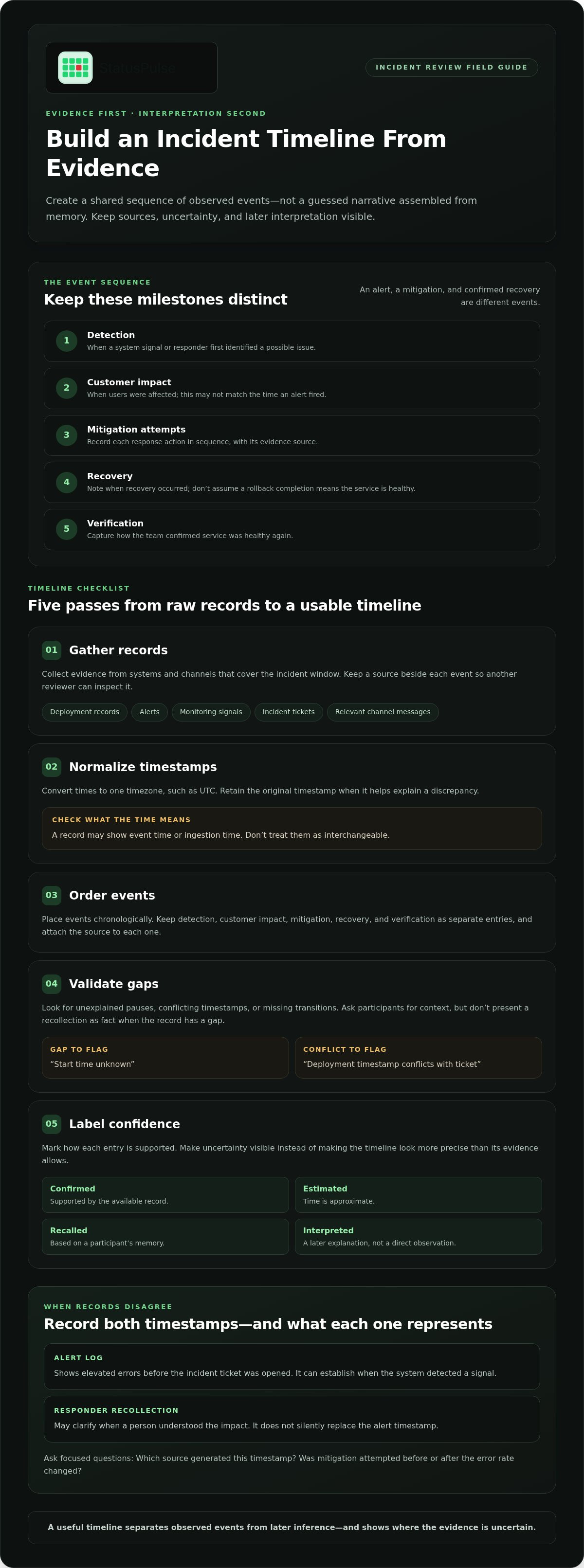
Once the scope is clear, build a timeline that shows what the evidence supports. A timeline is an evidence-linked sequence of observed events, not a guessed narrative assembled from memory. It should distinguish what happened from what the team later inferred.
A core step in how to run an effective incident review is to capture separate milestones. Detection, customer impact, mitigation attempts, recovery, and verification are not interchangeable. An alert may fire before customers notice errors, and a rollback may complete before the service is confirmed healthy.
Collect and normalize incident evidence
Gather deployment records, alerts, monitoring signals, incident tickets, and communication from relevant channels. Note the source beside each event, such as a deployment log or customer support report. Uptime and API monitoring records can provide dated signals. Teams using uptime and API monitoring can compare availability and API performance with deployment and alert records.
- Gather records. Collect evidence from systems and channels that cover the incident window. Preserve links or identifiers so another reviewer can inspect the source.
- Normalize times. Convert timestamps to one timezone, such as UTC, and retain the original timestamp when it helps explain a discrepancy. Check whether records refer to event time or ingestion time.
- Order events. Place events chronologically, keeping detection, impact, mitigation, recovery, and verification distinct. Add the source beside each entry.
- Validate gaps. Look for unexplained pauses, conflicting timestamps, or missing transitions. Ask participants for context, but don’t present a recollection as fact when the record has a gap.
- Label confidence. Mark entries as confirmed, estimated, recalled, or interpreted. This makes uncertainty visible instead of making the timeline look more precise than its evidence allows.
Make uncertainty visible in the timeline
Suppose an alert log shows elevated errors before the incident ticket was opened, while a responder remembers noticing the issue later. Record both timestamps and identify what each represents. The alert can establish when the system detected a signal; the recollection may clarify when a person understood its impact. Neither should silently replace the other.
Use explicit notes such as “start time unknown” or “deployment timestamp conflicts with ticket.” Then ask focused questions: Which source generated this timestamp? Was the mitigation attempted before or after the error rate changed? OSHA’s Incident Investigations Guide also emphasizes investigating underlying causes and systemic conditions rather than stopping at individual actions. The same evidence-first discipline keeps an operational timeline honest.
A clean timeline doesn’t need to hide uncertainty. It needs to show what is known, where each claim came from, and what remains unresolved. That gives the review a defensible basis for analysis without turning estimates into facts.
Analyze contributing conditions without turning the review into blame
Blameless doesn’t mean consequence-free or that nobody is accountable. It means examining the system context around decisions instead of treating an individual as the explanation. Ask what conditions made an action reasonable at the time, what information was available, and whether the process or system made a safer response difficult. People can own follow-up actions without being cast as the cause of the incident.
Separate the trigger that initiated the event from the contributing factors that shaped its progress and the impact experienced by users or services. For example, a deployment may trigger errors, while a dependency timeout, retry behavior, or unclear rollback guidance contributes to their duration. Treat each as a hypothesis until evidence supports it. Compare plausible explanations with the timeline, and keep alternatives visible if the evidence doesn’t settle them.
Hindsight alone is an unreliable measure of decision quality because responders acted with the information and constraints available at the time, not the facts discovered afterward. Use that principle to examine decisions fairly, while still asking whether the information, tools, or process should change.
Ask questions that reveal system conditions
At each key decision point, ask what responders knew, what they could see, and what options they had. Examine whether alerts were actionable, whether the right access and documentation were available, and whether dependencies or workload limited the response. Ask what helped, too. A workaround or clear handoff may reveal a useful adaptation worth preserving, even if other conditions increased risk.
Handle disagreement and accountability constructively
Describe observable actions before interpreting them. “The rollback began after the second alert” is verifiable; “the responder ignored the first alert” assumes intent. Invite people to explain what they saw and why they acted. If accounts conflict, record the difference and what evidence could resolve it. Don’t force consensus when the record remains uncertain.
Keep learning-focused review separate from personnel or conduct processes. If a concern requires that process, handle it through the appropriate channel rather than using the incident discussion to reach a performance judgment. This boundary helps participants speak candidly while keeping responsibility clear: the review addresses system improvements, and named owners remain accountable for completing agreed work.
Turn review findings into actions the team can verify
A finding only reduces risk when it changes how the system behaves or how people respond. Convert each useful finding into an action that targets detection, mitigation, resilience, or shared operational knowledge. “Improve alerting” is too vague to assign. “Update the API error alert to include the affected dependency and document the escalation path” describes a change the team can implement and inspect.
For each action, record one accountable owner, the intended outcome, priority, dependencies, and a review date. Define the evidence that will count as completion, such as a merged configuration change, a tested runbook, or a successful recovery exercise. Then schedule a later check: implementation proves the change was made, but not that it reduced risk.
Write action items that can be completed and checked
Make the completion condition observable. For example, replace “review rollback process” with “update the rollback runbook with the service-specific verification steps, then have the on-call engineer test them in a staging environment.” The owner can attach the revised runbook and test result before closing the item.
Track blockers and dependencies alongside the action. If a required platform change is deferred, record why, who accepted the risk, and when the decision will be revisited. Escalate when the owner lacks authority or a dependency threatens the review date. Don’t close an item because its ticket moved to “done”; inspect the implementation evidence and, where practical, test the intended behavior.
Check whether the change reduced risk
Set a follow-up check that matches the action. For a detection change, examine whether the signal now identifies the failure earlier or with more useful context. For a resilience change, verify the relevant recovery behavior. Avoid treating “no repeat incident” as proof by itself: the system may not have faced the same conditions again.
Assess review quality through action follow-through, the usefulness of completed changes, and recurring patterns across incidents. Incident counts alone can mislead. A rise might reflect better detection or reporting, while a quiet period doesn’t prove that risk has fallen. Look for repeated contributing conditions and whether previous actions addressed them.
Share findings without losing operational context
Adapt the summary to the reader. Engineers need the technical sequence, relevant dependencies, and decisions. Leadership needs customer impact, risk, and action status. Affected stakeholders need a clear account of impact and recovery without internal troubleshooting detail. Public status updates can support transparent communication. Keep them factual and distinguish confirmed impact from what remains under investigation.
Limit broadly shared records to what each audience needs. Remove credentials, personal data, or sensitive system details where appropriate, while retaining enough context for authorized teams to act. This balance keeps learning useful without exposing information unnecessarily.
If incident updates and action tracking are spread across separate tools, StatusPulse incident management combines public status pages with AI-assisted update drafting to support communication. People should still review updates, validate findings, and decide which actions address the risk.
Use monitoring and communication tools to support the review
Tools can preserve operational signals and communications, but they can’t determine why an incident happened. Use records to establish what a service did and when. Then compare them with deployment, response, and customer-impact evidence before drawing conclusions.
Uptime monitoring can show when website availability changed. API monitoring can help trace changes in API performance, while SSL certificate monitoring can provide relevant certificate validity records. These signals add precision to event reconstruction, but they have limits: a monitor’s observation reflects what it measures, not necessarily every user’s experience or the underlying cause.
Connect operational evidence with incident communication
Compare monitoring events with the timeline and note where they agree or differ. For example, an uptime alert may identify the beginning of an availability issue, while an API signal may show whether performance changed at the same time. Check the monitor’s scope and observed behavior before treating a signal as proof of customer impact.
Public status updates can also help establish what stakeholders were told and when. Compare each update with the evidence available at publication time. Consistent updates should distinguish confirmed impact from investigation in progress, and correct earlier statements when new facts change the picture. A clear incident communication transparency practice gives teams a useful record without treating public updates as a technical diagnosis.
AI can help draft status updates or summarize incident impact, especially when information is spread across records. Treat its output as a working draft. A person should verify the facts, check for missing context, and decide what to communicate. AI can organize evidence, but it can’t replace engineering judgment about cause or response.
Evaluate tooling against the review workflow
Assess tools against the work the team needs to do: preserve useful signals, make status updates accessible, and support incident coordination. Consider whether records can be compared during a review and whether the communication process leaves a usable history. A collection of tools may fit an existing workflow better than a consolidated platform. The trade-off is whether teams can bring relevant evidence together without losing context.
Include the cost model in that assessment. Per-subscriber fees can make broad stakeholder communication harder to forecast as audiences change, so compare pricing models against the expected audience and how it may change. Also consider data sovereignty: hosting location may matter to your organization, so weigh EU and US hosting options against its requirements without assuming either one establishes regulatory compliance.
StatusPulse brings uptime, API, and SSL monitoring together with public status pages and AI incident management. If those functions fit your review and communication workflow, explore StatusPulse’s monitoring and status page platform.
Make the next review easier to lead
Put the review process in place before the next disruption. Create a shared template that gives the facilitator a clear starting point, makes uncertainty visible, and leaves space to record decisions and follow-up. Test the template against a past incident. If the team can use it to separate known facts from open questions, it’s ready for a real review.
The goal of learning how to run an effective incident review isn’t to produce a perfect account of every event. It’s to make the next discussion more useful and the next improvement easier to verify. Keep refining the process as your systems and team practices change.
To support that workflow, explore StatusPulse’s monitoring, public status pages, and AI incident management.
Each review can make the next response clearer. Start with one practical improvement and keep learning.
Frequently Asked Questions
Who should take part in an incident review?
Invite people who can explain key decisions, service behavior, or customer impact. That often includes the incident lead, responders who handled mitigation, the service owner, and representatives from teams responsible for affected dependencies. Add support or communications colleagues if they can clarify what customers reported or were told. Keep attendance focused, and share findings with people who need them but don’t need to join the discussion.
How soon after an incident should you hold a review?
Schedule it once service is stable and participants can contribute without interrupting urgent recovery work. Don’t wait until memories fade or relevant records become difficult to retrieve. If the investigation is still active, hold an initial discussion about response and impact, then reserve time to revisit open technical questions. Timing depends on incident complexity and evidence availability, not a fixed number of hours or days.
What is the difference between an incident review and a postmortem?
The terms often refer to the same learning-focused process, though teams may use them differently. Some call the discussion an incident review and the written document a postmortem; others use “postmortem” for both. Define the terms in your team’s incident documentation so requests are clear. People should know whether they’re being asked to attend a discussion, contribute information, or read a completed record.
Can you run an incident review when the root cause is still unknown?
Yes. Review what the team observed and how it responded without presenting an unverified explanation as fact. For example, note that errors stopped after a configuration change while stating that the relationship hasn’t been established. List the evidence that could help resolve the question and decide whether further investigation is worthwhile. The review can still clarify response questions even if the technical cause remains open.
What should an incident review report include?
Give readers enough context to understand the event without relying on the meeting. Include a concise impact statement, the scope of the review, key decisions and their rationale, and what remains uncertain. A report can also note its author or reviewer, completion date, and intended audience. If teams need different levels of detail, maintain an internal technical record and a shorter stakeholder-facing version that omits sensitive operational information.
How do you know whether an incident review was effective?
Look at whether the review improved shared understanding, not just whether it produced a document. Ask a participant who wasn’t part of the response to explain the incident’s impact and why key decisions made sense at the time. If they can distinguish established facts from unresolved questions, the account is useful beyond the people who were present. Invite participants to flag unclear language or missing perspectives before treating the review as complete.


