

An alert can arrive in seconds. Deciding who owns it can take much longer. Establishing an incident response team means more than assigning people to an org chart: unclear authority, scattered updates, and improvised handoffs can leave skilled responders working at cross-purposes. A clear operating model helps the team coordinate under pressure.
That model does not need to be large or bureaucratic. It needs named owners, escalation criteria matched to incident severity, and a shared record of what is known. Technical responders and communicators should work from the same facts, even as those facts change.
This guide explains how to build a response model around your organization’s services and risks. It covers decision-making responsibilities, escalation and handoff rules, and internal and external updates. It also reflects the 2026 guidance in NIST SP 800-61 Revision 3, which treats incident response as part of ongoing cybersecurity risk management rather than a rigid sequence of phases.
Key Takeaways
- When establishing an incident response team, define who coordinates, investigates, owns the affected service, and communicates with stakeholders.
- Choose a response model that fits your team’s capacity and the severity of incidents it handles.
- Set observable escalation criteria and document handoffs from signal validation through recovery.
- Use monitoring to surface potential incidents, then have responders validate impact and decide what to do.
- Keep internal coordination separate from customer-facing updates, and use a public status page to share consistent information.
Why establish an incident response team before the next outage?
When a service fails, unclear ownership can slow coordination before anyone changes a line of code. The on-call engineer may investigate while a service owner waits for approval and customer-facing teams ask for an update. Establishing an incident response team in advance gives people a shared way to decide who acts, who coordinates, and who communicates.
An incident response team is a group of people with assigned responsibilities for detecting, assessing, mitigating, and communicating about incidents. The response capability should exist before an incident, but the people activated for a specific event can vary with its scope and impact.
What does an incident response team do?
The team coordinates investigation, mitigation, decisions, and stakeholder communication so that work moves in the same direction. Responders diagnose and address the problem. A designated lead sets priorities, tracks dependencies, and makes sure decisions reach the people who need them. Separating coordination from technical execution helps prevent conflicting actions and unowned work.
Roles do not need to belong to separate departments or full-time positions. In a smaller organization, one person may cover more than one function, as long as responsibilities are explicit. A general overview of an incident response team can provide context, but your operating model should reflect your services, dependencies, and decision-making authority.
Keep the capability standing, activate the group as needed
A standing response capability includes documented roles, contact paths, decision rights, and procedures. It remains in place when no incident is active. The incident group is the set of people brought together for a particular event, such as an engineer investigating a failed API, the API’s service owner, and a lead coordinating priorities.
This distinction keeps preparation practical. You do not need a large, permanently assembled department. You do need a known way to bring the right people together, transfer ownership, and keep relevant teams informed.
When should a team activate?
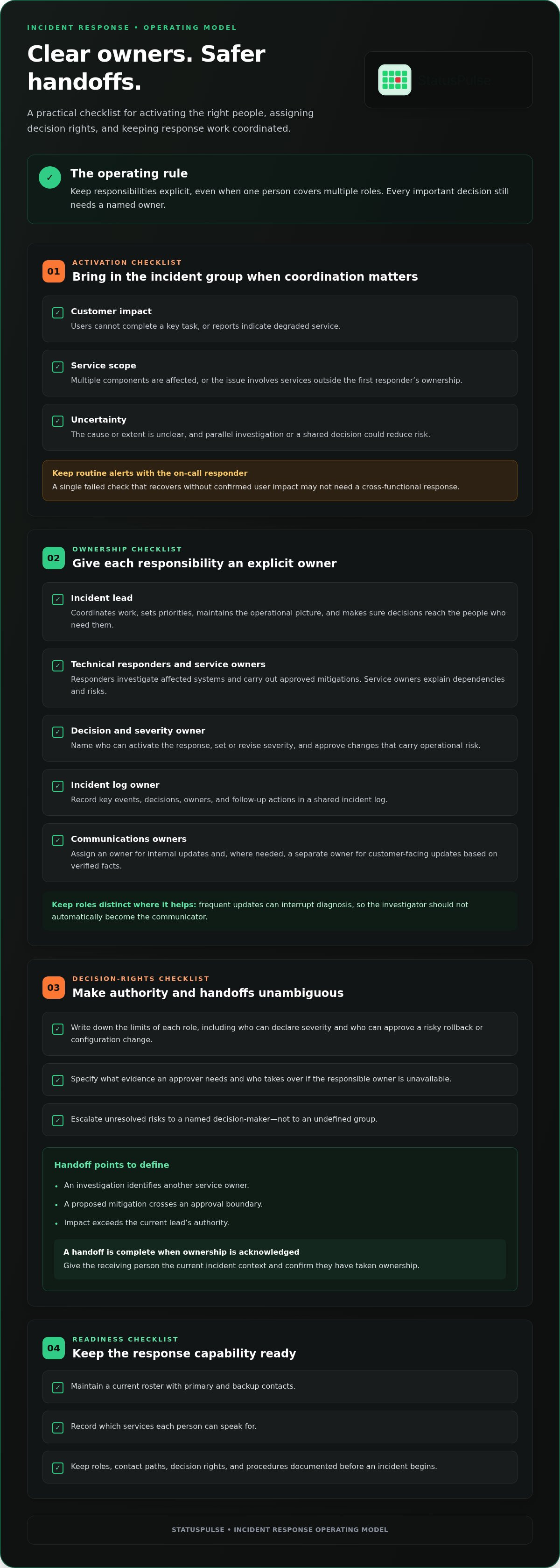
Not every alert needs a cross-functional response. A single failed check that recovers without confirmed user impact may stay with the on-call responder. Activate the incident group when evidence points to customer impact, multiple affected services, elevated operational risk, or uncertainty that calls for decisions across teams.
Use observable signals to guide that decision:
- Customer impact: Users cannot complete a key task, or reports point to degraded service.
- Service scope: The issue affects multiple components or depends on services the first responder does not own.
- Uncertainty: The cause or extent is unclear, and parallel investigation or a shared decision could reduce risk.
Monitoring provides signals, not ownership. An uptime monitoring guide can help teams assess availability checks and alert signals. Responders still need to validate impact and choose the response. Clear activation criteria route routine alerts without unnecessary escalation and bring the right people together when coordination matters.
Assign incident response roles, decision rights, and handoffs
Clear ownership matters more than a large, dedicated department. During an incident, people need to know who can make a decision, who is investigating, and who is responsible for keeping others informed. When establishing an incident response team, assign responsibilities around your service architecture, team coverage, and incident risks. One person can hold several roles in a small team, but each decision still needs a named owner.
Which responsibilities need explicit owners?
Separate coordination from technical execution. The incident lead maintains the operational picture and sets priorities; responders investigate systems and carry out approved mitigations. Service owners explain dependencies and risks. A communications owner turns verified facts into updates without pulling investigators away from technical work.
- Incident declaration and severity: Name who can activate the response and set or revise severity.
- Investigation and mitigation: Assign technical owners to affected components and identify who can approve changes that carry operational risk.
- Timeline and decisions: Give one person responsibility for recording key events, decisions, owners, and follow-up actions in a shared incident log.
- Stakeholder communication: Assign an internal communications owner and, where needed, a separate owner for customer-facing updates.
These assignments can overlap, but avoid making an investigator the default communicator if frequent updates would interrupt diagnosis. Keep a current role roster with primary and backup contacts, along with the services each person can speak for.
How should decision rights and handoffs work?
Write down the limits of each role. The incident lead may declare severity and coordinate work, while a service owner approves a risky rollback or configuration change. Define who can authorize that action, what evidence they need, and who takes over if the owner is unavailable. Escalate unresolved risks to a named decision-maker rather than an undefined group.
Use clear handoff points: when an investigation identifies another service owner, when a proposed mitigation crosses an approval boundary, or when impact exceeds the current lead’s authority. A handoff is complete only when the receiving person acknowledges ownership and gets the current impact, actions taken, open risks, and next decision required. Record the transfer in the incident log.
For example, if an API responder finds that failures originate in a shared database, they should pass the evidence and mitigation status to the database owner while the incident lead retains coordination. This keeps technical ownership close to the system without losing a shared operational picture.
Communication tools can help keep updates coherent, but they should not make decisions on the team’s behalf. AI-assisted incident management can help draft updates and summarize impact. A human owner should review the facts and approve what gets shared.
Choose an incident response model that fits team size and severity
No single structure fits every organization. The right model gives someone clear coordination responsibility at each severity level without adding process where it is not needed. Choose a model based on service ownership, incident frequency, and how much coordination an event could require.
| Model | Best fit | Benefit | Trade-off |
|---|---|---|---|
| Rotating lead | Smaller teams with clear service ownership | Shares coordination duties across responders | Context switching and uneven experience can affect response |
| Cross-functional group | Incidents that regularly involve several services or functions | Brings relevant owners together to resolve dependencies | Can draw people into incidents before their input is needed |
| Dedicated incident command role | Complex incidents spanning services, teams, or customer-facing work | Keeps coordination focused while specialists investigate | Requires enough coverage to prevent the role becoming a bottleneck |
Severity should change how much coordination an incident needs, not whether accountability exists. Keep one named lead responsible for the operational picture at every level. As impact or uncertainty increases, bring in service owners, communications support, or leadership according to defined triggers. Do not make the response depend on everyone agreeing who is in charge.
When is a lightweight or rotating model enough?
A rotating lead can work well when services have straightforward ownership and incidents rarely involve several teams at once. The assigned lead coordinates while the relevant responder investigates. The trade-off is context switching: an engineer may need to shift from technical work to coordination, and rotating leads may have different levels of incident experience.
Document a primary and backup for each rotation, along with the activation path. An absent or unavailable lead should not leave responders guessing. If incidents repeatedly cross service boundaries, consider whether a cross-functional response group or stronger coordination role would address the pattern.
When does a dedicated incident lead help?
A dedicated lead is useful when an incident spans services, teams, or customer-facing functions. They track priorities, dependencies, open decisions, and update timing. They do not take over specialist decisions: the service owner still assesses technical risk, while the lead ensures that the right people make and communicate decisions. Clear incident communication transparency helps responders and stakeholders work from the same verified information.
Choose a model that matches actual operating conditions, then review it after incidents. If the lead is routinely overloaded, responsibilities may need to split. If coordination adds little value to routine events, keep those responses lightweight and reserve broader activation for higher impact. Record what prompted a model change so future reviews can distinguish a recurring coordination gap from a one-off exception.
Build the incident response process: escalation, runbooks, and practice
A repeatable process gives responders a shared route from the first signal to recovery without assuming every incident has the same cause. As you build the process for establishing an incident response team, define the next action at each stage and who owns it. Keep escalation criteria observable so responders can act on evidence instead of debating whether an issue feels serious enough.
- Validate the signal. Check whether the alert reflects a real service condition. Compare monitoring data with user reports, recent changes, and other relevant signals.
- Assess and activate. Estimate customer impact, affected services, uncertainty, and operational risk. Bring in the response group when coordination or a shared decision is needed.
- Mitigate and track. Assign an owner to each technical action. Record the expected effect and any risk before a change, then check whether it improved the situation.
- Communicate updates. Share verified facts, known impact, actions underway, and the next update point. Mark unknowns as unknowns rather than filling gaps with guesses.
- Confirm recovery and review. Check service behavior against relevant signals and user impact. Afterward, review decisions, handoffs, and follow-up work.
Escalation should reflect what responders can observe: users cannot complete a key task, several services are affected, the cause or scope remains uncertain, or a proposed action carries risk beyond the responder’s authority. A runbook should guide the response, not force a risky step simply because a symptom looks familiar.
What belongs in an incident runbook?
Keep each runbook focused on a known failure mode, such as elevated API errors or an expired certificate. Include activation contacts, service ownership, relevant dashboards, escalation paths, and a place to record decisions. Link to current operational references instead of copying details that may go stale. Make one instruction explicit: record unknowns as unknowns, and verify assumptions before treating them as facts.
How can teams test the response process?
Use a tabletop scenario to walk through an alert, activation, handoff, mitigation decision, and update. No production changes are needed. Test whether participants know their roles, can find current references, and can pass information clearly. Review where a decision stalled or a handoff lost context, not just whether the scenario reached a technical resolution.
Review real incidents with the same questions. Turn each useful finding into an action with a named owner and follow-up date. For customer-facing incidents, a public status page can give updates a consistent home. Tools for coordinating monitoring and incident updates can support that workflow, while responders retain decision-making responsibility and review each update before publication.
Connect monitoring and incident communication without replacing human judgment
Monitoring can show that a service is failing. It cannot determine the full customer impact, choose a mitigation, or decide what to tell users. A sound operating model routes signals to responders, then separates internal coordination from external updates. This keeps tools useful without assigning them decisions they cannot own.
Internal channels support investigation and coordination: responders share evidence, assign work, and record decisions. A public status page serves a different purpose. It gives customers a consistent place to find verified information about service impact and response progress. Keep sensitive diagnostic details in internal channels, and publish only updates approved for external audiences.
What should incident tools support?
Assess tools against the work the team needs to do. Can responders see relevant signals, identify the affected service, coordinate actions, and share accurate updates without losing the incident record? A consolidated platform can reduce the need to move between separate monitoring and communication tools. Complex environments may still need specialized observability or response systems for requirements a general platform does not cover.
Map the incident workflow before selecting tools. Check whether signals reach the right owners, internal decisions stay distinct from customer updates, and the team can review what happened afterward. The goal is not one tool for every task. It is a workflow where evidence and updates stay connected without creating another source of confusion.
How can StatusPulse support the operating model?
Once responsibilities and escalation paths are clear, a platform can support the process. StatusPulse monitors website availability, API performance, and SSL certificate validity, giving responders operational signals to assess. Those signals can point to a possible issue, but the team still validates user impact and decides what action to take.
Customizable public status pages give teams a consistent place to share customer-facing incident updates. AI incident management can assist with drafting those updates and summarizing incident impact. A person should review the facts, decide what to disclose, and approve each update before it goes out. Human review matters most when impact is uncertain or details are changing.
Useful incident communication transparency comes from separating what the team knows from what it is still investigating. If monitoring signals, public updates, and AI-assisted summaries fit your operating model, explore StatusPulse monitoring and incident management.
Make the response model part of routine operations
A response model stays useful only if it keeps pace with changes in services, dependencies, and team responsibilities. Set a regular point to review ownership and escalation paths, and revisit them after major architecture changes or incidents that expose a gap. Keep the review practical: can the right people still act, and do documented handoffs match how work gets done?
Start small. Choose one service, confirm its escalation path, and walk through a realistic failure scenario. Use what the exercise reveals to improve the process before extending it across more systems. This gives establishing an incident response team a concrete next step without turning preparation into a large organizational project.
If you are assessing tools to support that operating model, consider whether monitoring, incident updates, and data location fit your needs. Explore StatusPulse monitoring and incident communication as one option for supporting your team’s response workflow.
Clear ownership is built through practice, not paperwork alone. Keep testing the process, learn from gaps, and make the next response easier to coordinate.
Frequently Asked Questions
How do you establish an incident response team?
Establishing an incident response team starts with an inventory of critical services, dependencies, and the people who understand them. Use that map to define which incidents the team handles and where its authority ends. For example, decide in advance whether a suspected data-integrity issue follows the same response path as a temporary availability problem. A short charter can capture this scope and help onboard new responders.
Who should be on an incident response team?
Choose participants who bring service knowledge, decision authority, or context the responders may need. Include coverage for critical dependencies, not just the team that owns the visible symptom. For a payment issue, responders may need input from the service owner and the person who understands the payment integration. Keep a current roster with backups, and review it when people change roles or services change ownership.
What roles are needed in an incident response team?
Define roles by the output each one is accountable for. One person maintains a reliable event record, another gathers technical evidence, and an authorized decision-maker assesses the risk of proposed actions. A communications owner prepares audience-appropriate updates from verified information. Role cards can state each function’s expected inputs and outputs, helping people understand what to hand over without prescribing every move.
How do small teams handle incident response?
Small teams can combine duties, but should identify conflicts before an incident. For example, someone proposing a high-risk change may need a second person to review its likely effects, even if both people hold other response duties. Agree on how to prioritize if two incidents compete for the same specialist. A clear priority rule helps the team make trade-offs openly instead of silently delaying one response.
When should an incident response team be activated?
Set activation thresholds before responders face ambiguous evidence. Some events may warrant early coordination before customer impact is confirmed, particularly if data integrity or a critical dependency could be at risk. Define what information is sufficient to start the response, then allow the lead to revise the assessment as facts emerge. Also document who can stand the team down and what recovery evidence they need.
How often should incident response teams practise?
There is no single practice interval that suits every team. Set the cadence according to how quickly services, dependencies, and ownership change, and bring practice forward when reviews reveal a recurring gap. Vary the exercise format: a scenario discussion can test judgment, while a communications drill can test whether people can produce a clear update from incomplete information. Record which capability each exercise tests so coverage does not become repetitive.
What tools does an incident response team need?
Choose tools that preserve a usable record of events and decisions, with clear access for the people who need to respond. Plan a fallback communication method in case the primary collaboration system is affected by the incident. Before adopting another tool, check whether responders can find past decisions and relevant references without copying sensitive details across unnecessary systems. The best fit depends on your architecture, access controls, and existing operational workflow.


