

A service starts timing out. Alerts fire, traces point to a dependency, and a recent deployment looks suspicious. The team needs an update now, but the evidence doesn’t yet prove what caused the failure. In that gap, AI incident communication can help turn scattered signals into a clear summary, but a plausible explanation is still only a hypothesis.
That distinction matters. AI can help engineers search logs, group related events, and compare timelines faster. It can also surface correlations that look convincing without establishing causation. The incident team still needs to test each explanation against technical evidence before calling it the root cause.
This guide explains where AI can assist an RCA workflow, how to validate hypotheses against logs, alerts, traces, and change records, and how to share useful updates while the investigation is open. You’ll learn a repeatable way to separate confirmed facts from uncertainty, so incident communication stays clear without claiming more than the team knows.
Key Takeaways
- Set a bounded incident window and add service, deployment, and dependency context before asking AI to synthesize evidence.
- Use AI to organize signals and propose hypotheses, then test each explanation against evidence and plausible alternatives.
- Choose between manual investigation, rule-based correlation, and AI-assisted synthesis based on the control and explainability your incident requires.
- Keep incident owners responsible for verifying findings and deciding what can be treated as fact.
- Use AI incident communication to draft impact summaries, while clearly separating confirmed facts, mitigation, and unresolved causes.
Why AI for Root Cause Analysis Needs Evidence, Not Just Fast Answers
A checkout service starts timing out. Soon, payment requests and order processing show errors too. The alerts confirm several failures, but not whether one caused the others or how many customers are affected. AI can organize the evidence, but a plausible explanation is not proof.
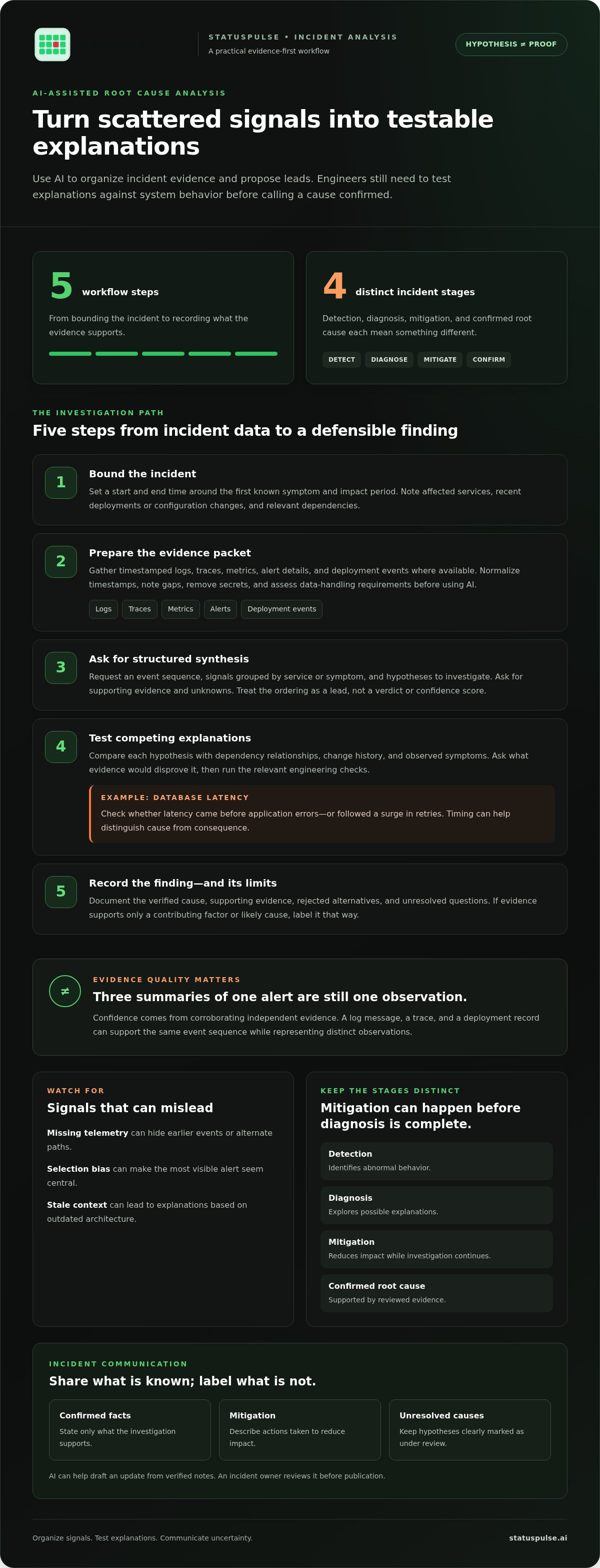
Keep the incident stages distinct: detection identifies abnormal behavior, diagnosis explores explanations, mitigation reduces impact, and a confirmed root cause is supported by reviewed evidence. Teams can mitigate while diagnosis is still underway.
An AI-generated hypothesis is a proposed explanation; a validated cause is one engineers have tested against system evidence. That distinction helps teams communicate clearly without overstating what they know.
What AI can contribute during an incident investigation
A language model can summarize supplied logs, notes, and timelines, or group similar errors by service and time. This can help engineers find investigation leads across scattered records. Root-cause analysis uses systematic methods to identify underlying contributors; What is Root Cause Analysis? provides a general introduction.
Clustering helps prioritize signals, but it doesn’t prove that they’re related. Compare grouped events with traces, changes, and system behavior. Results also depend on input quality: missing timestamps, incomplete telemetry, or stale service context can distort a summary.
Why a plausible explanation is not a proven cause
If database latency rises around the time an application starts failing, the events are correlated. But application retries could have caused the latency, or a shared dependency could explain both. Check timing and dependency behavior before treating either event as the cause.
- Missing telemetry can hide earlier events or alternate paths.
- Selection bias can make the most visible alert seem central.
- Stale context can lead to explanations based on outdated architecture.
Test AI-generated explanations against current evidence and plausible alternatives. If the available data can’t distinguish between causes, record that uncertainty and keep investigating. This prevents a useful lead from becoming an unsupported incident conclusion.
How AI Fits Into a Root Cause Analysis Workflow
Use AI to shorten the path from raw incident data to testable questions, not to skip evidence review. A useful workflow bounds the investigation, organizes relevant signals, tests hypotheses, and records what the evidence supports.
- Bound the incident. Set a start and end time based on the first known symptom and the period of impact. Identify affected services, recent deployments or configuration changes, and dependencies that could explain the observed behavior. A clear scope helps keep unrelated events from dominating the analysis.
- Prepare the evidence packet. Gather timestamped logs, traces, metrics, alert details, and deployment events where available. Normalize timestamps to a consistent time zone and note missing data or known instrumentation gaps. Remove secrets and assess data-handling requirements before supplying information to an AI system.
- Ask for structured synthesis. Have the AI summarize the event sequence, group signals by service or symptom, and list hypotheses to investigate. Ask it to cite supporting evidence and state what remains unknown. Treat its ordering as a guide for investigation, not as a confidence score or verdict.
- Test competing explanations. Compare each hypothesis with dependency relationships, change history, and observed symptoms. For a suspected database issue, check whether database latency preceded application errors or followed a surge in retries. Write down what evidence would disprove each explanation, then run the relevant engineering checks.
- Record the finding and its limits. Document the verified cause, supporting evidence, rejected alternatives, and unresolved questions. If the evidence supports only a contributing factor or a likely cause, label it that way. Keep the incident timeline and investigation notes clear enough for another engineer to review.
RCA confidence depends on corroborating independent evidence. A log message, a trace, and a deployment record can support the same sequence of events while representing distinct observations. Three summaries of one alert don’t provide three independent confirmations.
Preserve the distinction between an AI system causing an incident and a team using AI to investigate one. The Center for Security and Emerging Technology’s discussion of Reporting AI Incidents concerns reporting incidents involving AI systems. It can inform documentation discussions when AI itself is implicated, but it doesn’t validate an RCA hypothesis.
When an update is needed, communicate only what the investigation supports: current impact, mitigation, and what remains under review. AI incident communication can help turn verified notes into a clear draft, but an incident owner should review it before publication. For teams connecting monitoring signals with status updates, AI-assisted incident management can help draft updates and summarize outage impact.
Compare AI RCA Approaches by Evidence, Control, and Failure Modes
Manual investigation, rule-based correlation, and AI-assisted evidence synthesis solve different parts of an incident investigation. Choose based on the available evidence, the level of control reviewers need, and the cost of acting on a wrong conclusion. Teams can combine approaches instead of choosing just one for every incident.
| Approach | Inputs | Strengths | Limitations and failure modes | Explainability | Human control |
|---|---|---|---|---|---|
| Manual investigation | Logs, metrics, traces, deployment history, and engineer knowledge | Adapts to unfamiliar systems and ambiguous symptoms | Can be slow across large datasets; results depend on investigator context and coverage | Reasoning can be traced through inspected evidence and notes | High. Engineers choose evidence, tests, and conclusions |
| Rule-based correlation | Configured thresholds, event rules, and known service relationships | Consistent for recurring patterns that fit the rules | May miss novel failures or produce noisy matches when rules lack context | Often clear when the triggering rule and input are visible | Defined by the rules; people maintain them and review outcomes |
| AI-assisted synthesis | Supplied telemetry, event records, notes, and context | Can summarize large event sets and surface relationships worth investigating | May misread incomplete evidence, novel behavior, or ambiguous dependencies | Varies. Require links from claims to source evidence | People must validate hypotheses and own decisions |
Select methods according to evidence quality, incident risk, and review needs. A known alert pattern may suit a rule. A novel failure may require direct engineering investigation. AI can help triage a large evidence set, while engineers decide what to test and report.
Where AI assistance adds value, and where it does not
AI can reduce the effort of scanning long timelines, grouping similar errors, or spotting a deployment event near a change in service behavior. These are useful leads, especially when evidence spans multiple systems. They don’t replace good instrumentation, dependency knowledge, or engineering judgment.
Incomplete telemetry can conceal the signal that would change the interpretation. Novel failures may not resemble patterns in the supplied context, and ambiguous service dependencies can make proximity look like causation. A fluent explanation can still be wrong.
How to assess AI investigation outputs
Review each claim before using it in an incident report or update. Check whether it points to observable evidence and a relevant time window. Look for disclosed gaps, uncertainty, and alternative explanations. If the output states a cause but provides no way to trace that claim to evidence, treat it as a lead, not a conclusion.
Keep the distinction visible in AI incident communication: a suggested relationship may guide the investigation, while only a verified finding belongs in the confirmed-cause field. Teams that also need to turn monitored signals into clear status updates can use AI-assisted incident management to help draft updates and summarize impact, with a person reviewing them before publication.
Build Human Validation and Data Boundaries Into AI RCA
AI can make an investigation easier to scan, but incident owners still need to control what enters the analysis and what leaves it. Set clear boundaries: AI may organize supplied evidence and suggest explanations; engineers verify claims, decide what to record, and approve any external update.
Use a consistent review checklist before accepting a hypothesis:
- Evidence: Can each claim be traced to a source, timestamp, and relevant service?
- Alternatives: Have plausible causes been considered, including explanations that don’t support the leading hypothesis?
- Uncertainty: Are missing telemetry, assumptions, and unresolved questions stated plainly?
- Reproducibility: Can another engineer follow the evidence and repeat the check?
Keep an investigation record where it fits your incident process. Note the prompt, evidence sources, time window, assumptions, AI-generated suggestions, and the human decisions that followed. This makes it easier to distinguish what the system proposed from what an engineer verified, and gives later reviewers context without treating model output as an authoritative record.
Reduce hallucination and overconfidence in RCA
Constrain requests to the supplied evidence. For example: “Use only these records. For each hypothesis, cite the source and timestamp, label unsupported inferences, and list what remains unknown.” A narrow instruction won’t guarantee a correct result, but it makes unsupported claims easier to spot.
Require a responsible engineer to reproduce or test high-impact claims before they appear in a report or status update. Check whether the cited event supports the statement, whether its timing fits, and whether an alternative explanation remains viable. In AI incident communication, a polished sentence can sound more certain than the evidence allows. Preserve uncertainty in the draft until review resolves it.
Protect operational data during AI-assisted analysis
Before sharing logs or traces with an external processing service, classify the data according to your organization’s policies and requirements. Remove credentials, personal data, and payload fields that don’t help answer the incident question. Limit access to people who need the evidence for investigation or review.
Data minimization has a practical benefit: a smaller, relevant evidence packet is easier to inspect and less likely to expose unrelated information. Evaluate the processing service’s data-handling terms and hosting region against your organization’s requirements. Don’t assume that a tool’s output or location establishes suitability for every dataset.
Make these checks part of the workflow, not an afterthought. Explore AI incident management for human-reviewed status update drafts and outage impact summaries, while keeping RCA verification with the incident team.
Connect Verified RCA to AI Incident Communication
A useful incident update doesn’t need a confirmed root cause. It needs a clear account of what’s affected, what the team is doing, what remains unknown, and when readers can expect another update. Keep these points distinct so a working theory doesn’t become a public claim before the evidence supports it.
- Confirmed impact: State the observed symptoms and affected services. For example, say that API requests are failing rather than claiming a specific cause.
- Current mitigation: Describe actions already taken and their observed effect. Don’t imply recovery until monitoring or other evidence shows it.
- Unresolved cause: Label a suspected explanation as under investigation. Update or remove it if new evidence changes the picture.
- Next update: Give a clear expectation for the next communication, even if the investigation is still open.
Communicate uncertainty without overstating the cause
Separate symptoms from hypotheses in internal notes and customer-facing updates. “Requests to the API are timing out; the team is investigating a recent configuration change” reports an observation and a line of inquiry. “A configuration change caused the outage” states a conclusion and should wait until the evidence supports it.
Revise updates as the incident develops. If the suspected change is ruled out, remove that explanation rather than leaving it in the status history as if it were confirmed. Service-level signals can help show what users experience; the related guide, API Monitoring: The Developer’s Guide to High Availability in 2026, covers how API monitoring supports that view. For principles on making updates clear and accountable, consult The Architecture of Incident Communication Transparency.
AI can help draft an update from reviewed incident notes or summarize observed outage impact. It shouldn’t turn an unverified hypothesis into a definitive explanation. Have the incident owner check every claim, especially service scope, mitigation status, and wording about cause, before publication.
Where an integrated incident platform fits
Monitoring signals help teams understand service state; a public status page gives customers a shared place to see updates. Connecting these parts of incident response can reduce the gap between observing an issue and communicating what’s known, without conflating detection with diagnosis.
StatusPulse brings monitoring, public status pages, and AI-assisted incident management together. Its AI assists with drafting status updates and summarizing outage impact; the incident team remains responsible for verifying root cause and approving what to publish.
If your team wants to connect monitoring with human-reviewed customer updates, explore StatusPulse’s incident management platform.
Make the Next Incident Easier to Explain
Use your next incident review to improve how the team communicates under pressure. Choose a standard update format, name who approves public statements, and agree how to label observations, working theories, and confirmed causes. Then compare the updates with the investigation record after the incident. Where did wording get ahead of the evidence? Which details helped customers understand the impact? Turn those answers into a practical change to your templates or process.
That practice makes AI incident communication more useful over time. AI can help prepare a draft, but a clear review path keeps the final message tied to what the team actually knows. You don’t need perfect certainty to communicate well. You need honest updates that change as the evidence does.
To connect incident signals with reviewed updates, explore StatusPulse monitoring and incident communication. Start with a process your team can trust, then improve it one incident at a time.
Frequently Asked Questions
Can AI determine the root cause of an incident?
AI can help identify a likely cause, but its output alone doesn’t establish what caused an incident. Treat it as an investigative lead, then check whether the explanation fits the system’s architecture and whether engineering tests support it. For example, a proposed database failure should match database behavior and the timing of dependent service errors. If it doesn’t, keep investigating rather than recording the suggestion as fact.
How does AI root cause analysis work with incomplete telemetry?
With incomplete telemetry, AI can only reason from the records it receives. It may still help arrange known events, but a missing trace span or metric can hide a key dependency or change the apparent order of events. Ask the system to identify gaps rather than fill them with assumptions. Use available signals to narrow the investigation, and note where instrumentation limits prevent a firm conclusion.
Is AI for root cause analysis useful for small engineering teams?
It can help when a small team has more incident notes and alerts than time to review them, or when investigation context gets lost during handoffs. Start with a bounded question, such as grouping errors around a particular service and time window. AI won’t replace missing observability or operational knowledge. If preparing and checking its inputs takes longer than a focused manual review, keep the workflow simple.
What data should teams avoid sending to an AI system during an incident?
Avoid sending credentials, access tokens, private keys, personal data, and customer payloads that aren’t needed to investigate the fault. Internal hostnames, request identifiers, and architecture details may also be sensitive under your organization’s data-handling rules. Redact or replace values while preserving what investigators need, such as event order and error type. Classify the data and review the processing terms before sharing operational records externally.
How can engineers tell whether an AI-generated root cause is reliable?
Check whether the explanation points to specific records another engineer can inspect, and whether those records match the relevant incident window. Then ask what observation would contradict the proposed cause and test that possibility. A claim supported only by repeated copies of the same alert is weaker than one that matches separate system observations. Record the result of the check, not just the AI’s confidence or wording.
Can AI write customer incident updates from root cause analysis?
Yes. AI can turn reviewed incident notes into a draft, but the team should decide which findings are suitable to share. If the cause remains uncertain, an update can still describe the customer-visible symptom and the mitigation underway without stating a theory as fact. For AI incident communication, assign a human reviewer to check impact, recovery status, and wording before publishing, then revise the update when the evidence changes.


