

What if your monitoring dashboard shows all green lights while your customers are flooding support with complaints about missing notifications? Standard uptime checks only tell you if a port is open; they can't confirm if a message was actually delivered. To solve this, you need Email Round-Trip Monitoring That Proves a Message Actually Lands by sending a test email and verifying its arrival in a target inbox. This end-to-end validation ensures that every component, from DNS records to spam filters, is functioning correctly.
It's a common trap to trust basic port checks that ignore the complexities of modern mail flow. You know the server is running, but you don't know if the mail is actually moving. This article explains how to detect silent delivery failures by implementing a complete monitoring loop. We will examine the technical pitfalls of traditional monitoring and provide a clear path to validating your entire email infrastructure with precision.
Key Takeaways
- Understand why simple SMTP port checks fail to detect delivery issues and why you need Email Round-Trip Monitoring That Proves a Message Actually Lands.
- Learn the technical steps of an end-to-end test, from the initial SMTP handshake to verifying message arrival in a target inbox via IMAP.
- Identify invisible delivery bottlenecks such as greylisting delays and SPF, DKIM, or DMARC authentication errors that cause silent mail drops.
- Implement security best practices for monitoring, including the use of restricted IMAP scopes and app passwords to protect your mail infrastructure.
- Discover how EU-based hosting and integrated status pages provide a transparent, GDPR-compliant view of your mail flow health.
The False Security of SMTP and IMAP Port Monitoring
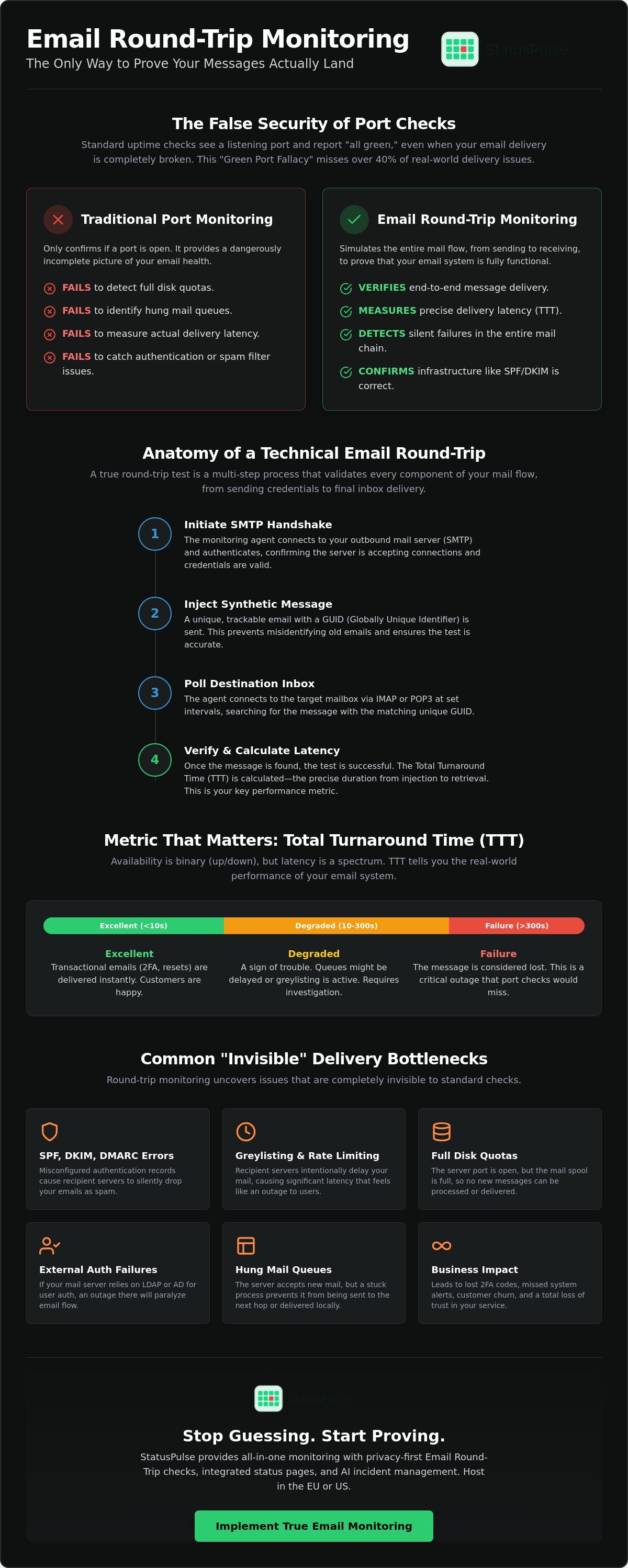
Traditional monitoring usually stops at the TCP connection. If port 25 responds, the dashboard stays green. This is the "Green Port Fallacy." An open port doesn't mean the Mail Transfer Agent (MTA) is actually accepting, processing, or relaying messages. It just means the service is listening. You can have a perfectly responsive SMTP port while your actual mail flow is completely paralyzed.
True validation requires Email Round-Trip Monitoring That Proves a Message Actually Lands. This synthetic test goes beyond basic connectivity. It sends a unique, trackable message through your outbound server and waits for it to appear in a designated mailbox. If the message never arrives, or takes too long to traverse the network, you have a functional failure. This remains true even if your server uptime looks perfect on paper.
Several silent failure points can bypass standard checks. For instance, full disk quotas on the mail spool will prevent new messages from being written to disk. Database locks on the user metadata store can stop the delivery process entirely. Even hung mail queues can accept incoming mail but fail to move it to the next hop. None of these issues are visible to a simple port monitor.
Why Basic Checks Miss 40% of Issues
Standard tools for monitoring email servers often miss internal logic errors. Your MTA might be running, but if the LDAP or Active Directory service it uses for authentication is down, users can't log in to send. Basic port checks also ignore queue latency. A message that takes three hours to arrive is a failure in practice, but a "pass" for simple uptime monitors. Functional validation is the only way to ensure the business logic of your mail system is intact.
The Business Impact of "Ghost" Emails
When mail fails silently, the damage is immediate and hard to quantify. Users don't get 2FA codes or password reset links, which directly causes customer churn. Automated system alerts and CRON job reports fail without warning, leaving your team blind to other infrastructure problems. If your uptime monitoring dashboard shows everything is "Operational" while your core communication is broken, you lose the trust of your customers. Implementing Email Round-Trip Monitoring That Proves a Message Actually Lands prevents these "ghost" outages from lasting more than a few minutes.
The Anatomy of a Technical Email Round-Trip
A technical round-trip isn't a single check. It's a chain of events that mirrors your actual mail infrastructure. It begins when the monitoring agent initiates an SMTP handshake with your outbound server. This step validates that the server accepts connections and that authentication credentials work. If the handshake fails here, you've identified an outbound blockage before any mail is even sent.
Once the connection is stable, the agent injects a unique, trackable message into the mail stream. This follows the general principles of the IETF Mail Monitoring standard, which provides a framework for observing MTA performance. After injection, the agent begins polling the destination IMAP or POP3 server at defined intervals. When the message appears, the agent verifies the unique identifier and calculates the Total Turnaround Time (TTT). This is the only form of Email Round-Trip Monitoring That Proves a Message Actually Lands, as it confirms the entire delivery pipeline is clear.
Crafting the Synthetic Test Message
Effective synthetic tests use unique GUIDs in the subject line or message body. This ensures the monitoring agent doesn't misidentify old messages or system notifications as the test result. You should also implement cache busting by varying message content. This ensures you aren't seeing cached header results from intermediate proxies. Test messages should mimic real-world traffic patterns, including standard headers and multipart bodies, to ensure they pass through spam filters just like a customer's email would.
Measuring Latency vs. Availability
Availability is binary, but latency is a spectrum. Total Turnaround Time (TTT) is the delta between the moment of SMTP injection and the successful retrieval of that specific message via IMAP. A 10-second TTT is normal for most transactional systems, but a 300-second TTT indicates a degraded state. By analyzing the handshake time separately from the retrieval time, you can distinguish between network-level latency and server-level processing delays in the mail queue.
Monitoring these metrics manually is complex and prone to false positives. Tools that offer automated uptime monitoring with integrated round-trip checks can simplify this by handling the polling logic and GUID tracking for you. This allows your team to focus on resolving the underlying infrastructure issues rather than managing the monitoring scripts themselves. This approach provides a reliable way to maintain visibility without adding significant overhead to your operations.
Identifying Invisible Delivery Bottlenecks
Even with a healthy server, your mail can still vanish. External factors like greylisting and DNS misconfigurations often act as invisible walls. These bottlenecks are the primary reason why you need Email Round-Trip Monitoring That Proves a Message Actually Lands. Without a full loop, you won't know if an ISP throttled your traffic or if a DMARC policy silently dropped your notification. You need to see the mail flow from the recipient's perspective to find these gaps.
Greylisting and Monitoring Sensitivity
Greylisting is a common anti-spam technique. It works by temporarily rejecting messages from unknown IP addresses with a 451 SMTP error. Legitimate servers will retry after a few minutes, but spammers usually don't. Your monitoring needs to be sensitive to this logic. If your agent alerts on the first 451 code, you'll get buried in false positives. You should tune your monitoring frequency or whitelist the monitoring agent's IP to avoid these artificial delays. Distinguishing between a temporary greylist delay and a permanent 5xx error is essential for accurate reporting.
Security Protocols: SPF and DKIM
Security protocols like SPF and DKIM are no longer optional for reliable delivery. If your monitoring tool sends mail from a domain it doesn't "own" in the eyes of DNS, it's going to the spam folder. Or worse, it gets dropped entirely. You should use a dedicated sub-domain for monitoring. Ensure the monitoring agent's IP is included in your SPF record. This is especially tricky when using third-party providers like SendGrid or Postmark. These services have their own reputation systems. If your monitoring traffic triggers their internal rate limits, your tests will fail while your production mail stays fine.
ISP throttling is another silent killer. Sending test emails every minute can look like a spam burst to some receivers. This is a common challenge when maintaining high availability across different services. Just as you follow an API Monitoring: The Developer’s Guide to High Availability in 2026 to keep your endpoints responsive, you must apply the same rigor to your mail flow. Balance your check frequency to stay under rate limits while still capturing meaningful data. Using Email Round-Trip Monitoring That Proves a Message Actually Lands ensures that these security and rate-limiting hurdles don't become permanent blind spots in your infrastructure.
Architecture for Reliable Mail Flow Observability
Modern mail stacks are distributed and often rely on global delivery networks. A regional routing failure can drop mail for a specific geography while your server stays accessible from your headquarters. This is why multi-region monitoring is essential. Testing delivery from different geographic nodes ensures that local ISP issues or regional blacklists don't become blind spots. To build a robust architecture, you need Email Round-Trip Monitoring That Proves a Message Actually Lands across your entire user base, not just one location.
Setting Realistic Monitoring Intervals
Choosing the right check frequency is a balance between visibility and overhead. While 1-minute checks work for APIs, they can be problematic for mail. High-frequency tests may trigger rate limits on your outbound provider or destination mailbox. A 5-minute interval is usually sufficient to capture outages without overwhelming your infrastructure. Mail flow is inherently asynchronous and requires wider alert thresholds than HTTP. Calculating the cost of monitoring against the risk of undetected downtime will help you find the right cadence for your specific volume.
Securing the Monitoring Mailbox
Never use a primary admin account for round-trip tests. This creates an unnecessary security risk and violates the principle of least privilege. Instead, use a dedicated mailbox with restricted IMAP permissions, specifically SELECT and FETCH only. Use App Passwords to isolate the monitoring agent from your core identity provider. You should also implement auto-deletion of test messages within the mailbox. This prevents mailbox bloat and ensures your storage quotas don't cause the monitoring test to fail itself.
Building this level of observability is part of a broader commitment to system transparency. For a deeper look at balancing technical precision with clear reporting, see our guide on Uptime Monitoring: A Developer’s Guide to Reliability and Honest Communication. This approach ensures your status page reflects reality, not just port availability. By treating mail flow as a critical functional path, you move beyond "green light" monitoring into true service validation.
StatusPulse provides a streamlined way to implement Email Round-Trip Monitoring That Proves a Message Actually Lands, offering the choice of EU or US hosting to support your data sovereignty requirements. You can start monitoring email delivery today with a platform built for technical precision and transparent pricing.
StatusPulse: Privacy-First Round-Trip Validation
StatusPulse treats email delivery as a functional requirement rather than a background process. We provide Email Round-Trip Monitoring That Proves a Message Actually Lands by treating every test as a critical diagnostic event. Our platform integrates this data directly into your public status page. This gives your users a real-time view of communication health without requiring manual intervention. When delivery drops below your defined SLAs, our AI incident management generates concise summaries to help your team communicate the impact clearly.
Integrity in monitoring means being honest about costs. We avoid the complex pricing models of industry incumbents. You won't find per-subscriber fees for mail alerts here. Our pricing is flat and transparent, allowing you to scale your monitoring without budget surprises. This grounded approach ensures that precision tools remain accessible to specialists who value reliability over flashiness.
Data Sovereignty and Mail Privacy
Choosing between EU or US hosting is a fundamental requirement for modern data sovereignty. StatusPulse gives you this choice to ensure your metadata stays within your required jurisdiction. We don't store the bodies of your test emails. We only track the unique GUID and the timestamps required for TTT calculations. This privacy-first approach is essential for European enterprises that must maintain strict compliance standards while monitoring third-party mail providers.
Closing the Loop with Status Pages
Automating your status updates removes the human delay during a mail outage. When round-trip latency exceeds your thresholds, the status page reflects the degradation immediately. This provides your customers with a reliable source of truth. It reduces support volume by acknowledging the issue before the first complaint arrives. By closing the loop between functional testing and public communication, you build long-term trust with your user base.
Is your mail flow actually working? Start monitoring with StatusPulse.
Eliminating the Blind Spots in Your Mail Flow
StatusPulse offers a straightforward path to this level of observability. We provide a platform with flat-rate pricing and no hidden fees, ensuring your costs don't spike as you scale. With the choice between EU or US data hosting and integrated AI incident management, you can maintain strict data sovereignty while automating your response to delivery drops.
Stop guessing whether your notifications are reaching their destination. You can start your free 14-day trial of StatusPulse monitoring to gain full visibility into your mail infrastructure. Secure your delivery pipeline and start communicating with confidence today.
Frequently Asked Questions
What is the difference between SMTP monitoring and round-trip monitoring?
SMTP monitoring only checks if the mail service is listening on a specific port. It cannot tell you if the server is actually processing mail. Email Round-Trip Monitoring That Proves a Message Actually Lands validates the entire delivery pipeline by sending a test message and retrieving it from a destination mailbox. This confirms that your MTA, DNS records, and spam filters are all functioning together.
Does email round-trip monitoring affect my mail server performance?
The performance impact of round-trip monitoring is negligible for any modern mail server. Sending a single synthetic test message every five to ten minutes adds virtually no load to your CPU or memory. This frequency is significantly lower than typical transactional traffic volumes. It's a lightweight way to gain functional visibility without risking the stability of your production environment.
How do I avoid my monitoring emails being marked as spam?
You avoid spam flags by using a dedicated sending subdomain and maintaining valid SPF, DKIM, and DMARC records. Your monitoring agent's IP should be included in your SPF policy to establish trust. Additionally, whitelisting the monitoring IP at the recipient level prevents greylisting delays. These steps ensure your tests reflect actual service availability rather than artificial security blocks.
Is it safe to give a monitoring service my IMAP credentials?
It's safe if you follow security best practices like using App Passwords. You should never use your primary administrator credentials for monitoring. Create a dedicated, restricted mailbox for these tests. Limit the IMAP scope to SELECT and FETCH permissions only. This isolation ensures the monitoring agent has no access to sensitive company data or other user mailboxes.
Can I monitor third-party services like Gmail or Office 365 with round-trip tests?
Yes, monitoring third-party providers is a core use case for round-trip testing. Even major cloud providers experience regional outages or routing issues that their own status pages might not report immediately. Testing the mail flow from your specific location allows you to detect these disruptions early. This gives your team a reliable source of truth when external services fail silently.
What is a reasonable timeout for an email round-trip alert?
A reasonable timeout usually ranges between five and ten minutes. Unlike HTTP requests, email is an asynchronous protocol where slight delays are expected. A very short timeout will trigger frequent false positives due to normal queue processing or greylisting. You should analyze your baseline delivery speed and set an alert threshold that captures genuine outages without creating unnecessary noise.
How does StatusPulse handle data privacy for email monitoring?
StatusPulse prioritizes data privacy by only storing the metadata necessary for latency calculations. We don't store the subject lines or bodies of your test messages. To support your data sovereignty needs, we offer a choice between EU or US hosting locations. Our Email Round-Trip Monitoring That Proves a Message Actually Lands is built for specialists who require technical precision without compromising regulatory compliance.


