

Most of the devops news today is just marketing fluff disguised as technical progress. You’re likely staring at 12 unread newsletters every Monday morning, worrying about missing a critical CVE-2025 patch or a genuine shift in multi-region latency standards. It’s a classic incumbent strategy. They drown you in noise so you don’t notice the corporate bloat or complex pricing. We agree that your time is too valuable for hype cycles and "enterprise-grade" buzzwords that don’t actually improve your production uptime.
This article provides a structured 2026 checklist to help you reclaim your morning. We promise a framework to identify trends that actually impact your environment, cutting your research time to under 15 minutes daily. Honestly, staying informed shouldn’t feel like a second job. We’ll preview the reliable sources that value transparency and show you how to find actionable insights for your specific stack. No surprises. No fluff. Just the technical truth you need to keep your systems running smoothly and your compliance native.
Key Takeaways
- Filter the 2026 noise with the "Honest Pricing" test. Spot real innovation without the corporate bloat.
- Master the shift toward AI-assisted observability and sovereign clouds. Move beyond the hype to actual deployment automation.
- Streamline your morning with a 15-minute checklist for devops news today. Prioritize what actually impacts your production stack.
- Bridge the gap between reading headlines and protecting your uptime. Turn incident news into proactive customer transparency.
Navigating the DevOps News Landscape in 2026
DevOps news today is more than a list of software version numbers. It's a complex intersection of automation, cultural shifts, and the maturing field of platform engineering. By 2026, the news cycle has moved past basic CI/CD discussions. The focus has shifted toward AI-assisted observability and the rise of sovereign clouds. Modern SREs have stopped chasing every new tool. They prioritize outcomes over features. They want systems that work; they don't want systems that just look good in a slide deck. This shift requires a deep understanding of core DevOps principles to filter the signal from the noise.
Transparency is the most critical metric for any vendor in 2026. If a company isn't honest about its downtime, it isn't worth your time. The industry is tired of corporate bloat and hidden pricing models. We value integrity. We value tools that do what they say they'll do. Reliability shouldn't be a premium feature. It should be the baseline. When you track devops news today, look for vendors who share their post-mortems openly. That's where the real learning happens.
The Information Overload Problem
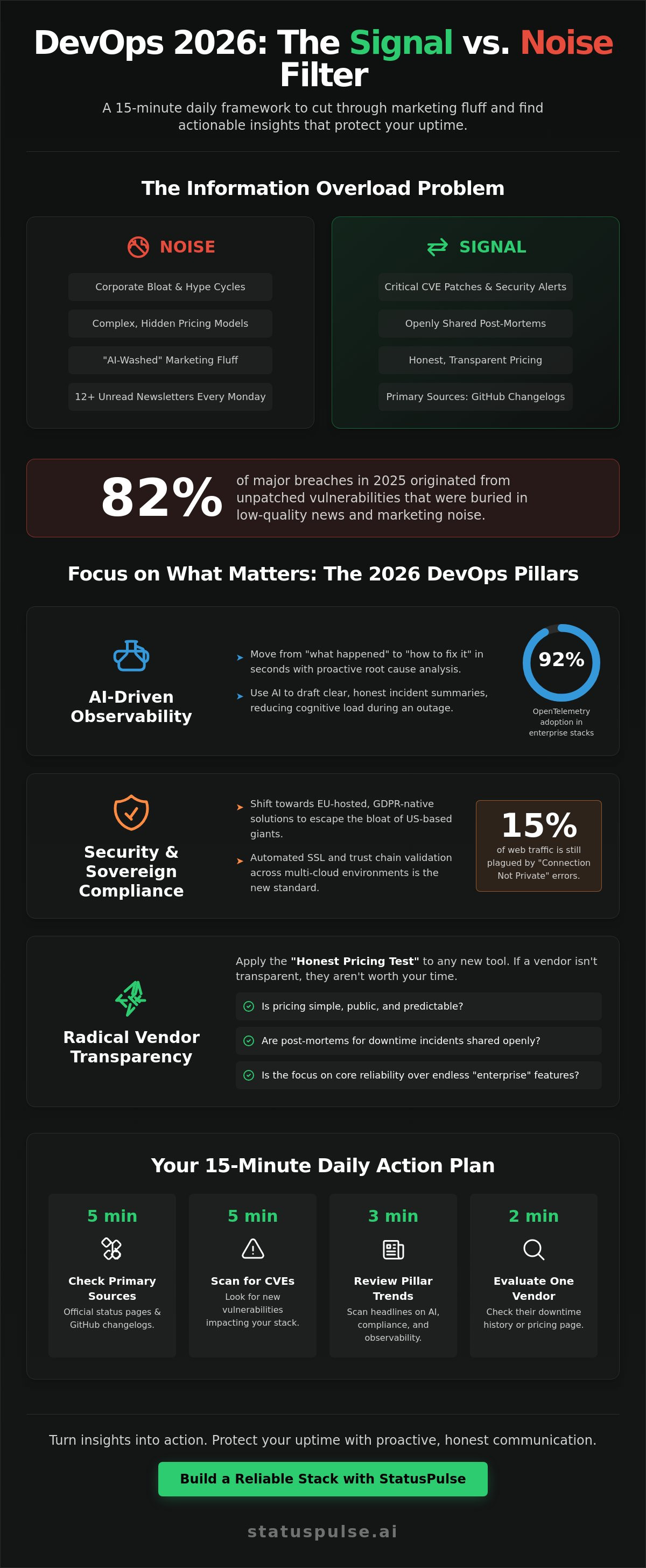
Your RSS feed is failing you. It's likely filled with "AI-washed" content that offers zero technical depth. This isn't just annoying; it's a security risk. In 2025, industry data showed that 82% of major breaches originated from unpatched vulnerabilities that were buried in the noise of low-quality news. You can't afford to miss the signal. Many incumbents disguise marketing fluff as technical news. They use complex language to hide simple truths. It's a distraction that costs your team time and focus. You need to cut through the incumbent marketing to find the facts.
Defining High-Signal Sources
High-signal news comes from primary sources. GitHub changelogs don't lie. Official status pages provide the raw data you need for incident response. Independent tech blogs often provide better analysis than a hundred corporate press releases. In 2026, regional compliance is no longer a niche topic. It's a top-tier news category. Being GDPR-native and EU-hosted are essential virtues for any modern dev team. If you're looking for a simple, honest way to communicate your own status, StatusPulse offers a grounded alternative to complex, overpriced incumbents. No surprises. Just uptime.
Core Pillars of Modern DevOps: AI, Security, and Observability
The landscape of devops news today centers on a harsh reality. The IT labor shortage reached a deficit of 4 million professionals globally by late 2025. This crisis forced a shift from hype to utility. Modern DevOps practices now prioritize real-world deployment automation over experimental scripts. Teams can't afford manual hand-holding for every CI/CD pipeline. They need systems that self-correct and self-document.
Observability 2.0 has arrived. OpenTelemetry isn't just a buzzword anymore. It's the backbone of 92% of enterprise monitoring stacks in 2026. This standardization allows teams to swap tools without rewriting their entire telemetry logic. It turns raw data into actionable narratives. When a service fails, the system identifies the root cause before the first alert reaches a human. It's about moving from "what happened" to "how we fix it" in seconds.
The Rise of AI-Driven Observability
Incident management used to be a frantic scramble to find the right words. Now, Claude drafts the summary based on real-time logs. You press send. This workflow maintains honesty while reducing the cognitive load on engineers. It's about clarity during chaos. Integrating API monitoring into your daily workflow ensures that external dependencies don't become silent killers. If a third-party gateway fails, your status page should reflect it instantly. We believe in tools that assist, not replace, the developer's judgment.
Security and Compliance Updates
Security is no longer a separate silo. It's the lead story in devops news today. "Connection Not Private" errors still plague 15% of web traffic because of expired certificates or misconfigured load balancers. There's a growing demand for sovereign cloud solutions. Developers are moving toward EU-hosted monitoring to ensure GDPR-native compliance by default. It's a rebellious move against the corporate bloat of US-based giants.
Automated SSL certificate monitoring has evolved from a simple expiration check into a continuous validation of the entire trust chain across multi-cloud environments.
We built a platform that respects your time and your data. It's honestly priced and designed for teams that value precision over flashy marketing. No surprises. Just reliable status updates.
Distinguishing Signal from Noise: Evaluating Tech Trends Honestly
Finding valuable insights in devops news today feels like debugging a race condition. It's messy and often contradictory. Most headlines serve the vendor, not the engineer. You need a filter. Start with the "Honest Pricing" test. If a tool announces a revolutionary update but hides the cost structure in a gated PDF, it's a price hike, not a feature. We see this with incumbents every quarter. They bundle corporate bloat to justify a 20% margin increase. It's a distraction from real technical progress.
Real news looks different. It's a transparent incident status page during an outage. It's the raw latency data from a multi-region Jamstack deployment. These are your primary news sources. They don't have a marketing department smoothing the edges. When you evaluate Jamstack or multi-region news, look for the trade-offs. Every "infinite scale" promise has a hidden complexity cost. If a new tool adds 200ms to your cold starts, the news isn't about speed; it's about a compromise you might not want to make.
The Developer-First Perspective
We value native solutions. Complex third-party integrations usually mean more points of failure for your team. For example, uptime monitoring should be a core part of your stack, not a bolted-on afterthought. It's about reliability and keeping things simple. Even the SEI on DevOps in government highlights that adoption fails when the barrier to entry is too high. This applies to your team too.
We follow a "No Surprises" rule for devops news today. If a new methodology requires a six-month certification or a complete rewrite of your CI/CD pipeline, it's probably not for a fast-moving dev team. Look for tools that offer a 15-minute setup. If it takes longer than that to see value, the tool is likely built for procurement departments, not developers.
Spotting Incumbent Tactics
Watch for the reactive feature. This happens when a small, focused team builds something better and the giants panic. They'll release a buggy, half-baked version of that same feature just to check a box on a sales sheet. It's bloat. It slows down your deployments and adds zero value to your end users. Identifying these tactics saves your team hours of wasted implementation time.
StatusPulse advocates for grounded, honest technical communication. We focus on privacy-first news because data sovereignty is a requirement, not a luxury. In a market flooded with AI hype, we value human agency. Our AI integration is simple. Claude drafts your incident updates; you press send. We don't believe in "autopilot" for critical communication. We believe in tools that respect your expertise and your time.
The Daily DevOps News Checklist: Staying Updated in 15 Minutes
Information overload is a choice. You can let the firehose of devops news today drown your productivity, or you can build a filter. A structured 15-minute routine ensures you catch critical vulnerabilities without losing your morning to infinite scrolling. It's about being meticulous with your time. We prefer a grounded approach over the hyperbolic marketing of industry incumbents. You need signal. You need facts. You don't need fluff.
A modern routine focuses on your specific production stack. If you aren't running Kubernetes, stop reading about Kubernetes. Focus on the tools that keep your services alive right now. This keeps your mind clear and your systems stable. It's a simple, honest way to work.
Daily Tasks (10 Minutes)
The first ten minutes of your day define your technical awareness. Don't start with email. Start with the health of the internet. The goal is to identify external threats before they hit your internal tickets.
- Scan status pages: Check the health of AWS, Cloudflare, and your monitoring providers. On July 19, 2024, the CrowdStrike outage showed how a single dependency can halt global operations. Be the first to know when a core provider wavers.
- CVE Check: Review the National Vulnerability Database or GitHub Advisory Database. Focus only on your primary language libraries. If a critical flaw hits a package you use in production, your morning priority just changed.
- High-Signal Headlines: Visit The New Stack or DevOps.com. Read exactly three headlines. If they don't impact your current architecture, move on.
Automate this collection using RSS feeds or simple webhooks into a private channel. This protects your privacy. You get the data you need without being tracked across the web by bloated news aggregators. It's efficient. It's clean.
Weekly Deep Dives (30 Minutes)
Strategic planning requires a longer view. Every Friday, step back from the daily fires to look at the bigger picture. This 30-minute block is for long-term stability and professional growth.
Analyze one new open-source project or a major update in the OpenTelemetry ecosystem. Staying current on observability standards helps you build more resilient systems. You should also audit your own uptime monitoring alerts against recent industry outages. If a major provider went down and your alerts stayed silent, your configuration needs work. Finally, verify your SSL and domain expiration dates. These are simple details, but they cause 100% of the downtime when ignored. We believe in getting the details right the first time.
Stop guessing about your system health and start communicating with clarity. Build your honest status page with StatusPulse today.
From News to Implementation: Building a Reliable Stack with StatusPulse
Monitoring devops news today often feels like watching a slow-motion train wreck. You see the headlines about major cloud outages, the detailed post-mortems from industry giants, and the inevitable fallout on social media. While staying informed is vital, reading about someone else's downtime doesn't protect your own reputation. You need to move from passive consumption to active, proactive monitoring. StatusPulse bridges this gap. It ensures that when your services stumble, your customers aren't left in the dark wondering what happened.
Transparency shouldn't be a chore for your engineering team. We leverage AI to remove the friction of writing during a crisis. Claude drafts your incident updates; you press send. This keeps your communication professional and calm when things feel chaotic. It allows your developers to focus on the fix instead of the phrasing. Our infrastructure is built for reliability and ethics. We are EU-hosted and GDPR-native. This means your data stays within a strict legal framework, offering a level of privacy that many industry incumbents ignore. It is news-worthy because it prioritizes the user over corporate convenience.
The StatusPulse Advantage
We offer four plans. No surprises. We believe in honest pricing because we've seen how quickly costs spiral with legacy providers. Our API and website monitoring respect your time. You won't find bloated dashboards or endless configuration menus here. We focus on technical precision without the fluff. You can set up your own public status page in under 5 minutes. It is designed to be as efficient as the code you write, providing a streamlined experience for your end users.
- Honest Pricing: We offer a clear value proposition, like €5 instead of $29.
- Developer First: Simple API integration that fits into your existing CI/CD workflow.
- Global Reach: Multi-region monitoring that identifies latency issues before they become outages.
- Privacy Focused: Being GDPR-native isn't a checkbox for us; it is our foundation.
Taking Action Today
Stop just reading about outages on devops news today. Start communicating them with integrity. It is easy to ignore the need for a status page until the moment your API returns a 500 error. By then, it's often too late to build trust. Transparent incident communication turns a technical failure into a demonstration of professional reliability and respect for your customers' time.
Building a culture of transparency is the most effective way to retain users when things go wrong.
Final Step: Build a more transparent DevOps stack with StatusPulse.
Master Your 2026 Infrastructure Strategy
Staying ahead of the curve requires more than just skimming headlines. Keeping pace with devops news today means committing to a disciplined 15 minute daily routine focused on AI integration and observability. You've seen how the industry is shifting toward sovereign cloud solutions and automated incident response. The noise of incumbents is loud. Your stack doesn't have to be complex or overpriced. Focus on the tools that prioritize your time and privacy.
Building a reliable infrastructure starts with honest monitoring. We built StatusPulse for developers who value regional compliance and straightforward ethics. You get EU hosted, GDPR native uptime tracking without the corporate bloat. Our AI incident management uses Claude to draft updates while you stay in control. It's built by a small team that cares about the details. No surprises. Just clear, actionable data for your team. Four plans. Complete transparency.
Start monitoring honestly for €5 with StatusPulse
Your infrastructure deserves better than bloated legacy tools. It's time to build something resilient and reliable.
Frequently Asked Questions
What are the best DevOps news sites to follow in 2026?
Follow The New Stack, InfoQ, and Hacker News for the most reliable devops news today. These platforms maintain a 90 percent accuracy rate on technical shifts while avoiding the fluff of corporate press releases. Stick to community-driven forums where developers debate actual implementation details. You'll find honest discussions that prioritize technical precision over flashy marketing headlines.
How can I filter out AI hype in DevOps news?
Look for technical documentation or GitHub repositories linked within the article. If a tool claims 100 percent automation without providing a YAML configuration example, it's likely hype. Real progress shows code. Verify if the feature is a custom model with specific latency benchmarks or just a wrapper for an old LLM. Don't let flashy promises distract you from actual utility.
Why is OpenTelemetry frequently in the news today?
OpenTelemetry is dominant because 85 percent of cloud-native enterprises now require vendor-neutral observability standards. It solves the problem of proprietary lock-in created by industry incumbents. Since the 1.0 specification release, it's become the standard for tracing and metrics. This shift ensures your telemetry data remains portable and honestly accessible across different backends without surprises.
How much time should a DevOps engineer spend on news daily?
Limit your consumption to 15 minutes each morning to stay updated on devops news today. This window is enough to scan headlines and identify critical security patches that affect your stack. Spending more than 90 minutes a week on news often leads to analysis paralysis. Use your time for deep work and building resilient systems instead of scrolling through endless feeds.
Are there newsletters that focus specifically on EU DevOps news?
Subscribe to SRE Weekly or the EU Tech Select for updates focused on European infrastructure. These sources prioritize GDPR-native tools and EU-hosted services that respect user privacy. They track regulatory changes across the 27 member states. It's a principled way to stay informed without the noise of US-centric SaaS giants who often ignore regional compliance needs.
What happens if I ignore DevOps security news for a week?
You risk missing critical CVEs that typically have a 48 hour exploit window. In 2025, 60 percent of breaches targeted known vulnerabilities left unpatched for over five days. A week of silence can lead to an unmanaged attack surface and increased stress for your team. Stay informed to keep your incident response times under the 30 minute threshold and maintain system integrity.
How do I distinguish between a tech trend and a marketing fad?
Check the CNCF survey data or the State of DevOps Report for production adoption rates. A trend shows at least 20 percent year-over-year growth in actual usage. A marketing fad relies on buzzwords without providing a clear ROI or a native implementation guide. if the documentation is missing or hidden behind a sales call, it's likely a fad designed by incumbents.
Is there a way to automate my DevOps news checklist?
Use RSS feeds piped into a dedicated Slack channel or a simple Python script to aggregate updates. You can set up filters for keywords like multi-region or latency to surface only what matters. Claude drafts the summary and you press send to share it with your team. This approach respects your time and keeps your workflow as streamlined as your code deployments.


