

Your server's health doesn't matter if your users can't find it. You can build the most robust database architecture in the world, but if your DNS fails, you're invisible. Effective DNS monitoring for uptime is the real foundation of a reliable system. It's the difference between a seamless connection and a "server not found" error that kills your conversion rate.
We understand the anxiety of silent failures. You've likely dealt with DNS hijacking scares or slow resolution times that cause high TTFB. It's frustrating when MX records disappear without a trace. You shouldn't have to tolerate complex, bloated tools that hide these issues behind confusing dashboards and enterprise price tags. You deserve transparency and precision.
This guide helps you master DNS monitoring to eliminate resolution failures and hidden latency before they impact your users. We'll show you how to achieve zero-downtime transitions and gain visibility into global resolution speeds. You'll learn to set up automatic alerts for record tampering, giving you total control over your infrastructure's most critical gateway.
Key Takeaways
- Server uptime is meaningless if your resolution path is broken. Learn how to bridge this visibility gap and ensure your site remains reachable.
- Identify the critical A, AAAA, and CNAME records that act as the bedrock for your global reachability and third-party integrations.
- Master DNS monitoring for uptime by matching your check frequency to your TTL settings for faster, more accurate incident detection.
- Eliminate hidden latency that mimics slow server performance and negatively impacts your Time to First Byte (TTFB).
- Automate your public status page updates to communicate with integrity and maintain user trust when DNS issues are detected.
The DNS Uptime Paradox: Why Your Server is Up but Your Site is Down
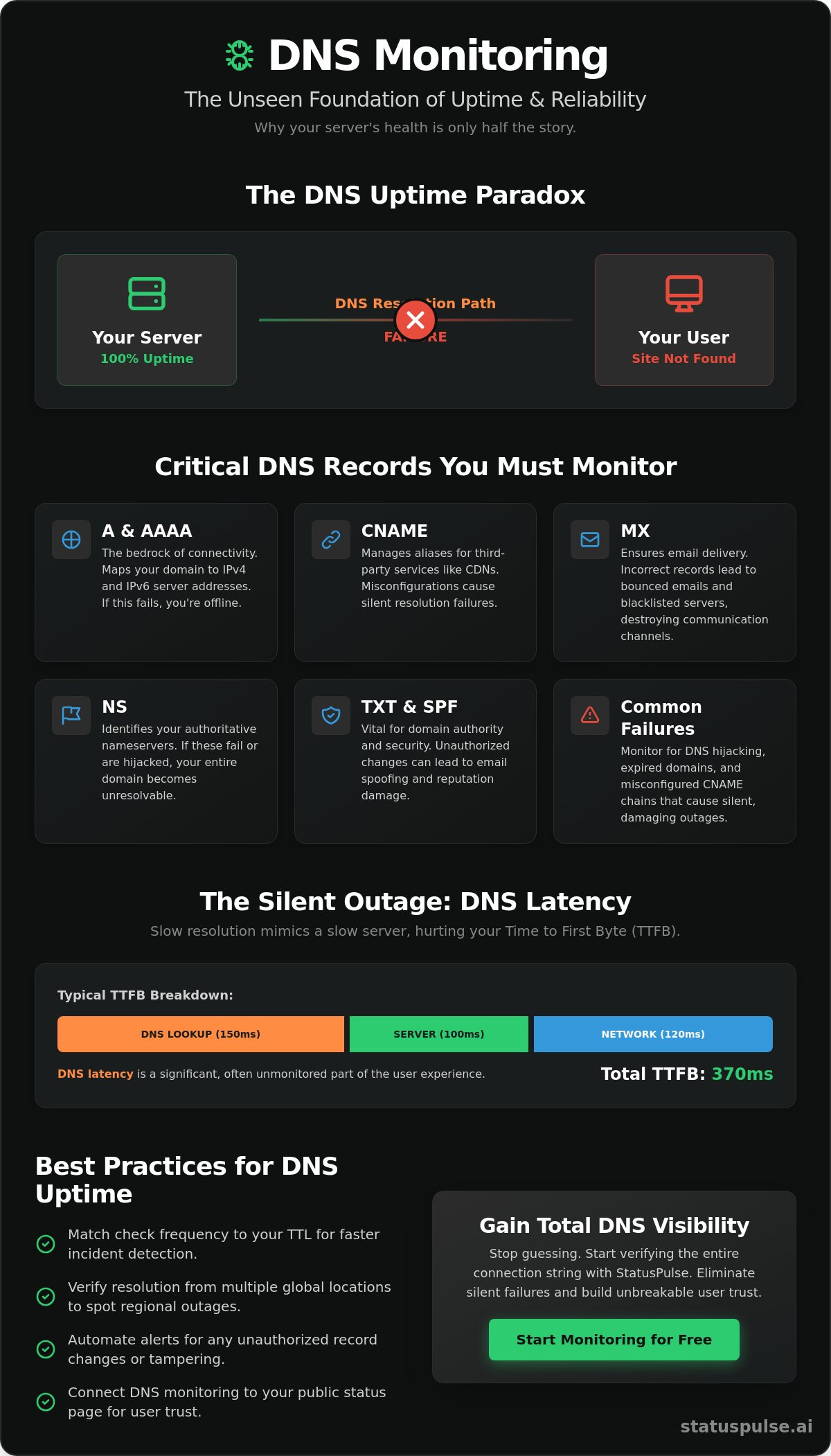
Your server is healthy. The CPU load is low. The database is responding to local queries. Yet, your users see a blank screen. This is the DNS Uptime Paradox. It's a common trap for teams that focus solely on server metrics while ignoring the path users take to find them. DNS is the single point of failure for every web-based service. If the resolution path is broken, your server’s health is irrelevant.
Standard monitoring often relies on direct IP pings. These checks are deceptive. They confirm the hardware is powered on, but they miss the logic of the Domain Name System (DNS). True DNS monitoring for uptime ensures the "phonebook" of the internet actually points to your infrastructure. Without it, you're monitoring a ghost ship that nobody can board. You need to verify the connection from the user's perspective, not just the data center's perspective.
The Chain of Resolution
Resolution is a relay race. A browser request hits a recursive resolver, which then queries Root servers, TLD servers, and finally your Authoritative servers. A failure at any point in this chain results in a total blackout. Recursive resolvers can also cache incorrect or stale records. This creates a scenario where your site works for some users but fails for others. It’s a fragmented outage that standard pings simply cannot detect. The resolver masks the problem by serving old data until the TTL expires, leaving you blind to the actual failure.
Common DNS Failure Scenarios in 2026
Technical glitches are only half the story. Administrative and security gaps cause the most damage. Consider these common risks:
- DNS Hijacking: Malicious actors reroute your traffic to their own endpoints. Your server stays up, but your data is compromised and your users are at risk.
- Expired Domains: It's the most avoidable cause of downtime, yet it still happens to major players. Once the domain expires, your records vanish instantly.
- Misconfigured CNAME Chains: Complex third-party integrations often lead to infinite loops or resolution errors. These are "silent" failures that only appear during specific resolution paths.
At StatusPulse, we prioritize clarity over corporate bloat. We know that visibility matters. We don't just check if a server is running; we verify that your users can actually reach it. Effective DNS monitoring for uptime is about seeing the whole picture, not just the hardware in the rack. It's time to stop guessing and start verifying the entire connection string.
Critical DNS Records You Must Monitor for High Availability
High availability isn't just about redundant servers. It's about ensuring every record in your zone file is accurate and active. If an A record points to the wrong IP, your database cluster is effectively offline. Implementing robust DNS monitoring for uptime means looking beyond a single IP address. You need a comprehensive view of your entire record set. Precision matters here. A single misconfigured character can break your service for hours.
Security and reachability depend on several key record types:
- A and AAAA Records: These map your domain to IPv4 and IPv6 addresses. They are the bedrock of your connectivity.
- CNAME Records: These manage aliases for third-party integrations and CDNs.
- MX Records: These ensure email delivery. Missing or incorrect MX records can lead to bounced communications or blacklisted servers.
- NS Records: These identify the authoritative nameservers for your zone. If these fail, the entire domain goes dark.
- TXT and SPF Records: These are vital for domain authority. Security agencies emphasize the importance of Defending Your DNS Infrastructure by validating that these records haven't been tampered with.
Monitoring A and CNAME Records for Web Traffic
Modern infrastructure moves fast. You need to detect unauthorized IP changes instantly to prevent hijacking. Modern CDNs often use CNAME flattening to improve performance, but this adds complexity to your resolution path. Tracking Time to Live (TTL) values is also essential. If your TTL is too high, a fix for a broken record won't propagate quickly. If it's too low, you might increase latency for your users. Balance is key. Monitoring these values ensures you maintain control over how quickly your changes take effect across the globe.
Infrastructure Integrity: MX, NS, and SOA
Your mail and name servers are the quiet workhorses of your domain. If your MX records disappear, mail servers will start rejecting your traffic. This often leads to long-term reputation damage. You should also monitor the Start of Authority (SOA) record. Specifically, keep an eye on the serial number. This number tells secondary servers when your zone has been updated. If the serial numbers are inconsistent across your nameservers, your DNS data will be out of sync. Consistency is the only way to ensure global reliability. For those serious about consistency, monitoring your infrastructure with a dedicated tool is a logical next step.
DNS Latency: The Silent Outage Affecting Your TTFB
Uptime is binary. Speed is a spectrum. Most legacy tools tell you if a record exists. They rarely tell you how long it took to find it. DNS lookup time is the delay before the first byte is even sent. It's the "silent outage." Your server metrics look perfect while your users stare at a loading spinner. This disconnect creates a dangerous blind spot for engineering teams who value precision over vanity metrics.
Slow resolution mimics a slow server or a poor network. If your DNS resolution takes 500ms, your Time to First Byte (TTFB) starts at 500ms. This happens before a single packet of data even leaves your database. This latency kills your SEO rankings. It drives up bounce rates. Search engines prioritize the end-to-end user experience. A slow handshake is a bad experience, regardless of your backend efficiency. You can't optimize what you don't measure.
Monitoring from a single location is a liability. It provides a false sense of security that can mask catastrophic failures. You might see 20ms lookups from your office in New York while your users in Tokyo face two-second delays. These are "Regional Blackouts." They happen when a specific nameserver node or routing path fails. Comprehensive DNS monitoring for uptime must be global to be truthful. Anything less is just a guess.
Measuring Global Resolution Performance
Measuring global performance is about identifying geographic gaps. You need to know exactly where the resolution chain is slowing down. Recent studies on Assessing DNS Resilience highlight that authoritative infrastructure is often the hidden weak link. If your provider's nameservers are sluggish, your local server speed is irrelevant. Using Uptime Monitoring allows you to correlate these latency spikes with actual user complaints. It's about being honest with your data.
Optimising DNS for Speed and Reliability
Optimizing for speed requires a strategic approach. Anycast DNS is a powerful tool here. It improves resolution times by routing users to the nearest available node. You also have to manage the TTL (Time to Live) trade-off. A low TTL gives you the agility to switch IPs during an incident. A high TTL improves performance by keeping records in the recursive cache for longer. Precision is everything. You must detect slow authoritative responses before they trigger client-side timeouts. Reliable DNS monitoring for uptime ensures your infrastructure remains both reachable and responsive. It’s about taking pride in the technical details that others ignore.
Best Practices for Setting Up DNS Uptime Checks
Setting up a check in seconds is easy. Setting it up correctly is where specialists differentiate themselves. Effective DNS monitoring for uptime requires a strategic alignment with your infrastructure's specific behavior. Most incumbents brag about speed of deployment. We prioritize the precision of the data gathered. Speed of setup is a vanity metric; accuracy during an incident is what saves your reputation.
Start with your monitoring frequency. It must match or beat your TTL, typically between one and five minutes. If your check frequency is slower than your TTL, you're flying blind during critical propagation windows. You won't see the fluctuations that affect your users. Don't stop at the root A record. Your infrastructure relies on a web of dependencies. Monitor your CNAMEs, MX records, and nameservers to get a complete picture of your reachability.
Configure your system to alert you on record changes, not just resolution failures. A change in an IP address or a modified TXT record can be the first sign of a security breach. If you only wait for a total resolution failure, you've already lost the battle. Use a monitoring service that checks from diverse global nodes. This is the only way to catch regional routing issues that might be invisible from your local data center. Precision requires a global perspective.
Configuring Actionable Alerts
Alert fatigue is a productivity killer. You don't need a notification for every transient network hiccup. Configure smart thresholds that distinguish between a momentary blip and a sustained outage. This reduces stress and keeps your team focused. Integrate these alerts directly into your DevOps workflow using Slack or PagerDuty. This ensures that the right person gets the right data at the right time. Automating the verification of DNSSEC signatures is another essential step. It guarantees that your records remain authentic and haven't been tampered with mid-transit.
Security and Privacy in Monitoring
Where your monitoring happens is as important as how it happens. For many principled teams, EU-based monitoring is a requirement for GDPR compliance and data sovereignty. It’s about ethical data handling and privacy. At StatusPulse, we avoid corporate bloat. We focus on clean data and straightforward tools. Pair your DNS monitoring for uptime with API Monitoring to ensure your entire application layer remains functional. If you value transparency and technical precision, start monitoring your DNS with StatusPulse today.
StatusPulse: Connecting DNS Health to Public Trust
Technical precision is a point of pride, but it doesn't exist in a vacuum. Your users don't care about your server architecture; they care about reachability. When a resolution error occurs, they want honesty. We believe that incident communication isn't just a feature. It's an ethical obligation. Reliable DNS monitoring for uptime is only half the battle. The other half is how you handle the fallout when things go wrong.
StatusPulse bridges the gap between your backend metrics and your public reputation. We've built a system that automatically updates your status page the moment a DNS issue is detected. You don't have to scramble to write an update while your site is down. Our AI-powered incident management takes over, translating complex DNS jargon into clear, reassuring language for your non-technical users. It’s about reducing stress for your team and your customers simultaneously.
We reject the corporate bloat and opaque pricing of industry incumbents. Our interface is built by developers, for developers. It’s straightforward. It’s honest. It provides the technical depth you need without the unnecessary friction of enterprise sales cycles. You get a tool that works as efficiently as your code, backed by a team that values your privacy and time.
The Value of Transparent Communication
Honesty is the best policy. It’s also a highly effective support strategy. By maintaining an accurate Public Status Page, you reduce support ticket volume instantly. Users who see a problem acknowledged are less likely to flood your inbox with complaints. They feel respected. Drafting incident updates that reflect real-time DNS health builds long-term trust. It shows you're in control, even when the internet’s phonebook is failing. Transparency is a competitive advantage that faceless corporations often ignore.
Getting Started with StatusPulse
You shouldn't have to spend hours configuring a monitoring tool. We offer a no-agent setup that lets you monitor your DNS records in under 3 minutes. It’s a streamlined process designed for speed and accuracy. You get a unified dashboard that tracks DNS, SSL, and API uptime in one place. No more switching between five different tabs to check your infrastructure health. Everything is centralized, logical, and easy to understand. Join the ethical monitoring movement at StatusPulse and take control of your global reachability. Precision monitoring and honest communication are finally in the same place.
Take Control of Your Global Reachability
A healthy backend is only half the story. If your resolution path is broken, your infrastructure is effectively invisible. You've learned that DNS monitoring for uptime is the foundation of a truly resilient system. By tracking critical records and identifying regional latency, you protect your SEO and user trust. It's about moving from reactive fixes to proactive precision.
Reliability shouldn't require corporate bloat or complex pricing models. You deserve a tool built for specialists that values technical integrity. StatusPulse provides lightweight, agent-free monitoring that respects your time. With our commitment to EU-based privacy and data sovereignty, your data remains secure and compliant. Our AI-driven incident management ensures that when a blip occurs, your communication is as clear as your code.
Stop leaving your reachability to chance. Build a more transparent, reliable gateway for your users today. Start Monitoring Your DNS Uptime with StatusPulse. Your infrastructure is ready for the next level of precision.
Frequently Asked Questions
What is DNS monitoring and why is it different from website monitoring?
DNS monitoring verifies the resolution path, whereas website monitoring focuses on the server's response. Standard uptime checks often bypass the DNS layer entirely. Effective DNS monitoring for uptime ensures that the link between your domain name and your server's IP remains intact. It catches issues that server-side monitoring misses, such as hijacking or expired domain records.
Can a DNS failure cause my SSL certificate to show as invalid?
A DNS failure can trigger SSL warnings if traffic is rerouted to an unauthorized server. If your DNS points to an IP that doesn't possess your specific certificate, browsers will block the connection. This is a common result of DNS hijacking. It can also happen if your TXT records for certificate validation are deleted, preventing automatic renewals.
How often should I check my DNS records for changes?
Check your records at a frequency that matches your TTL, typically every 1 to 5 minutes. High-frequency checks allow you to detect unauthorized changes almost instantly. If you wait too long, you risk missing the window where you could have mitigated a security breach. Consistent monitoring is the only way to maintain a reliable resolution trail.
What is the "Silent Outage" associated with DNS latency?
The "Silent Outage" refers to extreme DNS latency that makes a site feel unreachable. Technically, the server is up and the record resolves. However, if the lookup takes several seconds, users will bounce before the first byte arrives. It’s a performance failure that mimics a total outage, destroying your SEO rankings and user trust.
Does StatusPulse support monitoring for MX and TXT records?
StatusPulse provides full support for MX, TXT, and all other standard record types. We don't just stop at web traffic. Email delivery and domain security rely on these records remaining accurate. Our DNS monitoring for uptime covers your entire zone file to ensure your communication and authority remain protected from silent failures.
How do I prevent false positives in DNS monitoring alerts?
Prevent false positives by using multi-node verification and smart thresholds. A single failure from one location is often a regional network hiccup. StatusPulse uses global nodes to confirm an outage before notifying your team. This approach eliminates alert fatigue and ensures that when your phone buzzes, the issue is real and requires action.
Should I monitor my DNS from multiple geographic locations?
Monitoring from multiple geographic locations is essential for global infrastructure. DNS resolution isn't uniform. A nameserver node might fail in Europe while remaining active in North America. Regional blackouts are common. Global checks provide the only honest view of your site's reachability for every user, regardless of their location.
What happens to my uptime if I change my DNS provider?
Changing your provider can cause a temporary blackout if TTL values aren't managed correctly. New records must propagate across millions of recursive resolvers worldwide. Monitoring during this transition helps you track the handover in real time. It allows you to verify that the new authoritative servers are responding correctly before you decommission the old ones.


