

Your status page shouldn't be a source of panic. Marking your entire platform as "Down" when a single API endpoint is lagging is a lie that costs you money. It's a common trap. You want to be transparent, but you don't want to trigger a flood of support tickets for a minor background process. This is why you need a Component Impact Matrix: Modelling Partial Outages Without Confusing Your Customers. Most teams struggle to define where "degraded performance" ends and a "partial outage" begins. This ambiguity leads to customer anxiety and erodes the trust you've worked hard to build.
We agree that honesty is the only way to maintain a loyal user base. You'll learn how to build a technical framework that translates complex backend failures into clear, human communication. We'll walk through categorizing incident severity and setting up automated updates that keep your customers calm and your support inbox empty. By the end of this guide, you'll have a repeatable system for managing incidents with quiet confidence, ensuring your status page remains a tool for clarity rather than a source of confusion.
Key Takeaways
- Binary status pages are dead. Learn why a nuanced grid is the only way to model microservice health without scaring your users.
- Set objective thresholds for latency and error rates. Stop guessing when a system is officially degraded and start using data to drive your updates.
- Master the Component Impact Matrix: Modelling Partial Outages Without Confusing Your Customers to translate complex backend lag into honest, human communication.
- Connect your monitoring tools directly to your status page. Automation ensures your customers get the truth before your support inbox fills up.
- Privacy isn't an afterthought. Discover how a GDPR-native, EU-hosted platform builds trust through transparency and simple, honest pricing.
The Component Impact Matrix: Beyond Binary "Up" or "Down" Status
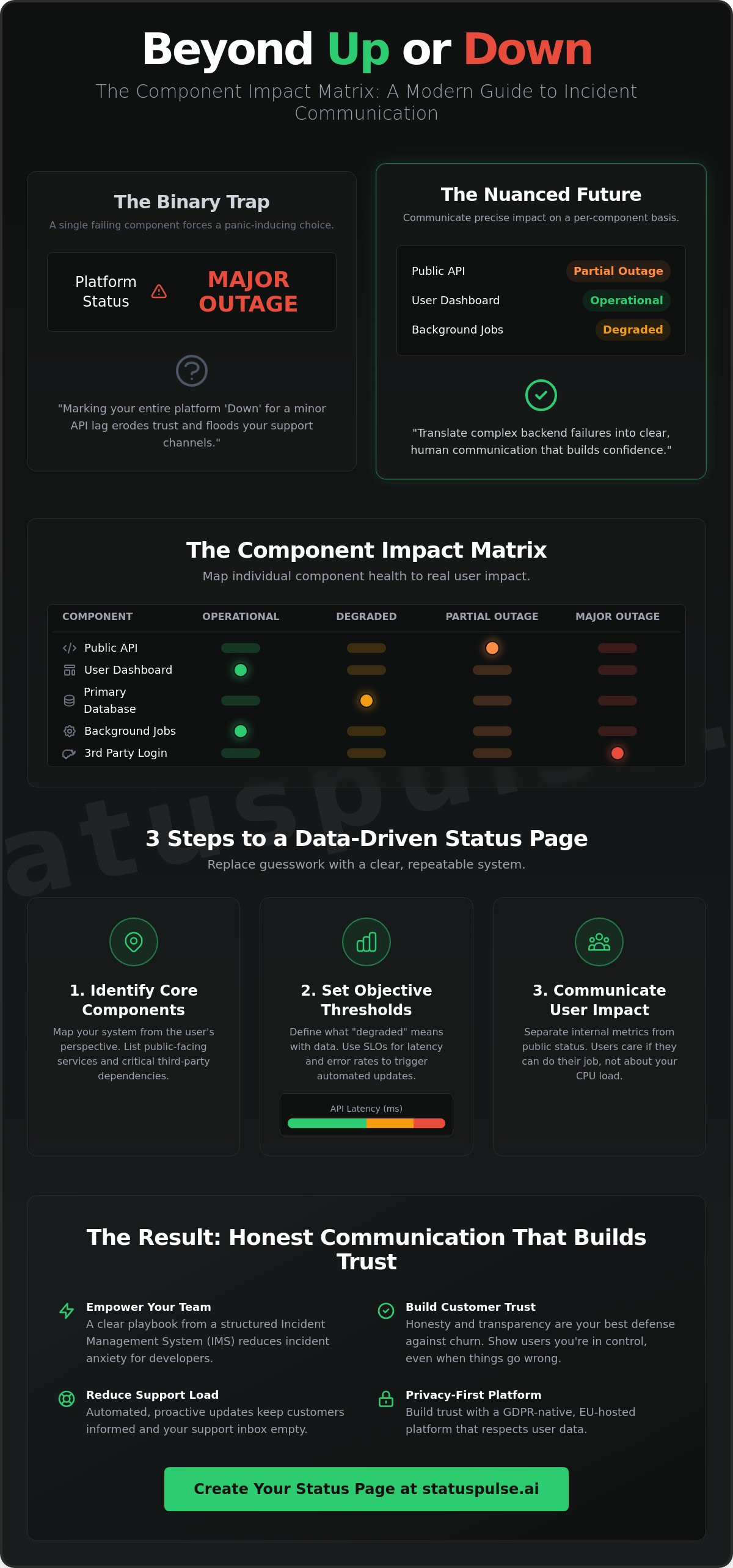
Binary status pages are a relic of a simpler time. In the era of monolithic apps, a server was either on or off. Today, your SaaS is a complex web of microservices and third-party dependencies. One failing database shard shouldn't turn your whole dashboard red. This is why you need a Component Impact Matrix: Modelling Partial Outages Without Confusing Your Customers. This matrix is a logical grid that maps specific system components against the severity of their failure. It moves your communication strategy beyond the binary choice of Up or Down.
Transparency is your best defense against churn. When technical debt spikes or a region goes dark, users don't just want to know that something is wrong. They want to know if it affects them. Incumbents often hide behind internal codes like SEV-1 or SEV-2. These mean nothing to a user trying to export a report. A well-defined matrix reduces incident anxiety for your developers by giving them a clear playbook. It also reassures users that you have a grip on the situation. Honest communication builds a foundation of trust that marketing can't buy.
Why "Partial Outage" is the Hardest Status to Communicate
The "Degraded Performance" label is a dangerous catch-all. It's often used as a rug to sweep technical failures under. If your API is taking 10 seconds to respond, it isn't just degraded; it's broken for anyone using it in a production environment. Balancing technical accuracy with user-facing simplicity is a constant struggle. You need to be precise without being overwhelming. The Transparency Gap is the distance between what your monitoring tools see and what your customers actually understand during a failure. Closing this gap requires a move away from vague labels and toward specific, component-based reporting.
The Anatomy of a SaaS Component Matrix
Start by identifying your core components. This usually includes your public API, the user dashboard, your primary database, and critical third-party integrations. You must map these dependencies carefully. A minor backend issue in a non-critical service might have zero impact on the user. However, a minor lag in your authentication service causes a major frontend failure. You can't communicate impact without a clear Service-Level Objective (SLO) for each component. This SLO acts as your baseline. It defines what "Normal Operation" looks like versus "Degraded." Use StatusPulse to track these metrics and keep your updates honest. When you know your baselines, you can automate your Component Impact Matrix: Modelling Partial Outages Without Confusing Your Customers with confidence.
Building Your Matrix: Defining Severity and Probability for Modern Stacks
Building a matrix isn't about guesswork. It's about hard data. To communicate effectively, you must set objective thresholds for latency, error rates, and throughput. A 500ms delay in your API might be acceptable. A 5000ms delay is a failure. Without these numbers, your status updates will be inconsistent and frustrating. Implementing a structured Incident Management System (IMS) ensures your team isn't scrambling when the dashboard turns yellow. You need a source of truth that triggers the right message at the right time.
Probability and impact are your two primary axes. Most teams focus on frequent, low-impact events like minor UI glitches. However, the "Low Probability, High Impact" events are where trust is won or lost. Think of a regional data center failure. It rarely happens, but when it does, it's catastrophic. These events need the most documentation in your Component Impact Matrix: Modelling Partial Outages Without Confusing Your Customers. If you haven't defined how to communicate a total regional blackout, you'll fail the transparency test when it matters most.
Your internal view should always be more granular than your external one. Your developers need to see every spike in CPU usage and every database lock. Your customers don't. They care about utility. If an internal cron job fails but the user can still process payments, your public status should remain green. Don't overwhelm users with technical noise. Keep your public matrix focused on the user journey. You can start building your own status page to see how these levels translate into clear, honest communication.
Defining the 4 Levels of SaaS Impact
- Level 1: Operational. All systems go. Performance meets all defined SLOs.
- Level 2: Degraded. The system is slow but functional. Users experience high latency but no hard errors.
- Level 3: Partial Outage. Specific features, like reporting or exports, are unavailable. Some regions might be affected.
- Level 4: Major Outage. The core service is down. This is the "Red" state where the primary value proposition is broken.
Assigning Components to the Matrix
Not all components are created equal. You must identify your Critical Path Components. These are the non-negotiables, such as your authentication service or payment gateway. If these fail, it's an immediate Level 4. Non-Critical Components, like an avatar upload service, only trigger a Level 2 or 3. By assigning a "Component Importance Score" to every part of your stack, you can automate your Component Impact Matrix: Modelling Partial Outages Without Confusing Your Customers. This removes human bias from incident reporting. It ensures your status page stays honest, even when the pressure is on.
Partial Outages: How to Map Technical Lag to Customer Experience
Latency is a thief. It steals time and trust. In the modern SaaS world, a server that responds in 15 seconds isn't "Up" in any meaningful sense. Your monitoring tools might show a green light because the port is open, but your users are staring at a spinning loader. This is why the "Latency is the New Down" mantra is so critical. If your application is too slow to be useful, it is effectively down. Your Component Impact Matrix: Modelling Partial Outages Without Confusing Your Customers must treat high latency as a partial outage, not just a minor hiccup.
Regional failures require the same level of blunt honesty. If US-East-1 is having a bad day, don't just put up a generic "investigating" banner. Tell your users exactly who is affected. "It is just you, US-East-1" is a powerful message. It reassures users in Europe or Asia that their data is safe and their access is stable. This specificity prevents your support team from being buried under tickets from users who aren't even experiencing the issue. Honesty is your best filter.
Upstream dependencies like AWS, Stripe, or Twilio are often the root cause of your "partial" status. Don't hide behind their failures. If Stripe is down and your users can't upgrade their plans, your status page should reflect that specific feature failure. Use your matrix to decide exactly when a technical spike becomes a public notification. If a third-party API call fails twice in ten minutes, it's a blip. If it fails for five minutes straight, it's time to update the page. This logic keeps your communication consistent and your team focused on the fix.
The "User Experience" Translation Layer
Technical metrics are for your dev team. User impact is for your customers. You need a translation layer that turns raw data into human sentences. Most incumbents focus on internal KPIs like Mean Time to Recovery (MTTR). While those matter for your post-mortem, they mean nothing to a customer who can't export a report. Use the table below as a starting point for your own matrix.
| Technical Metric | User-Friendly Status Update |
|---|---|
| > 2000ms API Latency | Search results and dashboard loading may feel sluggish. |
| 10% Webhook Failure Rate | Third-party integrations may experience delays in syncing. |
| 503 Error on /auth endpoint | New logins are currently unavailable; active sessions are unaffected. |
Managing the "Everything is Fine" Fallacy
Lying about your uptime is a death sentence for SaaS brands. Users aren't stupid. They know when a site is broken. When they see a "Green" status page during a clear outage, they stop trusting your brand entirely. This is the "Everything is Fine" fallacy that plagues corporate incumbents. They prioritize optics over integrity. At StatusPulse, we believe in a different path. We advocate for a developer-first approach where transparency is the default setting. For more on this philosophy, check out our guide on Uptime Monitoring: A Developer’s Guide. Building a Component Impact Matrix: Modelling Partial Outages Without Confusing Your Customers is the first step toward a more ethical, reliable relationship with your users.
Operationalizing the Matrix: AI-Powered Communication and Automation
Static spreadsheets are where good ideas go to die. During an active incident, nobody has time to hunt for a shared Excel file. You need a dynamic status page that lives and breathes with your infrastructure. Automation is the key to maintaining a Component Impact Matrix: Modelling Partial Outages Without Confusing Your Customers without burning out your engineering team. By connecting your monitoring tools directly to your public page, you ensure that the Transparency Gap stays closed. It moves your response from reactive to proactive. No more manual updates while the fire is still burning.
Automating the matrix doesn't mean removing the human element. It means giving your team a headstart. When your API Monitoring detects a sustained 5% error rate, the system should instantly update the relevant matrix coordinates. This triggers a draft message, not a public post. This human-in-the-loop requirement is vital. You should never fully automate public apologies. A bot doesn't understand the stress of a user who can't access their data. Speed is a tool, but empathy is a choice. A Component Impact Matrix: Modelling Partial Outages Without Confusing Your Customers works best when it empowers humans, not replaces them.
Claude Drafts, You Press Send: AI in Incident Management
AI can bridge the gap between technical logs and human empathy. Our philosophy is simple: Claude drafts, you press send. This approach uses AI to summarize complex technical logs into a "Status: Partial Outage" update that makes sense to a non-technical customer. It maintains a consistent, calm brand voice even when your Slack channels are in chaos. By using pre-set matrix templates, you significantly reduce your Time to Communicate (TTC). Speed matters. Clarity wins. A G2 review from February 2025 highlights how a robust API for automation is now the top priority for modern incident management teams who value their time.
Integrating with Your DevOps Workflow
Your status page needs real-time data to be effective. Set up 1-minute uptime checks to feed the matrix constant updates. This ensures that your status page reflects reality, not a cached version of the past. Always ensure your status page is hosted in a different region than your primary application. If US-East-1 goes down, your status page in the EU must stay up. This is why we prioritize being EU-hosted and GDPR-native. It isn't just about compliance; it's about pure reliability. You can automate your incident management today and stop manual reporting forever. One tool. Total transparency. No surprises.
StatusPulse: Honest Incident Communication for Principled Dev Teams
StatusPulse isn't just another status page. It's a principled choice for developers who value integrity over flashiness. We built this platform because we were tired of the corporate bloat and complex pricing models offered by industry incumbents. Most tools in this space treat transparency as a luxury feature. We treat it as a baseline. Our platform provides the perfect environment for your Component Impact Matrix: Modelling Partial Outages Without Confusing Your Customers. We believe that every team deserves a clear, honest way to communicate with their users without the "enterprise" tax.
Pricing should be simple and fair. We offer a bold value proposition: €5, not $29. While competitors like Statuspal start their plans at $49 and Status.io begins at $79, we remain honestly priced for teams that care about the details. This isn't just about saving money. It's about supporting a fair alternative that prioritizes human agency. We include native integrations for Jamstack, multi-region latency tracking, and SSL certificate monitoring as standard. You get high-level technical precision without the unnecessary overhead of a traditional enterprise provider.
Privacy is a core virtue, not a marketing afterthought. We are EU-hosted and GDPR-native by design. This geographic and ethical signature defines our identity in a globalized market. We provide a grounded, reassuring experience that reduces the stress of server outages. Your data stays in the EU, and your users stay protected. It's a straightforward approach for a complex world. By using our Component Impact Matrix: Modelling Partial Outages Without Confusing Your Customers, you can ensure your communication is as ethical as your infrastructure.
Simple Setup, No Surprises
You don't need a manual to get started. You can launch your first public status page in under 5 minutes. Our dashboard allows you to customize your component matrix with a few clicks, mapping your API and dashboard components to specific impact levels. There are no hidden fees or complex subordinate clauses to navigate. Just clear, efficient tools for honest teams. Start building your honest status page today and see the difference that quiet confidence makes.
The Developer-First Choice
We are a small team that cares about getting the details right. StatusPulse is the developer-first choice because we've stripped away the noise. There is no corporate bloat here. We maintain a rebellious streak against over-engineered tools that charge for features you'll never use. Our communication rhythm is fast-paced and logical, moving you quickly from the problem to the solution. Small, principled teams choose us because we value their time and their ethics. We provide the reliability you need and the honesty your customers deserve. Four plans. No surprises. You press send.
Own Your Uptime Strategy
Binary status pages are a relic of the past. Modern SaaS requires a nuanced approach that respects the user's intelligence. By implementing a Component Impact Matrix: Modelling Partial Outages Without Confusing Your Customers, you stop guessing and start communicating with data-backed precision. You've seen how translating technical lag into human impact reduces support volume and builds long-term trust. It's about being the adult in the room when things go wrong.
StatusPulse makes this transition effortless. We offer a platform that is EU-hosted and GDPR-native. It's built for developers who want simplicity and reliability. Our AI-powered incident drafting ensures you can move fast, while humans stay in control of the final message. There are no surprises here. We are honestly priced at €5 per month; we don't believe in the inflated rates of corporate incumbents. You've built a great product. Now, build a status page that matches its integrity.
Build your transparent status page for €5/month
Frequently Asked Questions
What is a Component Impact Matrix?
A Component Impact Matrix is a technical framework used to map specific system failures to their actual effect on the user experience. Instead of a single "up" or "down" light, it provides a granular view of your stack. This ensures that a minor background process failure doesn't look like a total platform crash. It's the core of a Component Impact Matrix: Modelling Partial Outages Without Confusing Your Customers.
How do you define a partial outage in a status page?
A partial outage occurs when specific features or regions are unavailable while the core service remains functional. For example, your users can log in, but they can't export reports. It's often triggered by regional failures like a specific AWS zone going dark. High latency also qualifies. If a critical task takes 30 seconds instead of 200ms, it's effectively a partial outage for that component.
Should I automate my public status page updates?
You should automate the detection and drafting, but keep a human in the loop for the final send. Automation ensures your status page stays in sync with your infrastructure in real-time. However, a purely automated bot can't provide the empathy needed during a crisis. We recommend a "Claude drafts, you press send" approach. This combines technical speed with human judgment to maintain trust.
How many components should I include in my status page matrix?
Stick to 5 to 10 core components that users actually care about. Including every microservice in your stack will only cause confusion for your customers. Focus on high-level categories like your API, Dashboard, Database, and Payments. If a failure doesn't impact the user journey, it doesn't need to be a public component. Less noise leads to more clarity and fewer support requests from panicked users.
What is the difference between a major outage and a partial outage?
A major outage is a total loss of core service where users cannot perform the primary function of your app. This is the critical "Red" state. A partial outage is limited. It affects only a subset of users or specific non-critical features. Distinguishing these correctly is the primary goal of the Component Impact Matrix: Modelling Partial Outages Without Confusing Your Customers. It prevents unnecessary panic during minor incidents.
Can AI really help with incident communication?
Yes, AI is excellent at summarizing technical logs into plain English for your customers. It can take a complex error report and draft a calm, consistent update for your users. This reduces your Time to Communicate significantly. It removes the pressure of writing from scratch during a high-stress event. You maintain total control while the AI handles the heavy lifting of initial drafting.
Why is EU-hosting important for a status page?
EU-hosting ensures your status page complies with strict GDPR requirements by default. It's about data sovereignty and privacy as a core virtue. For many businesses, having a GDPR-native provider is a legal necessity. It also provides regional redundancy. If your main US-based infrastructure fails, an EU-hosted status page remains accessible to your global audience. This ensures your communication line stays open when you need it most.
How do I reduce support tickets during a partial outage?
Be fast and be specific. A proactive status update can reduce ticket volume by over 50% according to some industry professionals. When users see that you've already acknowledged the issue, they don't feel the need to report it themselves. Use your matrix to provide granular details. Tell them exactly which feature is slow and when you expect a fix. Honest communication is your best defense.


