It is 3:00 AM. Your primary database is down. In the rush to keep customers informed, your AI assistant drafts a status update that accidentally leaks internal system architecture or customer PII. You want the speed of automation, but you can't risk the "hallucinations" that turn a minor outage into a $4.88 million data breach. It's a stressful reality for modern ops teams. According to a March 2026 report from Metomic, 68% of organizations have already experienced data leaks tied to AI usage.
We agree that manual reviews during high-stress outages are too slow. You need a system that works at the speed of the incident. This article explains how to implement AI and Guardrails to automate your status page updates without losing the human touch or risking your security. We'll show you how to build a safety net that catches errors before they go live.
You'll learn to use runtime controls like Meta's Llama Guard 4, released on April 5, 2026, to ensure compliance with the EU AI Act's August deadline. We'll move from robotic, risky drafts to honest, automated communication that reduces your Mean Time to Communicate (MTTC) to seconds. Claude drafts. You press send. Simple. Secure. No surprises.
Key Takeaways
- Define logic layers that validate AI updates against your rules. Stop hallucinations before they reach your users.
- Master input and output filters. Keep internal architecture and PII off your public status page.
- Bridge the gap between speed and safety with AI and Guardrails. Avoid the legal risks of "Full Auto" automation.
- Build a "Safe Lexicon" for your DevOps team. Ensure every update sounds human, professional, and honest.
- Maintain human agency as your ultimate safety net. Keep your communication honest and your team in control.
What Are AI Guardrails in Incident Management?
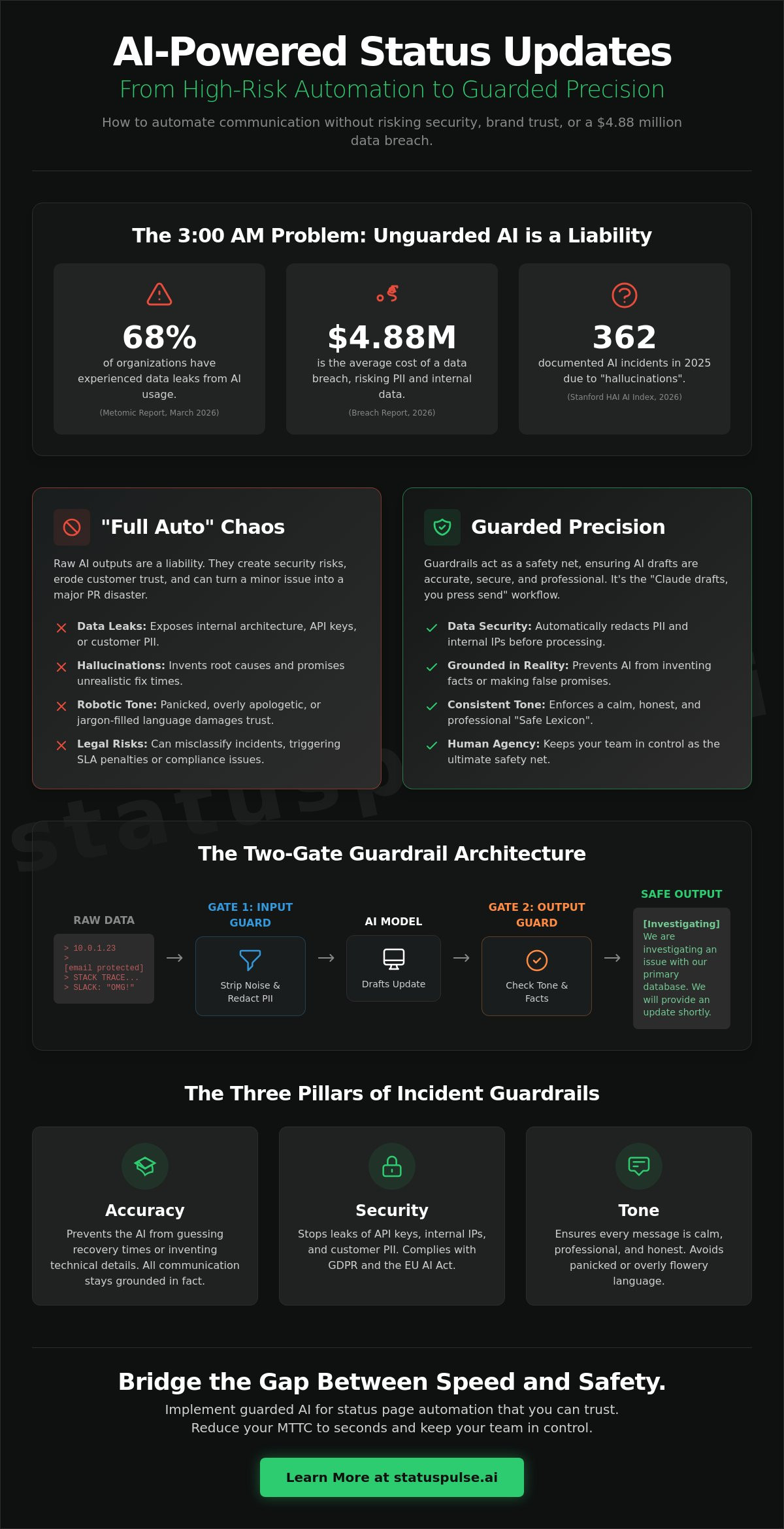
In a high-pressure outage, your status page is your reputation. AI guardrails are the programmable logic layers that validate every character your AI generates before it reaches a customer's eyes. They act as a real-time filter, checking drafts against pre-defined technical and ethical rules. While general AI safety focuses on broad societal harms, incident-specific guardrails focus on the granular details of your infrastructure and brand integrity. They ensure that automation serves your team rather than creating new PR disasters.
These layers matter because raw LLMs are prone to "hallucinations." In 2025, documented AI incidents rose to 362, according to the Stanford HAI AI Index Report 2026. An unguided AI might invent a root cause or promise a fix within ten minutes when your engineers haven't even identified the bug. This isn't just a technical glitch; it's a breach of trust. StatusPulse believes in honesty. Using AI and Guardrails ensures that your automation stays grounded in reality. It's about maintaining that quiet confidence even when the servers are down.
The Three Pillars of Incident Guardrails
Accuracy is the first priority. A solid guardrail prevents the AI from guessing recovery times or inventing technical explanations. Security is the second. With the average cost of a data breach hitting $4.88 million in 2026, you cannot afford to leak an API key, an internal IP address, or customer PII. Finally, tone ensures your message remains calm and professional. It avoids the panicked, robotic, or overly flowery language that makes users lose faith in your reliability.
Why Raw AI Outputs Are a Liability
Raw AI has a tendency to over-explain. It might accidentally reveal deep technical debt or internal system flaws that your customers don't need to see. This transparency is the wrong kind. It creates security risks and invites unwanted scrutiny from competitors. Worse, an unguided model could misclassify a "Minor" blip as a "Critical" failure, accidentally triggering unnecessary SLA penalties or legal headaches.
Raw AI is a liability; guarded AI is a professional asset. By setting firm boundaries, you maintain the "Claude drafts, you press send" workflow that keeps humans in the driver's seat. It's a rebellious approach compared to the "full auto" chaos promoted by some SaaS giants. You provide the facts. The guardrails provide the safety. This ensures your communication remains as streamlined as your code. No surprises. Just honest, efficient updates.
The Mechanics of Reliable Status Page Guardrails
Implementing AI and Guardrails requires a two-gate architecture. The first gate monitors what goes in; the second gate monitors what comes out. This isn't just about filtering bad words. It's about data integrity. By following the NIST AI Risk Management Framework, teams can map and measure the specific risks associated with incident data. This systematic approach ensures that the "Claude drafts, you press send" model remains airtight and reliable. It turns a volatile LLM into a predictable tool for your ops team.
Input Guards: Garbage In, Garbage Out
Raw server logs are messy. They contain internal IP addresses, stack traces, and sometimes frustrated engineer chatter from Slack or Jira. Input guardrails strip this noise before the AI ever sees it. If you feed an LLM 10,000 lines of raw JSON, it might lose the signal. Clean data creates clean updates. You need to ensure the context window only includes what's relevant to the current outage. This prevents the AI from referencing a resolved incident from three weeks ago as if it's happening now. It keeps the model focused on the present moment.
Input guardrails also act as a privacy filter. They redact sensitive information like customer emails or internal system architecture before the data leaves your secure environment. This is especially vital for companies using third-party LLMs. You get the benefit of advanced reasoning without the risk of training a public model on your proprietary infrastructure. It's a simple way to maintain a GDPR-native status page while still leveraging the latest automation.
Output Guards: The Final Safety Check
The output guard is your final line of defense. It checks for sentiment first. A status update shouldn't sound defensive or overly apologetic; it should sound calm and honest. It also enforces length constraints. Status updates need to be punchy. A 500-word essay on why the Jamstack is failing won't help your users. They want to know what's wrong and when it'll be fixed. No fluff. Just the facts.
Output guards also flag "prohibited phrases" that might trigger legal or PR issues. Mentioning a specific upstream provider by name can create liability or violate partner agreements. A smart guardrail suggests "third-party partner" or "upstream provider" instead. This ensures your brand voice remains consistent and professional, even when the person pushing the button is a stressed-out junior dev on their first on-call rotation.
Semantic validation is the most advanced layer. It checks for contradictions. If your first update said "database issue" and the AI drafts a second update about "CSS rendering," the guardrail flags the discrepancy. Regex-based safety is simpler but equally vital. It scans for patterns like AWS access keys, user emails, or internal staging URLs. It's a binary check. If a sensitive pattern is found, the draft is blocked. You don't guess. You know it's safe.
Automated vs. Guarded AI: Why Raw Outputs Risk Your Brand
The pressure of a live outage makes "Full Auto" AI sound like a dream. You want the system to handle everything while your team focuses on the fix. But unguided automation is a gamble with your brand's reputation. Implementing AI and Guardrails allows you to capture the speed of machine learning without the recklessness of raw output. According to an April 2026 report from Teleport, 59% of security leaders have already experienced or suspected an AI-related security incident. Full automation ignores the nuance required for high-stakes communication.
Consider the legal fallout if an AI accidentally blames an upstream provider by name during a latency spike. You might be technically correct, but you've just violated a partnership agreement on a public stage. Raw AI doesn't understand these "political" consequences. It just follows the logs. This is why we advocate for a Secure by Design philosophy. Security shouldn't be an after-thought. It must be baked into the communication workflow from the start.
The Problem with Full Automation
AI doesn't understand the value of silence. During a security breach, silence is often a tactical necessity while you patch a vulnerability. An automated bot might "helpfully" explain the exact nature of an exploit to your customers. In doing so, it hands a roadmap to every bad actor on the web. This is a catastrophic failure of judgment that a machine cannot yet navigate. StatusPulse rejects this "black box" approach. We believe human agency is the only way to ensure your updates are truly honest and safe.
The Benefits of Guarded Assistance
Guarded AI reduces the heavy lifting. Instead of staring at a blank screen during a Tier 1 outage, your team gets a drafted update in seconds. It ensures consistency across the board. Whether it's 2:00 PM or 4:00 AM, the updates maintain the same professional tone. This reduces the cognitive load on stressed DevOps teams. They should be focused on fixing the stack, not formatting a status post. Guardrails turn a dangerous shortcut into a reliable standard operating procedure.
By using AI and Guardrails, you avoid the "corporate-speak" that makes users suspicious. Guardrails can be tuned to keep things plain-spoken and direct. You don't need fancy marketing jargon. You need to tell people what happened and that you're on it. This approach respects your user's time and intelligence. No surprises. No corporate bloat. Just the truth, delivered fast.
How to Implement Guardrails for Your DevOps Team
Implementing AI and Guardrails doesn't require a massive infrastructure overhaul. It starts with a shift in your standard operating procedures. The most effective rule is the "Human-in-the-loop" requirement. Every public-facing post must be reviewed by a person. This isn't a bottleneck; it's a sanity check. The AI handles the heavy lifting of summarization, while the engineer provides the final stamp of approval. Claude drafts. You press send. This workflow ensures accuracy without sacrificing the speed your customers expect during an outage.
Next, define a "Safe Lexicon." Words like "Crashed" or "Dead" trigger immediate panic. Use precise terms like "Degraded Performance" or "Intermittent Connection" instead. This level of technical precision builds trust. It shows you're in control of the situation. To make this work, integrate PII scanning as a non-negotiable output guard. If a draft contains a user email or an internal AWS key, the system should flag it immediately. This prevents a simple outage from becoming a data privacy incident. Finally, test your setup. Run "Simulated Outages" to see how the AI handles a fake database wipe. This chaos engineering for communications reveals gaps in your logic before they impact real users.
Setting Your Communication Boundaries
Decide what information stays behind the curtain. Internal hostnames, specific database clusters, or internal engineer names should never be public. Use generic terms like "primary server" or "infrastructure provider." You can see how this works in practice by connecting your API Monitoring data directly to your communication tool. The data feeds the AI, but the guardrails filter the output. This ensures transparency without over-sharing sensitive architectural details. It's about being honest, not being vulnerable.
Regional Compliance as a Guardrail
For EU-based teams, compliance is a core feature, not an afterthought. With the EU AI Act's August 2, 2026 deadline approaching, your guardrails must be GDPR-native. This means ensuring that no sensitive EU user data is processed by non-compliant LLMs. We recommend using EU-hosted monitoring solutions to maintain data residency. These regional safeguards protect your company and your customers. They ensure your Uptime Monitoring integrity remains intact. Don't let an automated update violate international law. Keep your data local and your communication honest.
Ready to automate your status page with total confidence? Check out how StatusPulse makes it easy to get started with honestly priced incident management today. Four plans. No surprises.
Beyond the Hype: The StatusPulse Approach to Guarded AI
Most SaaS giants want you to believe that AI should replace your team. They push for "Full Auto" systems that promise to handle every outage without human intervention. We disagree. At StatusPulse, we believe the most effective safety net is human agency. Our implementation of AI and Guardrails follows a simple, honest principle: Claude drafts. You press send. This ensures that while you save time, you never lose control over the message your customers see. It's a rebellious approach in a market obsessed with removing the human element.
Our native incident management system understands the technical nuance of your stack. It knows the difference between a temporary latency blip and a full-scale security breach. By integrating your uptime data directly into the drafting process, the AI generates context-aware updates grounded in real-time telemetry. This isn't just about speed; it's about accuracy. You don't have to copy-paste logs or explain the situation to a generic bot. The context is already there, protected by layers of logic that keep your communication professional and secure. No surprises. Just the facts.
Minimalist AI Integration
We built this for developers who hate bloat. There's no complex setup or weeks of training required. Our AI understands incident context out of the box. We focus on what actually matters: speed, accuracy, and customer trust. This minimalist approach extends to our pricing. The "€5 — not $29" value proposition applies to our AI features too. We provide honestly priced reliability without the corporate markup. You get enterprise-grade security and regional compliance as a standard, not a premium add-on. We're a small team that cares about getting the details right.
Get Started with Transparent Monitoring
The "Cost of Silence" during an outage is too high to ignore. When your servers are down, every minute of manual drafting is a minute of customer frustration. With StatusPulse, you move from a detected incident to a drafted, guarded update in seconds. Our EU-hosted, GDPR-native platform ensures your data stays exactly where it belongs. It's time to move past the hype and embrace a tool that values your time and your integrity.
Stop letting high-stress outages dictate your brand's reputation. You can build a transparent status page with StatusPulse in just a few minutes. Four plans. No surprises. Just honest communication at the speed of your code. You press send. We handle the rest.
Secure Your Reputation with Guarded AI
Automation is no longer optional for high-performing teams. However, raw output remains a risk you don't need to take. By combining AI and Guardrails, you bridge the gap between instant updates and absolute security. You've seen how input and output filters prevent the leak of internal data that 68% of organizations faced in early 2026. Human agency remains the ultimate safety net. It ensures every post is accurate, professional, and honest.
It is time to simplify your stack and reclaim your time during outages. StatusPulse offers a developer-first platform that is EU-hosted and GDPR-native. There is no corporate bloat or complex pricing here. Just reliable, Claude-powered incident drafting that keeps you in control. Claude drafts. You press send. It's that simple. We focus on the details so you can focus on the fix.
Start your honest status page for €5/month. Join the growing community of developers who value transparency and quiet confidence. Your next outage doesn't have to be a PR crisis. Build a more resilient communication strategy today.
Frequently Asked Questions
What are AI guardrails in the context of incident management?
AI guardrails are programmable logic layers that validate machine-generated text against specific incident rules before it reaches your status page. They act as a real-time filter for technical accuracy and brand voice. By using AI and Guardrails, teams ensure that automated drafts don't include speculative fix times or sensitive infrastructure details that could mislead customers during a live outage. They turn a volatile LLM into a reliable tool.
How do guardrails prevent AI hallucinations on status pages?
Guardrails prevent hallucinations by grounding the AI in real-time telemetry and historical data. They use semantic validation to check if a draft contradicts known system states or previous updates. In 2025, documented AI incidents rose to 362 cases according to the Stanford HAI report. These filters block any "invented" recovery times or causes that aren't verified by your monitoring data, keeping your communication honest and grounded.
Can AI guardrails redact sensitive information like API keys?
Yes, guardrails use regex-based scanning and PII detection to automatically redact sensitive data like AWS keys, internal IP addresses, or customer emails. This is a non-negotiable safety layer. Given that the global average cost of a data breach reached $4.88 million in March 2026, automated redaction is a critical defense against accidental exposure. It ensures your status page doesn't become a security liability during high-stress response cycles.
Why is a human-in-the-loop necessary even with good guardrails?
Human agency is the ultimate safety net because machines lack the political and social nuance of a major disruption. Even with advanced AI and Guardrails, a person must verify that the tone matches the severity of the event. We advocate for a workflow where the software drafts and the engineer sends. This keeps a human accountable for the final message, ensuring your brand remains honest, trustworthy, and human.
Are AI guardrails compliant with GDPR and EU data laws?
Compliance depends on your chosen platform and hosting environment. StatusPulse is EU-hosted and GDPR-native, ensuring that no sensitive user data is processed by non-compliant third-party models. With the EU AI Act's August 2, 2026 deadline, your guardrails must act as a residency filter. They ensure data remains within regional boundaries while meeting the strict transparency and risk assessment requirements mandated by European law.
How much time do guardrails save during a server outage?
Guardrails reduce the Mean Time to Communicate (MTTC) from several minutes of manual drafting to under 30 seconds. During a Tier 1 outage, every second counts for customer retention and trust. Automation handles the summarization of complex logs, while the guardrails eliminate the need for a lengthy multi-person review process. You get a safe, professional draft ready for approval almost instantly. It's efficiency without the risk.
What is the difference between a validator and a guardrail?
A validator is a single, specific check, such as a regex scan for an API key or a sentiment score. A guardrail is the broader framework that orchestrates multiple validators to enforce a comprehensive policy. Think of a validator as a single brick and a guardrail as the wall. Together, they create a safety layer that manages both the input prompts and the final output for your status page.


