
Hardcoding database credentials in your monitoring configuration isn't just a shortcut; it's a liability that bypasses your entire security stack. Most engineering teams settle for surface-level uptime pings because the alternative involves exposing sensitive logic to third-party tools. You shouldn't have to choose between deep observability and the strict requirements of NIST CSF 2.0. This guide explains how to implement a custom probe query; vault-sealed credentials to monitor complex business logic while maintaining a zero-trust environment.
We agree that security compliance often feels like friction against technical depth. You will learn how to pull secrets dynamically from tools like HashiCorp Vault 2.0.1, ensuring your monitoring agent never sees a plaintext password. We'll walk through the architecture for secure, authenticated probes that detect incidents before they impact your users. This approach ensures your monitoring is as robust as your infrastructure, all while keeping your data sovereignty intact.
Key Takeaways
- Move beyond basic port pings to validate internal application states and data integrity using deep-tissue monitoring.
- Eliminate the risk of secret leakage by integrating monitoring tools with external secret managers like HashiCorp Vault.
- Implement a custom probe query; vault-sealed credentials. to ensure sensitive access keys never exist in plaintext within your monitoring configuration.
- Apply the Principle of Least Privilege to monitoring agents to maintain security compliance without sacrificing observability.
- Optimize query performance to ensure deep monitoring checks don't degrade production database or API response times.
Beyond the Ping: Why Custom Probe Queries are the New Standard
Traditional uptime monitoring is binary. It checks if a server responds to a TCP handshake or an ICMP ping. This approach is insufficient for 2026 microservices. A port can be open while the service behind it is functionally dead. We've seen too many status pages showing green checkmarks while users are staring at broken checkout buttons.
The Limitations of Synthetic Monitoring
Basic synthetic checks often rely on HTTP 200 status codes. This is a dangerous metric. A web server might return a 200 OK while the underlying database connection is timed out or a critical cache is empty. These zombie services look healthy on a dashboard but fail for every user. They create a false sense of security that delays incident response.
This gap is why teams are shifting toward Application performance management (APM) strategies that prioritize semantic health. We call this deep-tissue monitoring. It isn't enough to know the API is reachable; you need to know if the API can actually process a request. Silent degradations often bypass standard pings, leaving on-call teams blind until users start complaining on social media.
Defining the Custom Probe Query
A custom probe query; vault-sealed credentials. approach changes the monitoring relationship. Instead of a generic ping, the monitor executes a specific, user-defined script or query against the application. This might include a SQL health check that verifies read/write permissions on a specific table. It could also involve a GraphQL schema validation to ensure that recent deployments haven't broken downstream consumers. These checks go beyond the surface to verify that the internal state of the application matches expectations.
These probes offer granular visibility into internal states that standard uptime tools ignore. You might monitor if an asynchronous worker queue exceeds a specific threshold or if a local cache is successfully hydrating. By validating the actual logic, you reduce your Mean Time to Detection (MTTD) by catching errors before they cascade. This is the difference between knowing a server is powered on and knowing it's actually performing its job.
Implementing these checks requires a shift in security thinking. You can't just leave database passwords in a configuration file. At StatusPulse, we focus on making these deep checks secure by design. The goal is to move from "Is the service up?" to "Is the business logic functioning as intended?" without creating new security holes in your infrastructure.
The Security Dilemma: Protecting Credentials in Custom Probes
Custom probes require more than just public URL access. To validate an internal state, these probes need read permissions for databases or administrative API keys for internal services. This elevated access creates a significant security trade-off. If your monitoring tool is compromised, those credentials become a map for attackers to exploit your core infrastructure.
The risk of secret leakage is real. Storing plaintext secrets in configuration files or hardcoded environment variables is a legacy liability that most modern security teams won't tolerate. If an attacker gains access to your CI/CD pipeline or the monitoring host, they can harvest these keys to move laterally across your network. This is why DevOps teams are often skeptical of third-party monitoring agents that demand broad permissions without granular control.
The Attack Surface of Monitoring Tools
Monitoring agents are often overlooked in security audits. However, they are high-value targets because they sit at the intersection of multiple service boundaries. Compliance frameworks like SOC2 and GDPR demand strict control over secret access and audit logs for every credential use. The latest NIST Cybersecurity Framework 2.0 emphasizes the "Govern" function, requiring organizations to integrate risk management into every technical layer. Monitoring shouldn't be an exception to your zero-trust policy.
Introducing Vault-Sealed Credentials
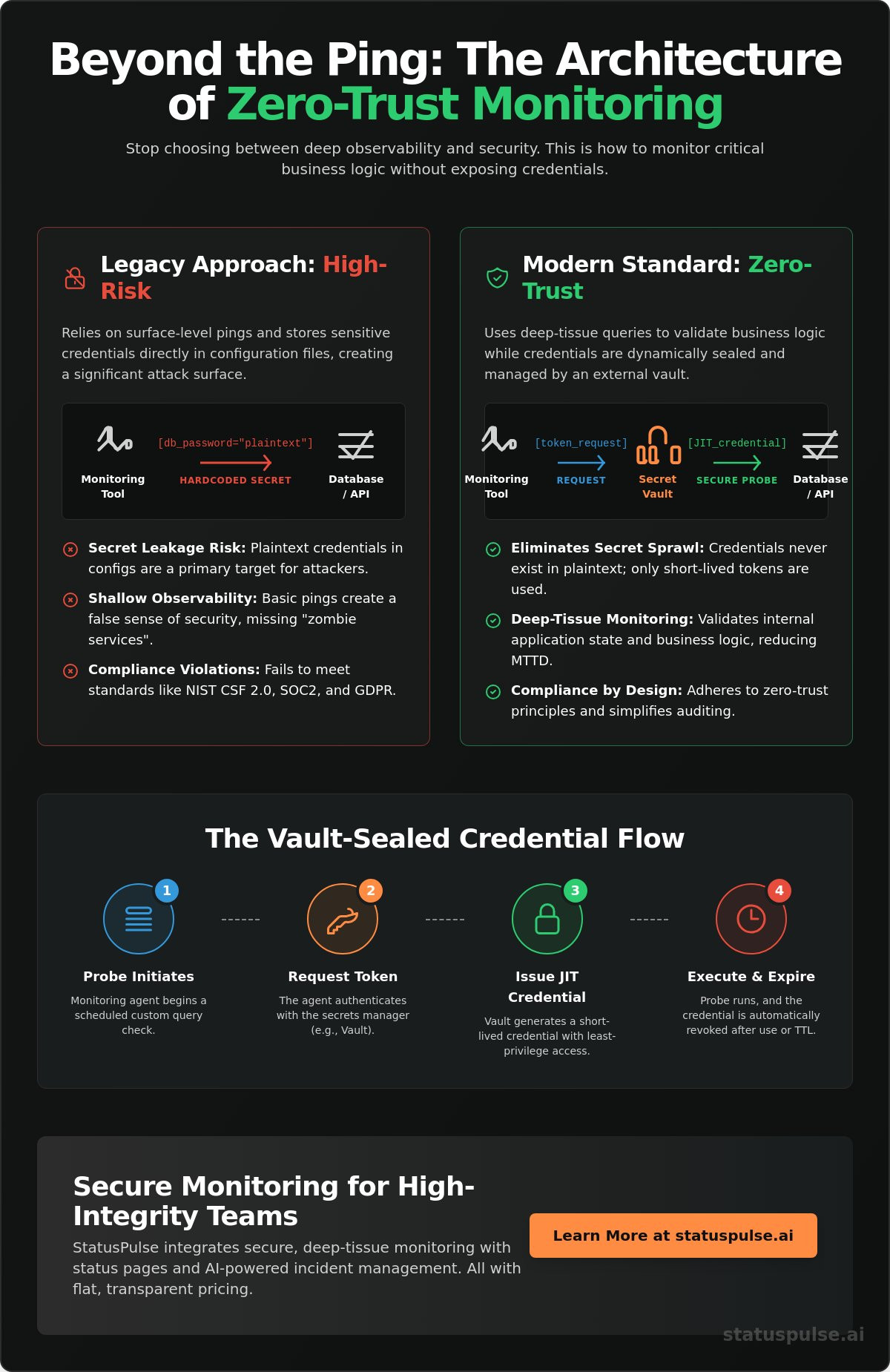
A custom probe query; vault-sealed credentials. architecture solves this by separating the query logic from the sensitive data. To "seal" a credential means to encrypt it so that only the final execution environment can decrypt it at runtime. The monitoring platform stores a reference or an encrypted blob, but it never has access to the raw secret in its persistent storage.
This process often utilizes Just-In-Time (JIT) credential injection. When a probe needs to run, it requests a short-lived token from a secret manager like HashiCorp Vault 2.0.1. The credential exists only for the duration of the query and expires immediately after. This limits the blast radius of a potential leak. It ensures your monitoring platform remains a zero-knowledge entity regarding your sensitive production data.
Implementing this level of security manually is complex. We've simplified this by building API monitoring features that integrate directly with your existing secret management workflows. This allows you to maintain deep observability without compromising your security posture or failing your next compliance audit.
Architecting Zero-Trust Observability with Vault Integration
Zero-trust monitoring assumes that every component, including the monitoring agent itself, is a potential point of compromise. You shouldn't grant your monitoring platform permanent, high-privilege access keys. Instead, use a secure handshake to authorize specific actions. This architecture ensures that sensitive data stays within your controlled environment.
StatusPulse integrates with secret managers to facilitate this process. If you're new to secrets management, these HashiCorp Vault tutorials provide a foundation for setting up secure authentication. By using a custom probe query; vault-sealed credentials., the monitor only receives the data it needs at the exact moment of execution. This prevents the "secret sprawl" that often plagues large-scale infrastructure.
How the Vault-Sealing Process Works
The sealing process is straightforward but rigorous. It follows a three-step cycle to ensure no plaintext secrets are ever persisted in the monitoring tool's database.
- Step 1: Define the secret path. You store your credentials in your own Vault instance, such as HashiCorp Vault 2.0.1, under a specific path.
- Step 2: Map the path to a probe. You provide the path reference to StatusPulse. The platform stores only the metadata, not the key itself.
- Step 3: Runtime injection. During the probe execution, the agent authenticates, fetches the secret, and injects it into the query. The secret is held in memory and discarded immediately after use.
Benefits of Dynamic Credential Rotation
Static passwords are a liability. Dynamic secrets generate short-lived credentials for every probe execution. This drastically reduces the window of opportunity for an attacker. If a key is only valid for sixty seconds, it's useless before a malicious actor can even log in. This level of automation eliminates the manual toil of rotating passwords across your entire monitoring stack.
This approach also satisfies strict audit requirements. Every access request is logged by the vault, providing a clear trail of which probe accessed which secret and when. This visibility is essential for meeting the "Govern" function of NIST CSF 2.0. When you use uptime monitoring with vault integration, you're building a system that is secure by default, not just as an afterthought.
Best Practices for Writing Secure Custom Probes
Writing the logic for a health check is as critical as securing the connection itself. A poorly designed probe can cause the very downtime it is supposed to detect. When you implement a custom probe query; vault-sealed credentials. must be handled with the same care as your production application code. This means moving away from ad-hoc scripts toward version-controlled, optimized monitoring logic.
The Principle of Least Privilege is your first line of defense. Never use administrative accounts for monitoring. If you are checking a database, create a dedicated user with read-only access to specific health tables. This limits the potential impact if a credential is ever misused. It also aligns with NIST SP 800-63B guidelines, which favor long, machine-generated passphrases for service accounts over complex but frequently rotated human passwords.
SQL Probe Patterns for Database Health
Database probes should never interfere with user transactions. Use non-blocking read hints, such as SET TRANSACTION ISOLATION LEVEL READ UNCOMMITTED in SQL Server or FOR SHARE in PostgreSQL, to prevent the probe from holding locks. Focus your queries on metadata rather than large data sets. Monitoring index fragmentation or the size of a specific audit table provides deep visibility without the overhead of a full table scan.
Always use vault-sealed read-only users for these checks. By pulling a short-lived credential from HashiCorp Vault 2.0.1 at runtime, you ensure that even if a database session is intercepted, the window for exploitation is minimal. This setup allows you to automate the rotation of monitoring credentials without manually updating configuration files across your fleet.
API Probe Logic for Complex Workflows
A simple status code check is often a lie. Modern APIs can return a 200 OK while delivering an empty or malformed JSON payload. Your probe logic should validate payload integrity by checking for specific keys or data types. For complex user journeys, sequence your API calls. Test the full flow: authenticate, fetch a resource, and verify the response. This ensures that the entire service chain is functional, not just the entry point.
Manage your API keys through vault-sealed headers. Instead of hardcoding a Bearer token, use a placeholder that your monitoring agent replaces with a dynamic secret. This keeps sensitive tokens out of your monitoring dashboard and your Git history. If you're ready to move beyond basic pings, you can start building these advanced checks today with API monitoring that prioritizes security and technical depth.
Finally, treat your monitoring as code. Store your probe definitions in your Infrastructure as Code (IaC) repositories. This allows you to peer-review changes to monitoring logic and maintain a history of your observability stack. It ensures that when your application evolves, your security and monitoring policies evolve with it.
StatusPulse: Secure Monitoring for High-Integrity Teams
StatusPulse is designed for engineering teams that have outgrown the bloated, expensive monitoring suites of the past decade. We provide a platform that treats your infrastructure with respect. By implementing a custom probe query; vault-sealed credentials., you maintain full control over your secrets while gaining deep visibility. Our focus is on precision rather than marketing flashiness.
Our interface is declarative and minimalist. You won't find cluttered dashboards or unnecessary features that distract from your primary goal. Instead, you get a focused toolset for building robust health checks. This approach ensures that your monitoring configuration is easy to audit and maintain. It's a tool built by specialists who understand the daily pressure of on-call rotations.
Zero-Trust Monitoring by Design
We prioritize your data sovereignty and privacy as core virtues. You have the choice between EU or US hosting, ensuring your monitoring data stays within your preferred legal jurisdiction. We don't believe in corporate bloat or opaque pricing models that punish you as you scale. Our platform is a lean alternative for those tired of the "faceless corporation" approach to enterprise software.
Security isn't a marketing afterthought here. We've built our architecture to support zero-trust principles from the ground up. By using vault-sealed credentials, we ensure that our platform remains a zero-knowledge participant in your secret management. This commitment to integrity reduces the stress of technical disruptions by providing a reliable, straightforward solution.
From Detection to Transparent Communication
Monitoring is only half the battle. When a probe fails, the technical data needs to reach your stakeholders in a readable, honest format. Our API monitoring triggers more than just a simple alert. It initiates an incident workflow where AI assists by drafting summaries based on the specific failure context. This reduces the manual toil for your DevOps team during a crisis.
This automated incident management bridges the gap between a technical failure and human understanding. Instead of scrambling to write a status update, your team can focus on the fix while the assistant drafts the initial report. This transparency builds trust with your users. You can start your journey toward honest uptime monitoring today with a platform that values technical depth and ethical simplicity.
Modernize Your Security and Observability Stack
Reliable monitoring requires more than a simple heartbeat. You need to validate the internal logic of your services without leaving your database keys in a configuration file. By implementing a custom probe query; vault-sealed credentials., you align your observability with zero-trust standards. This approach ensures your secrets are never stored in plaintext and your monitoring remains a zero-knowledge participant in your security stack.
It's time to replace legacy pings with semantic health checks that actually matter. You can maintain strict data sovereignty with our choice of EU or US hosting. Our AI-powered incident management helps you communicate failures honestly and quickly. Don't settle for corporate bloat or complex pricing models that punish your growth. Secure your monitoring stack with StatusPulse and build a resilient, transparent system for your users. You've built a secure application; your monitoring should finally match that standard.
Frequently Asked Questions
What is a custom probe query in uptime monitoring?
A custom probe query is a user-defined script or command that validates the specific internal state of an application rather than just its network reachability. It allows you to check database health, API payload integrity, or specific business logic outcomes. By using a custom probe query; vault-sealed credentials. ensure that these deep checks remain secure. It moves monitoring from simple connectivity to functional validation, providing a more truthful view of service health.
How do vault-sealed credentials improve monitoring security?
Vault-sealed credentials improve security by ensuring that sensitive keys never exist in plaintext within your monitoring platform. The monitor stores only an encrypted reference or a path to the secret. At runtime, the agent fetches the secret directly from your vault. This architecture prevents secret leakage if the monitoring dashboard is compromised, as the raw credentials aren't stored there. It's a principled approach to managing high-privilege monitoring access.
Can I use HashiCorp Vault with StatusPulse for my custom probes?
Yes, StatusPulse supports native integration with HashiCorp Vault. This allows you to pull secrets dynamically for every probe execution. You simply map the secret path in your Vault instance to your StatusPulse configuration. The system handles the authentication handshake and injects the credential into your query logic at the exact moment it's needed. This integration ensures your monitoring agent stays a zero-knowledge participant in your secret management.
What is the difference between a standard heartbeat and a custom probe?
A standard heartbeat only confirms that a server is responsive at the network level, such as a TCP handshake. A custom probe executes specific logic to ensure the service is actually working. For example, a heartbeat might confirm a port is open, while a custom probe detects that an internal cache hasn't refreshed in hours. Probes provide semantic health rather than just connectivity. They are the new standard for complex, data-driven applications.
Do custom probes impact my production database performance?
Probes can impact performance if they are poorly written, but proper optimization mitigates this risk. Use non-blocking read hints and target metadata or small health tables instead of running full table scans. When configured correctly, these checks add negligible overhead to your production environment. It's a trade-off that favors deep observability over the blind spots of basic pings. Monitoring should never be the cause of your downtime.
How does dynamic credential rotation work for monitoring?
Dynamic rotation generates short-lived credentials that are created for a single probe execution and expire immediately after. Instead of using a static password, the monitoring agent requests a temporary token from your secret manager. This drastically shrinks the window of opportunity for an attacker. It also automates the rotation process, removing the need for manual updates across your fleet. This keeps your monitoring infrastructure compliant with modern security standards like NIST CSF 2.0.
Why is zero-trust important for observability tools?
Zero-trust is vital because monitoring tools often require high-level access to sensitive infrastructure. If a monitoring tool is treated as a trusted entity with permanent keys, it becomes a high-value target for lateral movement. Implementing zero-trust means the monitor must prove its identity and request limited, temporary access for every action. This reduces your overall attack surface. It ensures that monitoring is a security asset rather than a liability in your stack.
Can I monitor internal APIs that are not exposed to the public internet?
Yes, you can monitor internal APIs by using private probes or agents installed within your network. These agents communicate outbound to the monitoring platform to report status but don't require you to open inbound firewall ports. This allows you to maintain the same level of secure, deep-tissue monitoring for your private microservices as you do for public endpoints. It's an essential strategy for maintaining visibility across a complex, multi-region microservices architecture.


