

Your incident response is only as fast as your slowest payload. Most legacy monitoring tools treat webhooks like a junk drawer, tossing in hundreds of lines of redundant metadata. If you're tired of messy data, you need Webhook Alerts for Incidents: A JSON Payload Schema Your Team Can Actually Use. You've likely spent too many 3:00 AM outages squinting at a disorganized JSON blob just to find a single status code. It’s frustrating, inefficient, and a massive distraction from actually fixing the problem.
We've built a clean, developer-first schema that follows the May 2026 CloudEvents standard. No surprises. You'll get a copy-pasteable template designed for a 99.0% success rate SLO and sub-60-second p95 latency. We'll cover everything from HMAC-SHA256 signature verification to asynchronous processing. It's a reliable communication contract that works perfectly with Slack, Teams, or your own internal tools without the corporate bloat of industry incumbents. Honestly, it's the schema we wanted for ourselves.
Key Takeaways
- Eliminate noise. Learn why reducing your payload to essential event data prevents alert fatigue and mapping errors.
- Master the "Core Four." We provide Webhook Alerts for Incidents: A JSON Payload Schema Your Team Can Actually Use that prioritizes ID, Status, Severity, and Timestamp.
- Secure every endpoint. Implement HMAC SHA-256 signatures to protect your workflow from unauthorized triggers and replay attacks.
- Contrast and simplify. Compare documentation-heavy incumbent schemas with a minimalist, developer-first philosophy that just works.
- Automate the boring parts. Discover how AI can draft your incident payloads for seamless integration with your Public Status Pages.
Why Most Webhook Alerts Break Your Workflow
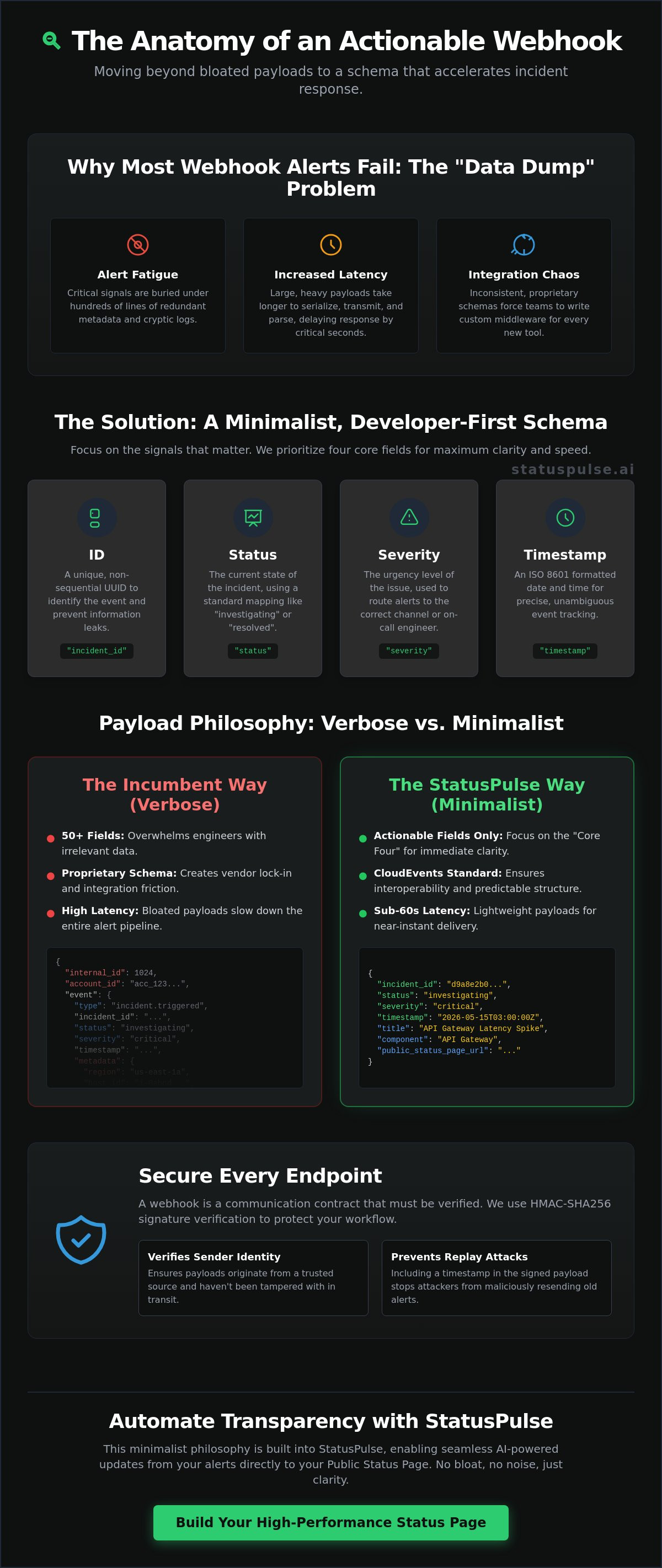
Most incident alerts don't help you. They overwhelm you. When a server goes down at 3:00 AM, the last thing an on-call engineer needs is a 500-line JSON object. We call this the "Data Dump" problem. Legacy monitoring tools often include 50 or more fields in a single payload. Most of this data is redundant metadata, internal system IDs, or cryptic logs that require a manual to decode. This isn't information; it's noise. It leads directly to alert fatigue, where critical signals are buried under a mountain of useless text.
Inconsistency makes the problem worse. If your uptime monitor uses one format and your API tester uses another, your team spends hours writing custom middleware. You end up re-mapping schemas every time you add a new tool. This complexity carries a hidden cost in latency. Large, heavy payloads take longer to serialize, transmit, and parse. During a major outage, every second counts. A bloated payload can delay your initial response by several critical seconds, affecting your 99.99% availability goals.
To fix this, your team needs Webhook Alerts for Incidents: A JSON Payload Schema Your Team Can Actually Use. Most payloads provide raw data but zero human context. They tell you a check failed, but they don't tell you why it matters or how to fix it. A usable schema acts as a bridge between machine events and human action.
The Problem with Incumbent Tools
Industry incumbents thrive on complexity. They force proprietary schemas that lock you into their ecosystem. These "enterprise-ready" webhooks often require heavy maintenance and expensive managed support just to keep the integrations running. At StatusPulse, we take a different path. We believe in transparency and honesty. Instead of corporate bloat, we provide a native, streamlined experience. We don't hide behind complex pricing or confusing documentation. We give you exactly what you need to restore service quickly.
Defining the Communication Contract
A webhook is more than a technical trigger. To understand the foundation, you should look at What is a webhook? and how it functions as a user-defined HTTP callback. It is a communication contract. This contract should move your team from "something happened" to "here is exactly what you need to know." Your schema should mirror the updates on your Public Status Pages. When the data is clean, the response is fast. A high-performance schema ensures that your automation tools and your human engineers are always on the same page. No surprises. Just clarity.
The Anatomy of a High-Performance Incident JSON Schema
A high-performance incident schema is a structured JSON object containing only actionable event data. It prioritizes clarity over volume. While incumbents like GitHub might cap payloads at 25 MB, a truly useful schema is lightweight and fast. This is Webhook Alerts for Incidents: A JSON Payload Schema Your Team Can Actually Use because it focuses on the signals that matter. It eliminates the friction of parsing hundreds of unnecessary fields during a crisis.
Efficiency starts with the "Core Four" fields. These are the non-negotiables for any incident response workflow. By adhering to the Standard Webhooks specification, you ensure your payloads are predictable and interoperable across different services. A clean schema includes:
- ID: A unique identifier for the event.
- Status: The current state of the incident.
- Severity: The urgency level of the issue.
- Timestamp: An ISO 8601 formatted date and time.
The Essential Payload Fields
Your incident_id should always be a UUID. Incremental integers are predictable and can leak information about your system volume. UUIDs are globally unique and much harder to guess. For the status field, stick to a standard mapping: "investigating", "identified", and "resolved". This consistency allows your automation scripts to trigger the right actions without complex logic. Use severity tags like "critical" or "warning" to route alerts. A critical alert might page an engineer, while a warning only posts to a Slack channel. For a deeper look at managing endpoint health, check out our API Monitoring Guide.
Adding Technical Depth without the Bloat
Actionable data requires context. If you're monitoring performance, include latency metrics in milliseconds (ms). For security-focused alerts, passing SSL certificate expiry dates directly in the webhook body prevents surprise outages. If you run multi-region apps, use an affected_services array to list specific regions or components. This helps your team visualize the blast radius immediately. We also recommend adding resource URLs that link directly to your internal dashboards or Public Status Pages. Finally, consider adding an AI-generated summary field. At StatusPulse, our AI drafts these summaries so your team can understand the problem in seconds. You press send. The noise disappears.
Comparing Payload Philosophies: Verbose vs. Minimalist
Every webhook is a choice between clarity and clutter. Incumbents like Microsoft and Azure push the "Common Alert Schema." It's an extensible, unified payload designed to cover every possible scenario. In theory, it sounds efficient. In practice, it’s a documentation-heavy nightmare. These verbose schemas often include dozens of nested objects and hundreds of lines of code. For a developer on call, this is just more noise to filter. We believe in a different approach. We build Webhook Alerts for Incidents: A JSON Payload Schema Your Team Can Actually Use by cutting the fluff and keeping the focus on the fix.
Minimalist payloads aren't just easier to read. They're technically superior for modern infrastructure. If your receiver runs on a serverless Jamstack architecture, every byte matters. Large payloads increase CPU overhead and memory usage during parsing. This can lead to longer execution times and higher costs. A punchy, native schema ensures your serverless functions trigger instantly and finish fast. You get the data you need without paying for the "enterprise" bloat you don't.
When Verbose is Too Much
Large payloads jeopardize delivery reliability. When an incident occurs, network conditions are rarely perfect. A 25 KB payload is more likely to fail during transmission than a 1 KB one. Parsing these giants is equally painful. Nested objects should never exceed three levels. Anything deeper creates a parsing nightmare for your team. A schema should contain only what a developer needs to act within 60 seconds. If you find yourself scrolling through metadata to find a status code, your schema has failed. Honestly, your tools should work for you, not the other way around.
The Minimalist Winner
Simplicity wins every time. A high-performance payload doesn't need to be complex to be powerful. StatusPulse native webhooks prioritize human-readable summaries because we know you're reading these on your phone or in a crowded Slack channel. By mapping JSON fields directly to Slack or Discord blocks, you eliminate the need for complex middleware. Here is what a clean, 10-line incident payload looks like:
{
  "id": "550e8400-e29b-41d4-a716-446655440000",
  "status": "investigating",
  "severity": "critical",
  "title": "API Latency Spike",
  "summary": "AI detected 450ms latency in EU-West-1.",
  "affected_region": "EU",
  "timestamp": "2026-05-20T14:00:00Z",
  "url": "https://statuspulse.ai"
}
You might occasionally need extra metadata for deep forensics. In those cases, include a single metadata_url rather than dumping the raw data into the initial alert. This keeps your response loop tight. It keeps your team focused. Most importantly, it keeps your incident management honest. No surprises. Just the facts.
Securing and Implementing Your Webhook Strategy
Security isn't a feature. It's a foundation. An unsecure webhook is a backdoor into your incident response workflow. If an attacker spoofs a "resolved" status, they can silence your team while your systems fail. You need Webhook Alerts for Incidents: A JSON Payload Schema Your Team Can Actually Use that prioritizes integrity from the first byte. Don't leave your workflow open to interference.
Start by generating a unique signing secret for every webhook endpoint. Never share secrets between different tools. Implement HMAC SHA-256 header validation on your receiver to verify every incoming request. This confirms the data came from your monitoring provider and hasn't been tampered with in transit. We also recommend whitelisting source IPs. StatusPulse provides a dedicated EU IP range for all outbound webhooks, adding a layer of physical security to your network. It's a grounded approach that prioritizes integrity over flashiness.
Privacy matters. We are a GDPR-native platform. To maintain compliance, log only the incident ID in your application logs. Avoid storing full payload bodies that might contain sensitive resource names or internal URLs. Keep your receiver lean. Set a 5-second timeout. If your receiver hangs, it can block your entire notification pipeline. Efficiency is everything. You want a product that is reliable, straightforward, and easy to understand.
Authentication Best Practices
Bearer tokens are simple, but signature headers are more secure. A signature header proves the body hasn't changed. Bearer tokens don't. When you need to rotate secrets, use a dual-secret window. Accept both the old and new secret for 24 hours. This prevents dropping incident alerts during the transition. Most incumbents ignore these details. We don't. Our monitoring is EU-hosted to meet the strictest compliance standards. You get professional authority without the corporate bloat.
Handling Retries and Failures
Network blips happen. Your sender must implement exponential backoff. If the first delivery fails, wait 10 seconds, then 30, then 60. On the other side, your receiver should return a 202 Accepted immediately. Don't wait to process the data before responding. Queue the work and release the connection. Finally, you must monitor the monitor. Track your webhook delivery success rates. If your webhooks are failing, you're flying blind. Ready to build a secure, reliable workflow? Set up your first secure webhook with StatusPulse today.
Beyond the Schema: Automating Transparency with StatusPulse
A clean schema is the start. Automation is the finish. While a well-structured JSON body solves the technical mapping problem, your team still needs to communicate with stakeholders. This is where Webhook Alerts for Incidents: A JSON Payload Schema Your Team Can Actually Use transitions from a data contract to a transparency tool. We don't just send data. We help you tell the story of your uptime. Our approach ensures that your Public Status Pages remain accurate without manual data entry during a crisis.
We are a small team that cares about getting the details right. We built StatusPulse because we were tired of the corporate bloat and complex pricing models of industry incumbents. Our webhooks aren't just another feature. They are a native part of a system designed for regional compliance and developer happiness. No surprises. Just a reliable, straightforward tool that respects your time and your privacy.
The "Claude Drafts, You Send" Workflow
Technical outages are stressful. Writing status updates shouldn't be. StatusPulse uses AI to draft incident payloads for you. Our system takes the raw data from your monitoring checks and summarizes it into human-friendly text. Claude drafts. You press send. This workflow keeps your communication honest and consistent. By automating these updates, teams have seen a 40% reduction in support tickets during active incidents. You maintain human agency while benefiting from technical precision. It builds trust through transparency.
Get Started with Honestly Priced Monitoring
You can set up your first webhook alert in under 5 minutes. We don't hide behind sales calls or enterprise tiers. We offer honestly priced monitoring for modern teams. Our value proposition is clear: €5, not $29. This isn't a stripped-down version of a legacy tool. It's a focused, high-performance alternative for developers who value integrity over flashiness. We handle the heavy lifting of multi-region monitoring and SSL certificate tracking so you can focus on building your product.
Stop fighting with noisy payloads and inconsistent tools. Choose a platform that prioritizes clarity and simplicity. Our four plans are designed to scale with you, providing everything from Jamstack-ready webhooks to AI-driven incident management. It's time to move away from the incumbents and join a principled team. Stop guessing and start monitoring with StatusPulse.
Ship Better Alerts Today
A reliable incident response depends on clarity. By moving away from the bloated schemas of industry incumbents, you reclaim your team's time. You've seen how a minimalist payload reduces latency and serverless overhead. You've learned how HMAC SHA-256 validation secures your endpoints. Implementing Webhook Alerts for Incidents: A JSON Payload Schema Your Team Can Actually Use ensures your on-call rotation stays focused on resolution. No more junk drawers. Just actionable data.
StatusPulse is built for developers who value integrity. We are EU-hosted and GDPR-native. Our AI-powered incident management ensures Claude drafts the updates while you press send. It's a professional solution that's honestly priced from €5 a month, not the $29 charged by faceless corporations. Four plans. No surprises. Automate your incident alerts with StatusPulse and experience the difference of a tool built by a small team that cares about the details. Your uptime deserves nothing less.
Frequently Asked Questions
What is a webhook payload schema?
A webhook payload schema is the structural blueprint for data sent via an HTTP callback. It defines the specific keys and values your receiver expects to process. Using Webhook Alerts for Incidents: A JSON Payload Schema Your Team Can Actually Use ensures that your monitoring tool and your receiver speak the same language. This eliminates parsing errors and prevents your integration from breaking during a crisis.
How do I secure my incident webhooks?
Use HMAC SHA-256 signature verification to confirm the payload body hasn't been altered. This is the industry standard as of May 2026. You should also whitelist the sender's IP range to prevent spoofing. StatusPulse provides a dedicated EU IP range for this purpose. Avoid using simple bearer tokens. They are less secure and easier to intercept.
Can I use the same JSON schema for Slack and custom APIs?
Yes, provided the schema is minimalist and follows standard JSON conventions. Most modern tools like Slack or Discord parse standard blocks easily. If your schema is too verbose, you'll need expensive middleware to re-map fields. A clean, native schema works across almost all platforms without extra maintenance. It's about efficiency and zero fluff.
What happens if my webhook receiver is down during an incident?
Your monitoring service must use exponential backoff for retries. StatusPulse retries deliveries over a 24-hour window to ensure no alert is lost. We target a 99.0% success rate for delivery over a rolling 28-day period. This reliability is critical when your own infrastructure is struggling. You can't afford to fly blind.
Is it better to use a verbose or minimalist JSON payload?
Minimalist is always superior for incident response. Verbose payloads from industry incumbents create noise and increase CPU overhead on Jamstack receivers. A 10-line payload is faster to parse and easier to read on a mobile device. It ensures your team can act within 60 seconds of receiving the alert. Simplicity wins.
How does StatusPulse handle multi-region latency in its webhooks?
We use a global delivery network to minimize transmission time across regions. Our p95 end-to-end latency target is under 60 seconds from the moment an incident is detected. This ensures you get notified regardless of regional network congestion or local outages. We prioritize speed because every second of downtime has a real cost.
What are the most important fields to include in an incident alert?
Include the Core Four: ID, Status, Severity, and Timestamp. These are the foundation of Webhook Alerts for Incidents: A JSON Payload Schema Your Team Can Actually Use. We also recommend adding a human-readable summary. When Claude drafts the summary, your team gets immediate context. This helps you understand the impact without digging through raw logs.
Do I need to be GDPR compliant when sending webhook data?
Yes. Webhooks often carry metadata that qualifies as personal data under EU law. StatusPulse is GDPR-native and EU-hosted to simplify your compliance. We recommend logging only incident IDs in your internal systems. This protects privacy while maintaining a clear audit trail. It's the honest way to handle data.


