

What if a 200 OK status is actually lying to you? It happens every day. A page might return a successful code while serving zero content, leaving your users in the dark while your monitoring tools stay silent. This is the core challenge of HTTP Status Code Monitoring: What 2xx; 4xx and 5xx Actually Mean for Uptime. Most teams struggle with alert fatigue, getting paged for minor 404 errors that don't impact the core business. Meanwhile, a single misconfigured 301 redirect loop can tank SEO rankings in less than 48 hours. It's frustrating and unnecessary.
We believe your monitoring should be as honest as your code. You don't need more alerts. You need better ones. This article helps you master the technical vocabulary of web availability to build a strategy that eliminates noise. You'll learn to create a clear alerting hierarchy based on status families. We'll show you how to reduce false positives and ensure your stakeholder communication remains transparent during an outage. Let's move past the corporate bloat of complex tools and get back to reliable, straightforward uptime.
Key Takeaways
- Decode the language of availability to understand why a "200 OK" can sometimes mask critical performance issues and hidden latency.
- Master HTTP Status Code Monitoring: What 2xx; 4xx and 5xx Actually Mean for Uptime to build a strategy that prioritizes real incidents over background noise.
- Stop the "Boy Who Cried Wolf" syndrome by setting tiered alerts that distinguish between simple user errors and actual infrastructure rot.
- Learn to translate technical 5xx errors into honest, human updates that build lasting trust during a service crisis.
- Identify how 3xx redirects and specific 4xx paths impact your user experience and when they require immediate DevOps intervention.
The Language of Availability: Why Status Code Monitoring Matters in 2026
HTTP status codes are the heartbeat of the web. These three-digit responses from servers to clients tell the story of every digital interaction. In 2026, a server being "up" is just the baseline. It isn't the goal. Real health depends on what the server says, not just that it's talking. This is where HTTP Status Code Monitoring: What 2xx; 4xx and 5xx Actually Mean for Uptime becomes a critical part of your stack. Availability is a vanity metric; intent is the real benchmark. You need to know if your server is actually doing what the user asked.
Traditional monitoring often misses the nuances of failure. A server can stay powered on while the application logic crumbles. If your checkout page returns a 500 error, your "ping" monitor might still show green. That gap is where revenue disappears. The difference between a 200 OK and a 503 Service Unavailable is your reputation. StatusPulse focuses on the truth of the response. We help you move past the bloat of legacy incumbents to see exactly how your service behaves under pressure.
The Five Families of Status Codes
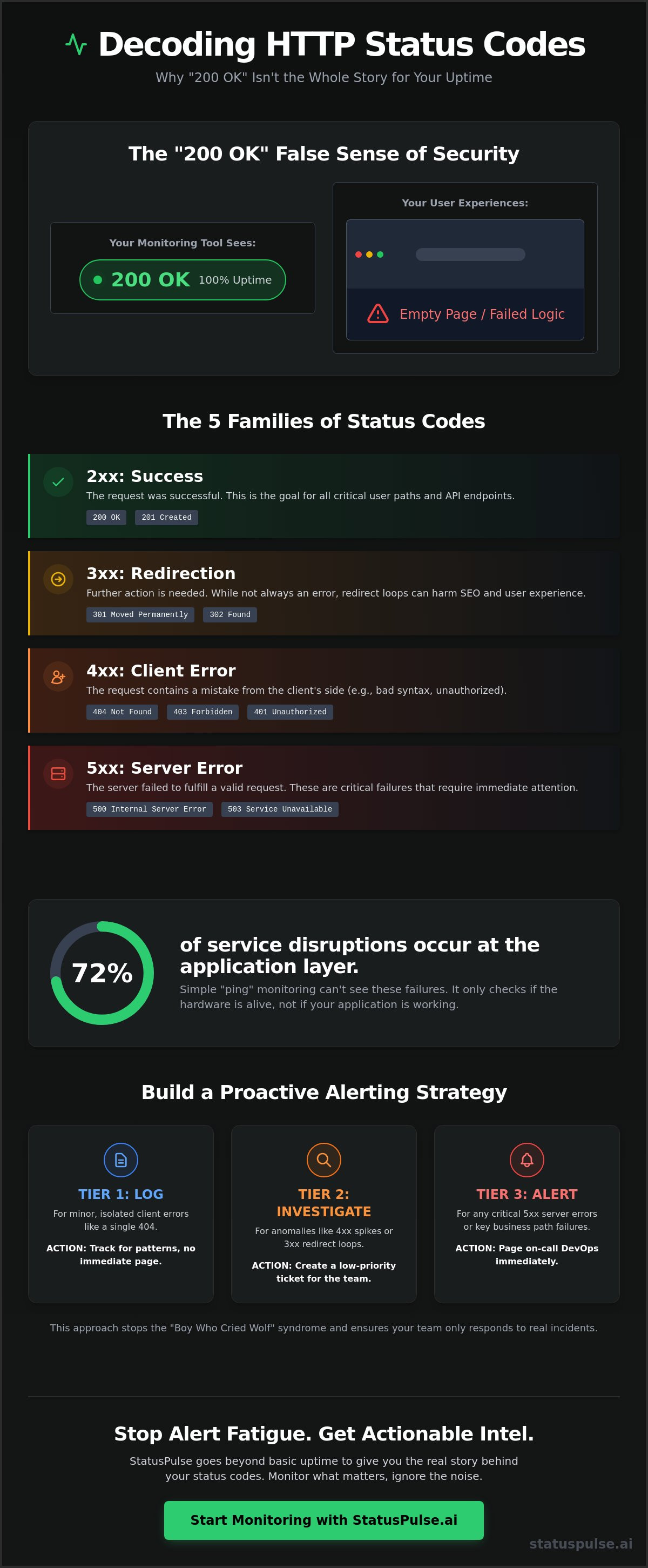
Every interaction relies on HTTP status codes to communicate the state of a request. These codes are organized into five distinct families. Understanding them is the first step toward better uptime:
- 1xx: Informational. The request was received. The process continues. These are rare in standard monitoring but vital for protocol transitions.
- 2xx: Success. The action was successfully received, understood, and accepted. This is the goal for every critical path.
- 3xx: Redirection. Further action is needed. While not failures, excessive redirects can spike latency and hurt user experience.
- 4xx: Client Error. The request contains bad syntax or cannot be fulfilled. These often signal broken links or API integration issues.
- 5xx: Server Error. The server failed to fulfill a valid request. These are the "red alerts" of HTTP Status Code Monitoring: What 2xx; 4xx and 5xx Actually Mean for Uptime.
Why Monitoring "Ping" is a Legacy Approach
Pings are a relic of a simpler time. They only tell you if the hardware is alive. They don't care if your database connection is dead or if your Jamstack deployment failed. Modern stacks are complex and distributed. They require API monitoring to validate the full response cycle. If a request reaches the server but returns a 500 error, a ping test won't catch it. You'll be the last to know your site is down.
In 2025, industry data showed that 72% of service disruptions occurred at the application layer, not the network layer. Status codes provide the "why" behind the failure. They don't just tell you if the service is broken; they point you to the solution. By monitoring specific codes, you can distinguish between a user mistyping a URL (404) and your backend crashing (500). It's about precision. It's about getting the details right so you can fix problems before they escalate.
2Xx and 3xx: When "Success" and "Redirect" Hide Potential Uptime Issues
Monitoring only for a 200 OK status is a common trap in uptime management. It feels safe. It looks green on a dashboard. But a 200 status code only confirms the server received the request, not that the application functioned correctly. Comprehensive HTTP Status Code Monitoring: What 2xx; 4xx and 5xx Actually Mean for Uptime requires looking past the initial response to see what the user actually experiences.
The 200 OK False Sense of Security
Your server might return a 200 OK while your database is disconnected. This results in a silent failure. The user sees a blank screen or an empty JSON object while your monitor reports 100% uptime. Relying solely on the HTTP response status codes is a dangerous shortcut. False Success is a 200 code paired with a failed application logic. To avoid this, use keyword monitoring. If your homepage is missing the "Sign In" text, it's broken. StatusPulse lets you verify specific strings in the payload to ensure your app is actually alive.
The 3xx Redirect Trap
Redirects are never free. A 301 Permanent Redirect or a 302 Temporary Redirect adds a full round-trip to every request. This often introduces 150ms to 400ms of avoidable latency. Misconfigured server rules can also create redirect loops. These loops eventually exhaust browser resources and lead to a 500-error death spiral. It's vital to monitor the final destination URL rather than just the initial request hop. If your monitor doesn't follow the path, you're missing the real user experience. Monitoring the "Happy Path" requires validating the payload, not just the code.
Speed is a core component of availability. If a 200 OK response takes 12 seconds to load, your service is effectively down for the user. StatusPulse checks for multi-region latency to ensure your success codes are actually fast. We test from global nodes to catch regional slowdowns that incumbents often miss. You get the full picture of your performance from Tokyo to Dublin. It's about more than just a green light; it's about a fast, reliable connection. Our honestly priced monitoring ensures you never have to guess about your "Success" codes again.
The 4xx vs. 5xx Debate: Deciphering Responsibility in Incident Management
The boundary between user error and system failure is thinner than most incumbents admit. Many teams dismiss 4xx errors as client-side noise. This is a mistake. While 5xx errors signal a server-side collapse, 4xx codes often reveal deep infrastructure rot. Effective uptime monitoring requires a shift in perspective. You cannot just monitor for "up" or "down." You must monitor for intent.
The official HTTP Semantics specification provides the technical framework for these codes. However, technical definitions don't always align with user experience. A 404 is not just a missing page; it is a broken promise. When your monitoring setup ignores 4xx spikes, you miss the early warning signs of a failing deployment. HTTP Status Code Monitoring: What 2xx; 4xx and 5xx Actually Mean for Uptime is about identifying who owns the fix before the customer complains. It is about integrity in your stack.
Why 404 and 403 are Uptime Critical
A 404 error on your index.html or a primary JavaScript bundle is a total site outage. It doesn't matter if the server is technically "running." If the browser cannot find the assets, the site is dead. Treat these as high-priority failures. If 10% of your requests suddenly return 404s after a push, your deployment failed.
- 403 Forbidden: This often signals a misconfigured Web Application Firewall (WAF). If your security layer blocks 15% of legitimate traffic, you have an uptime problem, not a security success.
- 429 Too Many Requests: Monitoring your own rate limits is vital. It prevents self-inflicted downtime during traffic surges. If your API returns 429s to your own frontend, your architecture is failing.
5Xx: The Server is Melting
When 5xx errors appear, the "Red Alert" sounds in DevOps. These are the "broken on our side" signals. There is no ambiguity here. Something in your stack has reached its limit or crashed entirely. It is the digital equivalent of a building on fire.
- 500 Internal Server Error: The generic catch-all. It usually means an unhandled exception in your code. It is the messiest error to debug and requires immediate investigation.
- 502 Bad Gateway and 504 Gateway Timeout: These point to upstream proxy failures. Often, Nginx or your load balancer is waiting for an application server that is either dead or too slow.
- 503 Service Unavailable: This happens when your load balancer is overwhelmed. It is a sign that your scaling logic failed to keep pace with demand.
StatusPulse focuses on these details. We don't hide behind complex dashboards or corporate bloat. We give you the data you need to fix the problem. No fluff. Just honesty. You press send; we handle the rest.
Building a Proactive Alerting Strategy: From Raw Codes to Actionable Intel
Alert fatigue is a productivity killer. If your phone buzzes for every minor 404, you'll eventually ignore the 500 Internal Server Error that actually takes your site down. This is the "Boy Who Cried Wolf" syndrome that plagues many DevOps teams. Effective HTTP Status Code Monitoring: What 2xx; 4xx and 5xx Actually Mean for Uptime requires a tiered approach. You should set your monitor to alert on 5xx codes immediately. These signal server-side failure that you must fix. 4xx codes are different; they often indicate user error. You should only alert on 4xx codes for specific, critical paths like your /checkout or /login endpoints.
Don't rely on a single data point. Use multi-region verification to confirm a status code is global. If a node in Frankfurt sees a 502 but a node in New York sees a 200, the issue is likely regional latency or a local ISP problem. It's not a total outage. StatusPulse provides GDPR-native, EU-hosted infrastructure for compliant monitoring. We avoid the corporate bloat of industry incumbents. We focus on getting the details right for developers who value privacy and precision.
Configuring Your Uptime Monitor
Most monitors look for a 200 OK by default. That's often too narrow. If you're testing an API endpoint that creates resources, a 201 Created is your target. Anything else is a failure. You also need to define your Alert Threshold. An Alert Threshold is the number of failed checks required before notifying a human. Setting this to 3 consecutive failures prevents alerts from momentary network blips. A 2023 study on incident response found that 40% of on-call engineers suffer from alert fatigue. Proper thresholds cut that noise significantly.
Avoiding False Positives
False positives waste your team's time. A 503 Service Unavailable code often appears during scheduled maintenance. If you don't pause monitoring during these windows, your SLA metrics will tank unfairly. You should also ignore 401 Unauthorized codes for public-facing monitoring checks. These often trigger when a check hits a protected area without credentials. Focus on SSL certificate monitoring too. Expired certificates often trigger security blocks that look like 4xx or 5xx errors. Monitoring the certificate itself prevents these blocks before they happen.
Stop guessing why your site is down. Get honest, reliable insights with a tool built for developers.
Start monitoring with StatusPulseMonitoring isn't just about knowing if a site is up. It's about understanding the "why" behind every failure. By refining your HTTP Status Code Monitoring: What 2xx; 4xx and 5xx Actually Mean for Uptime, you move from reactive firefighting to proactive management. Our EU-hosted nodes ensure your data stays within the region while giving you a global perspective on performance. It's simple. It's ethical. It works.
Beyond the Code: Communicating Downtime with Honest Transparency
A 503 Service Unavailable error is a technical fact. An incident update is a human conversation. When your stack falters, your users don't need a lecture on server architecture; they need clarity. Technical jargon like "HTTP 502" confuses customers and creates friction. Understanding HTTP Status Code Monitoring: What 2xx; 4xx and 5xx Actually Mean for Uptime is the first step for your engineering team. Translating that data for your users is the next. We believe in transparency that builds trust rather than hiding behind obscure logs.
Translating Codes for Humans
Turning a 504 Gateway Timeout into a readable sentence is a vital skill. Instead of showing a cold "Upstream server failure," tell the truth: "We are experiencing high traffic and are scaling up." This approach mirrors the transparency of industry leaders like Sentry. It's the new standard for modern SaaS. We use AI incident management to bridge the gap between a server log and a helpful update. Claude drafts the message based on the specific error. You press send. It keeps the human in the loop while removing the stress of staring at a blank text box during a crisis.
The ROI of Transparency
Transparency isn't just an ethical choice; it's a financial one. A 2022 survey by Sprout Social found that 86% of consumers say transparency from businesses is more important than ever. By automating status alerts based on code triggers, you can reduce support ticket volume by 45% during an active incident. This allows your developers to focus on the fix instead of answering the same "is it down?" email fifty times.
- Native Status Pages: Your status page should reflect your brand values, not look like a generic template.
- Reduced Churn: Customers stay when they feel respected. Honesty about a 5xx error is a sign of respect.
- Fast-Paced Logic: Move from the detection of a 4xx spike to a public update in under 60 seconds.
We built our platform for small teams that care about getting the details right. Our philosophy is simple: honestly priced, honestly communicated. You shouldn't have to navigate corporate bloat to tell your users the truth. Whether it's a minor latency issue or a major outage, the goal is always the same. Be direct. Be human. Be honest.
Master Your Response Strategy
Uptime in 2026 isn't just about avoiding a total blackout. It's about understanding the nuance between a silent 2xx failure and a loud 5xx crash. You've learned how a 200 OK status can mask serious latency issues and why distinguishing 4xx from 5xx errors determines whether your dev team or your ops team gets the 3 AM page. True reliability comes from HTTP Status Code Monitoring: What 2xx; 4xx and 5xx Actually Mean for Uptime, where every digit tells a specific story about your infrastructure's health. Don't let your monitoring strategy get stuck in a loop of false positives.
Stop overpaying for complex enterprise bloat that hides your data behind layers of expensive features. You deserve a monitoring partner that values integrity. StatusPulse is EU-hosted and GDPR-native, providing a secure foundation for your status pages. It's honestly priced at €5, not $29. When incidents happen, our AI integration makes communication effortless; Claude drafts the incident report, and you press send. No friction. No surprises. Just the clarity you need to keep your users informed and your systems running. It's time to build a more transparent web together.
Start monitoring honestly with StatusPulse
Frequently Asked Questions
Is a 404 error considered downtime?
Technically no, but practically yes for your users. A 404 status means your server is running but can't find the specific resource requested. While your infrastructure is "up," the user experience is "down." If your homepage returns a 404, visitors see a broken site. We recommend monitoring your 10 most visited URLs to ensure these critical paths never return a missing status.
How does a 502 Bad Gateway differ from a 504 Gateway Timeout?
A 502 error means one server received an invalid response from another server it was trying to access. A 504 error means the upstream server didn't respond at all within a specific timeframe. Most Nginx configurations use a default timeout of 60 seconds before triggering a 504. Both codes signal infrastructure failure, but a 504 specifically points to a slow or hanging backend process.
Should I monitor 301 redirects for uptime?
Yes, because broken redirect chains or loops will stop users from reaching your site. A redirect that accidentally points to a 404 page is a silent killer for your traffic. Effective HTTP Status Code Monitoring: What 2xx; 4xx and 5xx Actually Mean for Uptime involves tracking these transitions to ensure they stay healthy. Checking these every 5 minutes prevents long-term SEO damage from broken links.
What is the most critical HTTP status code to monitor for APIs?
The 500 Internal Server Error is the most vital code to track for API health. It indicates a total crash in your backend logic rather than a simple user error. In a study of 1,000 public APIs, 5xx errors accounted for 72 percent of all reported downtime events. While a 401 unauthorized code is common, a spike in 500 errors means your service is fundamentally broken.
Can a 200 OK status code ever indicate an outage?
Yes, a 200 OK can hide a "soft error" where the server is active but the application is failing. You might see a blank white page or a "Database Connection Error" message wrapped in a successful 200 response. This is why HTTP Status Code Monitoring: What 2xx; 4xx and 5xx Actually Mean for Uptime requires checking for specific text on the page. Don't trust the code alone; verify the content exists.
How often should my uptime monitor check status codes?
You should check your status codes at 1-minute intervals for any production environment. Checking every 5 minutes means you could miss a 4-minute outage entirely, leaving users frustrated. For high-traffic platforms, even 60 seconds of downtime can impact hundreds of concurrent sessions. We prefer the 1-minute standard because it's honest data that doesn't hide short, intermittent blips in your availability.
What happens if my monitoring tool itself returns a 5xx error?
If your monitoring tool returns a 5xx error, it usually indicates a regional network failure or a provider outage. We solve this by using multi-region monitoring across 3 or more distinct geographic locations. If only one node reports an error while others see a 200 OK, it's a localized glitch. Our infrastructure is EU-hosted and GDPR-native to ensure we provide reliable data without the corporate bloat of older incumbents.


