

What if your "EU-based" monitoring server is actually an open door for US federal data seizures? By 2026, simply picking a region in a cloud console won't satisfy regulators who are focused on the jurisdictional reach of the CLOUD Act. You've likely spent hours wrestling with complex SCC workarounds and privacy impact assessments just to keep a simple status page running. It's a heavy burden for a tool that's supposed to reduce stress. This guide to GDPR-Compliant Uptime Monitoring: Why EU-Hosted Matters in 2026 explains why true data sovereignty now requires a stack that's native to the continent, not just parked there.
We agree that compliance shouldn't feel like a full-time legal job. You deserve a monitoring solution that respects European privacy laws without hidden cookies or corporate bloat. You'll discover why true data sovereignty in 2026 requires more than just EU-based servers for your monitoring stack. We'll show you how to achieve zero-risk compliance and move away from expensive incumbents. We will also preview the shift to EU-native infrastructure that simplifies incident communication while keeping your costs predictable. It's time to trade complex workarounds for honest, reliable monitoring that actually belongs here. Simple infrastructure. No legal headaches.
Key Takeaways
- Stop falling for the "EU region" marketing trap. US-based incumbents cannot protect your data from the CLOUD Act, regardless of where their servers are located.
- True sovereignty requires more than a checkbox. Learn why EU incorporation and zero non-EU sub-processors are the new essential standards for 2026.
- Audit your monitoring stack with a five-step plan. Map your sub-processors to identify hidden legal risks and verify the integrity of your Data Processing Agreement.
- Discover the technical requirements for GDPR-Compliant Uptime Monitoring: Why EU-Hosted Matters in 2026 and how to secure your infrastructure metadata.
- Choose honesty over corporate bloat. Transition to an EU-native, developer-first alternative that offers professional precision for €5 — not $29.
Beyond the Checkbox: Defining GDPR-Compliant Monitoring in 2026
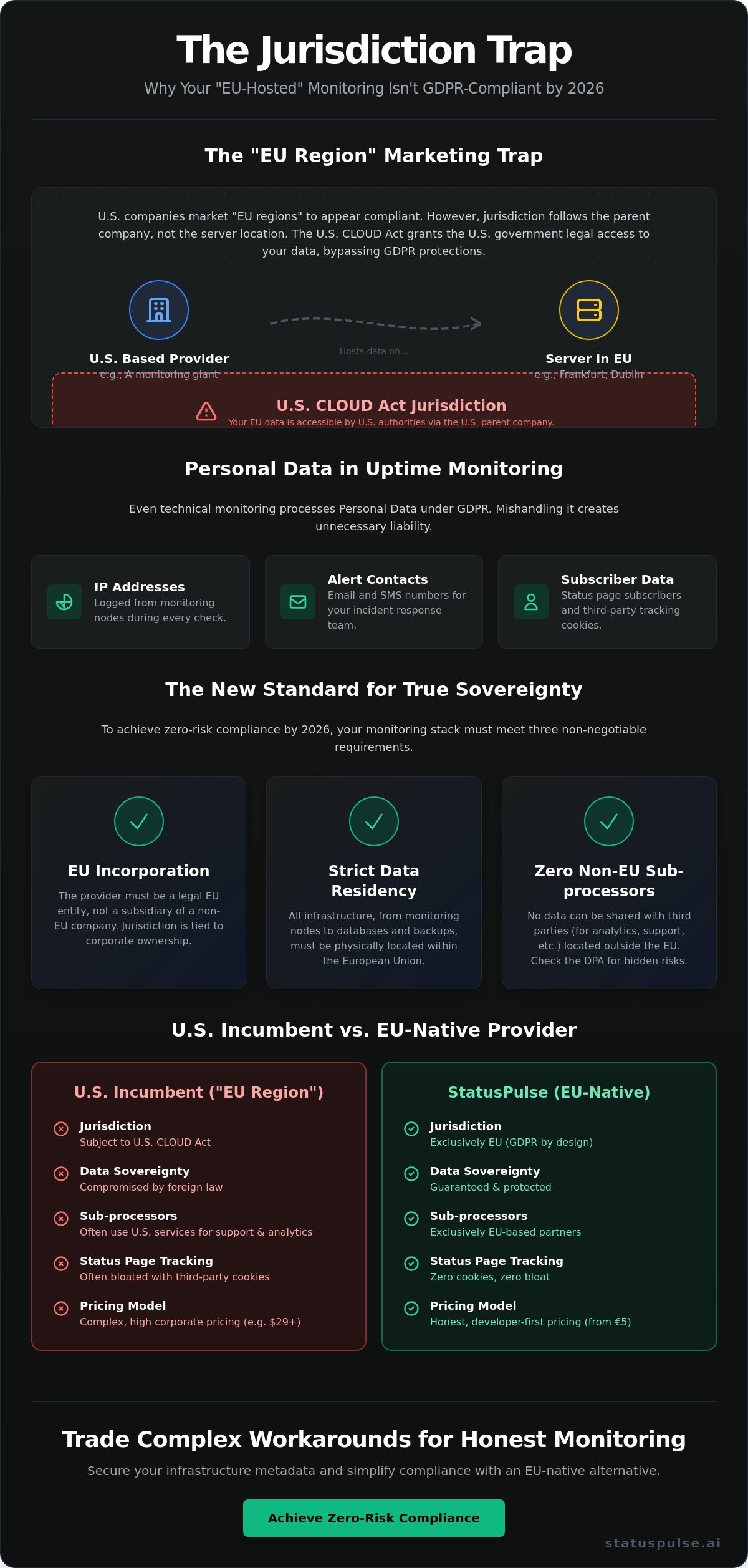
Compliance isn't a static checkbox anymore. In 2026, it's an active jurisdictional requirement that demands constant proof. Many companies still think a signed Data Processing Agreement (DPA) is enough to protect them. It isn't. True compliance requires three specific pillars: strict data residency, EU-incorporation, and zero non-EU sub-processors. If your monitoring provider is a US subsidiary, your data is still subject to the CLOUD Act. This legal reach bypasses the protections of the General Data Protection Regulation (GDPR) and creates a liability trap for your business.
Data Sovereignty has emerged as the primary metric for EU SaaS procurement. It's no longer a "nice to have" feature for legal teams. It's a binary requirement for any serious enterprise. Understanding GDPR-Compliant Uptime Monitoring: Why EU-Hosted Matters in 2026 is about recognizing the shift from "global first" to "regionally secure." We built StatusPulse to address this reality. We don't use US-based sub-processors for core functions. We don't hide data flows in complex cloud architectures. We keep it simple. We keep it in the EU.
The 2026 Regulatory Landscape
Enforcement is faster and more aggressive. European regulators have implemented new 12 to 15 month resolution targets for cross-border data violation cases. They've stopped sending polite warnings. Instead, they now target "shadow" data flows. These are the hidden telemetry streams that many monitoring tools send to US analytics providers without user consent. The shift from simple reprimands to viability-threatening fines is real. In the first quarter of 2026, several high-profile cases proved that even minor technical monitoring leaks can result in penalties that cripple a company's budget.
Personal Data in Uptime Monitoring
Uptime monitoring seems purely technical, but it's fueled by personal data. Every IP address logged during a check is personal data. Every email address in your alert list is personal data. Status page subscriber data is especially sensitive. Many incumbents still clutter their status pages with tracking cookies and third-party scripts. This creates massive, unnecessary liability for your brand. A clean monitoring stack avoids this. It uses minimal data collection. It doesn't track your users. It just monitors your uptime. The goal is simple: less data, less risk.
- IP addresses from monitoring nodes are personal data.
- Email alerts and SMS numbers require strict DPA oversight.
- Third-party tracking on status pages is a compliance failure.
Choosing a partner that understands these nuances is the only way to stay safe. You need a tool built by developers who value privacy as much as performance. No bloat. No surprises. Just honest, compliant monitoring.
The Jurisdiction Trap: Why EU Regions Are Not Enough
Many US monitoring incumbents market "EU regions" to stay relevant. It's a clever mask. They want you to believe that a server in Frankfurt or Dublin equals compliance. It doesn't. Jurisdiction follows the parent company, not the physical hardware. If a US corporation owns the infrastructure, the US government retains legal access to the data. This creates a hidden vulnerability for European firms that prioritize data sovereignty.
Location isn't jurisdiction. Ownership is. When you use a US-based provider, you're subject to US law, regardless of where the data center sits. This reality is the core reason why GDPR-Compliant Uptime Monitoring: Why EU-Hosted Matters in 2026 has become a non-negotiable requirement for 72% of European IT leaders. Relying on "regions" provided by non-EU entities is a high-risk strategy that ignores the extraterritorial reach of American surveillance laws.
The CLOUD Act vs. GDPR
The US CLOUD Act of 2018 changed the game. It compels US service providers to disclose data even if it's stored on foreign soil. A US warrant for data sitting in Berlin creates a legal deadlock because GDPR Article 48 prohibits recognizing foreign judgments unless a specific international agreement exists. This conflict leaves businesses caught in the middle of a jurisdictional tug-of-war. The legacy of the "Schrems II" ruling from July 16, 2020, continues to haunt these setups. By 2026, Standard Contractual Clauses (SCCs) are under heavier scrutiny than ever. They often fail to provide the "essential equivalence" required by EU data protection legislation when FISA 702 is involved.
The Problem with US-Owned Sub-processors
If your uptime monitor uses AWS, Google Cloud, or Azure, it's not truly sovereign. These are US-owned sub-processors. Even if the service is "EU-hosted," the underlying infrastructure stack remains under US control. This creates a "backdoor" by design. There's a fundamental difference between being EU-hosted and being EU-native. A native stack is owned and operated by an EU-incorporated entity, keeping the data entirely outside the reach of the CLOUD Act.
StatusPulse prioritizes a native EU stack to avoid these jurisdictional traps. We don't just rent space from American giants. We build on regional infrastructure that respects your borders. It's a cleaner way to work. If you're ready to move beyond the jurisdiction trap, you can start monitoring with a native EU partner today. We believe in GDPR-Compliant Uptime Monitoring: Why EU-Hosted Matters in 2026 because your data shouldn't be a pawn in international legal disputes. Our approach is simple, honest, and strictly European.
Evaluating the Sovereign Monitoring Stack: Uptime, SSL, and API
Monitoring isn't just a heartbeat check; it's a matter of data sovereignty. Every HTTP request sent to your server carries metadata. If those checks originate from US-based data centers, you're exporting infrastructure signatures across the Atlantic. In 2026, GDPR-Compliant Uptime Monitoring: Why EU-Hosted Matters in 2026 is the difference between a secure stack and a compliance liability. Localized monitoring eliminates the 100ms latency penalty inherent in trans-Atlantic pings, providing a true reflection of your EU users' experience.
SSL monitoring follows the same logic. Tracking certificate health is vital for preventing "Connection Not Private" errors. However, exposing your handshake metadata to non-EU entities introduces unnecessary risk. A sovereign stack keeps this information within the Union, ensuring your security posture remains airtight. For API monitoring, synthetic checks must respect data residency at every hop. If a monitoring agent triggers a workflow that touches personal data, that data must stay within EU borders. It's about protecting the entire path, not just the endpoint.
Reliability Primitives for EU Dev Teams
EU-based developers need precision without the legal baggage of complex data transfer agreements. Multi-region monitoring within Europe, specifically using nodes in Frankfurt, Paris, and Amsterdam, ensures high availability and low noise. Automated SSL and domain expiry checks act as a final safety net. These tools prevent outages before they happen. For a deeper technical dive into maintaining uptime, see API Monitoring: The Developer’s Guide.
- Low Latency: Checks from EU nodes reflect real user conditions.
- Data Integrity: Infrastructure metadata never leaves the jurisdiction.
- Keyword Verification: Ensure your app isn't just "up" but actually serving the right content.
The Role of AI in Compliant Incident Communication
Incident management is inherently stressful. AI can help, but it shouldn't be a black box that operates without oversight. The StatusPulse approach is built on human agency. AI drafts the incident update to save you time during a crisis, but you remain the controller. You review the draft. You press send. This maintains the honest communication style your users expect without the risk of AI hallucination in public updates.
Using EU-hosted LLM endpoints is non-negotiable for compliance. It prevents "Shadow AI" risks where sensitive incident summaries are used to train models in the US. By keeping the entire pipeline within the EU, you ensure that your internal post-mortems and external updates remain private. It's a principled way to use modern tech. No surprises. Just reliable, GDPR-Compliant Uptime Monitoring: Why EU-Hosted Matters in 2026.
Transitioning to a Sovereign Stack: A 5-Step Audit
Moving to a sovereign stack is a strategic pivot. It requires a rigorous look at every link in your data chain. Start by mapping your sub-processors. If your monitoring provider relies on US-owned infrastructure, the 2018 US Cloud Act gives US authorities potential access to that data. This legal reach is why GDPR-Compliant Uptime Monitoring: Why EU-Hosted Matters in 2026 is now a top priority for European DevOps teams.
Follow this 5-step audit to secure your stack:
- Map sub-processors: Identify every US-owned entity in your monitoring chain. Jurisdiction follows the parent company, not just the data center location.
- Review DPAs: Check for a heavy reliance on "standard contractual clauses" (SCCs). These are often legally fragile without additional technical measures like localized encryption.
- Analyze costs: Compare the real cost of compliance. An average legal review of a complex US-based DPA can take 3 to 5 billable hours. Compare this to the straightforward, native compliance of an EU provider.
- Test modern architecture: Ensure 1-minute uptime checks work flawlessly with Jamstack and edge-heavy setups. Your monitor needs to verify these endpoints without triggering false positives.
- Privacy-first status: Deploy cookie-free public status pages. Studies show that 65 percent of users feel frustrated by constant cookie prompts. Removing them eliminates consent banner fatigue.
Auditing Your Current Monitor
Transparency is a binary state. If your current monitor requires a sales call to provide a DPA, it's a major red flag. Ethical providers make these documents available for download immediately. You should also audit your public status page for hidden trackers. Many industry incumbents bundle Google Analytics or tracking pixels into your public pages. This forces a consent banner on your users during a server crisis. Verify the root jurisdiction of the company. A server in Frankfurt provides no protection if the parent company is headquartered in the United States.
Migration Without Downtime
Switching your monitoring shouldn't create blind spots. Run your new EU-hosted monitor in parallel with your old system for at least 14 days. This overlap allows you to verify consistency and fine-tune alert thresholds. Export your historical uptime data in CSV or JSON format to preserve your reliability record for stakeholder reporting. This transition is a key step in achieving GDPR-Compliant Uptime Monitoring: Why EU-Hosted Matters in 2026. For a deeper dive into technical setups and honest communication, read this Uptime Monitoring: A Developer’s Guide. This guide helps you navigate the transition while maintaining high availability. Honest communication with your users starts with a clean, documented migration process.
StatusPulse: The Honestly Priced, EU-Native Alternative
We built StatusPulse because the status quo in server monitoring felt broken. Most tools are built by massive corporations for other massive corporations. They prioritize growth over privacy. We take a different path. StatusPulse is built by developers for developers who value ethics as much as uptime. We don't just host in Europe; we are incorporated here. This means your data never leaves the jurisdiction of the CJEU. It is the only way to ensure true GDPR-Compliant Uptime Monitoring: Why EU-Hosted Matters in 2026.
Our infrastructure is native to the EU. We don't use US-based sub-processors that complicate your compliance audits. Every byte of monitoring data stays on European soil. This setup eliminates the legal grey areas created by shifting transatlantic agreements. You get a tool that respects your sovereignty and your users' privacy by design. We believe that regional compliance is a core virtue, not a marketing afterthought.
Four Plans. No Surprises.
Transparent pricing shouldn't be a luxury. We rebel against the complex, per-seat pricing models used by industry incumbents. They often start low and then hit you with compliance surcharges or "enterprise" tiers. We don't do that. Our entry point is €5, not $29. It is a fair price for a powerful tool. We provide four clear plans that scale with your team, not your compliance risk. You get professional-grade monitoring without the corporate bloat.
- 1-minute checks: We monitor your endpoints every 60 seconds to catch downtime before your customers do.
- SSL monitoring: You receive alerts before certificates expire, preventing avoidable outages.
- Jamstack support: Our platform is optimized for modern web architectures, ensuring your static sites and APIs remain performant.
We have stripped away the unnecessary filler. You won't find 50-page contracts or aggressive sales calls here. You get high-level technical precision without the price gouging. It is a straightforward approach for teams that want to focus on their code rather than their vendor relationships.
Honest Communication as a Competitive Edge
Transparency builds trust. When your services go down, how you communicate matters more than the outage itself. StatusPulse provides public status pages that are completely free of third-party tracking baggage. Your users see your status, not a dozen marketing cookies. It's a cleaner, more ethical way to manage incidents. By stripping away the tracking, you show your customers that you value their privacy even during a crisis.
Our incident management uses AI to save you time without taking away your control. Claude drafts the incident update, and then you press send. This ensures human agency remains at the center of your communication strategy. You get the efficiency of AI with the nuance of a human touch. It is about working smarter, not just faster. You can join the EU-native movement today at statuspulse.ai and experience monitoring that respects your values and your budget.
Secure Your Infrastructure for the 2026 Compliance Shift
The era of checkbox compliance is over. Relying on US-based incumbents who merely offer EU regions creates a jurisdiction trap. It leaves your data vulnerable to the US CLOUD Act. By 2026, technical sovereignty will be the standard for every serious European enterprise. Transitioning to a sovereign stack isn't just about avoiding legal friction. It's about reclaiming control over your uptime, SSL, and API data. A 5-step audit is the first move toward total transparency.
Choosing GDPR-Compliant Uptime Monitoring: Why EU-Hosted Matters in 2026 means prioritizing integrity over corporate convenience. StatusPulse provides a refreshing alternative. EU-native infrastructure. GDPR-compliant AI. No US CLOUD Act risk. We've stripped away the bloat and the hidden risks. You get professional authority without the hyperbolic marketing. Our system is built by a team that cares about the details. This ensures your monitoring is as resilient as your reputation.
Start monitoring honestly for €5/month at StatusPulse.ai
Take the first step toward a simpler, more ethical monitoring strategy today. It's time to monitor with confidence.
Frequently Asked Questions
Is UptimeRobot GDPR compliant in 2026?
UptimeRobot is a US-based entity, which complicates full compliance under the current Schrems II framework. While they provide a Data Processing Agreement, their primary operations and data storage often involve US infrastructure. For businesses requiring strict GDPR-Compliant Uptime Monitoring: Why EU-Hosted Matters in 2026, relying on US-owned incumbents introduces a layer of legal risk that a contract alone cannot fix.
Does the US CLOUD Act affect my monitoring data stored in the EU?
Yes, the US CLOUD Act grants US authorities the power to request data from any US-headquartered company, regardless of where the physical servers are located. If your provider is a US corporation with a data center in Frankfurt, they must still comply with US warrants. Only an EU-native provider, owned and operated within Europe, can legally shield your data from these specific foreign requests.
What is the difference between EU-hosted and EU-native monitoring?
EU-hosted simply means the servers are located in Europe, even if the parent company is American. EU-native means the company is headquartered, owned, and governed by European laws. This distinction is critical for GDPR-Compliant Uptime Monitoring: Why EU-Hosted Matters in 2026. A native provider ensures that both the physical hardware and the corporate entity remain outside the reach of the US CLOUD Act.
Does uptime monitoring data count as "personal data" under GDPR?
Yes, IP addresses and technician contact details are classified as personal data under GDPR Article 4. Every time a monitor checks your site, it logs metadata that can identify individuals. Your status page also captures the IP addresses of every visitor. Because this data is identifiable, it must be stored and processed according to strict European privacy standards to avoid heavy fines.
Can I use a US-based status page if I have an EU DPA?
You can, but it creates a significant compliance gap during audits. A Data Processing Agreement is a legal document, but it doesn't change the fact that an EU citizen's IP address is being exported to the US the moment they load your page. Regulators in 2026 increasingly view these "data exports" as non-compliant if a local, safer alternative exists within the European Union.
Is there a GDPR-compliant monitoring tool with a free tier?
Several EU-native providers offer free tiers that prioritize privacy. These tools give you basic HTTP checks and a public status page without using tracking scripts or selling your data. We believe privacy shouldn't be a premium feature. You'll find that European alternatives often provide more honest limits than the big incumbents because they don't carry the same corporate bloat.
How does AI incident management stay compliant with GDPR?
Compliance depends on where the AI processing happens and whether the data is used for training. We use a human-controlled system. Claude drafts your incident updates, but you press send. No personal data from your logs is used to train public models. By keeping AI processing within secure, EU-compliant environments, we ensure your incident reports stay private and professional.
Why should I avoid cookie-based status pages?
Cookies on a status page are a liability that requires a consent banner. When your site is down, the last thing your users want is a pop-up asking for tracking permission. We use cookie-free monitoring to ensure 100% privacy and instant access. It's a cleaner approach that respects your users' time and avoids the legal headache of managing cookie consent during a technical crisis.


