

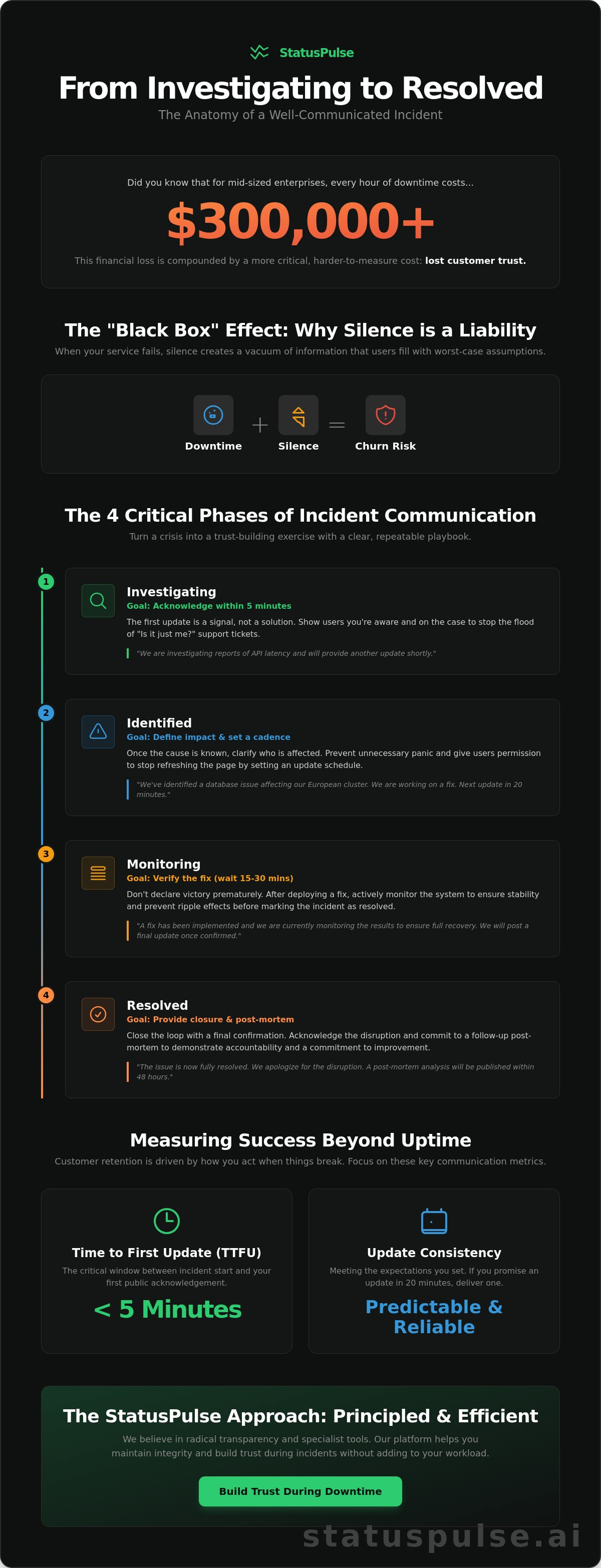
Did you know that 91% of mid-sized enterprises lose at least $300,000 for every single hour of downtime? When the dashboard turns red, the instinct is often to go silent and focus entirely on the code. But silence isn't a strategy; it's a liability. You likely feel the pressure of high-stress repairs while worrying that one wrong word on your status page will trigger a wave of customer churn. This is why mastering the protocol in From Investigating to Resolved: The Anatomy of a Well-Communicated Incident is critical for your survival. With SEC regulations now requiring material incident disclosure within four business days, your communication is a core business risk.
We agree that technical disruptions are inevitable, but losing your customers' trust doesn't have to be. You will learn how to use transparent communication to maintain authority during a crisis. We're moving past corporate fluff to provide a grounded, ethical approach to incident management. You will gain a repeatable playbook designed to reduce support ticket volume and prove your reliability. We explore the specific phases of a well-handled outage, from the first "Investigating" post to the final "Resolved" update.
Key Takeaways
- Identify the psychological "black box" effect and why technical teams must prioritize transparency over silence during high-stress repairs.
- Navigate the four critical communication milestones detailed in From Investigating to Resolved: The Anatomy of a Well-Communicated Incident to maintain customer authority.
- Deploy AI incident management as an efficient assistant to reduce engineer cognitive load without losing human integrity in your updates.
- Track the metrics that actually impact customer retention, including Time to First Update (TTFU) and update consistency.
- Streamline your response using public status pages that prioritize clarity and ethics over complex, bloated enterprise features.
The Psychology of Downtime: Why Silence is Your Most Expensive Mistake
Silence is a choice. During a technical disruption, it is usually the wrong one. When your API or dashboard goes dark, your users enter a psychological state known as the "Black Box" effect. Without information, they assume the worst. They assume you don't know there's a problem. Or worse, they assume you don't care. This vacuum of information breeds frustration. Frustration leads directly to churn. You aren't just losing uptime; you are losing the trust you worked months to build.
Technical teams often default to silence during high-stress incidents. The logic seems sound. Every minute spent writing a status update is a minute not spent fixing the bug. This is a tactical error. While you fix the code, your brand equity is evaporating. Modern incident management requires a dual-track approach. One track handles the repair. The other track handles the relationship. If you ignore the relationship, the repair won't matter because the customer will already be gone.
Transparency acts as an insurance policy for your Service Level Agreements (SLAs). When you are honest about a failure, customers are more likely to grant you the grace needed to resolve it. It's the difference between being a faceless corporation and a principled team. Mastering the transitions in From Investigating to Resolved: The Anatomy of a Well-Communicated Incident turns a crisis into a trust-building exercise. Honesty buys you time. Silence costs you money.
The Nervous Customer: A Profile
Users feel vulnerable when their tools fail. Their work stops. Their deadlines loom. This creates a spike in cortisol. A proactive update on your status page tells them they aren't alone. It prevents the "Is it just me?" support ticket surge. You save your support team from being buried. You build a foundation of trust before the next outage even occurs. Reliability isn't just about 100% uptime. It's about how you act when things break.
The Ethics of Uptime
We believe in radical, principled transparency. Corporate obfuscation is a relic of the past. Faceless incumbents use vague language to hide behind their 99.9% guarantees. We suggest a different path. Honesty is a more effective retention strategy than any marketing spin. By positioning your team as specialists who value truth, you differentiate yourself from the bloat. Tools like StatusPulse help you maintain this integrity without adding to your workload. Truth is the most efficient protocol.
The 4 Phases of Incident Communication: A Timeline
The clock starts the moment a service fails. You have exactly five minutes to acknowledge the issue before users lose patience. This timeline is the core of From Investigating to Resolved: The Anatomy of a Well-Communicated Incident. It moves through four distinct stages: Investigating, Identified, Monitoring, and Resolved. Each phase requires a different level of detail and a specific emotional tone. Efficiency here isn't just about speed. It's about clarity.
Phase 1 & 2: Acknowledgment and Scope
When a disruption begins, you rarely have all the answers. That’s okay. The first update isn't about the solution; it's about the signal. You need to tell users that you are looking. A simple "We are investigating reports of API latency" is enough. It stops the flood of support tickets immediately. During this stage, understanding the psychology of a crisis is vital. People process information differently when they are stressed. They need short, frequent, and honest updates.
Once you identify the cause, move to the Identified phase. Here, you define the impact. Is it a total outage or a minor slowdown? Tell them exactly who is affected. If only your European cluster is down, say so. This prevents unnecessary panic for your North American users. Most importantly, set a cadence. Tell them when to expect the next update. "Next update in 20 minutes" gives the user permission to stop refreshing the page. It creates a sense of controlled urgency.
Phase 3 & 4: Verification and Closure
The Monitoring phase is where many teams stumble. You've pushed a fix. The dashboard looks green. The instinct is to mark it "Resolved" and walk away. Don't. This is the "Monitoring" trap. Systems are complex. A fix in one area might cause a ripple elsewhere. Stay in the Monitoring phase for at least 15 to 30 minutes. Use uptime monitoring to verify the fix across different regions before you announce a full recovery. This protects your integrity.
The final phase is the Resolved notice. This is the handshake. It should summarize the fix without getting lost in technical jargon. You don't need to explain every line of code. Just state what happened and what you did to prevent it from happening again. This closure restores confidence. It proves you are a principled team that values precision. For a more streamlined experience, using a tool like StatusPulse can automate these transitions, keeping your users informed while you focus on the repair.
Drafting Updates: AI Efficiency vs. Human Integrity
In 2026, AI is a standard tool for technical teams. It isn't a replacement for human judgment. We view AI as an assistant, not the author. Large enterprise platforms often promise full automation. They claim AI can draft your entire incident report without a second thought. We disagree. Automating public communication entirely risks "hallucinations" and a loss of human agency. Maintaining integrity in From Investigating to Resolved: The Anatomy of a Well-Communicated Incident requires a human in the loop. You need a specialist to verify the truth before it hits your status page.
AI's real value lies in reducing cognitive load. During a high-stress repair, your engineers shouldn't be struggling with prose. AI can sift through logs, find the signal in the noise, and suggest a starting point. This allows your team to stay focused on the fix while ensuring the outside world isn't left in the dark. Following incident management communication best practices means using technology to enhance, not replace, your ethical commitment to transparency.
Using AI to Summarize Technical Logs
AI can ingest thousands of lines of raw error data and identify the root cause in seconds. It can transform a 503 Service Unavailable error on a specific cluster into a readable summary. This isn't about hiding the truth. It's about translating technical reality into customer impact. Efficient prompt engineering ensures these updates remain honest and grounded. Check our guide on AI incident management to see how we assist engineers without taking away their control.
The Anatomy of a Perfect Update Message
Specific technical nouns build more trust than generic adjectives. Don't say "performance is degraded." Say "API response times have increased to 2.5 seconds." This precision proves you understand the problem. We use the "One Sentence Rule" for status titles: if you can't explain the status in one sentence, you don't understand the scope yet. Avoid corporate-speak. Keep updates punchy and declarative. Use the comparison below to guide your next post.
| Vague Corporate Update | Transparent Technical Update |
|---|---|
| We are experiencing intermittent connectivity issues. | Database connection pool is exhausted in the US-East cluster. |
| Our team is working on a resolution. | We are scaling the web tier to handle a sudden traffic spike. |
| Service will be restored soon. | The fix is being deployed. Expected recovery is 15 minutes. |
Integrity is your most valuable asset. Use AI to move faster, but let a human provide the final handshake. This balance keeps your communication efficient and your customers' trust intact.
Measuring Success Beyond the Uptime Percentage
Uptime is a vanity metric for communication teams. A system can technically meet its 99.9% availability goal while still alienating every single user during the 0.1% it is down. We measure success by how well you bridge the information gap. This is the core philosophy of From Investigating to Resolved: The Anatomy of a Well-Communicated Incident. Success isn't just a green checkmark. It is a customer who feels informed and respected.
Time to First Update (TTFU) is the king of communication metrics. It is the only number your users care about when their workflow stops. If your TTFU exceeds ten minutes, you are already losing the room. You also need to track Update Consistency. This is the delta between when you promised an update and when you actually posted it. If you promise a report in 20 minutes, deliver it in 19. Precision here is the exact measure of your reliability. It proves you are in control of the situation.
There is a clear financial ROI to this approach. Support ticket deflection is your primary cost-saving metric. Every user who finds an answer on your status page is one fewer person opening a high-priority ticket. This keeps your support team from being overwhelmed during a crisis. Finally, we look at Post-Incident Sentiment. Trust shouldn't just return to baseline after a fix. If handled with radical transparency, your reputation can actually improve. You proved that you don't hide when things get difficult.
The Post-Mortem: Closing the Loop
Every major incident requires a public post-mortem. This is where you move from repair to education. We believe in a blameless culture. Focus on the system vulnerabilities, not the individual who pushed the commit. Use API monitoring data as the objective evidence for your report. Show the logs and explain the architectural changes you've made. Honesty is your best retention tool.
Communication Cadence Best Practices
Standardize your intervals based on severity. Critical outages require updates every 15 to 30 minutes. Minor latencies might only need them every hour. If a disruption is material, move beyond the status page. Use direct email or SMS alerts for your most affected users. Be wary of "Zombie Incidents" that seem resolved but return within the hour. Keep your monitoring active until the data is stable for at least one full cycle.
Stop guessing how your customers feel during an outage. Build a Public Status Page that prioritizes transparency and starts measuring your real impact today.
The StatusPulse Approach: Principled Tools for Specialists
StatusPulse isn't just another SaaS product. It's a rebellion against corporate bloat. We watched established players build complex, expensive platforms that prioritize enterprise feature-lists over user experience. We chose a different path. We built a tool for specialists who value precision and ethics. Our platform integrates native uptime monitoring with AI-assisted communication in a single, streamlined dashboard. You don't need a dozen integrations to tell your customers the truth.
This approach is the practical implementation of From Investigating to Resolved: The Anatomy of a Well-Communicated Incident. We believe that privacy isn't a marketing afterthought. That's why we use EU-based hosting. It ensures your data remains under strict regulatory standards. We also believe in transparent pricing that respects your intelligence. No hidden tiers or complex cost functions. Just a principled tool for a focused team that values integrity over flashiness.
Our architecture is designed to reduce the stress associated with technical disruptions. By combining monitoring and communication, we eliminate the context switching that slows down response teams. You get a grounded, reliable system that works as hard as you do. We don't hide behind corporate obfuscation. We provide the tools you need to be radically transparent with your users, even when things go wrong.
Automating the Boring Parts
Efficiency is the goal. StatusPulse detects failures through our native uptime monitoring before your users even notice a delay. When an incident occurs, our AI incident management tools help you draft your first update in seconds. These tools act as assistants. They suggest the prose while you maintain final human agency over the message. We support Markdown for all updates. This allows you to create clean, declarative communication that looks professional and remains easy to read. You stay in control of the narrative while the technology handles the heavy lifting.
Your Status Page is Your Brand
Your status page is a reflection of your brand's integrity. It's where you prove your commitment to transparency. We provide a reliable, simple interface that reduces the stress of outages for both you and your customers. A clean layout suggests a controlled, professional response. By stripping away unnecessary filler, you show your users that you value their time. You aren't just fixing a bug; you are preserving a relationship. Reliability shouldn't be complicated. It should be a standard. Launch your honest status page today and see how principled tools change your incident response.
Turn Every Incident into an Opportunity for Trust
Technical disruptions are inevitable. Your response to them shouldn't be a gamble. Silence during an outage is a liability that costs thousands per minute. By following the roadmap in From Investigating to Resolved: The Anatomy of a Well-Communicated Incident, you move from reactive chaos to controlled transparency. You've seen how a strict timeline, human-led AI drafting, and communication-focused metrics protect your brand equity. Reliability isn't just about code; it's about the handshake you offer your customers when things break.
We built StatusPulse to replace corporate bloat with principled efficiency. You get native monitoring and AI-powered drafting in one streamlined dashboard. We prioritize your privacy with EU-hosted standards and your budget with honest pricing. It's time to stop hiding behind vague status updates and start building a culture of radical honesty. Your customers will thank you for the clarity.
Build transparency with StatusPulse
Frequently Asked Questions
What is the most important thing to include in an initial incident update?
Acknowledgment is the primary goal. You need to tell users that you know there's a problem and you're looking into it. Don't wait for a solution. A simple signal stops the panic. Include a clear status like "Investigating" and promise a time for the next update. This transparency is the first step in From Investigating to Resolved: The Anatomy of a Well-Communicated Incident.
How often should I update my status page during a long outage?
Update intervals depend on severity. For critical outages, post every 15 to 30 minutes. Even if there's no new technical progress, tell them you're still working. For minor issues or latency, hourly updates are usually sufficient. Consistency is the metric that matters most. If you promise an update in 20 minutes, deliver it in 19. This builds a foundation of reliability.
Should I use AI to write my incident reports?
AI should be your assistant, not your author. Use AI incident management tools to summarize complex technical logs or draft initial prose. This reduces the cognitive load on your engineers during high-stress repairs. However, a human specialist must always provide the final handshake. Never automate public communication entirely. It risks technical hallucinations and damages the trust you've built with your audience.
How do I handle a "partial outage" on my status page?
Specificity is the protocol for partial outages. Don't use vague language that scares everyone. Define exactly which cluster, region, or API endpoint is affected. If only your European users see latency, state that clearly. This prevents unnecessary support tickets from users in other regions. Transparent reporting on specific components proves you have a deep understanding of your own architecture.
Is it better to have a public or private status page?
Public status pages are the ethical choice for most SaaS teams. They act as a badge of transparency and an insurance policy for your trust. A public page reduces support volume by giving users a central place for answers. Private pages are only necessary for internal infrastructure or highly sensitive proprietary services. For customer-facing tools, radical honesty is a more effective retention strategy than hiding behind a login.
What metrics should I track for incident communication?
Track Time to First Update (TTFU) and Update Consistency. TTFU measures how quickly you acknowledge a failure. Consistency measures the delta between your promised and actual update times. These communication-specific metrics are more important for customer retention than simple uptime percentages. They prove you are in control of the situation. Monitoring these values is a core part of From Investigating to Resolved: The Anatomy of a Well-Communicated Incident.
How can I reduce support tickets during a service disruption?
Proactive communication is the most efficient tool for ticket deflection. Post to your status page the moment your uptime monitoring detects a failure. Use direct alerts like SMS or email for material incidents. When users see an official acknowledgment, they don't feel the need to open a ticket. This keeps your support team focused on helping people rather than answering the same "is it down?" question repeatedly.
What should be included in a blameless post-mortem?
Focus on systems, not individuals. A blameless post-mortem identifies the architectural vulnerabilities that allowed the failure to occur. Include a timeline of events, the root cause, and the specific steps you're taking to prevent a recurrence. Use objective data from your API monitoring to back up your claims. This grounded approach turns a technical failure into an educational opportunity for your team and your customers.


