
What if the most honest status update you ever send is actually drafted by an AI? You know the pressure of the coordination tax during a critical outage. Your engineers are busy fixing the Jamstack, yet the status page remains empty because of writer's block. Using AI to Draft Incident Updates: Benefits; Risks and Guardrails is now a core skill for teams that value transparency. Organizations combining AIOps and observability have already seen a 50% reduction in mean time to repair. It's not about replacing your voice. It's about getting the first draft ready in seconds so you can focus on the fix.
We agree that the fear of AI hallucinations is real. You can't afford a technical report that invents facts while your users are frustrated. This article promises to show you how to maintain the balance of speed and accuracy without losing human trust. We'll preview the essential safety measures for the August 2, 2026, EU AI Act and the Colorado AI Act. You'll learn how to build a workflow where the AI handles the heavy lifting and you stay in total control. No corporate bloat. Just clear, consistent communication.
Key Takeaways
- Turn technical logs into readable updates in seconds. Draft faster. Fix sooner.
- Master the core mechanics of Using AI to Draft Incident Updates: Benefits; Risks and Guardrails to maintain a professional tone.
- Avoid "hallucinations" and robotic phrasing. Keep your incident communication human, honest, and grounded in reality.
- Establish non-negotiable guardrails. Ensure every AI-generated update passes a human sanity check before it goes live.
- Slash support ticket volume during outages. Proactive, clear updates mean fewer "Is it down?" emails in your inbox.
What is AI-Assisted Incident Communication?
Incident communication used to be the bottleneck of every DevOps workflow. An engineer finds a bug; the support team waits for a summary; the customers wait for an answer. By May 2026, this lag is no longer acceptable. AI-assisted communication uses Large Language Models (LLMs) to bridge the gap between technical reality and customer expectations. It turns raw system logs into human-readable drafts instantly. It's the difference between staring at a blank screen during a crisis and simply reviewing a pre-written update. We call this the shift from manual drafting to the "Automated Incident Summary" era.
There is a vital distinction between autonomous AI and assisted drafting. Fully autonomous systems can be dangerous. They might misinterpret a latency spike or hallucinate a fix that hasn't happened yet. Using AI to Draft Incident Updates: Benefits; Risks and Guardrails focuses on the "human-in-the-loop" model. You get the speed of a machine with the judgment of a human. The AI handles the heavy lifting of technical translation. You provide the final check. You press send. This approach respects your time and your customers' intelligence.
The Role of LLMs in DevOps Workflows
Complexity shouldn't lead to confusion. When a multi-region outage hits, your logs are a mess of JSON and error codes. LLMs act as a professional translator. They take that technical noise and produce a clear narrative for non-technical stakeholders. This keeps your status page and Slack channels aligned. It ensures your team speaks with one voice. You should always ground these workflows in AI safety principles to ensure the model doesn't overstep its bounds. It's about turning a "server 404" into a reassuring message that you're investigating connectivity issues.
Why Speed Matters in Incident Transparency
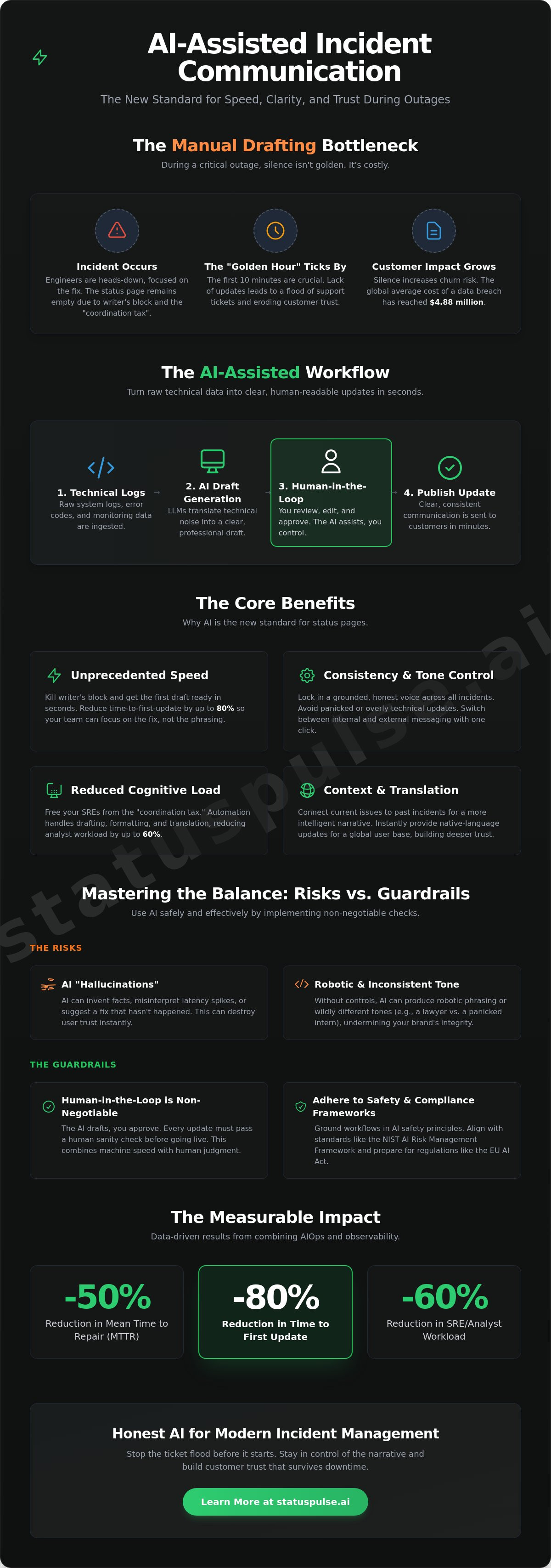
The first 10 minutes of an outage are the "Golden Hour." If you stay silent, users assume the worst. Support tickets start flooding in, and customer churn follows. The global average cost of a data breach has reached $4.88 million; silence only makes those losses grow. Fast communication builds a foundation of trust that survives downtime. AI reduces time-to-first-update by up to 80%. By hitting that 10-minute window, you reduce the "coordination tax" that exhausts your engineering team. You stop the ticket flood before it starts. You stay in control of the narrative.
The Core Benefits: Why AI is the New Standard for Status Pages
High pressure outages often lead to silence. Silence leads to customer churn. When your Jamstack site goes down, your engineers are busy debugging, not writing. By Using AI to Draft Incident Updates: Benefits; Risks and Guardrails become clear as soon as your first update goes out in under two minutes. It kills writer's block instantly. Your developers don't have to be poets. They just need to be developers. The AI handles the heavy lifting of drafting, so your team can focus on the fix.
AI doesn't just write; it translates. For companies with a global footprint, sending a native-language update to a user in Tokyo while the team is in Berlin is a massive advantage. It happens in seconds. It also looks back at your history. It can connect current latency to a previous multi-region database migration from April 2026. It builds a narrative that shows you're learning from past mistakes. This context builds a foundation of trust that survives even the toughest downtime.
Consistency and Tone Control
Incumbents often leave tone to chance. One engineer sounds like a lawyer. Another sounds like a panicked intern. StatusPulse uses AI to lock in a grounded, honest voice. It avoids the blame game. You won't see vague finger-pointing at "third-party upstream providers." Instead, you get the facts. You can switch between technical summaries for internal Slack and customer-facing updates with one click. This level of control aligns with the NIST AI Risk Management Framework, which emphasizes risk-aware communication. It ensures that even in a crisis, your integrity remains intact. Claude drafts. You press send.
Reducing Cognitive Load for SREs
SREs are already taxed by the coordination tax. They shouldn't have to worry about formatting timestamps or status changes during a critical failure. By integrating with uptime monitoring, the AI sees the raw data first. It drafts the update based on real-time latency and error rates. The true value of Using AI to Draft Incident Updates: Benefits; Risks and Guardrails lies in returning time to your developers. This reduces analyst workload by up to 60%. It allows your best people to focus on the code. If you're tired of corporate bloat and complex pricing, setting up a simple status page can transform how your team handles the next incident.
Navigating the Risks: Hallucinations and the 'Robot' Problem
Efficiency shouldn't come at the cost of the truth. While AI-assisted drafting is incredibly fast, it's prone to "hallucinations." These are situations where the model confidently invents technical details that simply don't exist. Using AI to Draft Incident Updates: Benefits; Risks and Guardrails requires a deep understanding that LLMs are prediction engines, not truth engines. If your Jamstack site is down because of a specific API latency issue, an unguided AI might hallucinate a multi-region database failure instead. It sounds professional, but it's a lie. Publishing incorrect technical data destroys the very trust you're trying to build.
Data privacy is another significant concern that many teams overlook in the heat of an outage. Feeding technical logs or internal Slack conversations into a public LLM can inadvertently expose Personally Identifiable Information (PII) or proprietary secrets. With the global average cost of a data breach reaching $4.88 million as of May 2026, you can't afford a casual approach to data handling. This is why StatusPulse remains GDPR-native and EU-hosted. We believe your incident data should stay yours, not become training material for a giant corporation's next model.
Over-reliance is a silent killer of professional standards. When teams become too comfortable with AI drafts, they often stop double-checking the output. This leads to the "Robot" problem. Your updates start to sound generic and detached. They lose the specific, helpful details that actually reduce support ticket volume. In 2026, reported losses from cybercrime exceeded $16.6 billion, a 33% increase from 2023. In such a high-stakes environment, your communication must be beyond reproach. Using AI to Draft Incident Updates: Benefits; Risks and Guardrails is about using the tool as a starting point, not a final answer.
When AI Gets the Tech Wrong
AI struggles with the nuances of your specific, proprietary infrastructure. It doesn't know your custom middleware or your unique internal naming conventions. It might provide a root cause analysis (RCA) that is 90% correct but 10% dangerously wrong. This "confident incompetence" can lead to customer confusion or even legal liability if the hallucinated cause contradicts your eventual post-mortem. You must verify every technical claim with a human engineer before you publish any AI-generated update to your public status page.
The Trust Gap: Maintaining the Human Connection
The "Uncanny Valley" of communication happens when an update feels too robotic. Customers value honesty over corporate perfection. If you sound like a faceless corporation using a script, you lose the "principled underdog" connection that builds long-term loyalty. Following AI in Incident Response Best Practices means keeping a human in the loop at all times. It ensures your voice stays grounded, reassuring, and, most importantly, human. We don't want to sound like incumbents; we want to sound like a team that cares about the details.
Essential Guardrails for Safe AI Implementation
Safety isn't a feature; it's a foundation. As we approach the August 2, 2026, implementation of the EU AI Act, transparency is no longer optional. It's a legal mandate for high-risk systems. Using AI to Draft Incident Updates: Benefits; Risks and Guardrails requires building a protective fence around your automation. You need a system that catches errors before they reach your customers. The most critical guardrail is the human-in-the-loop rule. This is non-negotiable. AI provides the speed, but you provide the soul and the final sanity check.
Pre-defined prompt templates are your first line of defense. They lock in your brand tone and ethical standards. This prevents the AI from sounding like a faceless incumbent or an over-eager marketing bot. Audit trails are equally vital. You must track who approved every AI-generated update and when. This accountability ensures that if a technical nuance is missed, you know exactly where the process broke down. It turns a potential PR disaster into a learning opportunity. It keeps your team honest and your users informed.
PII scrubbing is another pillar of safe implementation. You must ensure no customer data or internal secrets ever reach the LLM. With the Colorado AI Act taking effect on June 30, 2026, risk management programs for high-risk AI are now a standard requirement. Failing to scrub sensitive data is a $4.88 million mistake waiting to happen. We believe in a principled approach to data. Your incident logs should stay within your control, not become training data for a third-party model.
Technical Guardrails and Privacy
StatusPulse takes a grounded approach to technical safety. We use EU-hosted AI models to maintain strict GDPR compliance. We also implement specific "temperature" settings. By lowering the randomness of the model, we reduce the chance of creative hallucinations. It's about precision, not flair. Our system is native, simple, and honestly priced. We don't hide behind complex layers of corporate bloat. We provide the tools you need to stay compliant and secure.
Workflow Guardrails: The Approval Chain
Accountability requires a clear chain of command. You should set up multi-user approval for any public-facing AI drafts. This prevents a single point of failure during a high-stress outage. You can use AI for internal-only summaries to keep your team aligned, but public status pages require a higher standard. We follow a simple framework: Claude drafts; you press send. This maintains human agency over technical complexity. If you want to see how a GDPR-native status page handles AI drafting with integrity, you can start today with zero surprises.
StatusPulse: Honest AI for Modern Incident Management
StatusPulse isn't another faceless SaaS giant. We are a small team built by developers, for developers. While incumbents like PagerDuty charge $41 per user plus $415 for AI add-ons, we believe high-end tools should be accessible. Using AI to Draft Incident Updates: Benefits; Risks and Guardrails is a core part of our platform. It's not an expensive afterthought. We focus on what matters: honesty, speed, and reliability. Our goal is to reduce the stress of server outages by providing a product that's easy to understand. We prioritize integrity over flashiness.
The coordination tax often stems from disconnected tools. StatusPulse fixes this. Our API monitoring integrates natively with our AI drafting engine. When a system fails, the AI sees the raw data immediately. It creates a draft based on real-time facts, not generic guesses. Because we are EU-hosted and GDPR-native, your data stays within the European Union. We don't feed your sensitive logs into public training sets. This is the foundation of our AI strategy. It respects your privacy and your regional compliance needs, especially as the August 2, 2026, EU AI Act requirements take full effect.
Efficiency Without Complexity
Corporate bloat slows you down when every second counts. You don't need complex pricing models or enterprise sales calls. You need a status page that works. Our AI learns from your specific incident history safely. It understands your unique Jamstack or multi-region setup. This allows for drafts that feel like your team wrote them. We offer these high-end features without the typical incumbent price tag. €5, not $29. Four plans. No surprises. This is how incident management should feel. By automating the repetitive parts of an update, your SREs can focus 100% on the technical fix.
Take Control of Your Transparency
Transparent communication is your strongest tool against customer churn. Organizations using AI defenses contained data breaches 108 days faster in 2025. With Opsgenie shutting down on April 5, 2027, many teams are looking for a more principled home. StatusPulse is that home. We help you master the balance of speed and accuracy. Our framework is simple: Claude drafts. You press send. It maintains your human agency while removing the stress of writer's block. This reduces support ticket volume by keeping customers informed in real-time. Join the rebellion against complex, faceless corporations. You can set up your first AI-assisted status page in under five minutes. Start your honest status page today at StatusPulse.ai and see the difference that integrity makes.
Master Your Incident Voice
Transparency is a strategic choice. You can hide behind silence or lead with clarity. Mastering the balance of speed and accuracy is the only way to maintain trust when things break. Organizations that combine AIOps and observability have already seen a 50% reduction in mean time to repair. By August 2, 2026, the EU AI Act will make these transparency guardrails a legal requirement for many. You need to be ready today.
Using AI to Draft Incident Updates: Benefits; Risks and Guardrails means putting your customers first without burning out your team. You keep the human in the loop. You verify every technical detail. You avoid the corporate bloat that makes outages more painful than they need to be. StatusPulse is built for this. We are EU-hosted and GDPR-native. Our Claude-powered drafting engine handles the heavy lifting while you stay in control. Claude drafts. You press send. No $29 minimums or complex add-ons. Just honest tools for honest teams.
Build trust with StatusPulse: Honestly priced status pages starting at €5.
Take control of your downtime. Your users will thank you for the honesty.
Frequently Asked Questions
Can AI fully automate my status page updates?
No, you should never let AI fly solo on your public status page. Complete automation removes the human accountability required for customer trust. While AI can process raw logs at lightning speed, it lacks the context of your specific business ethics. Using AI to Draft Incident Updates: Benefits; Risks and Guardrails requires a human to review the draft before it goes live. This ensures the message is honest and accurate.
What are the biggest risks of using AI for incident management?
Hallucinations and the "Robot" problem are the primary dangers. An AI might confidently invent a root cause that contradicts your actual system architecture. This confuses customers and damages your professional authority. There is also the risk of PII exposure if you use public LLMs. Protecting your data is vital, especially since the global average cost of a data breach reached $4.88 million in 2025.
Is using AI for incident communication GDPR compliant?
AI communication is GDPR compliant if you use the right infrastructure. Using AI to Draft Incident Updates: Benefits; Risks and Guardrails involves choosing tools that are EU-hosted and GDPR-native. StatusPulse ensures your data stays within the European Union. We don't use your technical logs to train public models. This principled approach keeps you compliant with regional laws while using modern automation to stay competitive.
How do I prevent AI from hallucinating technical details?
You prevent hallucinations by using technical grounding and low temperature settings. Grounding forces the AI to only use the specific logs you provide. Lowering the model's temperature reduces its "creativity," making it stick strictly to the facts. Most importantly, a human engineer must verify every technical claim. It's about precision, not flair. You want a reliable report, not a creative story that obscures the truth.
Do I need a large team to use AI incident drafting?
No, AI drafting is actually most effective for small, focused teams. It eliminates the coordination tax that slows down smaller engineering groups during an outage. You don't need a dedicated communications team when the AI can generate a professional first draft in seconds. It allows a single engineer to manage the fix and the status page simultaneously without losing quality or consistency across updates.
What is the 'Human-in-the-loop' model in AI communication?
The "Human-in-the-loop" model means the AI handles the drafting while a person provides the final approval. It's a partnership of speed and judgment. The machine processes the complex technical noise into a readable summary. Then, you review it, tweak the tone if needed, and press send. This framework ensures total accountability. You remain the master of your brand voice while the AI does the heavy lifting.
How does AI help reduce support tickets during an outage?
AI reduces support volume by hitting the 10-minute "Golden Hour" of incident transparency. Rapid updates stop the flood of tickets before they start. When customers see a clear, technical update quickly, they feel reassured and stop asking "is it down?". This proactive approach can reduce analyst workload by up to 60%. It keeps your support team sane while engineers focus on the technical fix.
Can I customize the tone of AI-generated incident updates?
Yes, you can use pre-defined prompt templates to lock in your specific brand voice. This prevents the AI from using the hyperbolic marketing language typical of SaaS incumbents. You can choose to sound technical for your Slack channels or plain-spoken for your public status page. It ensures consistency across all your team members. Your voice stays grounded, reassuring, and honest every time you communicate.


